375 JUDGES INAUGURATED FOR 2027 ELECTION PETITION TRIBUNALS AS NIGERIA PREPARES FOR POST-POLL DISPUTES
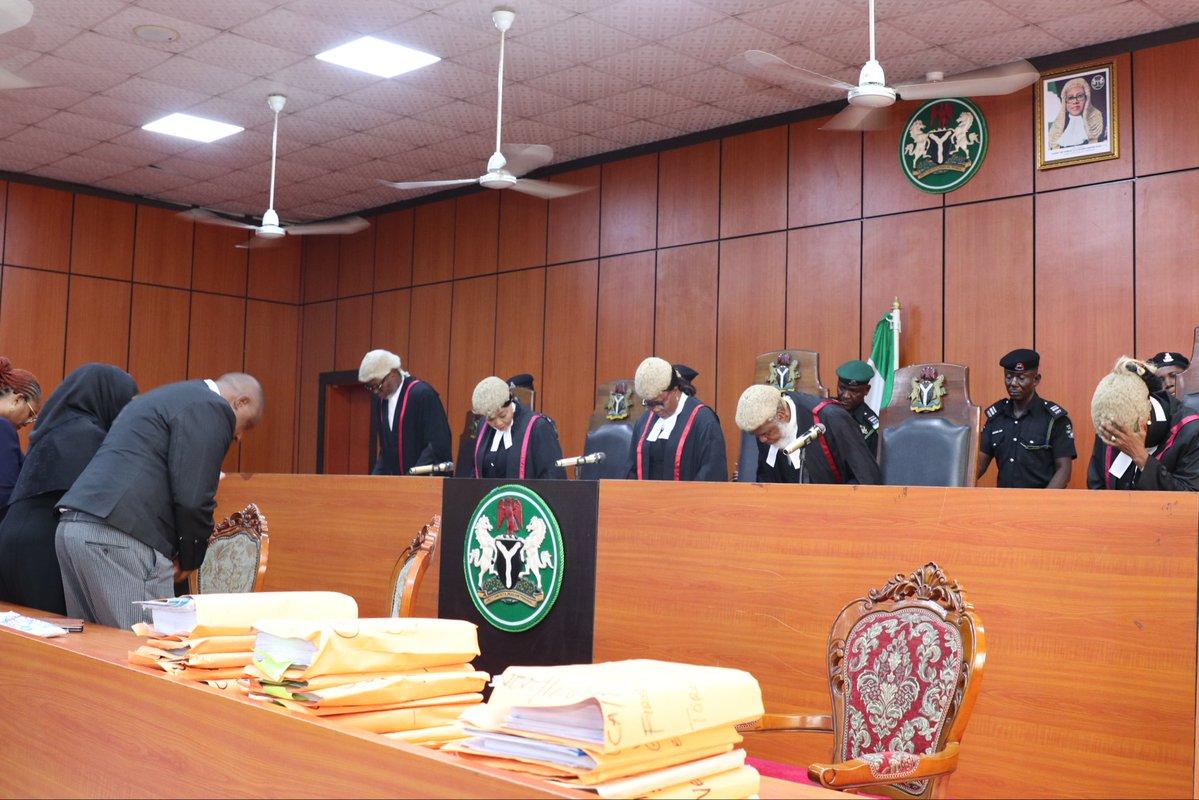
The President of the Court of Appeal, Justice Monica Dongban-Mensem, has inaugurated 375 judges to serve on election petition tribunals for Nigeria’s 2027 general elections. The group comprises 138 returning tribunal members and 237 newly nominated judges drawn from courts and judicial institutions across the country. The ceremony was held at the Body of Benchers Complex in Abuja, 68 days before the January 16 presidential and National Assembly elections. The judges were warned to resist political pressure and inducement, while INEC Chairman Joash Amupitan cautioned that AI-generated deepfakes and manipulated digital evidence could become major challenges in election disputes.
Nigeria’s judiciary has formally begun preparing for the legal battles expected to follow the 2027 general elections, with the President of the Court of Appeal, Justice Monica Dongban-Mensem, inaugurating 375 judges to serve on election petition tribunals across the country. The judges were sworn in on Monday at the Body of Benchers Complex in Abuja, 68 days before Nigerians are scheduled to vote in the presidential and National Assembly elections on January 16, 2027. Of the 375 judicial officers selected for the assignment, 138 have previously served on election petition tribunals, while 237 are new nominees drawn from courts and judicial institutions across Nigeria.
The inauguration marks one of the most important institutional preparations for the coming election because Nigeria’s electoral process does not end when votes are counted and winners declared. In many major contests, disputes move almost immediately from polling units and collation centers into courtrooms, where judges must determine whether elections complied with the Constitution, the Electoral Act and regulations issued by the Independent National Electoral Commission. The tribunal members inaugurated on Monday will therefore be responsible for handling some of the most politically sensitive cases likely to arise from the 2027 contests.
Justice Dongban-Mensem told the judges that the credibility of democratic elections depends not only on how ballots are cast and counted but also on whether disputes are resolved through impartial, effective and timely judicial processes. She said the judiciary has a constitutional duty to protect the people’s mandate, uphold constitutional supremacy and sustain public confidence in democratic governance when electoral disagreements emerge.
She also warned that the judges would be operating under intense public scrutiny. Election petition judgments in Nigeria routinely generate strong reactions from political parties, candidates, supporters and civil society organizations, particularly when courts overturn election results, dismiss petitions on technical grounds or resolve disputes involving close vote margins. Dongban-Mensem urged the tribunal members to remain conscious that every action, ruling and judgment would be examined closely by the public.
The Court of Appeal president emphasized that their nomination was based on consultations with heads of courts and the Nigerian Bar Association, with consideration given to professional competence, integrity, judicial temperament and experience. She told the judges that their appointments were not privileges and should never become opportunities for personal, political or financial advantage.
Her message was direct: tribunal members must resist improper influence from politicians, powerful individuals, associates or anyone attempting to interfere with the administration of justice. She said their decisions must be based only on the evidence before them, the applicable law and their judicial conscience, regardless of the political status of the parties appearing before their panels.
The constitutional framework for the tribunals is clear. Sections 285(1) and 285(2) of the 1999 Constitution, as amended, place responsibility on the President of the Court of Appeal to constitute election petition tribunals for disputes arising from elections to the National Assembly, State Houses of Assembly and governorship positions. The Electoral Act 2026 also establishes timelines for constituting the panels and opening tribunal registries.
The presidential election follows a different structure because presidential election petitions are handled by the Court of Appeal sitting as the Presidential Election Petition Court, with appeals proceeding to the Supreme Court. The judges inaugurated on Monday are primarily being prepared for tribunal work involving governorship, National Assembly and state legislative contests across the federation.
The timing of the inauguration reflects the compressed schedule under which election litigation must operate. Nigeria’s Constitution imposes strict deadlines for filing, hearing and deciding election petitions. Tribunal judges cannot treat electoral disputes like ordinary civil litigation that can remain unresolved for years. Petitioners, respondents and the courts must operate within constitutional timelines because delays can affect political stability, governance and public confidence.
That urgency was repeatedly stressed during Monday’s ceremony. Justice Dongban-Mensem said election tribunals have a responsibility not only to deliver justice but to deliver it within time limits that preserve the value of the electoral process. A legally correct judgment delivered after constitutional deadlines can become useless because the court may no longer possess jurisdiction to decide the case.
The 375 judges will therefore enter an environment where both speed and accuracy are essential. They will be expected to examine disputed result sheets, witness testimony, BVAS records, accreditation data, polling-unit documents, INEC records and increasingly sophisticated forms of electronic evidence, all while ensuring that every party receives a fair hearing.
INEC Chairman Professor Joash Amupitan used the occasion to warn that the 2027 election could introduce a new level of complexity into election litigation because of rapid advances in artificial intelligence and digital manipulation. He said election tribunals may have to confront evidence involving deepfake videos, cloned voices, fabricated digital instructions and manipulated recordings designed to appear authentic.
Amupitan warned that election periods could become vulnerable to what he described as synthetic operational directives, in which malicious actors use artificial intelligence to impersonate election officials and circulate false instructions claiming that polling units have been relocated, cancelled or changed. Such content could be designed to suppress turnout in particular communities or create confusion on election day.
He also warned about deepfake videos or audio released immediately before voting, when legal restrictions and broadcast blackouts may make it difficult for candidates or institutions to respond quickly. A fabricated recording could falsely portray a candidate admitting to misconduct or an election official announcing fraudulent instructions, with the intention of influencing voters before authorities have time to disprove it.
Another risk identified by the INEC chairman involves fake declaration videos showing cloned returning officers supposedly announcing election results before official collation has been completed. Such material could spread rapidly across social media and potentially trigger public unrest if supporters believe legitimate results are being manipulated.
Amupitan told the tribunal judges that electronic evidence in 2027 would therefore require rigorous scrutiny. He stressed the importance of provenance, forensic chain of custody, certified records from INEC and compliance with the Evidence Act when courts are asked to determine whether digital material is genuine.
The warning reflects how much Nigeria’s election litigation has changed in recent cycles. Earlier election petitions were dominated by physical result sheets, witness testimony and allegations involving ballot stuffing or violence. More recent disputes have centered increasingly on electronic accreditation, server records, result-upload platforms, BVAS machines and digital evidence.
The introduction of technology has not eliminated electoral disputes; in some cases, it has created new ones. Candidates and political parties now contest not only vote totals but how electronic systems were configured, whether results were transmitted correctly, whether devices malfunctioned and whether digital records can be relied upon as evidence.
The 2027 tribunals may therefore confront cases that combine traditional allegations of over-voting or intimidation with claims involving artificial intelligence, manipulated video, cyber interference or fake digital documents. Judges who have never previously handled election cases will need to understand both the legal framework and the technical evidence likely to appear before them.
That helps explain why 237 of the judges are newly nominated while 138 have prior tribunal experience. The returning members bring institutional knowledge from earlier election cycles, while the larger group of first-time tribunal judges expands the judicial capacity available for cases that may arise across all states and the Federal Capital Territory.
The inauguration is being followed by a specialized three-day capacity-building workshop intended to prepare the judges for the assignment. Such training typically covers election law, constitutional timelines, evidence, case management, judicial ethics and recent appellate decisions that tribunals must follow.
The Chief Justice of Nigeria, Justice Kudirat Kekere-Ekun, used the gathering to issue a parallel warning to lawyers who will appear before the tribunals. She cautioned against conduct capable of turning courts into extensions of political competition rather than forums for resolving genuine legal disputes.
The CJN specifically warned lawyers against filing multiple cases on the same subject matter before different courts, seeking contradictory orders from courts of coordinate jurisdiction or using ex-parte applications as tactical political weapons. Such practices have previously generated public controversy in Nigeria, particularly when competing courts issue conflicting orders relating to party primaries, candidate nominations or election disputes.
Kekere-Ekun said professional misconduct by lawyers can undermine the credibility of the judiciary even when judges themselves follow proper procedures. She urged counsel appearing before election tribunals to respect ethical standards and avoid using litigation merely to create political advantage.
Attorney-General of the Federation Lateef Fagbemi, SAN, also urged the Nigerian Bar Association to consider developing specific ethical guidelines for lawyers handling election cases. He argued that election litigation is unusually sensitive because careless or abusive legal tactics can affect not only individual litigants but public trust in the democratic process.
The combination of warnings from the Court of Appeal president, the CJN, the attorney-general and INEC reflects the pressure surrounding Nigeria’s 2027 elections. Political competition has already intensified months before voting, with parties building alliances, candidates mobilizing supporters and disputes beginning to emerge over eligibility, party structures and campaign conduct.
Election tribunals will enter that environment only after votes are cast, but their composition and credibility are already politically important. Parties must trust that judges hearing their petitions are independent and that politically connected litigants cannot influence outcomes through pressure or inducement.
Justice Dongban-Mensem addressed that issue directly when she told the judges that no individual, regardless of status, should be permitted to compromise their independence. She said political pressure, intimidation, personal relationships and inducement must play no role in tribunal decisions.
That warning has particular significance because Nigerian election judgments frequently become subjects of partisan accusations. Losing parties sometimes accuse judges of political bias, while winning parties defend the same judgments as legally sound. In such an environment, judges must rely on transparent reasoning and clear application of law if the judiciary hopes to maintain public confidence.
The 2023 general elections demonstrated how central courts can become to Nigeria’s post-election politics. Presidential, governorship, Senate, House of Representatives and state assembly results generated litigation across the federation, with some elections upheld and others overturned at tribunal or appellate level. In several states, legal battles continued months after elected officials had already assumed office.
One of the recurring criticisms of election litigation has been that outcomes sometimes appear to turn on procedural technicalities rather than the substantive question of who received the lawful votes. Judges respond that election petitions are specialized proceedings governed by strict constitutional and statutory rules, meaning petitioners must prove their cases according to specific evidentiary requirements.
The 2027 tribunal judges will face the same tension. Petitioners will expect courts to correct alleged irregularities, while respondents will rely on procedural protections and the presumption that officially declared results are valid unless successfully challenged.
The burden of proof can be especially demanding in cases involving widespread allegations across hundreds or thousands of polling units. Petitioners may need to present polling-unit evidence, witnesses or certified records showing not merely that irregularities occurred but that they were substantial enough to affect the outcome.
Electronic records may simplify some aspects of that task but complicate others. Digital systems can create verifiable audit trails, but they can also produce disputes over authenticity, access, transmission, metadata and admissibility. The warnings about AI therefore come at a moment when tribunals are already adapting to technological evidence.
Amupitan argued that election tribunals are more than administrative panels deciding private disputes between candidates. He described them as institutions capable of reducing political tension by converting grievances into legal proceedings rather than street confrontation.
When courts operate with speed, transparency and impartiality, he said, they can contribute to de-escalation, institutional accountability and preservation of the social contract. When judgments are seen as unpredictable, excessively technical or delayed, public confidence can deteriorate.
The INEC chairman also linked Nigeria’s electoral justice system to the country’s regional influence, saying electoral management officials in countries such as Kenya and Ghana closely watch developments in Nigeria. His argument was that instability or institutional failure in Africa’s largest democracy can have consequences beyond Nigeria itself.
That international dimension increases the importance of the 2027 tribunals. Foreign observers, diplomatic missions and democracy organizations routinely monitor Nigeria’s elections, but their assessments increasingly extend beyond voting day to the way disputes are handled afterward.
An election may be considered administratively successful but still generate prolonged political instability if major parties believe courts are inaccessible or biased. Conversely, credible judicial review can help contain disputes even when elections themselves are contentious.
The tribunal judges therefore occupy a position that is both legal and institutional. They are not responsible for conducting elections, counting votes or declaring winners. Those functions belong primarily to INEC. Their role begins when candidates or parties challenge outcomes and ask the judiciary to determine whether the law was followed.
The courts are also not expected to replace voters by choosing candidates based on preference. Their mandate is to determine whether election results and procedures comply with the Constitution and electoral law and whether proven irregularities justify legal remedies.
Those remedies can range from dismissal of a petition to cancellation of results in specific polling units, recounts, supplementary elections or, in certain circumstances, the removal of a declared winner and recognition of another candidate. Because those outcomes can alter political leadership, election petition judgments attract extraordinary attention.
The 375 judges inaugurated on Monday will therefore work under conditions unlike ordinary judicial assignments. Their rulings may affect governors, senators, representatives and state lawmakers, while decisions can reshape political control in individual states or constituencies.
Public confidence will depend partly on whether tribunal panels explain their reasoning clearly. Complex judgments based on technical legal provisions can be difficult for ordinary voters to understand, creating opportunities for politicians to misrepresent court decisions for partisan purposes.
Transparency will therefore be essential. The more clearly tribunals explain what evidence was accepted, what allegations were proved and how legal standards were applied, the harder it becomes for competing political narratives to completely replace the judicial record.
The 2027 cycle will also test the effectiveness of the Electoral Act 2026, which provides updated rules governing election administration and litigation. The Court of Appeal president specifically cited Section 134(3)(a) and (b), which establishes timelines relating to the constitution of tribunals and opening of registries.
The existence of those deadlines is one reason preparations are beginning well before election day. Registries must be ready to receive petitions almost immediately after results are declared because litigants operate within strict periods for challenging elections.
The presidential and National Assembly elections scheduled for January 16 are now just over two months away. Governorship and state House of Assembly elections are due on February 6, creating two major waves of potential litigation within a short period.
If the scale of litigation resembles previous elections, tribunals across the federation could receive hundreds of petitions. The 375-member judicial pool provides capacity to establish panels in multiple states simultaneously rather than forcing a smaller number of judges to handle an unmanageable caseload.
Yet numbers alone will not determine whether the process succeeds. The judges will need adequate security, administrative support, access to records, courtroom facilities and enough legal research resources to meet constitutional deadlines.
They will also need protection from political pressure. Election disputes can involve powerful governors, ministers, national party leaders and wealthy candidates whose political careers may depend on tribunal decisions.
Dongban-Mensem’s warning against improper influence therefore goes to the heart of the assignment. Judicial independence is tested most severely when the stakes are high and when a decision can remove a sitting officeholder or reverse a politically important result.
The inauguration of the 375 judges signals that Nigeria’s judiciary intends to be institutionally ready before those disputes arrive. The number of returning judges provides continuity, while the larger number of first-time tribunal members reflects the scale of preparation required for a nationwide election.
The next challenge is ensuring that the training and warnings delivered in Abuja translate into courtroom conduct when petitions begin arriving. The tribunal system will ultimately be judged not by Monday’s ceremony but by whether litigants receive fair hearings, whether judgments are delivered within constitutional timelines and whether decisions can withstand appellate scrutiny.
For Nigerians, that process will form an important second stage of the 2027 election. Voting will determine the initial results, but in disputed races the final legal outcome may depend on evidence tested before the panels inaugurated on Monday.
With 68 days remaining before the presidential and National Assembly polls, the judiciary is now formally positioned for that responsibility. The inauguration of 375 judges, the warnings against political pressure and abuse of process, and the new focus on AI-generated evidence all point to an election cycle in which the courtroom may become almost as consequential as the polling unit once voting is over.