
ABOUT 400 FRENCH SCHOOLS CLOSED AS STUDENT PROTESTS INTENSIFY
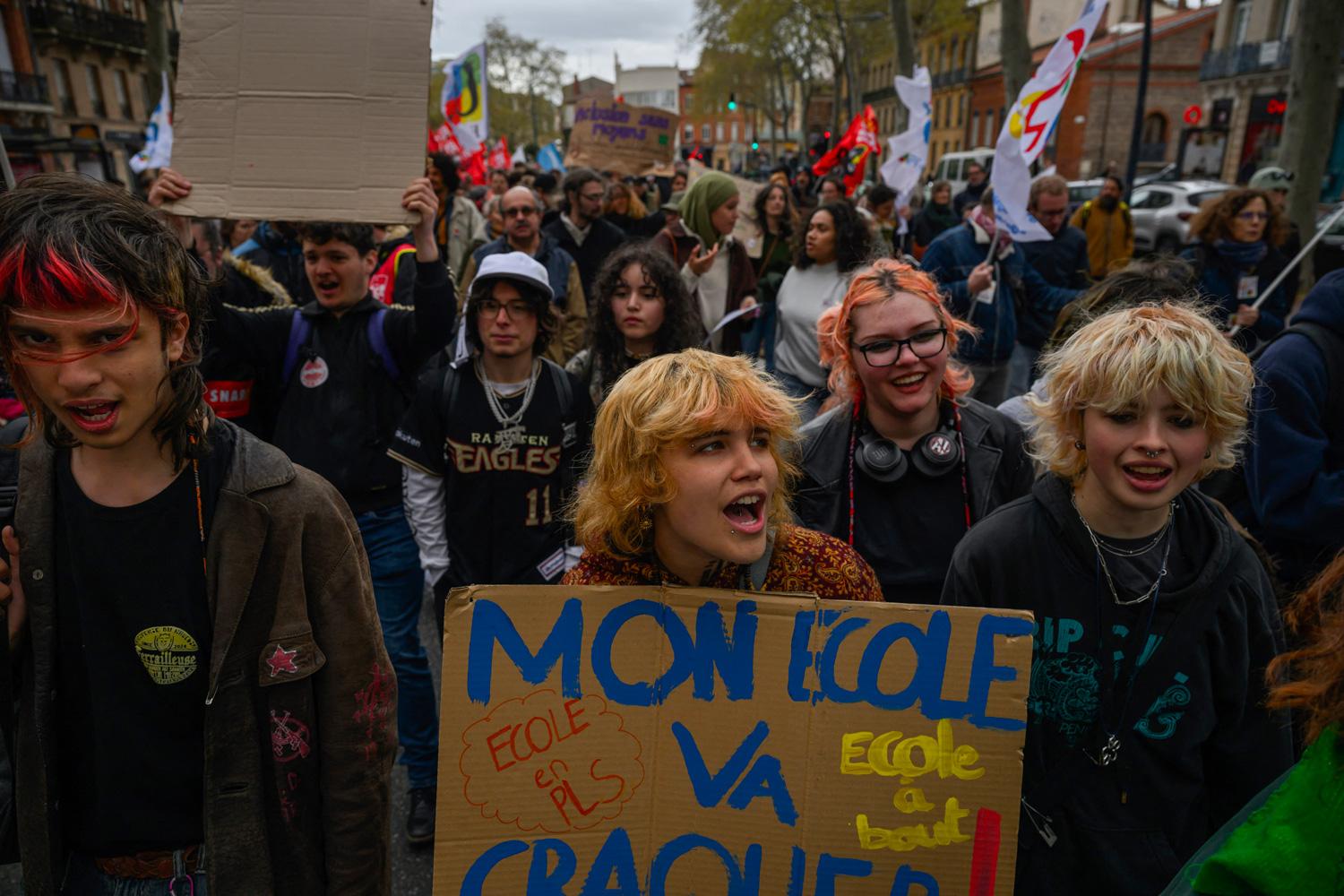
About 400 schools and other educational institutions across France are expected to remain closed on Friday as a fast growing student protest movement over teacher shortages, deteriorating buildings and school resources continues to disrupt education nationwide. The demonstrations began in the Paris region but have since spread across the country, with protests reported in cities including Toulouse, Strasbourg, Marseille and Nantes. While many demonstrations have remained focused on education demands, some have descended into violence involving fires, property damage and clashes with police. The French government says a violent minority has exploited the movement, while opposition figures and some student groups accuse authorities of worsening tensions through heavy policing.
About 400 schools across France are expected to remain closed on Friday as nationwide student protests over deteriorating school conditions, teacher shortages and limited resources continue to disrupt education and increasingly confront the government with a broader public order crisis.
Education Minister Édouard Geffray said Thursday night that slightly more than 400 schools and other educational establishments would not open as normal.
Some institutions are shifting lessons online where possible.
The closures represent one of the clearest signs yet that a protest movement that began with complaints about conditions inside French high schools has developed into a significant national disruption.
Students have organized blockades, demonstrations and walkouts across the country.
In several cities, peaceful protests have been accompanied by violent incidents involving fires, damaged property and clashes between groups of youths and riot police.
FROM SCHOOL COMPLAINTS TO NATIONAL DISRUPTION
The demonstrations initially emerged in the Paris region in September.
Students raised complaints about shortages of teachers, overcrowded classes, aging school buildings and a lack of resources.
The movement then spread rapidly.
By late September, more than 300 schools were already experiencing blockades or other disruptions.
That figure has now grown.
The closure of roughly 400 institutions means thousands of students are being affected directly even if they are not participating in demonstrations.
The government is increasingly encouraging schools to use remote learning where security conditions make normal classes impossible.
WHAT STUDENTS SAY THEY WANT
The underlying demands vary between schools, but several themes appear repeatedly.
Students want more substitute teachers so classes are not repeatedly canceled when permanent staff are absent.
They are also demanding improvements to deteriorating school infrastructure.
Some students have complained about damaged buildings, overcrowding, heating problems and classrooms that become extremely uncomfortable during periods of intense heat.
Others are calling for greater funding and more staff.
For many participants, the protests are centered on what they describe as declining conditions in public education.
SOME PROTESTS HAVE TURNED VIOLENT
The movement has become more serious because violence has accompanied demonstrations in several cities.
Authorities reported fires at at least two high schools on Thursday.
In Marseille, teachers were accidentally splashed with gasoline during an incident at another school.
A vehicle was set on fire in Strasbourg.
In Toulouse, riot police clashed with groups of youths near Lycée Déodat de Séverac.
Images from the city showed fires burning outside the school as students and police confronted one another.
The violence has increasingly overshadowed the original education demands.
TOULOUSE BECOMES ONE OF THE FLASHPOINTS
Toulouse has emerged as one of the most visible centers of the unrest.
Students gathered outside Lycée Déodat de Séverac as part of nationwide protests demanding more substitute teachers, additional resources and improved learning conditions.
Reuters photographs from Friday showed students demonstrating outside the school.
Other images showed masked youths during confrontations and a protester throwing a garbage bin into a fire.
The scenes illustrate the division now appearing within the wider protest movement.
Many students continue to demonstrate peacefully.
Others have participated in confrontations or vandalism.
Authorities say some of those committing violence may not even be students.
GOVERNMENT SAYS VIOLENT GROUPS ARE EXPLOITING THE MOVEMENT
Justice Minister Gérald Darmanin has argued that a violent minority is taking advantage of legitimate student grievances.
Education Minister Geffray has similarly warned that the broader high school movement risks being overtaken by what he described as violent fringe elements.
The government says its priority is to allow students to continue attending school safely.
Authorities have deployed riot police and other security personnel around affected schools and demonstration areas.
Remote learning has also been recommended where officials believe normal operations cannot continue safely.
POLITICAL BLAME HAS INTENSIFIED
The protests have also become politically contentious.
A source close to Prime Minister Sébastien Lecornu said intelligence officials told a government crisis meeting that political activists associated with the hard left, including members of La France Insoumise, had played a role in initiating or encouraging parts of the movement.
La France Insoumise has denied responsibility for organizing violence.
LFI lawmaker Louis Boyard rejected the government's claim.
Party figures have accused authorities of using political accusations to distract from the students' complaints about schools.
The competing claims remain disputed.
There is no publicly established evidence showing that all or most of the student protests are centrally directed by one political party.
GOVERNMENT UNDER PRESSURE FROM MULTIPLE DIRECTIONS
The school unrest comes at a politically difficult moment for the French government.
The country is also dealing with broader labor protests and opposition to planned spending cuts.
France has significant fiscal pressures and the government is attempting to reduce its budget deficit.
That has created tension with public sector workers, including teachers.
Unions have warned that spending restraints could worsen staffing shortages and working conditions.
This means the school protests are occurring within a wider debate over public services and government finances.
SCHOOL BUILDINGS HAVE BECOME A SYMBOL OF THE ANGER
Many of the demonstrations have focused not only on staffing but on physical conditions inside schools.
Students and teachers in some areas say buildings require significant repairs.
Complaints include aging classrooms, poor ventilation and insufficient maintenance.
School infrastructure has become particularly controversial following increasingly hot summers.
Some French schools were built decades ago and lack modern cooling systems.
Students have argued that such conditions make learning increasingly difficult during extreme heat.
WHY SUBSTITUTE TEACHERS MATTER
One of the most persistent complaints is the lack of replacement teachers.
When a teacher is absent and no substitute is available, students can lose hours of instruction.
Repeated cancellations can affect preparation for examinations and create significant differences between schools.
Students and parents have argued that the problem is particularly serious in already disadvantaged areas.
The French government has acknowledged staffing challenges but says recruiting and retaining teachers is a long term problem that cannot be resolved immediately.
REMOTE LEARNING RETURNS AS A SAFETY TOOL
Some schools are now turning to online lessons.
The approach was widely used during the COVID 19 pandemic.
Authorities are now using it for a different reason.
Where entrances are blocked or where demonstrations create safety risks, remote learning allows schools to continue teaching without requiring students or staff to enter affected buildings.
However, online education also creates disadvantages.
Not every student has equal internet access, equipment or an appropriate environment for studying at home.
Extended closures can therefore deepen educational inequality.
PARENTS ARE CAUGHT BETWEEN SUPPORT AND CONCERN
Parents are also facing a complicated situation.
Some support student demands for better school conditions.
Others are increasingly concerned about violence and extended school closures.
Families may also face practical difficulties when younger students unexpectedly remain at home.
For working parents, repeated closures can create significant disruption.
This can gradually reduce public support even for protests that began with widely shared concerns.
ARRESTS HAVE INCREASED
Police have detained large numbers of people during the demonstrations.
Reuters reports that arrests have climbed into the thousands since the protests began.
Many of those detained have subsequently been placed in custody while investigators determine whether they were involved in violence or property destruction.
Arrest figures should not be interpreted as convictions.
People detained by police may later be released without charges.
But the scale of the detentions demonstrates how much the situation has escalated beyond ordinary student demonstrations.
SCHOOL FIRES HAVE RAISED SECURITY CONCERNS
Arson incidents have become among the most serious developments.
Fires inside or around educational institutions create obvious risks to students, teachers and emergency workers.
They can also force schools to remain closed long after demonstrations end.
A damaged school may require extensive repairs before classes can resume.
That creates a secondary consequence of violent protest.
Students campaigning for better educational conditions could ultimately lose additional classroom time because of damage to their own schools.
STRASBOURG AND MARSEILLE ALSO AFFECTED
The unrest is not concentrated in one region.
In Strasbourg, at least one vehicle was set on fire.
In Marseille, an incident involving gasoline created alarm after teachers were accidentally splashed.
Other protests have taken place in Nantes, Lille and additional cities.
The geographic spread makes the situation more difficult for the national government to manage.
Local authorities are confronting different levels of disruption at the same time.
THE GOVERNMENT HAS CALLED CRISIS MEETINGS
Prime Minister Sébastien Lecornu has convened senior officials to discuss the unrest.
Government ministers have canceled or adjusted travel plans as authorities focus on the protests.
The crisis meetings are examining both the education complaints and security response.
The government faces a difficult balance.
A purely security driven response risks increasing anger among students who believe their grievances are being ignored.
But allowing violent incidents to continue risks further injuries, destruction and public backlash.
POLICE RESPONSE IS ALSO UNDER SCRUTINY
Student groups and opposition politicians have criticized some police tactics.
Videos circulating online have shown officers using riot control methods during confrontations.
Authorities say police intervention is necessary when protesters attack officers, set fires or damage property.
Critics argue that aggressive policing can escalate confrontations involving teenagers and young adults.
Determining whether individual police actions were proportionate requires examination of each incident.
The broader debate reflects a recurring tension in large demonstrations between public order and the right to protest.
FRANCE HAS A LONG HISTORY OF STUDENT PROTEST
Student activism has played an important role in French political history.
Young people have repeatedly organized around education reforms, employment and broader political issues.
Some student movements have eventually expanded into national protests involving unions and workers.
That history means governments often watch school and university demonstrations closely.
A movement that initially appears limited can expand quickly if it connects with wider public dissatisfaction.
The current protests have already shown that potential.
THE MOVEMENT IS NO LONGER ONLY ABOUT EDUCATION
The demonstrations began around specific school issues.
But they are increasingly becoming connected with wider political tensions.
Government spending plans, public sector wages and broader economic dissatisfaction are now part of the surrounding debate.
Opposition parties are attempting to position themselves around the issue.
The government is accusing political groups of exploiting the unrest.
That political expansion can make resolving the original school grievances more difficult.
WHY 400 CLOSURES MATTER
The number itself changes the scale of the story.
A demonstration outside one school is a local protest.
Hundreds of schools closing across an entire country indicates a national disruption.
Each closure affects students, parents, teachers and local communities.
It also creates pressure on education authorities to restore normal operations quickly.
The longer the closures continue, the more likely the issue becomes to affect public opinion beyond those directly involved in the protests.
STUDENTS RISK LOSING LEARNING TIME
The central irony of prolonged school protests is that students themselves can lose significant instructional time.
In examination years, even short disruptions can create anxiety.
Schools may later need to adjust schedules or provide additional lessons.
Remote classes can reduce some of that loss but are not a complete substitute for normal instruction.
If hundreds of schools remain disrupted for an extended period, the academic consequences could become significant.
GOVERNMENT PROMISES DIALOGUE
Education Minister Geffray has said he intends to meet representatives of students, parents and education staff.
Dialogue could become an important attempt to separate legitimate education grievances from violent unrest.
If students believe authorities are seriously addressing teacher shortages and school conditions, pressure for demonstrations may decrease.
If negotiations fail, protests could continue or expand.
The government will also need to explain how any improvements will be financed during a period of budget pressure.
VIOLENCE COULD UNDERMINE THE STUDENT MESSAGE
One of the biggest risks for organizers is that violence could overshadow the issues that triggered the movement.
Images of burning cars and clashes naturally attract more attention than discussions about substitute teachers or classroom conditions.
That can change public perception.
Government officials are already framing the crisis increasingly around security.
Student organizers who want broader public support may therefore have an interest in distancing themselves clearly from vandalism and attacks.
WHAT HAPPENS NEXT
Friday will provide an important indication of whether the crisis is stabilizing or expanding.
Authorities will be watching how many of the roughly 400 closed institutions can reopen.
They will also monitor demonstrations in Toulouse, Paris, Marseille and other cities.
The government's talks with education representatives could determine whether there is a path toward reducing tensions.
Further fires, violent clashes or large scale arrests would increase pressure for a stronger security response.
Conversely, peaceful demonstrations and meaningful negotiations could shift attention back toward the underlying education demands.
For now, France is confronting both problems simultaneously.
Students are raising serious concerns about staffing and conditions in public schools.
At the same time, violence in parts of the protest movement has created a national security and public order challenge.
With around 400 educational institutions closed, the demonstrations have moved well beyond isolated school protests and become one of the most significant disruptions facing France's education system this year.