AKPABIO DARES AMAECHI TO PROVE 50% NDDC CONTRACT DEDUCTION ALLEGATION AS 2027 POLITICAL FEUD ESCALATES
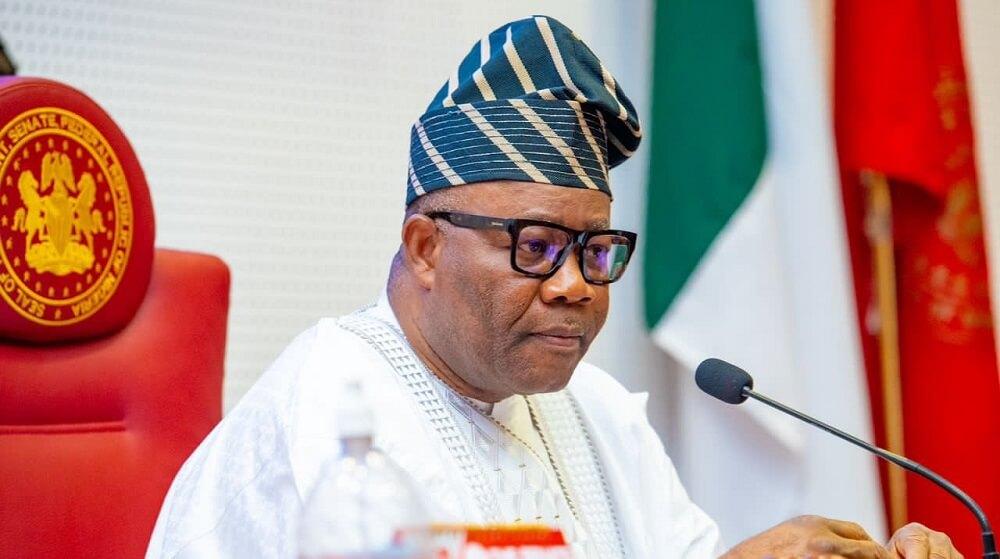
Senate President Godswill Akpabio has challenged Rotimi Amaechi to produce documentary evidence for his allegation that Akpabio introduced a 50 percent deduction from payments to NDDC contractors while serving as Niger Delta Affairs minister. Amaechi made the claim at an ADC campaign rally in Bauchi on November 14 but did not publicly identify affected contractors, contracts or payment records, prompting Akpabio’s office to demand specific evidence and urge him to submit any credible material to investigative authorities. The allegation remains unproven, while the dispute has reopened wider questions about NDDC accountability, its history of abandoned projects and procurement irregularities, and the growing use of corruption accusations in the 2027 political campaign.
ABUJA, NIGERIA — Senate President Godswill Akpabio has challenged former Rivers State Governor and African Democratic Congress vice-presidential candidate Rotimi Amaechi to produce documentary evidence supporting his allegation that Akpabio introduced a 50 percent deduction from payments to contractors handling projects for the Niger Delta Development Commission, escalating a politically charged dispute over one of Nigeria’s most controversial development institutions as the 2027 election campaign intensifies. Akpabio’s office described the allegation as serious enough to demand verifiable records rather than campaign rhetoric, insisting that Amaechi should identify the specific contracts involved, name the contractors allegedly affected, state when the deductions were made, explain how the payment mechanism operated and provide evidence establishing Akpabio’s personal role in the arrangement. Amaechi, who made the accusation during an ADC campaign rally at Tafawa Balewa Stadium in Bauchi on Saturday, did not publicly present contract documents, bank records or other documentary material at the event, meaning the accusation remains an unproven political allegation rather than an established finding of wrongdoing.
Amaechi’s accusation came during a broader attack on the ruling establishment in which he criticized President Bola Tinubu over economic hardship and directly responded to what he described as recent remarks Akpabio had made about him in Port Harcourt. Turning his attention to the Senate President, Amaechi told supporters to ask Akpabio who introduced what he described as a 50 percent deduction from payments to NDDC contractors, asserting that Akpabio was responsible for the practice. The statement was significant because Akpabio served as Minister of Niger Delta Affairs between 2019 and 2022, a period when the ministry exercised substantial supervisory influence over the NDDC and when the commission was undergoing one of the most extensive forensic reviews in its history. Amaechi did not, however, specify whether he was referring to a formal administrative policy, an alleged unofficial deduction demanded from contractors, a procurement practice or some other financial arrangement, leaving the exact nature of his accusation unclear.
Akpabio responded on Sunday through his Special Adviser on Media and Publicity, Eseme Eyiboh, saying an allegation made at a political rally does not become fact merely because it is delivered forcefully before supporters. His office said Amaechi had not identified a single affected contractor, produced a payment record showing a 50 percent deduction or explained how Akpabio personally participated in such a system. The Senate President’s position is that if Amaechi possesses credible evidence of unlawful deductions involving NDDC contractors, he should submit the material to competent investigative authorities rather than leave the accusation at the level of campaign rhetoric. Akpabio’s office therefore attempted to move the argument away from the political stage and toward a standard of proof that could be examined by anti-corruption agencies, auditors, prosecutors or the courts.
The exchange has reopened scrutiny of the NDDC because the commission has long been associated with allegations of abandoned projects, procurement irregularities, inflated contracts and weak accountability despite receiving enormous public funding intended to address decades of underdevelopment in the Niger Delta. The commission was created to accelerate infrastructure and social development across Nigeria’s oil-producing states, where communities have endured environmental degradation, unemployment, poor roads and inadequate public services despite the region generating much of the country’s petroleum wealth. Over time, however, repeated controversies over project awards, contractor payments and political interference have turned the NDDC itself into a symbol of the governance failures it was created to correct.
That history gives Amaechi’s allegation political resonance even though it remains unsupported publicly. During Akpabio’s tenure as Niger Delta Affairs minister, the Federal Government commissioned a forensic audit of the NDDC covering thousands of contracts awarded over nearly two decades. The final review examined 13,777 contracts for projects and programmes awarded between 2001 and August 2019 and identified serious problems involving abandoned projects, funding gaps, irregularities, mismanagement and due-process violations. The audit found that more than 13,000 projects had at different stages been abandoned, incomplete, terminated or otherwise problematic across the Niger Delta, reinforcing longstanding concerns that huge amounts of money had passed through the commission without producing development equal to the scale of expenditure.
That audit, however, should not be confused with Amaechi’s present accusation. The forensic review covered contract activity largely predating Akpabio’s ministerial tenure and was ordered as part of a broader examination of the NDDC’s historical operations. Its findings documented structural problems within the commission but did not, on the basis of information currently made public in connection with this dispute, establish that Akpabio created a 50 percent contractor deduction scheme. The existence of past corruption concerns at the NDDC therefore provides context for why such an allegation attracts attention, but it cannot substitute for evidence about the specific practice Amaechi now claims occurred.
That distinction is central to responsible reporting because political allegations involving contract payments can easily be interpreted as accusations of corruption, extortion or diversion of public funds even when the speaker does not spell out the legal character of the conduct being alleged. Amaechi’s statement is specific enough to be tested. If a 50 percent deduction was imposed, records should potentially exist in the form of contractor invoices, payment certificates, correspondence, bank transfers, procurement documentation or testimony from businesses that were allegedly compelled to surrender part of their payments. Akpabio’s challenge is essentially that those materials should be produced so the allegation can move from politics into evidence.
The Senate President also used his response to redirect public scrutiny toward Amaechi’s own record in government. Akpabio’s office cited Amaechi’s eight years as Rivers State governor from 2007 to 2015 and argued that public accountability should apply equally to every former officeholder. In particular, the statement raised the Port Harcourt monorail project, which became controversial because of its high cost, incomplete implementation and failure to develop into the large-scale public transportation system originally envisioned. It also referenced the Malaria-Free Rivers initiative and argued that the public was entitled to ask how much money was spent, what results were achieved and what institutional decisions contributed to the eventual outcomes.
That counterattack does not answer Amaechi’s NDDC allegation, but it demonstrates how quickly the dispute has moved from one specific accusation into a broader contest over the records of two veteran politicians. Both men have held powerful executive positions and have spent decades at the center of Niger Delta politics. Amaechi served as governor of Rivers State and later as Minister of Transportation under former President Muhammadu Buhari, while Akpabio served as governor of Akwa Ibom State, Minister of Niger Delta Affairs and now President of the Senate. Their rivalry therefore brings together personalities with extensive histories in public administration, federal politics and regional power struggles.
The timing of the confrontation also matters. Amaechi is currently campaigning as the ADC’s vice-presidential candidate and has increasingly positioned himself as one of the opposition’s most aggressive critics of the Tinubu administration. Akpabio, as Senate President and one of the most senior figures in the ruling APC, has become one of the government’s leading political defenders. Their exchange is therefore occurring inside an election campaign in which allegations about corruption, economic hardship and the management of public resources are becoming central arguments between the government and opposition.
Amaechi used the same Bauchi rally to promise that an ADC-led government would restore fuel and electricity subsidies, fight corruption and redirect public resources toward ordinary Nigerians. He argued that economic hardship had worsened under Tinubu and told supporters that the opposition understood the pressure households were facing. Those remarks were part of a broader campaign message designed to contrast the ADC with the ruling party’s economic reforms, particularly the removal of the petrol subsidy and changes to electricity pricing.
Akpabio’s response attempted to undermine the credibility of that broader opposition message by arguing that corruption allegations cannot simply be used as campaign weapons without evidence. His office said the credibility of any public accusation depends on the quality of the supporting material rather than the prominence of the person making it or the size of the political audience hearing it. That argument is likely to remain central to the Senate President’s defence if Amaechi continues repeating the allegation without releasing documentation.
At the same time, the NDDC’s history means the issue cannot easily be dismissed merely as an election-season quarrel. Contractors have for years complained about delayed payments, abandoned projects and opaque administrative procedures, while political actors from across the Niger Delta have repeatedly accused one another of influencing contract awards. The commission has also been the subject of parliamentary investigations, anti-corruption scrutiny and public disputes involving ministers, lawmakers and management boards.
One of the most dramatic periods came in 2020, when the House of Representatives investigated allegations of financial mismanagement at the NDDC and Akpabio, then Niger Delta Affairs minister, appeared before lawmakers. That hearing became nationally famous after Acting Managing Director Daniel Pondei collapsed during questioning and Akpabio publicly claimed that many NDDC contracts had gone to lawmakers, remarks that triggered an intense confrontation between the minister and the National Assembly. Those episodes entrenched the perception that the commission was entangled with powerful political interests, even though individual allegations arising from that period often remained contested.
The forensic audit was intended partly to bring greater clarity to that system. When the final report was submitted in 2021, officials said auditors had examined tens of thousands of records and found widespread evidence of poorly executed or abandoned projects. Akpabio himself publicly presented the audit as a transparency exercise capable of exposing years of waste and helping the government reform the commission. That history creates an unusual dimension to the current dispute because Amaechi is now accusing the same former minister who supervised the audit process of having introduced an alleged financial deduction affecting contractors.
Whether Amaechi can substantiate that accusation will therefore be decisive. If he produces verifiable documentation showing that contractors were systematically required to surrender half of approved payments and that Akpabio personally authorized or benefited from such arrangements, the matter could potentially warrant investigation by the Economic and Financial Crimes Commission, Independent Corrupt Practices and Other Related Offences Commission or other competent agencies. If he cannot produce evidence, Akpabio will be able to argue that a serious accusation was deployed primarily for political effect.
There is currently no public indication that either the EFCC or ICPC has opened a fresh investigation specifically into Amaechi’s 50 percent claim. There is also no public statement from the NDDC confirming that such a deduction policy existed. The absence of an immediate official investigation does not prove the allegation false, but it means the issue remains at the stage of accusation and denial rather than established administrative or criminal fact.
The NDDC itself has undergone substantial restructuring since the turmoil of the forensic-audit period. Successive administrations have attempted to restore a conventional governing board, improve procurement discipline and place greater emphasis on completing existing projects rather than constantly awarding new ones. The commission has also promoted regional development plans intended to align its spending more closely with the priorities of Niger Delta communities and state governments.
Despite those reforms, public distrust remains high because of the gap between decades of expenditure and the condition of many communities across the region. Roads remain incomplete, flooding and erosion continue to affect settlements, oil-producing communities complain about environmental degradation and youth unemployment remains severe. Every allegation involving the commission therefore resonates with a wider sense that the Niger Delta has not received development commensurate with the money allocated to it.
That is why Akpabio’s office emphasized that arguments over the NDDC should remain focused on transparent procurement, completed projects and measurable development rather than being reduced to political insults. The statement said the commission exists to address genuine infrastructure and environmental needs and that debates about its finances should ultimately serve the interests of residents rather than political personalities.
The same standard applies to Amaechi. If he possesses evidence, releasing it could transform the dispute from a campaign exchange into a matter of public accountability. Contractors named in the evidence could be interviewed, payment records could be examined and investigators could determine whether deductions occurred and where the money went. Without those details, however, the accusation cannot currently be independently verified.
Amaechi’s political standing adds further importance. As a former governor and former federal minister, he is not a peripheral commentator. He had access over many years to senior government circles, participated in federal cabinet discussions and was a major figure in the Buhari administration during part of the same period Akpabio served as minister. That background may cause supporters to assume he has inside knowledge, but proximity to government is not itself evidence. Any allegation involving public money still requires documentation or testimony capable of independent verification.
Akpabio’s insistence on documentary proof is therefore reasonable as a legal and evidentiary standard, even though his own record remains subject to legitimate scrutiny. Public figures who accuse one another of financial wrongdoing should expect their claims to be tested, and denials from powerful officeholders should likewise not end legitimate investigation where credible evidence exists. The correct standard is the same for both sides: specific claims should be supported by facts that can be independently examined.
The dispute also illustrates a broader problem in Nigerian political campaigning, where allegations of corruption are often made at rallies and press conferences but rarely followed by formal petitions, documentary disclosures or prosecution. Politicians frequently accuse rivals of mismanaging billions of naira during election periods, only for the claims to fade once the campaign ends. That pattern weakens accountability because genuine allegations become difficult to distinguish from political attacks.
Akpabio is attempting to exploit that weakness in Amaechi’s claim by demanding that he move beyond rhetoric. Amaechi now faces a choice between producing evidence, filing a formal petition or continuing to repeat an allegation that remains unverified. The response he chooses could determine whether the dispute grows into an investigation or remains a campaign talking point.
The Senate President’s attempt to reopen questions surrounding the Rivers monorail shows that he is also prepared to contest the argument on political terrain. The monorail was one of Amaechi’s signature infrastructure initiatives as governor, designed to reduce congestion and modernize transportation in Port Harcourt. Critics argued that the project was expensive, limited in scope and never developed into the functional mass-transit system promised by the government. Amaechi and his supporters have defended aspects of his infrastructure record and blamed subsequent administrations for failing to complete or maintain projects initiated during his tenure.
By bringing that project back into the debate, Akpabio is effectively arguing that Amaechi cannot demand accountability from others without accepting scrutiny of his own government. That argument may resonate politically, but it remains separate from the factual question of whether a 50 percent NDDC deduction existed. One politician’s controversial record does not prove or disprove allegations against another.
For the Niger Delta, the broader concern is that another dispute over the commission could become consumed by national political rivalry while the underlying problems remain unresolved. Communities across Rivers, Bayelsa, Akwa Ibom, Delta, Cross River, Edo, Ondo, Abia and Imo continue to demand roads, clean water, electricity, schools, hospitals and environmental remediation. The value of any investigation into NDDC finances ultimately depends on whether it improves the commission’s ability to deliver those services.
Contractors also have a direct interest in the outcome because any systematic deduction from approved project payments could affect construction quality. If contractors receive significantly less than the contractual amount after unofficial deductions, they may reduce project scope, abandon sites or attempt to recover losses through inflated pricing. That is one reason corruption in public procurement can produce visible consequences far beyond the money allegedly diverted.
Conversely, unfounded accusations can also damage public institutions and legitimate businesses by creating the impression that every contract payment involves corruption. That is why evidence matters not only to Akpabio’s reputation but also to the credibility of the NDDC procurement system itself.
The commission could help clarify the controversy by stating whether any formal deduction structure existed during Akpabio’s tenure and explaining how contractor payments were processed. Such information would not necessarily resolve allegations of unofficial misconduct, but it could establish the administrative framework within which payments occurred and help separate official policy from claims of clandestine deductions.
The Auditor-General, Bureau of Public Procurement and anti-corruption institutions could also become relevant if records emerge. A systematic 50 percent deduction affecting multiple contracts would likely leave a substantial financial trail, particularly where projects were paid through government accounts. Investigators could compare certified contract values with actual contractor receipts and examine whether any differences were authorized by taxes, retention fees, mobilization adjustments or other lawful deductions.
That technical examination would also be necessary because public contracts can involve legitimate deductions that have nothing to do with corruption. Taxes, withholding obligations, retention sums and other statutory charges can reduce the amount a contractor receives at particular stages of a project. Amaechi’s accusation appears to describe something far larger and more improper, but without documentation it is impossible to determine exactly what he meant or whether the alleged 50 percent figure referred to one type of transaction or an across-the-board system.
The political language surrounding the dispute is already becoming sharper. Akpabio’s office accused Amaechi of rabble-rousing and mudslinging, while Amaechi used similarly combative language when making the original allegation. Such rhetoric may energize supporters but can make factual clarification more difficult because both sides become invested in defending their political positions.
The approach of the 2027 election increases that danger. Amaechi is campaigning to remove the APC from power, while Akpabio occupies one of the most influential offices in the ruling political establishment. Every accusation between them will therefore be interpreted through a partisan lens, even where the underlying issue deserves independent investigation.
That makes the role of journalism, investigators and documentary evidence especially important. The essential questions are straightforward. Did NDDC contractors have 50 percent deducted from their approved payments? Was that deduction lawful or unofficial? Who ordered it? When did it happen? Which contracts were involved? Where did the deducted funds go? What evidence links Akpabio personally to the practice?
Amaechi’s allegation cannot currently answer those questions. Akpabio’s denial cannot answer them either. Only records, credible witnesses and an independent investigation could establish what happened.
The controversy also comes at a moment when public trust in government financial management is under intense pressure because Nigerians are being asked to accept difficult economic reforms. Opposition politicians increasingly argue that citizens should not bear higher fuel, electricity and living costs while corruption and waste remain unresolved. The government responds that reforms are necessary to stabilize the economy and that opposition figures are exaggerating hardship for electoral advantage.
Against that background, allegations of large deductions from public contracts carry additional political weight. Voters may see them not merely as a Niger Delta issue but as evidence in a broader argument over whether public resources are managed honestly.
Akpabio’s decision to issue a detailed challenge rather than ignore Amaechi suggests the allegation is politically serious enough to require a response. By demanding names, contracts and payment records, his office has effectively set a public evidentiary test for the former governor.
Amaechi can now meet that test by presenting verifiable material, refine his allegation with specific examples or decline to provide further evidence. Each option will shape how the dispute develops.
If documents emerge, the controversy could move rapidly into formal investigation and place renewed scrutiny on Akpabio’s tenure at the Niger Delta Affairs ministry. If no evidence appears, the Senate President is likely to continue portraying the accusation as campaign propaganda.
Either way, the exchange has once again placed the NDDC at the center of national political debate and reminded Nigerians of the unresolved questions surrounding how billions of naira intended for Niger Delta development have been managed over the years.
The most responsible conclusion at this stage is therefore limited but clear. Amaechi made a serious and specific allegation. Akpabio has denied wrongdoing and demanded proof. The claim has not been independently established, and no public documentary record has yet been produced showing that the Senate President created or personally participated in a 50 percent deduction system affecting NDDC contractors.
What happens next depends largely on evidence. If Amaechi has the documents he says are implied by his accusation, presenting them to investigators would allow the facts to be tested outside the heat of campaign politics. If he does not, the allegation risks becoming another example of a damaging corruption claim raised during an election without the material necessary to substantiate it.
For the communities the NDDC was created to serve, that distinction matters more than the political feud itself. The Niger Delta’s development crisis has survived too many administrations, audits and investigations for another serious allegation to end as little more than an exchange of insults. Whether the accusation is ultimately proven or disproven, the controversy should strengthen demands for transparent contractor payments, public procurement records and clear accountability over every naira intended for development in one of Nigeria’s most economically important regions.