AMAZON INDIGENOUS LEADERS TAKE ILLEGAL MINING, DEFORESTATION AND DRUG TRAFFICKING DEMANDS TO UNITED NATIONS CONFERENCE IN VIENNA
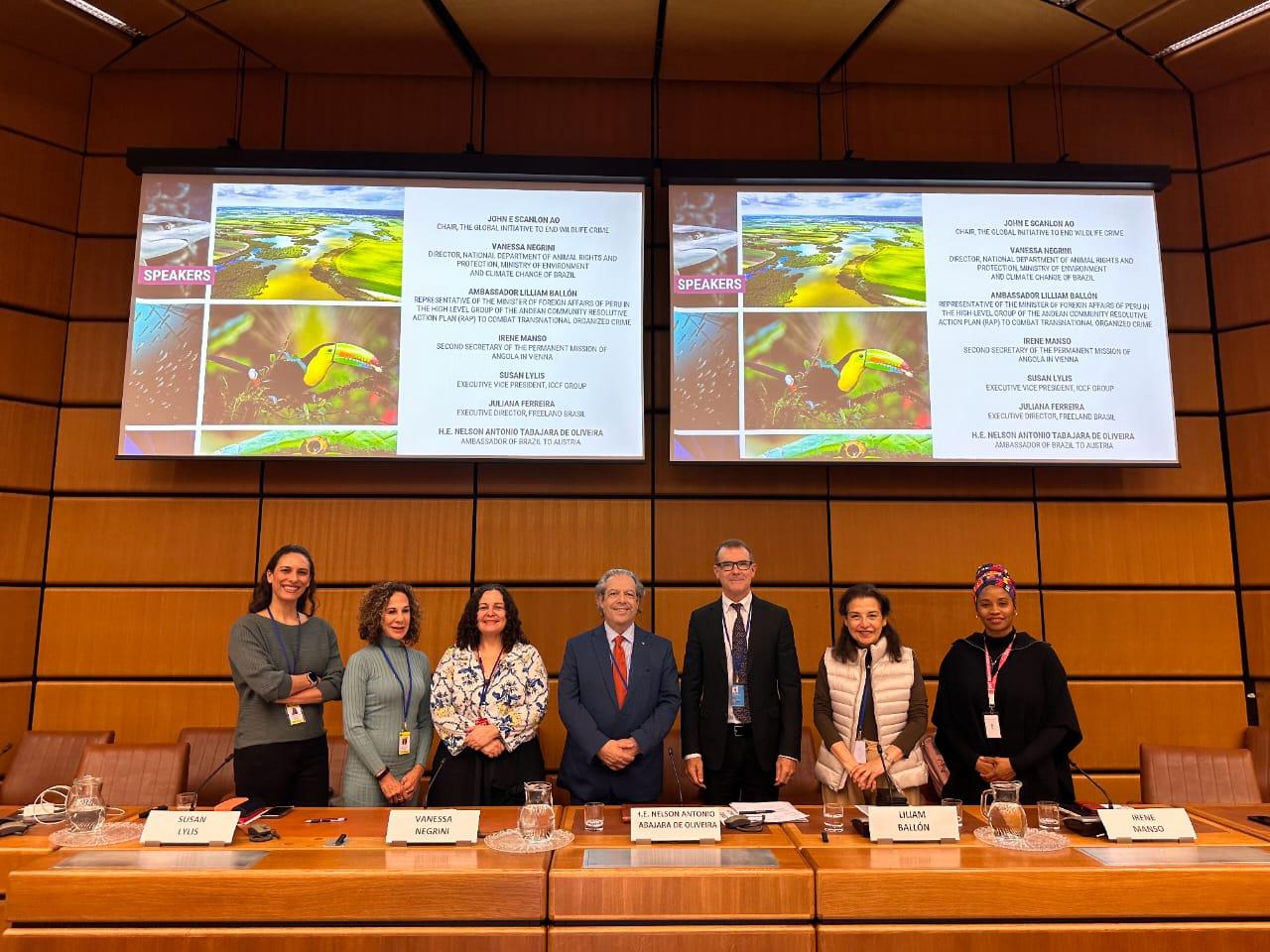
Indigenous leaders from Brazil, Peru, Colombia and Ecuador are participating in discussions surrounding the United Nations COP13 organised-crime conference in Vienna, where they are demanding stronger international action against illegal mining, drug trafficking, deforestation and the financial networks supporting environmental crime in the Amazon. The representatives want Indigenous territorial guards recognised and protected, stronger land rights and a formal role for Indigenous peoples if governments begin negotiating a new international protocol covering crimes that affect the environment. The conference runs from October 19 to October 23, 2026.
Indigenous leaders from across the Amazon are taking their campaign against illegal mining, deforestation and drug trafficking directly to the United Nations this week, arguing that environmental destruction in the rainforest can no longer be treated simply as a conservation problem because many of the activities driving it are now deeply connected to organised criminal networks operating across national borders. More than a dozen Indigenous representatives from Brazil, Peru, Colombia and Ecuador are participating in discussions linked to the 13th Conference of the Parties to the United Nations Convention against Transnational Organized Crime, known as COP13, which opened in Vienna, Austria, on Monday, October 19, and runs until Friday, October 23. Their central message is that international governments must follow the money behind environmental crime, strengthen protection for Indigenous territories and give Indigenous communities a meaningful role in shaping any new international rules designed to confront criminal economies in the Amazon.
The delegation arrives in Vienna at a moment when governments are considering whether to begin negotiations on a new international protocol under the United Nations Convention against Transnational Organized Crime specifically addressing crimes that affect the environment. Such a framework could cover illegal mining, illegal logging, wildlife trafficking and related activities that increasingly operate through the same cross-border financial, transport and smuggling networks used by drug traffickers and other criminal organisations. Indigenous representatives say the proposed agreement could become an important tool, but only if it recognises that the communities living inside the Amazon are not simply victims waiting to be protected by distant governments. They argue that Indigenous peoples are already carrying out surveillance, organising territorial guards, monitoring rivers and forests and confronting illegal operators on the ground, often with far fewer resources than the criminal groups entering their lands.
Among those participating in the wider Vienna effort are Patricia Gualinga of Ecuador, a member of the United Nations Permanent Forum on Indigenous Issues, Galois Flores of Peru’s Autonomous Territorial Government of the Wampis Nation, Francisco da Silva Piyako from Brazil’s Juruá region and Ingry Mojanajinsoy, an Inga Indigenous leader from Colombia. Other representatives include Marcelo Odicio, president of the Federation of Native Kakataibo Communities in Peru, whose people have faced growing pressure from drug trafficking, illegal coca cultivation and violence in their ancestral territory. The participation of leaders from four Amazonian countries reflects the reality that the criminal networks they are confronting do not stop at national borders and often move gold, drugs, timber, fuel, machinery and money through several countries before reaching international markets.
Galois Flores has become one of the most prominent voices in the campaign because the Wampis Nation has developed its own territorial monitoring structures in response to illegal gold mining. He has warned that mercury used in mining is contaminating rivers on which Indigenous families depend for drinking water and fishing, while armed criminal groups increasingly possess the money, weapons and logistical capacity to intimidate communities that resist them. The Wampis have established monitoring posts staffed by Indigenous guards, an extraordinary response that illustrates how some communities have been forced to create their own frontline security systems because government presence in remote rainforest areas is weak or inconsistent.
Flores and other Indigenous leaders are asking governments to treat environmental crimes with the same seriousness given to drug and arms trafficking. Their argument is that illegal mining cannot be dismantled simply by destroying one dredge or arresting a handful of miners because the wider business depends on financiers, gold buyers, fuel suppliers, transport companies, money-laundering networks and international markets willing to absorb illicitly produced minerals. If authorities attack only the physical mining site while leaving those financial and commercial networks intact, illegal operators can return once police or military units leave. This cycle has been documented repeatedly across the Amazon, where miners often rebuild equipment and resume operations after raids because the economic incentives remain powerful.
The same pattern applies to illegal logging and deforestation. Trees may be cut in one location, processed elsewhere and moved through supply chains that make it difficult for buyers to know whether timber was legally harvested. Criminal organisations can also use deforestation as a first stage in land grabbing, clearing forest in order to establish cattle ranches, farms, illegal roads or drug-trafficking corridors. Indigenous leaders therefore want governments to understand environmental crime as an organised economic system rather than a collection of isolated local offences.
Drug trafficking has become equally intertwined with environmental destruction. In parts of Peru’s central Amazon, Kakataibo communities say traffickers have established illegal coca plantations and drug-processing laboratories inside ancestral forests. Marcelo Odicio has said six Kakataibo leaders have been killed since 2020, while others regularly receive threats because they oppose criminal activity and defend community land. These deaths are part of a wider pattern of violence against environmental and land defenders across Latin America, where Indigenous leaders, community activists and conservationists are frequently targeted by groups seeking access to territory and natural resources.
The risks are not limited to Peru. In Brazil, Francisco Piyako has described armed men entering Ashaninka territory and threatening families while searching for community leaders. Indigenous communities along the Brazil-Peru border have also developed cross-border cooperation to confront drug trafficking, including forms of binational territorial monitoring that operate in areas where formal state security can be limited. These efforts demonstrate why Indigenous leaders are asking governments in Vienna to recognise community-based territorial defence as a legitimate and essential part of fighting organised crime.
In Colombia, Ingry Mojanajinsoy has warned that armed groups once heavily dependent on drug trafficking are increasingly diversifying into illegal mining. This creates a particularly dangerous combination because criminal organisations that already possess weapons, transport routes and money-laundering networks can quickly move into gold extraction and other illegal resource economies. Even communities located away from the actual mining sites can suffer because contaminated water travels downstream, affecting fish, drinking supplies and agriculture across wide areas.
The environmental consequences are therefore inseparable from public health. Mercury, which is commonly used in illegal gold mining to separate gold from sediment, can enter rivers and accumulate in fish. Communities that depend on those rivers for food can then be exposed over long periods, creating risks for neurological development, pregnancy and general health. Indigenous leaders say this kind of pollution is especially destructive because it attacks the foundation of community life, damaging not only the forest but the water, food systems and cultural practices that depend on healthy ecosystems.
The Vienna conference gives these concerns an international platform because COP13 brings together governments operating under the United Nations Convention against Transnational Organized Crime. The treaty was created to strengthen cooperation against criminal networks that operate across borders, including through extradition, law-enforcement cooperation and measures against money laundering. Environmental crime has become increasingly relevant to the convention because illegal mining, timber trafficking and wildlife trafficking often use exactly the same international structures as other forms of organised crime.
One of the major questions at the 2026 conference is whether governments will formally launch negotiations on a new protocol addressing crimes that affect the environment. A protocol would create a more specialised international framework and could encourage countries to harmonise laws, share intelligence and coordinate investigations more effectively. Indigenous leaders support the idea but are demanding that they be involved from the beginning rather than being consulted only after governments have already written the rules.
They are particularly concerned about what could happen if governments rely primarily on military raids without listening to people who live in the affected territories. Amazon Watch and Indigenous representatives have argued that heavily militarised operations can place local populations at risk if security forces enter remote areas without understanding community structures, territorial boundaries or the local political situation. They say operations may temporarily displace illegal groups while failing to address corruption, finance and international demand, leaving communities exposed once troops withdraw.
This criticism does not mean Indigenous leaders are asking governments to stop law-enforcement action. Instead, they want enforcement to be more strategic and better integrated with community protection, land rights and financial investigations. Destroying illegal mining equipment may be necessary, but leaders say authorities also need to trace the companies buying gold, identify financial backers, investigate money laundering and close the markets that make illegal extraction profitable.
Land rights are another central demand. Indigenous communities with legally recognised and clearly demarcated territories are generally better positioned to defend their lands, challenge illegal operations in court and demand state protection. Communities without secure land rights can be more vulnerable to illegal mining, logging and land grabbing because criminals exploit uncertainty over ownership and jurisdiction. Indigenous leaders therefore argue that territorial recognition should be treated as part of security policy rather than merely an administrative or cultural issue.
They also want greater formal recognition for Indigenous guards. Many communities have organised their own unarmed or lightly equipped patrol structures to monitor illegal activity, document environmental damage and alert authorities. These guards often know the terrain far better than outside security forces and can identify unusual movements long before national authorities become aware of them. However, they may operate without adequate legal protection, communications equipment or emergency support when they confront heavily armed criminal groups.
Marcelo Odicio and others are asking governments to recognise those guards and provide stronger protection for leaders facing death threats. This demand is particularly urgent because attacks on environmental defenders remain concentrated in Latin America. Global Witness documented at least 105 killings of land and environmental defenders in Latin America in 2025, representing the overwhelming majority of such killings recorded worldwide that year. Colombia recorded the highest number among countries cited in the Associated Press reporting, followed by Brazil.
Those figures show that environmental protection in the Amazon is not an abstract policy debate. For many communities, opposing illegal mining or logging can become a life-or-death decision. Leaders may be targeted because they report traffickers, organise patrols or refuse to allow mining equipment into communal territory. Families can also be threatened in an effort to force leaders to withdraw.
This violence has wider consequences because the killing or intimidation of respected leaders can weaken community institutions. Criminal groups benefit when people become too frightened to report suspicious activity or when local organisations collapse under pressure. That is why Indigenous representatives are framing leader protection as part of the fight against organised crime rather than a separate human rights issue.
International markets are also under scrutiny. Illegal gold extracted from the Amazon can be mixed with legally produced gold and enter global supply chains, making it difficult for banks, jewellers and consumers to know its origin. Once gold has been melted and reprocessed, physical traceability becomes extremely difficult. Indigenous campaigners therefore want stronger due diligence requirements and financial investigations capable of identifying companies and traders that benefit from suspicious supply chains.
The same issue exists with timber. Illegal wood may enter legal processing facilities, acquire fraudulent documents and then move into international markets appearing legitimate. Effective enforcement therefore requires cooperation between producer countries, transit countries and consumer markets. A new international protocol could potentially help governments share information about suspicious shipments and companies.
Drug trafficking adds another international dimension because cocaine and other illicit products move from the Amazon through complex routes into North America, Europe and other markets. The profits can then be reinvested into mining, land grabbing or other illegal businesses. This diversification makes criminal organisations more resilient because losing one source of income does not necessarily destroy the wider network.
The Indigenous leaders in Vienna are trying to persuade governments that these activities should be analysed together. Illegal mining, logging and drug trafficking may look like separate crimes when viewed individually, but in remote areas the same armed group may control several of them simultaneously. Criminal networks can use the same aircraft, river routes, corrupt officials and money-laundering channels for multiple illicit businesses.
That integrated understanding has significant implications for policy. A government agency responsible for mining may see one part of the problem, while narcotics officers see another and environmental authorities see a third. If those institutions do not share intelligence, criminal organisations can exploit the gaps between them.
The United Nations Office on Drugs and Crime has already begun working with Indigenous communities in parts of Latin America on environmental monitoring. In Brazil, UNODC has supported projects that help communities track illegal gold mining and improve coordination with authorities. The agency says such work has contributed to the development of broader systems for detecting and responding to environmental crime.
However, Indigenous representatives want those partnerships expanded and institutionalised. They are concerned that community involvement may remain limited to local monitoring while governments negotiate international rules without giving Indigenous peoples a formal seat in the process. UNODC had not confirmed at the time of Associated Press reporting whether Indigenous representatives would have a formal role in negotiations over a future protocol.
That uncertainty is one reason the Vienna delegation is applying pressure now. Indigenous leaders argue that once negotiations formally begin, it may become much harder to change the structure of the process. They therefore want governments to commit from the outset to meaningful consultation and participation.
Free, prior and informed consent is one principle being emphasised. Under international Indigenous rights standards, governments are expected to consult Indigenous peoples on measures that significantly affect their territories and way of life. Leaders say security policies should not be exempt from that obligation simply because they are presented as operations against organised crime.
A poorly designed security intervention can create unintended consequences. Military units unfamiliar with local governance may treat residents with suspicion, damage community property or create confrontation while criminal leaders escape. In other cases, corruption can mean that sensitive information provided by communities reaches the very groups they are trying to report.
Trust therefore becomes essential. Indigenous leaders are more likely to cooperate with government agencies if they believe information will be protected and action will follow. Repeated failures can make communities reluctant to report criminal activity because doing so creates danger without delivering security.
This is also why Indigenous governance matters. Many Amazonian peoples have their own decision-making institutions, territorial rules and systems for resolving disputes. International campaigners argue that governments should work through those institutions rather than treating communities as informal populations without recognised authority.
The Wampis Nation provides a strong example because it has established an autonomous territorial government that organises protection and monitors illegal activity across its territory. That model demonstrates how Indigenous political structures can become important partners in security and environmental governance.
Similar initiatives exist elsewhere in the Amazon, although they vary significantly depending on national law and community organisation. In some places, communities maintain patrol posts along rivers or roads. In others, they use satellite information, drones or mobile applications to document illegal activity and send evidence to authorities.
Technology can strengthen these efforts, but it cannot replace physical presence. Satellite imagery may reveal forest loss, but community members often know who entered the area, which river route was used and whether criminal groups are threatening residents. Combining local knowledge with technological monitoring can provide a far more complete picture.
The international community has increasingly acknowledged the environmental role of Indigenous territories. Research has repeatedly shown that forests under secure Indigenous management can experience lower rates of deforestation than comparable unprotected areas. This gives Indigenous land rights importance not only for human rights but also for climate policy.
The Amazon plays a major role in global climate regulation because of its enormous carbon stores and influence on rainfall systems. Large-scale forest loss can release greenhouse gases while weakening the ecosystem’s ability to absorb carbon. Environmental crimes therefore create consequences far beyond the communities where they occur.
Illegal mining adds further damage through river pollution and forest clearing. Mining camps require fuel, machinery and transport routes, which can encourage wider deforestation and settlement. Workers may also bring social problems, including violence, trafficking and disease, into isolated areas.
For communities whose identity is tied closely to rivers and forests, this damage has cultural as well as economic consequences. Hunting grounds, sacred sites and traditional food systems can be destroyed alongside the physical environment. Indigenous leaders therefore resist efforts to measure damage only in financial terms.
The conference in Vienna is important because it creates an opportunity to translate these realities into international criminal law and cooperation. Environmental agreements often focus on conservation targets, while organised crime treaties focus on law enforcement. Indigenous leaders are trying to connect those two worlds by arguing that some of the most serious environmental destruction in the Amazon is now driven by sophisticated criminal economies.
If governments agree to begin negotiating a new protocol, the process could take years. Countries would need to decide which crimes are covered, how responsibilities are defined and what forms of international cooperation are required. Reaching agreement across jurisdictions with different legal systems would be complex.
The Indigenous delegation is therefore not expecting the Amazon’s problems to be solved during one week in Vienna. Their immediate goal is to influence the direction of the negotiation before the framework becomes fixed. They want environmental crimes recognised as serious transnational offences and Indigenous participation built into the process from the beginning.
The financial dimension will be especially important. Criminal groups survive because illegal activities generate profits and because those profits can be moved, hidden and converted into legitimate assets. Following money across banks, shell companies, gold traders and international businesses may be more effective than repeatedly destroying equipment in the forest.
This approach is consistent with wider organised-crime enforcement strategies. Authorities targeting narcotics networks often try to seize assets and disrupt financial channels because removing money can weaken an organisation more effectively than arresting low-level participants. Indigenous leaders want the same logic applied to illegal gold and timber.
Consumer countries also have responsibilities. If international buyers continue purchasing commodities without demanding credible traceability, criminal networks will retain access to profitable markets. European and North American governments can therefore influence Amazon crime through import rules, financial regulation and corporate due diligence.
This shared responsibility is one reason the Vienna discussions matter. Environmental crime in the Amazon may begin thousands of kilometres from European capitals, but the money and final products can move into global markets. The problem is therefore international even when the immediate environmental damage is local.
Indigenous representatives also want international institutions to recognise that security cannot be measured only by the number of police or soldiers deployed. A community may technically have state forces nearby but still feel unsafe if criminal organisations control roads, intimidate leaders or corrupt officials. Real security, they argue, requires functioning institutions, protected land rights and economic alternatives that reduce dependence on illegal economies.
Poverty and limited economic opportunity can also make enforcement harder. Illegal mining and coca cultivation provide income in regions where legal jobs may be scarce. Criminal leaders can exploit that desperation by recruiting workers who may not see themselves as part of organised crime even though their labour supports illegal networks.
Long-term solutions therefore need development as well as policing. Communities need access to education, healthcare, legal markets and sustainable livelihoods that make it easier to resist criminal economies. Conservation policies that simply remove income without offering alternatives can create resentment and drive people back towards illegal activity.
Indigenous communities themselves often propose economic models based on sustainable forest products, tourism, traditional agriculture and conservation finance. They argue that supporting these alternatives is more effective than repeatedly responding after criminal networks have already established control.
The Vienna conference therefore brings together several debates that are usually discussed separately: organised crime, environmental protection, Indigenous rights, financial regulation and international trade. Indigenous leaders are trying to show that these issues have become inseparable in the Amazon.
Their presence also challenges a longstanding pattern in international policymaking in which Indigenous people are discussed as affected populations rather than participants with expertise. The leaders arriving from Peru, Brazil, Colombia and Ecuador are not asking only for sympathy. They are presenting specific security strategies developed through direct experience confronting illegal miners and traffickers.
These strategies include territorial monitoring, cross-border guards, environmental surveillance and cooperation with authorities. The leaders want governments to recognise these systems formally and provide resources rather than replacing them with externally designed programmes.
For the United Nations, the challenge will be determining how Indigenous participation can fit within negotiations that are formally conducted between states. International treaties are normally negotiated by governments, while civil society participates through consultations, side events and advocacy. Indigenous leaders say environmental crime protocols affecting ancestral territories require a stronger model of participation.
This debate is likely to continue beyond COP13 even if governments agree to launch negotiations. Questions about representation, consent and decision-making will remain central as draft language develops.
The conference itself is scheduled to run through Friday, October 23, at the Vienna International Centre. More than a thousand participants are expected across government, international organisations and civil society, reflecting the broad reach of the United Nations Convention against Transnational Organized Crime.
For the Amazon delegation, the week includes formal discussions as well as side events focused specifically on the relationship between green crime and organised criminal economies. Panels will examine illegal mining, deforestation, drug trafficking and shared responsibility between producer regions and global markets.
A diplomatic roundtable is also expected to give Indigenous leaders an opportunity to speak directly with UN officials, delegates and civil society representatives. Participants include Ingry Mojanajinsoy and Marcelo Odicio, along with experts working on Indigenous rights and environmental crime.
The objective is to move the conversation away from the idea that Amazon communities are simply waiting for outside rescue. Indigenous representatives want delegates to understand that effective solutions already exist locally but need stronger legal recognition, funding and protection.
The urgency behind their appeal is clear. Illegal gold mining continues polluting rivers, traffickers continue expanding routes through remote forests and community leaders continue receiving threats. Meanwhile, international demand for gold, timber and drugs keeps the criminal economy profitable.
Environmental crime can therefore continue even during periods when official deforestation statistics improve. Brazil recently reported significant reductions in overall Amazon deforestation, but illegal mining and other criminal pressures remain severe in particular territories. A national improvement does not mean every Indigenous community is safer.
The Vienna delegation is trying to make that distinction visible. The Amazon is enormous, and national statistics can obscure local crises where criminal groups exercise significant control. Indigenous leaders say international policy must be capable of responding to those local realities.
Their campaign also carries a broader message about sovereignty. Indigenous nations argue that protecting ancestral land is not simply environmental activism but the exercise of their right to govern territory and determine what activities take place there. Illegal miners and traffickers undermine that authority just as they undermine the authority of national governments.
This makes community resistance a form of law enforcement in its own right, even when it is not formally recognised by the state. Indigenous guards patrol borders, remove illegal equipment, report criminal activity and attempt to prevent outsiders from entering protected areas.
The danger is that they often perform those roles without adequate protection. Criminal groups may be better armed, while police reinforcements can be hours or days away. Leaders who confront traffickers can become identifiable targets.
The Vienna demands therefore combine immediate and structural goals. Indigenous representatives want threatened leaders protected now, but they also want international systems changed so that environmental crime becomes less profitable and communities gain more authority over their territories.
They are also challenging governments to confront corruption. Illegal mining and drug trafficking on a large scale usually require some level of cooperation, protection or deliberate inaction from officials, businesses or security actors. Equipment, fuel and commodities can move through checkpoints and formal markets only if oversight fails or is manipulated.
A protocol that ignores corruption would therefore address only part of the problem. Governments will need mechanisms for investigating officials and businesses that facilitate environmental crime, not simply the workers found at illegal sites.
The same is true for money laundering. Criminal profits must eventually enter the financial system or be converted into assets. Gold is particularly attractive because it is valuable, portable and difficult to trace once melted.
Strengthening traceability is therefore one of the most important long-term challenges. Governments and companies need systems capable of establishing where gold was mined and whether it passed through legitimate channels. Without such systems, illegal gold can be mixed with legal production and effectively disappear into the global market.
This is why Indigenous leaders are focusing on the financial networks behind destruction rather than only the people physically cutting trees or operating dredges. The individuals at the mining site are often the most visible participants but not necessarily the people making the largest profits.
A successful international response would therefore need to move up the criminal chain, identifying financiers, exporters, importers and money launderers. That could require cooperation between police, customs agencies, banks and environmental authorities in multiple countries.
COP13 offers a platform for that kind of cooperation, but the actual impact will depend on what governments agree to do after the conference. International declarations can create political momentum, but enforcement ultimately depends on national institutions and budgets.
Indigenous representatives understand that limitation, which is why they are also demanding stronger domestic protection for their communities. International agreements can support their work, but police, prosecutors and courts still need to act inside individual countries.
The most important outcome from Vienna may therefore be whether governments commit to treating environmental crime as a core organised-crime issue rather than a secondary environmental concern. Such recognition could influence funding, law-enforcement priorities and the way agencies cooperate.
For Indigenous leaders, that shift is long overdue. They argue that communities have been warning for years that miners, loggers and drug traffickers increasingly operate as interconnected criminal enterprises. The violence and pollution they experience are the human consequences of that system.
The conference provides an opportunity to place those warnings directly before governments from around the world.
It also gives Indigenous leaders a chance to insist that any future environmental-crime protocol must be developed with the people who are already defending the territories most heavily affected.
Their argument is ultimately straightforward. The Amazon cannot be protected by international law if criminal networks remain more organised than the governments trying to stop them, and governments cannot design effective strategies while ignoring the Indigenous communities who encounter those networks first.
As delegates meet in Vienna through October 23, the question will be whether that message translates into concrete commitments. A decision to begin negotiating a new protocol would be an important first step, but Indigenous leaders will judge the process by whether their participation is meaningful and whether governments follow through with protection, financial investigations and stronger land rights.
For the communities represented in Vienna, this is not simply another international conference. The decisions under discussion could influence whether leaders facing armed miners and traffickers receive meaningful support, whether polluted rivers are restored and whether future generations inherit forests that remain under community control rather than criminal domination.