AMERICAN BASKETBALL PLAYER ARRESTED IN LAGOS AFTER NDLEA SAYS 33.5KG OF CANNABIS FOUND IN HIS LUGGAGE
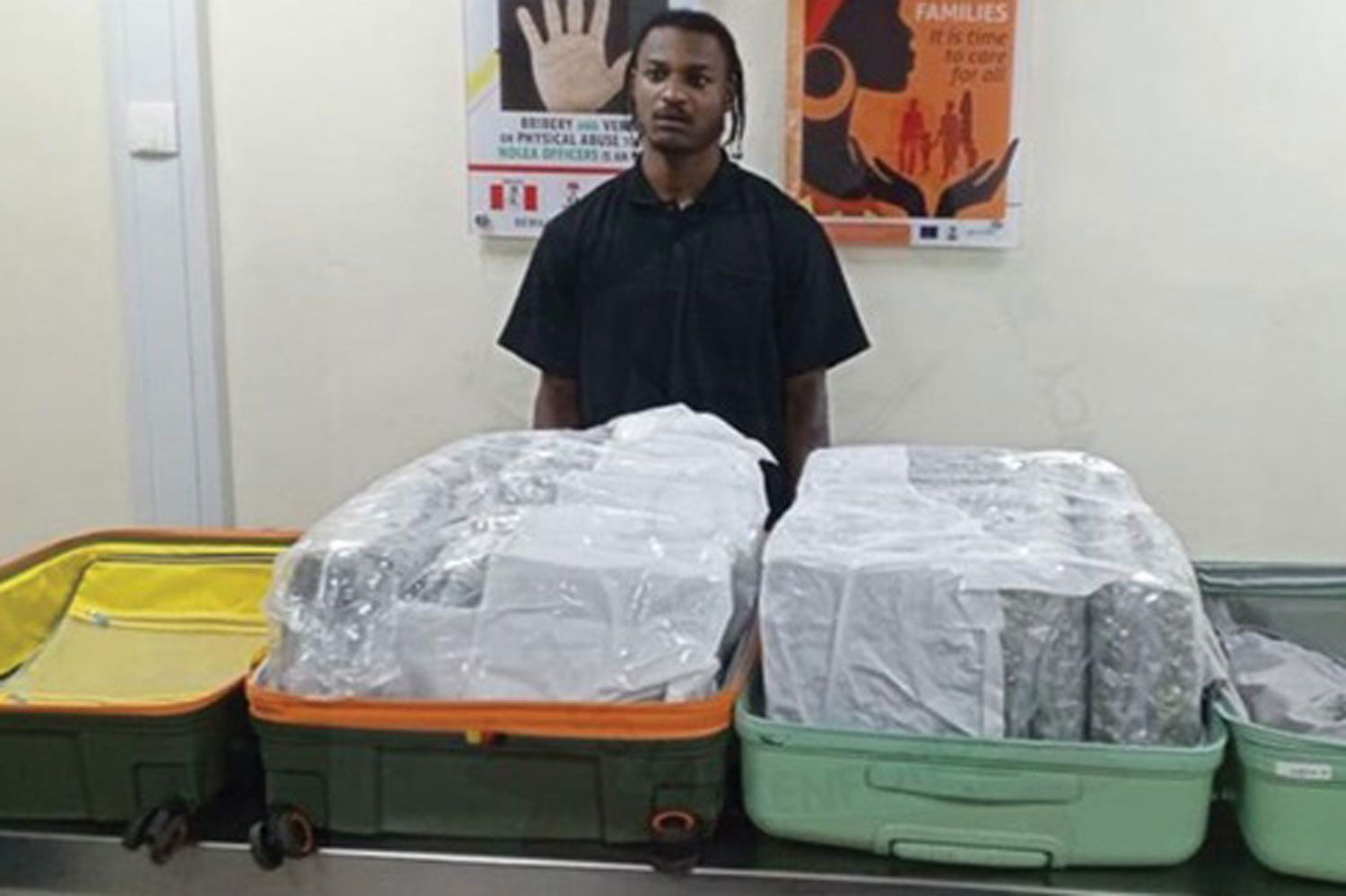
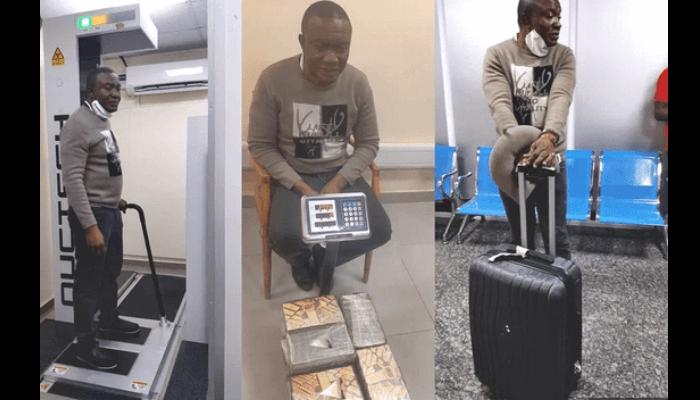
Nigeria’s National Drug Law Enforcement Agency says it arrested 28-year-old American basketball player Greene Da’monte Khiree at Murtala Muhammed International Airport in Lagos after officers allegedly found 16 packages of “Loud” cannabis weighing about 33.5 kilograms, roughly 74 pounds, inside two checked-in bags bearing his name tags. NDLEA says Khiree, a Savannah, Georgia native who told investigators he had been living and playing professional basketball in Thailand since October 2025, was observed abandoning the two bags before attempting to leave the airport with only his carry-on luggage. The agency has not publicly announced a final court judgment, identified alleged accomplices or established a wider trafficking network, so the allegations remain subject to investigation and possible prosecution.
Nigeria’s National Drug Law Enforcement Agency has arrested a 28-year-old American professional basketball player, Greene Da’monte Khiree, after officers at Murtala Muhammed International Airport in Lagos allegedly discovered approximately 33.5 kilograms of cannabis in two checked-in bags linked to him, according to the agency. NDLEA said Khiree, a native of Savannah, Georgia, arrived in Lagos from Thailand and was intercepted after officers observed what they described as suspicious behaviour involving his baggage. The agency alleges that he abandoned two checked-in suitcases in the airport car park and attempted to leave the terminal area with only his carry-on luggage, prompting officers to investigate the unattended bags. According to NDLEA, the two bags carried name tags identifying Khiree and contained 16 packages of what the agency described as “Loud,” a high-potency cannabis variety, weighing about 33.5 kilograms in total. The arrest has drawn attention not only because of the quantity allegedly recovered but also because Khiree is described by the agency as a professional athlete who had been based in Thailand, raising questions about how international air routes are being used in cannabis trafficking into West Africa.
The agency said the arrest took place on Wednesday at the main international airport in Lagos after Khiree arrived on a flight from Thailand, where he reportedly told investigators he had lived and played professional basketball since October 2025. NDLEA’s account says the basketball player was initially observed leaving behind his two checked-in bags before moving toward the exit with only hand luggage, behaviour the agency says triggered further scrutiny by officers. When the abandoned luggage was examined, officials said the suitcases contained 16 compressed packs of cannabis weighing roughly 33.5 kilograms, or about 74 pounds. Although some early reports described the haul as “about 75 pounds,” the agency’s kilogram figure translates more closely to 73.9 pounds, and that is the more precise measurement for publication. The allegations remain subject to further investigation and any subsequent criminal proceedings, and Khiree has not been convicted of an offence based on the information publicly available.
NDLEA’s description of the cannabis as “Loud” is significant because the term is commonly used in West African enforcement reporting to refer to potent, often imported strains of marijuana associated with higher tetrahydrocannabinol content than many locally cultivated varieties. The agency has repeatedly identified such cannabis in seizures linked to international air travel and maritime cargo, particularly routes connecting Nigeria with North America, Europe and parts of Asia. The latest case fits into that broader pattern, although the agency has not publicly disclosed where the cannabis was allegedly sourced, who financed the shipment, whether Khiree was acting alone, or whether investigators believe he was carrying the drugs for another person or organisation. Those unanswered questions are important because drug-smuggling prosecutions often distinguish between personal possession, courier activity and participation in a wider trafficking network, and the available public statement does not yet establish which of those scenarios authorities are alleging beyond the fact of the airport seizure.
The route from Thailand is also noteworthy because Southeast Asia has increasingly appeared in international narcotics enforcement cases involving high-value cannabis and synthetic drugs, even though legal regimes differ sharply across the region. Thailand has gone through major changes in cannabis regulation in recent years, creating a highly visible domestic market that has attracted both legitimate businesses and increased law-enforcement scrutiny over cross-border movement. None of that proves any legal connection between Thailand’s domestic cannabis market and the substance allegedly found in Khiree’s luggage, but the reported point of departure is likely to attract the attention of investigators as they examine how the drugs were acquired, packaged and moved through the airport system. NDLEA has not publicly stated whether Thai authorities have been contacted or whether there is evidence of accomplices in Thailand or Nigeria.
The circumstances surrounding the abandoned luggage are central to the agency’s case because they may be used by investigators to argue that Khiree was aware of the contents and attempted to distance himself from the bags before leaving the airport. That interpretation, however, remains an allegation by law enforcement rather than a judicial finding. The fact that luggage bears a passenger’s name tag does not by itself prove knowledge of every item inside, although it can form part of a broader evidentiary case when combined with baggage records, travel documents, surveillance footage, fingerprints, communications and statements made during questioning. If prosecutors proceed with charges, they would be expected to present evidence establishing not only possession but also the necessary level of knowledge and intent under Nigerian drug laws.
Khiree’s identity as a professional basketball player gives the case an unusual profile compared with routine airport seizures. NDLEA says he told officers that he had been living and playing basketball professionally in Thailand since October 2025, but the agency’s statement did not identify the club, league or contract under which he was playing. That detail matters because professional status can be independently verified through team rosters, league records or contractual documents, and until such information is confirmed, the safest description is that NDLEA identifies him as an American professional basketball player who says he had been based in Thailand. His hometown of Savannah, Georgia, has also been reported consistently, but there is no indication that U.S. authorities have publicly commented on the arrest or that any American federal agency is currently involved in the case.
The arrest comes against the backdrop of a broader NDLEA campaign targeting international drug trafficking through Nigerian airports and seaports. In recent years, the agency has announced repeated seizures involving cocaine, heroin, methamphetamine, opioids and cannabis concealed in luggage, cargo, food products, vehicle parts and commercial consignments. Murtala Muhammed International Airport remains one of the agency’s most important enforcement locations because of the volume of international traffic passing through Lagos and the city’s role as a major regional transport and commercial hub. NDLEA frequently uses passenger profiling, intelligence, baggage screening and physical inspection to identify suspicious movements, and the Khiree case appears to have begun with behavioural observation before officers examined the abandoned luggage.
The agency’s public statements in such cases are usually released after preliminary investigation rather than after conviction, making legal language especially important. Khiree should therefore be described as arrested, accused or alleged to have possessed the cannabis, rather than as a convicted trafficker. The quantity involved is substantial and would likely expose him to serious charges if prosecutors establish the allegations, but criminal liability will ultimately depend on the evidence presented in court. Nigerian drug-trafficking laws provide severe penalties for unlawful possession, importation and trafficking of controlled substances, but sentencing depends on the specific offence and the court’s findings.
The case may also raise questions about how checked baggage containing such a large quantity of cannabis passed through earlier airport controls before arriving in Lagos. International aviation security systems are primarily designed to detect weapons, explosives and other immediate threats to aircraft, while customs and narcotics screening varies by country and airport. A bag can therefore pass standard aviation-security checks without necessarily being subjected to the same type of narcotics inspection conducted by customs or anti-drug agencies. NDLEA’s statement does not indicate whether the bags were detected through an X-ray anomaly, canine screening, intelligence or solely because of Khiree’s alleged attempt to abandon them.
If investigators determine that the basketball player was acting as a courier, the next question would be who organised the movement and who was expected to receive the drugs in Nigeria. International drug networks often rely on individual couriers who may be recruited through personal contacts, promises of payment or debt, while more sophisticated operations use repeated travel patterns and multiple intermediaries to reduce the risk to organisers. There is currently no verified evidence that Khiree belonged to such a network, and no other suspect has been publicly named in connection with the seizure. Any suggestion of organised-crime involvement should therefore remain speculative unless NDLEA releases additional findings.
The quantity allegedly recovered also makes personal-use explanations appear difficult to reconcile with the scale of the seizure, although that does not by itself establish the exact purpose for which the drugs were carried. Thirty-three and a half kilograms of cannabis is far beyond ordinary consumer quantities, and law-enforcement agencies would typically treat such an amount as evidence consistent with distribution or trafficking rather than private consumption. Prosecutors, however, would still need to prove the relevant offence under Nigerian law rather than rely solely on the weight.
Nigeria has increasingly become both a destination and transit point in global narcotics trafficking, reflecting its large population, major ports, extensive international air links and position between producing and consumer markets. NDLEA has repeatedly argued that traffickers use Lagos and other Nigerian cities to move drugs onward to West Africa, Europe, North America and Asia, while also supplying a growing domestic market. Cannabis remains the most widely seized illicit drug in Nigeria, but the agency has also reported rising concern over synthetic substances, pharmaceutical opioids and imported high-potency marijuana.
The use of the term “Loud” in this case may therefore be intended not only as a description of the drug but also as an indicator of its commercial value. Imported high-potency cannabis can sell at a significant premium compared with lower-grade local marijuana, making relatively compact shipments financially attractive to trafficking groups. NDLEA has previously highlighted this economic incentive when announcing seizures of imported cannabis concealed in luggage or air cargo. The agency has not released an estimated street value for the 33.5 kilograms allegedly seized from Khiree, so any valuation circulating on social media should be treated cautiously unless tied to an official statement.
The arrest also comes at a time when international sports figures are under increasing scrutiny when they travel across jurisdictions with very different drug laws. Cannabis may be legal or decriminalised in some U.S. states and subject to varying regulations elsewhere, but travellers remain bound by the laws of the country they enter. Nigeria maintains strict criminal prohibitions on unauthorised cannabis importation and trafficking, meaning legal possession in another jurisdiction would not protect a traveller from prosecution after arrival in Lagos. There is no indication that Khiree has argued that the cannabis was lawfully obtained or that he misunderstood Nigerian law, and any such defence would need to emerge through his legal representatives rather than speculation.
The fact that he is an American citizen may trigger consular involvement, although the U.S. Embassy does not generally intervene to prevent lawful prosecution of American nationals abroad. Consular officials can typically provide information about local legal procedures, contact family members at the detainee’s request and monitor welfare, but they cannot compel Nigerian authorities to release a person facing criminal allegations. At the time of writing, there was no widely reported public statement from the U.S. Embassy in Abuja or the U.S. Consulate in Lagos regarding Khiree’s arrest.
For NDLEA, the case offers another high-profile example of the agency’s strategy of publicising major seizures as a deterrent. Chairman and Chief Executive Officer Brigadier General Mohamed Buba Marwa has repeatedly emphasised intelligence-led enforcement and international cooperation as key tools in disrupting drug networks. High-profile arrests involving foreigners often receive particular attention because they demonstrate that Nigeria’s anti-narcotics enforcement is not limited to domestic suspects and that travellers arriving from overseas are subject to scrutiny regardless of nationality or profession.
The agency’s statement is also likely to be used in broader messaging around airport vigilance. According to the account, Khiree was not discovered because officers already knew his luggage contained drugs; rather, they allegedly became suspicious after observing him abandoning checked baggage before attempting to leave with only his carry-on. If accurate, that sequence highlights the importance of behavioural observation and real-time airport surveillance in addition to conventional baggage screening. It also suggests that officers were monitoring passenger movements beyond the baggage carousel itself.
Questions remain over why Khiree would allegedly abandon bags with his own name tags still attached if he knew they contained contraband, and that detail may become important in any defence. Prosecutors may argue that abandonment was an attempt to dissociate himself from the suitcases after arrival, while defence lawyers could offer alternative explanations regarding baggage handling or ownership. Without access to surveillance footage, witness statements and Khiree’s own full account, it is impossible to determine which interpretation is stronger.
The handling of his checked baggage records will therefore be critical. Airlines maintain detailed baggage-tag information linking each checked bag to a passenger reservation and boarding record. Those records can establish that the suitcases were checked under his ticket, but again, they do not by themselves answer the separate question of who packed the bags or what he knew about their contents. Investigators will likely examine whether he personally checked them in, whether there were any baggage irregularities during the journey, and whether he travelled alone.
His travel history may also be relevant. If Khiree had made repeated trips between Thailand and Nigeria or other countries, prosecutors could seek to determine whether those journeys were connected to legitimate basketball activity, personal travel or something else. There is no public evidence at this point of repeated drug-related travel, so any attempt to portray the arrest as part of a longstanding pattern would be premature.
The basketball connection could also generate interest in Thailand, particularly if he was genuinely under contract with a club there. Teams and leagues generally have conduct clauses and may suspend or terminate players facing serious criminal allegations abroad, but no Thai club has yet been publicly identified in connection with the case. Until a team confirms his employment, reports should avoid naming speculative clubs or attributing institutional responsibility to any basketball organisation.
If the case reaches court, Nigerian prosecutors will likely rely heavily on the physical evidence allegedly seized, baggage documentation, officer testimony and any statements Khiree made after arrest. Defence lawyers may challenge chain of custody, knowledge, voluntariness of statements or the circumstances of the search, depending on the facts. The public does not yet have enough information to know what legal arguments will be raised.
The phrase “attempting to exit the airport” may also require careful interpretation. According to NDLEA, Khiree was observed leaving behind his two checked-in bags and moving toward the exit with only his carry-on luggage. That conduct may be relevant to intent, but it should not be described as an attempted escape unless authorities specifically allege that he knew officers were pursuing him or that he fled from law enforcement. There is no verified indication of a chase, resistance or use of force during the arrest.
Likewise, there is no public report that weapons, other drugs or additional contraband were found on him personally. The case as described by NDLEA centres on the cannabis allegedly found inside the checked luggage. Any social-media claims suggesting broader criminal conduct should be treated separately unless supported by official evidence.
The agency’s announcement on Sunday, several days after the Wednesday arrest, also suggests that investigators spent time documenting the seizure and questioning Khiree before making the case public. NDLEA often delays public announcements until preliminary investigation is complete enough to provide a narrative, especially in cases involving foreign nationals or suspected international links. That does not mean the investigation is finished; further arrests or charges could follow if officers identify accomplices.
The case may also renew debate over cannabis policy in Nigeria, although there is no indication the government is considering legalisation. Some advocates have argued for medical or industrial cannabis reform, but trafficking of psychoactive cannabis remains illegal. Even in jurisdictions that have relaxed cannabis laws, cross-border transport without authorisation remains tightly regulated, meaning the legal distinction between domestic possession and international importation is significant.
For Nigeria, the international dimension also matters diplomatically. Foreign nationals arrested for drug offences can attract media attention in their home countries and sometimes become subjects of consular negotiations, but criminal cases generally proceed under Nigerian law. The United States, like Nigeria, prosecutes international drug trafficking and routinely cooperates with foreign governments on narcotics enforcement, so there is no inherent diplomatic conflict simply because the accused is American.
If Khiree is formally charged, one key issue will be whether prosecutors accuse him specifically of unlawful importation, possession, trafficking or a combination of offences. Those distinctions affect the evidence required and potential penalties. NDLEA’s initial statement focused on the seizure and arrest rather than laying out a complete charge sheet, so VNTV is not assigning a specific statutory offence beyond the agency’s allegation that the bags contained illegal cannabis.
The amount allegedly recovered also raises logistical questions about concealment. Sixteen packs weighing 33.5 kilograms would occupy substantial luggage space, making it difficult to conceal within ordinary clothing alone. NDLEA has not released detailed photographs or descriptions of how the packages were arranged inside the suitcases, whether they were vacuum-sealed, wrapped in foil or disguised among personal belongings. Those details may become relevant if the agency later presents exhibits in court or releases additional images.
Public interest in the case is also likely to focus on why a professional athlete would allegedly take such a risk. That question cannot be answered responsibly without knowing Khiree’s own account. Financial difficulty, coercion, deception and deliberate participation are all possible scenarios in international courier cases, but there is no evidence in the public record establishing any of them here. The safest approach is to report what NDLEA alleges and avoid inventing a motive.
The broader lesson for travellers is straightforward: baggage remains the legal responsibility of the passenger under many enforcement systems, especially where tags and travel records connect luggage to an individual. Travellers are routinely warned not to accept packages from strangers or allow others to pack their bags because proving lack of knowledge after discovery can be difficult. Khiree’s case may therefore become another cautionary example cited by narcotics agencies, regardless of the final court outcome.
For Nigerian authorities, the seizure reinforces the continuing challenge of balancing growing international travel with effective border controls. Lagos handles millions of passengers annually, and anti-narcotics officers must identify suspicious cases without disrupting legitimate travellers. Intelligence, profiling and cooperation with airlines are therefore central to enforcement, but those tools must also operate within legal standards designed to prevent arbitrary searches or discrimination.
No evidence has emerged that Khiree’s profession played any role in how officers selected him for scrutiny. NDLEA’s account specifically points to his alleged behaviour with the luggage as the trigger. That distinction matters because high-profile professions can attract attention after arrest, but enforcement actions must still rest on observable conduct or intelligence rather than celebrity status.
The case also raises reputational concerns for basketball communities in both the United States and Thailand. One athlete’s arrest should not be generalised to the sport, his former teammates or foreign players more broadly. Professional athletes often travel internationally and can face legal systems very different from those at home, but there is no basis for treating this incident as evidence of a wider problem within basketball.
As of the latest public information, the immediate next step is expected to involve continued NDLEA investigation and possible prosecution. The agency has not publicly announced a final court date, plea or bail decision, and no conviction has been reported. Any future update should therefore be checked against court records or a fresh NDLEA statement rather than inferred from the arrest itself.
The verified facts at this stage remain clear but limited. Greene Da’monte Khiree is a 28-year-old American from Savannah, Georgia, whom NDLEA identifies as a professional basketball player based in Thailand. He arrived in Lagos from Thailand, was observed allegedly abandoning two checked-in bags, and was arrested after those bags, bearing his name tags, were searched. NDLEA says officers recovered 16 packages of “Loud” cannabis weighing approximately 33.5 kilograms.
What remains unproven is equally important. There has been no court finding that Khiree knowingly imported the cannabis, no publicly established motive, no confirmed identification of accomplices, and no evidence yet showing whether the alleged shipment was part of a larger trafficking network. Those questions will determine whether the case develops into a simple courier prosecution or a broader investigation with international dimensions.
For NDLEA, however, the arrest already represents another substantial airport seizure and another example of the agency’s focus on imported high-potency cannabis. The quantity involved is significant, the alleged route is international, and the suspect’s profile ensures that the case will continue attracting attention as investigators move toward possible prosecution.
For Khiree, the consequences could be serious if prosecutors prove the allegations. Nigerian drug laws are strict, and foreign nationality does not provide immunity from prosecution. His professional basketball career, future travel and immigration status in other countries could also be affected depending on the outcome of the case.
The most responsible conclusion at this stage is therefore one grounded in the evidence rather than the attention surrounding his profession. NDLEA says an American basketball player arriving from Thailand was linked to two abandoned checked bags containing 33.5 kilograms of cannabis at Lagos airport. The arrest is real, the seizure is substantial, and the investigation is ongoing, but criminal guilt remains a matter for the courts to determine.