ANTHONY JOSHUA SAYS POWER ALONE WILL NOT BE ENOUGH TO BEAT TYSON FURY IN CARDIFF BLOCKBUSTER
Anthony Joshua says power alone will not be enough to beat Tyson Fury when the British heavyweight rivals finally meet at the Principality Stadium in Cardiff on December 11, 2026. Speaking on the Mr Verzace Podcast, Joshua called himself and Fury “polar opposites” but said Fury has enough experience against powerful opponents that simply searching for a knockout would be a mistake.
LONDON — Anthony Joshua says he is preparing to bring far more than his renowned punching power into the biggest all-British heavyweight showdown of his career, insisting that fitness, patience, distance control, movement and intelligent punch selection will be essential if he is to defeat Tyson Fury when the longtime rivals finally meet at Cardiff’s Principality Stadium on December 11. With less than a month remaining before a fight British boxing has spent more than a decade trying to make, Joshua has described himself and Fury as “polar opposites” physically and stylistically but has rejected the idea that his clearest route to victory is simply landing one enormous right hand on a man who has repeatedly demonstrated an ability to survive heavy punishment.
Speaking on the Mr Verzace Podcast, the British-Nigerian former unified heavyweight champion acknowledged the obvious physical contrast between himself and Fury, describing the two men as fundamentally different in appearance and fighting style. Joshua pointed to his muscular build and explosive punching power while noting that Fury has never depended on a conventionally athletic physique or a reputation for ending fights with one isolated shot. “He’s definitely not got a bodybuilder’s physique, that’s quite evident, and yeah, he doesn’t possess one-punch power, so we’re polar opposites, I would say,” Joshua said.
The comment might sound like a familiar piece of heavyweight pre-fight teasing, but Joshua’s wider explanation was considerably more analytical. He argued that Fury has spent his career facing physically powerful opponents and is too experienced to be defeated merely by someone arriving with heavy hands. Joshua said he therefore intends to use his complete boxing skill set rather than approach the fight as a search for one decisive punch.
Joshua said Fury is accustomed to dealing with opponents who can hurt him and stressed that both men have accumulated enough high-level experience to understand how to survive difficult moments. “I’m going to have to just bring more than a powerful punch to beat any man in the ring,” Joshua said, explaining that he intends to use his legs, hands, distance, anticipation and punch selection throughout the contest.
The former champion described himself as an educated and calculated fighter who can build attacks gradually rather than relying entirely on knockout power. His planned approach is to put punches together, steadily break Fury down and remain prepared to work for all 12 rounds if the opening he wants does not appear early.
That willingness to discuss a long fight is significant because much of the public debate around Joshua’s chances has traditionally focused on whether his power can overwhelm Fury before the taller, more awkward former champion establishes control of the contest. Joshua’s comments indicate that he understands the danger of making the knockout his entire strategy.
“I don’t think I could only bring power to the table and expect to knock out Tyson, because I know he’s better than that,” Joshua said. His preferred metaphor was gradual rather than explosive: put punches together, “chip at the tree,” and remain physically prepared to continue until either the first minute or the final minute if necessary.
The message represents an important tactical evolution for a fighter who built much of his early reputation on dramatic stoppages. Joshua rose rapidly after winning Olympic super-heavyweight gold for Britain at London 2012, becoming a professional world champion within four years and developing one of boxing’s most commercially successful careers behind a combination of athleticism, size and destructive punching.
Fury’s route to heavyweight supremacy has been very different. Standing 6-foot-9 and frequently entering fights at weights far above those associated with conventional athletic physiques, Fury has relied heavily on movement, timing, feints, reach, adaptability and an unusual ability to change tactical approaches during a fight. At various points he has boxed on the outside, pressured opponents aggressively, switched stances and used his size physically in clinches.
Those contrasting qualities are part of what has made the matchup so compelling for British boxing fans for years. Joshua appears constructed like the archetypal heavyweight athlete. Fury has often defied expectations of how an elite heavyweight should look while repeatedly demonstrating remarkable coordination and endurance for a man of his dimensions.
Yet reducing the contest to physique would misrepresent both men. Joshua has developed considerably beyond the relatively direct pressure fighter seen during the early stage of his career, while Fury has shown substantial physical strength and stopping ability despite Joshua’s comments about his lack of single-shot knockout power.
Fury’s stoppage victories over Deontay Wilder remain the clearest evidence. After their first fight ended in a draw, Fury changed his approach dramatically for the rematch and overwhelmed Wilder with forward pressure before stopping him in the seventh round. He later stopped Wilder again in the 11th round of their third fight after both men were knocked down during a violent contest.
Joshua’s reference to one-punch power is therefore more accurately understood as a comparison of their natural styles rather than an assertion that Fury cannot hurt opponents. Fury generally creates stoppages through accumulation, pressure, fatigue and combinations, while Joshua has produced several finishes in which a relatively short sequence of heavy punches transformed a fight almost immediately.
The December matchup has accumulated unusual historical weight because Fury and Joshua have spent most of the past decade as the two most prominent British heavyweights without ever sharing a professional ring. Their careers repeatedly moved toward one another only for negotiations, contractual complications, defeats or championship obligations to intervene.
At different stages, a meeting between them would have been for undisputed heavyweight supremacy. Both men held major world championships, commanded enormous audiences and appeared to be moving toward a fight that could determine the leading British heavyweight of their generation.
Instead, Oleksandr Usyk changed the division. The Ukrainian defeated Joshua twice, first taking his unified heavyweight titles in 2021 and then beating him again in their 2022 rematch. Usyk later moved on to Fury and defeated him twice as well, becoming the central figure in heavyweight boxing and altering the competitive context surrounding the long-awaited British rivalry.
Fury and Joshua now enter their December confrontation no longer as undefeated champions competing for undisputed supremacy but as veteran former champions attempting to define how their era will ultimately be remembered. That shift has arguably increased the personal significance of the contest even if the circumstances are different from those imagined several years ago.
The fight will nevertheless carry major championship significance. Frank Warren has confirmed that the WBA will sanction Fury-Joshua for its primary heavyweight world championship, adding a world-title dimension to an event already capable of selling itself on rivalry and national interest.
The Principality Stadium provides an appropriately large stage. The Cardiff venue has previously hosted major Joshua fights and can accommodate tens of thousands of spectators with its roof closed, creating the kind of concentrated atmosphere promoters believe suits one of the biggest domestic bouts in British boxing history.
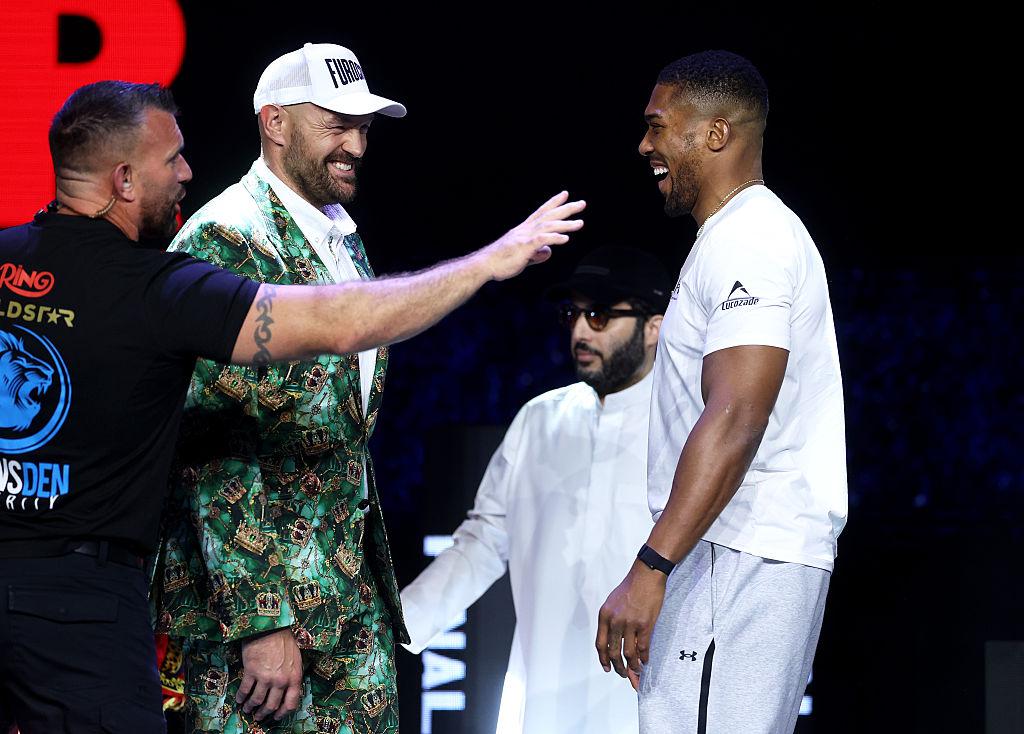
The fighters formally came face-to-face at their September 30 launch press conference in London after years of verbal exchanges from separate stages, interviews and social-media posts. Perhaps surprisingly, the first official confrontation was mostly cordial.
Fury and Joshua exchanged jokes, showed respect and avoided the kind of hostility that had characterized parts of their rivalry. At one point Fury suggested they share a pint of Guinness after the fight, while Joshua jokingly questioned whether he could trust him. Their face-off ultimately ended without confrontation.
The atmosphere did not erase the competitive tension. Both men understand that the fight carries implications extending far beyond another entry on their professional records. For Fury, victory would reinforce his claim to being the defining British heavyweight of the generation. For Joshua, beating Fury would provide perhaps the most symbolically important victory available after the disappointment of losing twice to Usyk.
Joshua’s path to Cardiff came perilously close to collapsing in July. Fighting Kristian Prenga at the Jeddah Superdome in Saudi Arabia, Joshua suffered one of the most alarming opening rounds of his professional career.
Prenga dropped him with a powerful uppercut inside the opening 20 seconds. Joshua regained his feet but remained visibly shaken, and Prenga continued attacking before sending him to the canvas for a second official knockdown later in the round.
At that point, a Fury fight that had been discussed for years appeared capable of disappearing within minutes. A defeat to a major underdog would have seriously damaged Joshua’s commercial and competitive position and potentially destroyed plans for the December blockbuster.
Joshua survived the round and transformed the fight almost immediately afterward. He entered the second with far greater aggression, forced Prenga backward and eventually landed a series of heavy right hands that sent the Albanian crashing through the ropes. The fight was stopped at 2:43 of the second round.
The comeback demonstrated both sides of the Joshua debate. His vulnerability was obvious: he can be hurt, and the early knockdowns reinforced longstanding questions about how he responds when caught cleanly. But his recovery also showed resilience and the finishing instinct that has made him dangerous throughout his career.
Joshua’s ability to survive those moments may prove relevant against Fury because the December fight is unlikely to follow a completely predictable tactical script. Fury is known for changing approaches and creating awkward situations, meaning Joshua may have to make adjustments rather than execute one rigid game plan.
Fury has experienced adversity of his own. His legendary recovery after being knocked heavily down by Wilder in their first fight remains one of the defining images of his career. He later survived additional knockdowns in the trilogy and has built much of his reputation around an unusual capacity to recover when apparently seriously hurt.
That history partly explains Joshua’s warning against assuming one huge punch will decide the contest. Fury has already survived the power of Wilder, one of the most dangerous punchers in heavyweight boxing history.
Joshua’s strategy will therefore likely require him to distinguish between hurting Fury and finishing him. A boxer who becomes reckless after landing a heavy shot can create openings for counters, clinches and tactical recovery, areas where Fury has repeatedly demonstrated intelligence.
Conditioning becomes particularly important under those circumstances. Fury frequently uses his size to make opponents work physically, leaning in clinches and forcing them to carry his weight while simultaneously maintaining enough movement to frustrate them at distance.
Joshua has sometimes appeared at his best when fighting at a measured pace and maintaining tactical discipline. His rematch victory over Andy Ruiz Jr. in 2019 was built around controlled movement and distance management rather than the aggressive exchanges that contributed to his upset loss six months earlier.
That Saudi Arabia rematch demonstrated Joshua’s ability to execute a disciplined strategy across 12 rounds. He stayed behind his jab, resisted unnecessary exchanges and won a clear decision to regain his world titles.
Against Fury, however, distance presents a more difficult problem. Fury is taller, has a longer reach and is comfortable boxing from the outside. Joshua cannot simply assume that remaining at long range will favor him.
He may therefore need to alternate between patient boxing and controlled pressure, cutting off the ring without chasing Fury and attacking effectively when he closes the distance.
The body could become particularly important. Fury’s height creates a large target below the head, while sustained body punching could potentially reduce his mobility as the fight progresses. Joshua has produced damaging body attacks in previous contests, although committing downstairs can also leave openings for Fury’s counters.
Fury will have his own tactical priorities. He may seek to establish his jab immediately, make Joshua reset repeatedly and use feints to draw reactions before attacking from unconventional angles.
He could also choose a physically aggressive strategy resembling his later fights with Wilder, moving forward and forcing Joshua into exchanges where his height and weight can become weapons.
That uncertainty is one of Fury’s greatest advantages. Opponents often prepare for one version of him and encounter another. Joshua’s emphasis on anticipation and calculation suggests his camp is preparing for several possibilities rather than assuming Fury will simply box from long range.
The trainers around Joshua will therefore play a significant role. Preparation for a fighter as adaptable as Fury requires tactical flexibility and confidence in making adjustments between rounds.
The psychological dimension is equally important. Fury has built a career around mind games and often attempts to control the emotional environment surrounding a fight before the opening bell.
Joshua has increasingly emphasized emotional discipline after periods in which defeats appeared to weigh heavily on him. His post-fight reaction following the second Usyk defeat demonstrated how much pressure he had been carrying, while later interviews suggested he had reconsidered how he approaches competition and expectations.
His comments ahead of Fury sound deliberately practical. Rather than making elaborate predictions about an early knockout, Joshua is framing success as the product of preparation, conditioning and repeated correct decisions.
That approach may also reflect lessons from the Prenga scare. Joshua discovered again in July that heavyweight boxing can change with a single punch. Preparing for 12 rounds is therefore a form of protection against believing the contest must unfold according to expectations.
Fury has similarly experienced how quickly heavyweight fortunes can change. He lost consecutive decisions to Usyk after years in which he frequently spoke as though his place at the top of the division was untouchable.
Those defeats did not erase Fury’s accomplishments but changed the mythology surrounding him. He is no longer unbeaten, and Joshua will enter Cardiff knowing that Usyk demonstrated Fury can be outboxed over 12 rounds.
Joshua cannot simply reproduce Usyk’s strategy because the two fighters possess completely different physiques and movement patterns. But the Usyk contests provide evidence that Fury’s size and adaptability do not make him tactically invulnerable.
Usyk’s ability to maintain a high work rate, create angles and pressure Fury late in rounds caused significant problems. Joshua’s challenge will be to find a version of sustained pressure suited to his own strengths.
Fury, meanwhile, can study Joshua’s four professional defeats for evidence of vulnerabilities. Ruiz exposed Joshua during exchanges after being hurt himself, Usyk consistently disrupted him with movement and angles, and Daniel Dubois eventually overwhelmed him with power.
The July knockdowns against Prenga provided another reminder that Joshua can be vulnerable early. Fury may attempt to test him immediately rather than allowing him to establish a comfortable rhythm.
Yet Joshua has also shown that being hurt does not automatically mean defeat. His comeback against Prenga was dramatic precisely because he moved from apparent crisis to decisive victory within a few minutes.
The December fight therefore brings together two heavyweights whose careers have repeatedly included extraordinary recoveries. Both have been knocked down multiple times. Both have lost major championship contests. Both have reconstructed their careers after moments when critics questioned whether they could return to the top level.
That shared history makes the simplistic power-versus-skill narrative incomplete. Joshua has boxing ability as well as power, and Fury possesses physical strength alongside technique. The contest may ultimately be determined by which man better combines his attributes rather than which fighter most closely follows his established stereotype.
Promoters have naturally described the event in historic terms. Frank Warren called it a fight that “had to happen,” while Eddie Hearn has repeatedly argued that an event involving Britain’s two biggest heavyweight stars belonged in the United Kingdom rather than being staged overseas.
The location itself became an important part of negotiations. Saudi Arabia has become the center of many of boxing’s largest financial events, and both Joshua and Fury have fought significant bouts there. Yet Joshua’s camp pushed for the long-awaited meeting to take place in Britain.
Cardiff eventually emerged as the compromise after Wembley and other venues were discussed. The Principality Stadium’s retractable roof removes much of the weather risk associated with a December stadium event and gives organizers flexibility around the unusual Friday fight date.
The event’s commercial reach will extend far beyond Britain. Matchroom and Queensberry have confirmed the contest, and the fight is being promoted as one of the defining global boxing events of 2026.
The undercard is also beginning to take shape, with additional heavyweight attractions being added as promoters attempt to build a major event around the main contest.
Yet everything ultimately returns to Fury and Joshua. Neither man needs another opponent to explain why this fight matters. For years, boxing fans have debated the matchup without receiving an answer.
Joshua was once the unified champion with the larger collection of belts. Fury was the man who dethroned Wladimir Klitschko and later returned from years outside the sport to reclaim heavyweight supremacy.
Their careers repeatedly overlapped without intersecting. Negotiations came close before falling apart. Mandatory challengers appeared. Arbitration intervened. Losses changed championship plans.
By 2026, the likelihood of the fight ever occurring had increasingly seemed uncertain. Their September face-off therefore carried a sense of completion even before either man had thrown a punch.
Now Joshua is attempting to remove another assumption from the buildup: that his chance of winning depends on landing something enormous.
He wants the fight understood as a tactical contest as much as a physical one. His comments about using his feet, hands, anticipation and distance are an attempt to present himself as more complete than the power-punching image associated with his career.
Whether he can execute that vision against Fury is the question Cardiff will answer.
Fury will almost certainly attempt to prevent Joshua from settling into a predictable rhythm. His constant feints, stance adjustments and changes in tempo are designed to force opponents into hesitation.
Joshua must therefore remain patient without becoming passive. Waiting too long can allow Fury to accumulate rounds, while rushing into attacks can provide the openings Fury wants.
That balance between patience and aggression may prove more important than raw punching power.
Joshua also recognizes that Fury is likely to remain dangerous deep into the contest. Preparing for a full 12 rounds means accepting the possibility that even successful early work may not produce an immediate finish.
The Prenga fight showed how powerful Joshua remains when he finds his opportunity. Fury’s career shows why finding that opportunity may require more work than usual.
For British boxing, December 11 represents the resolution of an argument that has survived multiple championship cycles. Lennox Lewis, David Haye and other former champions have offered opinions over the years, while fans have divided repeatedly over which man would prevail.
The result will not retroactively determine who would have won when both were undefeated champions several years ago. Fighters age, styles evolve and careers take different paths. But the winner will gain the only thing neither man currently possesses: an actual victory over the other.
Joshua appears increasingly focused on that fact rather than the mythology surrounding the event.
He has made clear that he trusts his own preparation and experience. He is not promising that one right hand will erase Fury’s advantages or pretending that the man opposite him has not already survived enormous punishment during his career.
Instead, Joshua says he intends to build the victory.
The knockout may still come. With Joshua’s power, that possibility exists from the opening exchange until the final bell.
But the former champion is preparing as though it will not.
That may prove to be the most revealing element of his latest comments. For much of his career, opponents have entered the ring knowing Joshua could change everything with one combination. Against Fury, Joshua appears determined not to become trapped by his own reputation.
He wants movement if movement is needed, patience if patience is required, combinations rather than isolated punches and enough conditioning to fight until the last minute of the 12th round.
Fury presents his own mixture of unpredictability, size and experience, and the tactical battle may change several times before the contest is settled.
The years of speculation will finally end at the Principality Stadium.
For Joshua, the objective is no longer simply to prove that he can punch harder than Tyson Fury. It is to demonstrate that when Britain’s two defining heavyweights of their era finally stand across from one another, he can think, adapt, endure and execute better as well.