APC REJECTS COURT ORDER, INSISTS UZODIMMA REMAINS IMO WEST CANDIDATE AS OKOROCHA CLAIMS TICKET
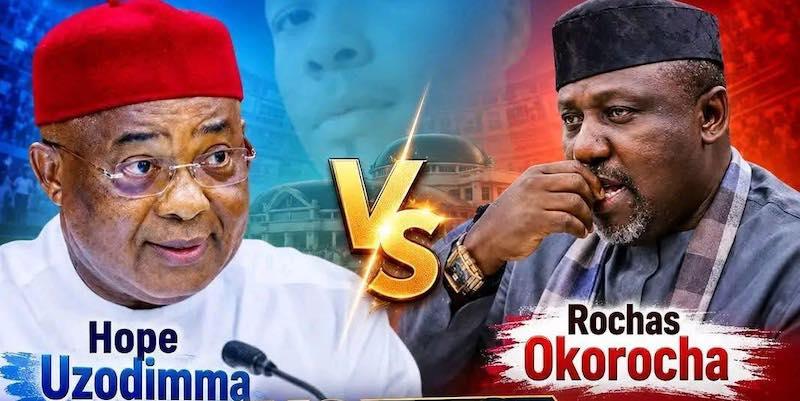
The Imo State APC says Governor Hope Uzodimma remains its candidate for Imo West despite a Federal High Court judgment declaring former governor Rochas Okorocha the lawful winner of the party’s May 18 primary. Justice Obiora Egwuatu ordered the APC to submit Okorocha’s name to INEC, directed INEC to publish him as the candidate and told Uzodimma to stop presenting himself as the APC flagbearer. The party says it will pursue legal remedies, but no higher-court stay was reported at the time of this update. Punch Newspapers
The All Progressives Congress in Imo State has insisted that Governor Hope Uzodimma remains its candidate for the Imo West Senatorial District in the 2027 elections despite a Federal High Court judgment ordering the Independent National Electoral Commission to recognise former governor Rochas Okorocha as the party’s lawful candidate, deepening one of the most consequential internal political battles in the state ahead of the January 16 election.
The party’s position was announced on Thursday after Justice Obiora Egwuatu of the Federal High Court in Abuja ruled in favour of Okorocha in his challenge to the APC’s May 18, 2026 senatorial primary. The court ordered the party to submit Okorocha’s name to INEC, directed the electoral commission to publish him as the APC candidate for Imo West and ordered Uzodimma to stop presenting himself as the party’s candidate.
Imo APC responded by maintaining that its own position had not changed. In a statement signed by State Publicity Secretary Onwuasoanya Jones, the party said Uzodimma remained its candidate because he had emerged from the primary election with what the party described as overwhelming support from its members. The party also said its legal department would study the judgment and determine the next course of action.
The response creates an immediate legal and political confrontation between the party’s internal declaration and the operative order of the Federal High Court. Unless the judgment is set aside or stayed by a higher court, the orders issued by Justice Egwuatu remain the current judicial position on the candidacy dispute. The APC can challenge the decision through the appellate process, but publicly maintaining that Uzodimma remains the candidate does not by itself suspend the effect of the judgment.
The dispute has its origins in the APC senatorial primary conducted on May 18, when Uzodimma and Okorocha competed for the party’s ticket in Imo West. The results initially recognised by INEC showed Uzodimma winning by an overwhelming margin, with 230,464 votes against Okorocha’s 1,098. That result appeared to settle the contest politically, but Okorocha challenged it in court and argued that the process that produced Uzodimma as the recognised candidate was legally defective.
Justice Egwuatu ultimately accepted Okorocha’s challenge. The court held that evidence before it showed that Okorocha had actually won the majority of votes cast at the primary and should therefore be recognised as the lawful winner. The judge also faulted inconsistencies in documents presented in support of Uzodimma’s nomination, according to reports of the judgment.
The court consequently ordered the APC to submit Okorocha’s name to INEC and directed the electoral commission to publish him as the party’s candidate. Uzodimma was also specifically ordered to stop presenting himself as the APC flagbearer for the Imo West senatorial election scheduled for January 16, 2027.
The ruling is particularly significant because both men are major figures in Imo politics and have previously occupied some of the state’s most powerful political offices. Okorocha served as governor of Imo State from 2011 to 2019 before later serving in the Senate, while Uzodimma has governed the state since 2020 and remains one of the APC’s most influential political figures nationally.
Their contest therefore goes far beyond an ordinary party primary dispute. It represents a struggle between two established political networks with significant influence across Imo West and the wider state, making the court battle potentially important to the APC’s internal cohesion ahead of the 2027 elections.
The Imo APC has made clear that it does not accept the Federal High Court judgment as the final word. Jones said the party remained committed to Uzodimma and would examine the legal decision before deciding its next step. Other state officials have gone further, describing the judgment as deeply troubling and indicating that the matter will be taken to the Court of Appeal.
Imo State Commissioner for Information Declan Emelumba publicly criticised the ruling and said appellate intervention would be sought. The state APC leadership has also raised concerns over what it describes as questions surrounding constitutional interpretation, judicial precedent and the evaluation of evidence presented in the case.
Those objections, however, will ultimately have to be tested before a higher court. Political statements rejecting a judgment do not replace the formal process required to overturn it, and the APC would need to obtain a stay or a successful appellate judgment if it wants to prevent the Federal High Court orders from taking effect.
At the time of this report, there was no independently confirmed indication that the Court of Appeal had issued a stay of execution. That means Okorocha currently holds the benefit of the Federal High Court ruling even as the APC insists politically that Uzodimma remains its chosen candidate.
INEC now occupies a central position in the dispute because the court’s orders were directed partly at the electoral commission. The agency was instructed to publish Okorocha’s name as the APC candidate for Imo West, potentially requiring changes to candidate records previously reflecting Uzodimma as the party’s flagbearer.
Electoral disputes of this kind can move quickly through the courts because statutory deadlines governing pre-election matters are intended to ensure that candidacy questions are resolved before voting begins. With the Imo West election scheduled for January 16, the APC has limited time to pursue appellate remedies and obtain legal clarity before ballots and other election materials are finalised.
The court battle also highlights the importance of documentation in party primaries. Political parties are generally responsible for organising internal nomination processes, but those processes must comply with their constitutions, electoral law and the requirements monitored by INEC. When disputes arise, courts can examine result sheets, nomination documents, monitoring reports and other evidence to determine whether the candidate submitted by a party emerged lawfully.
In this case, the Federal High Court concluded that the material presented supported Okorocha’s claim rather than the result previously recognised in favour of Uzodimma. That finding directly challenges the APC’s public account of its own primary and explains why the ruling has generated such a strong reaction within the party.
The enormous numerical difference between the initially reported result and the court’s conclusion is likely to remain one of the most controversial parts of the case. A primary result showing 230,464 votes for Uzodimma and only 1,098 for Okorocha would ordinarily suggest an overwhelming victory. Yet the court concluded, after reviewing evidence placed before it, that Okorocha was the lawful winner.
That contradiction will almost certainly feature prominently in any appeal. The APC is expected to argue that the primary result represented the genuine decision of party members, while Okorocha’s legal team is likely to defend the Federal High Court’s assessment of the evidence and insist that party authorities cannot override the lawful outcome of the process.
Okorocha has welcomed the ruling as a victory for his challenge to the primary. His camp has portrayed the decision as confirmation that the nomination process used to recognise Uzodimma was flawed and that the courts have corrected what they consider an improper outcome.
The APC’s response has been the opposite. The party insists that Uzodimma emerged legitimately and has urged members and supporters not to become distracted by the judgment. Its statement called on party structures to continue working toward victory across constituencies in the state while the legal department handles the dispute.
That message appears designed partly to prevent the court ruling from destabilising campaign preparations. Internal candidate disputes can weaken mobilisation, split local party organisations and create uncertainty among supporters over which political figure they should campaign for.
Imo West, also known as Orlu Senatorial District, is politically important because it contains a large bloc of local government areas and has produced several prominent state leaders. Both Okorocha and Uzodimma have deep political roots in the district, making the battle for the APC ticket especially intense.
The legal dispute could also revive older political divisions within the APC in Imo. The relationship between Okorocha and Uzodimma has been marked by years of rivalry, dating back to the political realignments surrounding the 2019 governorship election. Those divisions have periodically resurfaced despite attempts by national party leaders to encourage reconciliation.
The latest senatorial dispute places those rival networks back in direct competition at a time when the APC would ordinarily prefer to enter the election cycle with a unified state organisation.
For the national leadership of the party, the issue presents a difficult challenge. The APC must defend its internal processes while also operating within court orders. If the party backs Uzodimma through the appeals process, it will need to persuade a higher court that Justice Egwuatu’s interpretation of the primary evidence was wrong. If the judgment survives appeal, the party would ultimately have to campaign with Okorocha as its recognised candidate regardless of its current political preference.
There is also the possibility that the dispute could reach the Supreme Court depending on the outcome of any appeal and the legal questions involved. Pre-election litigation in Nigeria frequently progresses through several levels of the judiciary when major party nominations are at stake.
What is clear for now is that the Federal High Court has ruled for Okorocha. The APC may challenge that ruling, but its insistence that Uzodimma remains the candidate should be understood as the party’s political and legal position rather than the present judicial determination.
This distinction is essential because reports that simply state that Uzodimma remains the APC candidate without reference to the court order could mislead readers about the current legal situation. The party says he remains its preferred candidate, but the Federal High Court has ordered otherwise.
Similarly, reports should not describe Okorocha as permanently confirmed for the ballot while appellate options remain open. The judgment gives him the current legal advantage, but the matter could change if a higher court grants a stay or overturns the ruling.
The next major development will therefore be whether the APC formally files an appeal and whether it seeks an immediate stay of execution. A stay could temporarily preserve the existing candidate status while the appeal is heard, whereas the absence of a stay would increase pressure on INEC to comply with the Federal High Court order.
The timing of any appellate action will matter greatly because the election calendar is already advancing. Campaign materials, candidate lists and ballot-production schedules all depend on a clear determination of who legally represents each party.
INEC has previously faced similar disputes in which courts ordered changes to candidate lists close to elections. The commission generally maintains that it complies with valid court orders while also responding to subsequent appellate decisions when they are issued.
The situation could therefore remain fluid in the coming days. Okorocha may push INEC for immediate compliance, while the APC and Uzodimma pursue appellate relief. Each side is likely to argue that the law supports its position.
Politically, the dispute risks consuming attention that the APC would otherwise direct toward campaigning against opposition parties. Instead, two of the state’s most prominent APC figures are fighting over the same ticket, potentially forcing party leaders to choose sides.
For Uzodimma, the ruling threatens a planned transition from the governorship into the Senate. For Okorocha, the judgment offers a path back to a chamber in which he previously served after leaving the Imo governorship.
The personal stakes are therefore substantial for both men, but the institutional implications for the APC may be even greater. The party must now defend the credibility of a primary that a federal judge has rejected while maintaining discipline among rival factions competing for influence.
The judgment may also trigger wider debate over how party primaries are conducted and documented. Nigerian courts have repeatedly emphasised that political parties must follow their own rules and the law when selecting candidates, and disputes over result sheets, delegate lists and nomination documents remain common ahead of major elections.
Whatever the final outcome, the Imo West dispute demonstrates how internal party contests can move rapidly from political battles into legal battles capable of changing candidate lists entirely.
For now, the facts are sharply divided between the court and the party. Justice Obiora Egwuatu has ruled that Rochas Okorocha won the APC primary, ordered INEC to publish his name and directed Hope Uzodimma to stop presenting himself as the party’s candidate. The Imo APC, however, insists Uzodimma remains its flagbearer and says the judgment will be challenged.
That contradiction is likely to dominate Imo politics until an appellate court intervenes or the parties accept a final legal outcome. Until then, the APC enters the 2027 election season with two political heavyweights claiming the same Imo West ticket and a Federal High Court judgment standing between the party’s preferred candidate and the ballot.