ARGENTINA DESIGNATES MUSLIM BROTHERHOOD CHAPTERS AS TERRORIST ORGANIZATIONS UNDER MILEI

Argentina under President Javier Milei has designated the Lebanon, Egypt and Jordan chapters of the Muslim Brotherhood as terrorist organizations and added them to the countrys RePET terrorism registry. The move enables financial sanctions and operational restrictions, but viral claims that Milei completely banned the entire Muslim Brotherhood from Argentina overstate the scope of the official decision.
Argentina has formally designated the Lebanon, Egypt and Jordan chapters of the Muslim Brotherhood as terrorist organizations, expanding President Javier Mileis security alignment with the United States and other governments that have taken action against parts of the transnational Islamist movement.
The decision was announced by the Office of the President on January 14, 2026 and formally incorporated the three chapters into Argentinas Public Registry of Persons and Entities Linked to Acts of Terrorism and Terrorist Financing, known as RePET. The measure subjects the listed organizations and individuals connected to them to financial sanctions and operational restrictions intended to limit their ability to raise money, move assets or conduct activities within Argentinas jurisdiction.
The governments decision was coordinated by the Foreign Ministry, the Ministry of National Security, the Ministry of Justice and the State Intelligence Secretariat. According to the official announcement, the designation was based on intelligence and official reports that Argentine authorities said documented transnational illegal activity, support for violent extremism and links with other organizations designated as terrorist groups.
The action does not amount to a blanket legal ban on every organization or individual associated with the Muslim Brotherhood worldwide. The official measure specifically identifies the groups chapters in Lebanon, Egypt and Jordan, making that distinction important as social media posts circulate claiming Milei has completely banned the Muslim Brotherhood from Argentina.
Under the Argentine framework, placement on RePET allows authorities to impose restrictions intended to prevent the listed entities from using the countrys financial system or operating freely within its territory. The registry forms part of Argentinas wider counterterrorism architecture and is designed to support the identification, monitoring and sanctioning of individuals and organizations linked to terrorism and terrorist financing.
The Milei administration said the step was intended to strengthen Argentinas ability to detect and prevent terrorist financing and improve cooperation with foreign governments pursuing similar policies. Officials specifically referred to cooperation with countries including the United States, Israel, Paraguay, the United Arab Emirates and Egypt.
The decision also followed moves by Washington concerning Muslim Brotherhood chapters. In November 2025, United States President Donald Trump ordered a review process aimed at determining whether several branches of the organization, including those in Lebanon, Jordan and Egypt, should be designated as foreign terrorist organizations and specially designated global terrorists.
Argentina subsequently moved ahead with its own designation in January, deepening a foreign policy alignment between Milei and Trump that has become one of the defining characteristics of the Argentine presidents international agenda.
Milei has repeatedly sought to reposition Argentina closer to the United States and Israel while adopting a harder approach toward groups his government associates with terrorism and transnational organized crime. His administration previously designated Hamas as a terrorist organization and has taken additional actions involving other organizations considered security threats by Buenos Aires.
Days after the Muslim Brotherhood decision, Argentina also designated Irans Quds Force and 13 individuals connected to the organization under its terrorism framework. The government linked that decision to Argentinas long history of concern about Iranian backed activities following the deadly attacks against the Israeli Embassy in Buenos Aires in 1992 and the AMIA Jewish community center in 1994.
Those attacks continue to shape Argentinas national security policy and its approach to Middle Eastern organizations. Argentine courts and prosecutors have long investigated alleged Iranian and Hezbollah involvement in the AMIA bombing, while successive governments have faced pressure to strengthen measures against organizations suspected of supporting terrorism.
The Milei administration has adopted an especially public position on those issues. It has repeatedly presented its foreign and security policy as part of a broader alignment with what it describes as Western democratic countries and has emphasized cooperation with Washington and Jerusalem on terrorism, organized crime and international security.
The Muslim Brotherhood itself is a complex and decentralized movement founded in Egypt in 1928. It has developed branches, affiliated political movements and associated organizations across several countries, and governments around the world have taken sharply different positions toward it. Some states classify the organization or particular branches as terrorist groups, while others distinguish between political organizations associated with the Brotherhood and groups accused of involvement in violence.
That difference is important when assessing Argentinas action. Buenos Aires did not issue a general declaration applying automatically to every organization associated with the Muslim Brotherhood across the world. Instead, Resolution 32 of 2026 specifically established that the Lebanon, Egypt and Jordan chapters met the requirements for registration under Argentinas terrorism framework.
The Argentine government said its assessment relied partly on confidential reports describing the designated chapters as having transnational structures and links to activities associated with violent extremism, radicalization and support for terrorist organizations. Those are the governments stated grounds for the designation and should be distinguished from independent judicial findings against every individual connected to those chapters.
The registration carries practical financial consequences because Argentinas anti money laundering and counterterrorism system can restrict assets and transactions involving listed organizations. Financial institutions and other regulated entities may also face obligations to identify and report transactions involving people or entities appearing on the registry.
The policy fits into a broader effort by the Milei government to strengthen national security measures and expand intelligence cooperation with countries that share its approach to terrorism. Authorities have argued that Argentina must prevent its territory and financial system from being used to support organizations accused of violent activity elsewhere.
Mileis government has also connected the policy to domestic security concerns. Argentina has one of Latin Americas largest Jewish communities and remains deeply affected by the unresolved political and judicial consequences of the terrorist attacks of the 1990s. Those events continue to influence both foreign policy and security planning.
The presidents close relationship with Trump has added another political dimension to the move. Milei has made his alignment with Washington unusually explicit and has repeatedly described the United States as one of Argentinas most important strategic partners. His government has followed or supported several initiatives consistent with priorities pursued by the Trump administration.
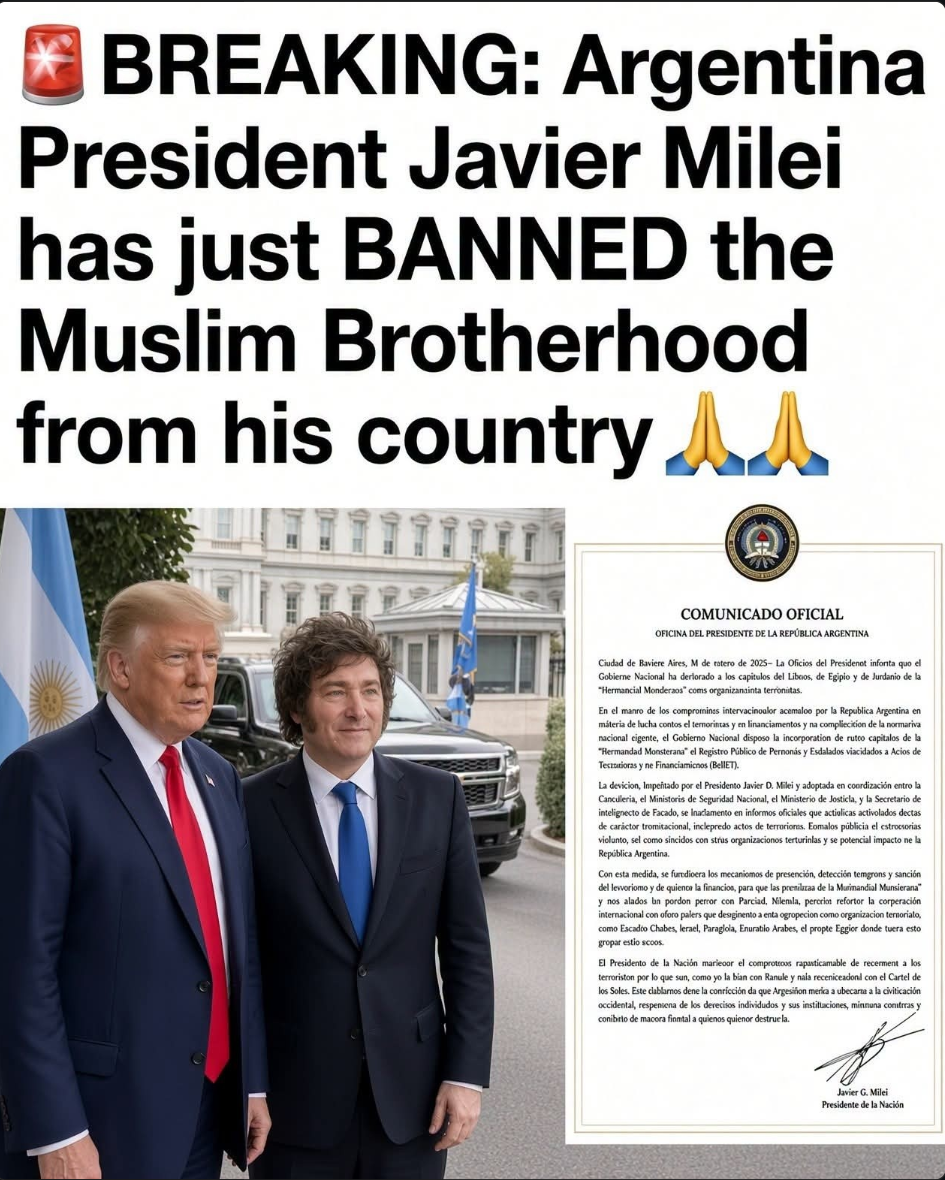
The image circulating online uses a photograph of Trump and Milei together to present the decision as part of that alliance. The broader connection is real, but the wording suggesting that Milei has simply banned the Muslim Brotherhood from the entire country removes an important legal distinction from what Argentina actually did.
The official measure focuses on the designated national chapters and places them within a counterterrorism sanctions framework. It does not establish a general prohibition on Islam, Muslim religious activity or Muslim communities in Argentina, and the policy should not be described in those terms.
That distinction is especially important because security measures involving organizations that identify with political Islam can easily be misrepresented online as restrictions on Muslims generally. The Argentine governments documents frame the action specifically as a counterterrorism and terrorist financing measure targeting identified organizations rather than a religious policy.
Argentina has also argued that the designation will allow closer international coordination by aligning its registry with actions taken by other governments. That cooperation can involve financial intelligence sharing, sanctions enforcement and restrictions on cross border movement or transactions associated with designated individuals.
The government has not publicly released the classified intelligence underpinning every aspect of its assessment, making independent evaluation of all the allegations difficult. The official statement says the decision was based on reports documenting transnational illegal activity and links to violent extremist organizations, but much of the detailed evidence remains within government security channels.
That means the confirmed fact is the legal designation itself and the governments stated justification for it. Claims about specific individuals, operations or undisclosed activities should not be treated as independently established unless supported by court records, publicly available intelligence or other verified evidence.
The measure nevertheless represents a significant policy choice by Milei and further defines Argentinas direction under his administration. It places the country among governments taking formal action against specific Muslim Brotherhood branches and strengthens Buenos Aires cooperation with Washington and other partners on terrorism related financial controls.
For Milei, the action is also consistent with a broader ideological and diplomatic shift away from the more ambiguous relationships previous Argentine governments maintained with some governments and political movements in the Middle East. His administration has instead pursued a more openly pro United States and pro Israel foreign policy while emphasizing aggressive action against organizations it considers extremist threats.
The longer term significance of the designation will depend on how Argentine authorities enforce the restrictions and whether additional Muslim Brotherhood branches or associated individuals are later added to the registry. The government could also face legal or diplomatic questions if sanctions affect organizations or individuals that challenge their inclusion.
For now, the official position is narrower than the viral claim circulating online. Argentina has not announced that every part of the Muslim Brotherhood has been universally banned from the country. It has formally designated the Lebanon, Egypt and Jordan chapters as terrorist organizations and placed them under the financial and operational restrictions attached to Argentinas RePET counterterrorism registry.
That distinction does not make the policy insignificant. It represents a substantial security and foreign policy decision by Mileis government and reinforces his alignment with the United States and other countries pursuing similar measures. But accurate reporting requires describing the scope of the decision as Argentina itself defined it rather than presenting the broader social media claim as fact.