BRAKE FAILURE TURNS DEADLY IN LAGOS AS TRUCK ASSISTANT IS THROWN TO DEATH IN EPE CRASH
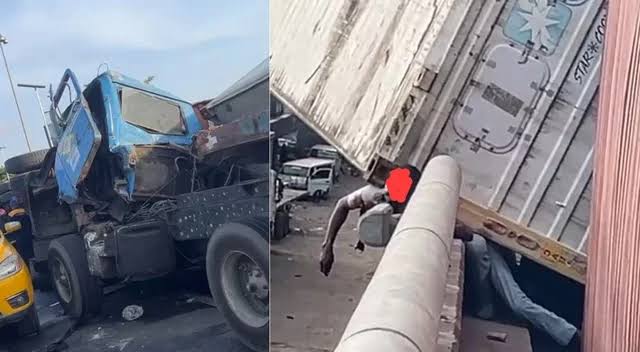
A motor assistant has died after two granite-laden tipper trucks collided at Oke-Oso, inward Itokin, in Epe, Lagos, early on October 31. LASEMA says preliminary investigation showed that one truck, registration ABG-226XB, suffered brake failure, lost control and sideswiped another tipper. The collision threw the assistant from the vehicle, killing him on impact. His remains were handed to the Federal Road Safety Corps, while both trucks were recovered from the scene.
A truck assistant has died in a fatal early-morning collision involving two granite-laden tipper trucks in the Epe area of Lagos State after one of the heavy-duty vehicles reportedly suffered brake failure, lost control and struck the other truck. The Lagos State Emergency Management Agency said the crash occurred at Oke-Oso, inward Itokin, at approximately 6:19 a.m. local time on Saturday, October 31, with the force of the collision throwing the motor assistant from the first truck and killing him on impact. Emergency responders recovered the body, handed it over to personnel of the Federal Road Safety Corps and removed both damaged trucks from the roadway as authorities again warned commercial vehicle operators about the potentially fatal consequences of poor mechanical maintenance.
According to LASEMA Permanent Secretary Dr Olufemi Oke-Osanyintolu, the agency’s Whales Response Team stationed in Epe was activated after receiving information about the collision. Responders arriving at the scene found two granite-carrying tipper trucks involved, including a vehicle with registration number ABG-226XB. Preliminary investigation by the emergency agency indicated that the brakes of that truck failed while it was moving along the corridor, causing the driver to lose control before the vehicle sideswiped another tipper truck travelling in the area. The impact was severe enough to eject the motor assistant from the vehicle, leaving him with fatal injuries before emergency medical intervention could save him.
LASEMA said the deceased was an adult male but did not immediately release his identity. His remains were recovered from the accident scene, properly secured and transferred to the Federal Road Safety Corps for the necessary procedures. Authorities did not announce any additional fatalities from the truck collision, and available reports did not indicate that the drivers of the two trucks suffered life-threatening injuries. Both damaged vehicles were subsequently recovered from the scene and taken to the FRSC office, allowing the affected section of the road to be cleared for normal vehicular movement.
The fatality once again places the condition of heavy-duty vehicles operating on Lagos roads under scrutiny. Tipper trucks regularly carry granite, sand and other construction materials across Lagos and neighbouring states, often covering long distances while transporting loads weighing several tonnes. Mechanical failures involving such vehicles can be particularly dangerous because their weight dramatically increases stopping distances and the destructive force generated during a collision. When braking systems fail, drivers may have only seconds to attempt evasive manoeuvres, especially on busy roads where other vehicles, pedestrians and roadside businesses leave limited space for escape.
LASEMA’s finding that brake failure preceded Saturday’s crash remains a preliminary emergency-response assessment rather than the conclusion of a full mechanical or criminal investigation. A comprehensive examination may be required to establish why the braking system failed, when the vehicle was last serviced, whether warning signs were previously detected and whether the truck complied with roadworthiness requirements before being put into operation. Such questions become especially important after a fatality because mechanical failure can sometimes result from sudden component breakdown, but it can also be linked to poor maintenance, worn parts, overloading or failure to respond to known defects.
The death comes amid renewed attention to serious truck accidents in Lagos. Only days earlier, four people were killed and six injured after a container-laden articulated truck overturned onto a Toyota Hiace bus at Berger Bridge, inward Eleko, along the Ibeju-Lekki Expressway. LASEMA said preliminary findings in that crash pointed to excessive speed while the truck was ascending the bridge before the driver lost control. Another recent incident near Freeman Market at Mile 2 resulted in the deaths of a mother and child after two container trucks overturned, prompting road-safety authorities to call for greater attention to vehicle maintenance, cargo loading and driver conduct.
These incidents have intensified longstanding concerns over articulated trucks, tankers and other heavy commercial vehicles operating within one of Africa’s busiest urban transport systems. Lagos depends heavily on road transport for the movement of construction materials, fuel, containers and consumer goods, meaning heavy vehicles remain an unavoidable part of everyday traffic. The challenge for authorities is ensuring that vehicles carrying unusually heavy loads remain mechanically sound and are operated by drivers capable of safely handling them in congested urban and semi-urban conditions.
Brake systems on commercial trucks require particularly rigorous maintenance because they operate under extreme pressure. A heavily loaded tipper travelling at speed generates enormous momentum, and its brakes must convert that energy into heat whenever the vehicle slows or stops. Worn brake components, inadequate servicing, damaged air-brake systems or excessive loading can reduce braking efficiency and potentially result in complete failure. Regular inspections are therefore one of the most important safeguards against crashes similar to the one recorded in Epe.
Saturday’s accident also highlights the vulnerability of truck assistants, commonly called motor boys, who frequently travel alongside commercial drivers and help with loading, unloading, navigation, maintenance and other tasks. These workers spend long periods on the road and are exposed to many of the same risks as drivers, yet their role often receives attention only after fatal accidents. The circumstances under which the assistant was thrown from the vehicle may eventually raise questions about seating arrangements, seat-belt use and whether commercial truck cabins provide adequate protection to assistants during serious impacts.
Seat belts can significantly reduce the risk of occupants being ejected during crashes, although investigators have not publicly established whether the deceased was restrained at the time of the collision. Ejection from a moving vehicle dramatically increases the likelihood of fatal injury because an occupant can strike the road surface, roadside structures or another vehicle with enormous force. Determining exactly how the victim was thrown from the truck would require a more detailed investigation than LASEMA’s initial emergency assessment.
The Oke-Oso–Itokin corridor itself carries considerable commercial traffic, including heavy vehicles moving between Lagos communities and adjoining routes serving construction, agricultural and industrial activity. Roads used frequently by loaded trucks require not only responsible driving but continuous monitoring of surface conditions, signage and traffic management because mechanical failure can become even more dangerous where drivers encounter bends, gradients, potholes or congestion.
LASEMA’s emergency response prevented the crash from causing prolonged obstruction after responders secured the area and coordinated recovery of the damaged trucks. Heavy vehicles involved in accidents can block major portions of a carriageway, creating secondary collision risks as approaching motorists suddenly encounter wreckage or debris. Recovery operations involving tipper trucks can also require specialised equipment because ordinary tow vehicles may not be capable of moving them safely, particularly when they are carrying heavy materials.
The agency’s response to the Epe crash formed part of a busy overnight period for Lagos emergency services. LASEMA said its teams also responded to a separate collision on Odo-Iyalaro Bridge, inward Maryland, involving a Toyota Camry and a Toyota Venza. Preliminary findings indicated that the Venza had stopped after running short of fuel when the Camry struck it, with authorities suspecting that the Camry driver may have been under the influence of alcohol. The driver sustained injuries, received initial treatment from LASEMA paramedics and the Lagos State Ambulance Service and was later taken to a trauma centre. Both vehicles were removed to Area F Police Station after the scene was cleared.
In another overnight emergency, responders were deployed to Olosha in Mushin after a HOWO truck became stuck in a failed section of the road, obstructing approximately 60 percent of the carriageway. No injuries were recorded in that incident, and LASEMA deployed its heavy-duty Super Metro recovery equipment to remove the truck and restore traffic. Together, the incidents demonstrate the variety of road emergencies Lagos authorities handle on a daily basis, from fatal collisions and suspected impaired driving to vehicle breakdowns capable of creating severe traffic disruption.
Oke-Osanyintolu used Saturday’s incidents to renew calls for motorists to maintain their vehicles properly, avoid driving under the influence of alcohol and comply with road-safety regulations. Mechanical condition is particularly important for commercial vehicles because defects that might merely immobilise a lighter vehicle can become deadly when they affect a fully loaded truck travelling at road speed.
Roadworthiness inspections are intended to identify such problems before vehicles enter public roads. Effective inspection regimes examine brakes, tyres, steering systems, lights, suspension and other safety-critical components. Their effectiveness, however, depends on regular enforcement and on vehicle operators maintaining their trucks between official inspections rather than treating roadworthiness certification as a one-time administrative requirement.
Operators themselves bear an important responsibility because a truck may accumulate considerable mileage in a relatively short period. Construction vehicles often operate repeatedly between quarries, building sites and material depots, placing heavy stress on braking systems, tyres and suspension. Preventive maintenance can appear costly to operators working under financial pressure, but postponing repairs can result in accidents whose human and economic consequences are far greater.
The Saturday fatality also illustrates why drivers must report brake problems immediately rather than continue operating a vehicle they suspect is unsafe. Warning signs can include reduced braking response, unusual noises, pulling to one side, changes in pedal pressure or dashboard warnings. On air-brake systems common in heavy vehicles, pressure abnormalities can indicate a potentially serious fault requiring immediate inspection.
Employers and fleet owners must create conditions in which drivers can report such problems without being pressured to continue a trip simply to meet delivery schedules. Where commercial incentives reward completing more journeys in less time, there can be pressure to postpone maintenance or keep vehicles operating despite emerging defects. Road-safety enforcement therefore needs to examine not only the actions of individual drivers but also the maintenance practices of companies and vehicle owners.
Nigeria’s road-safety agencies have repeatedly warned that human error and vehicle defects remain major contributors to road crashes. Speeding, dangerous overtaking, fatigue, distracted driving and driving under the influence can combine with mechanical problems to produce especially severe incidents. Heavy commercial vehicles increase the stakes because they can crush smaller vehicles or cause multiple casualties when control is lost.
Saturday’s crash did not produce a mass-casualty event, but one worker lost his life in circumstances that LASEMA believes began with a mechanical failure. That makes the incident an important reminder that road-safety statistics ultimately represent individual families dealing with sudden deaths, not simply numbers in official reports.
The deceased motor assistant began the morning as part of an ordinary commercial journey transporting granite and never returned home. His death occurred within seconds after the truck reportedly lost braking ability and collided with another vehicle, demonstrating how quickly routine work on Lagos roads can turn fatal.
Further investigation may establish whether anyone bears legal responsibility for the condition of the truck. If evidence shows that the braking system was defective and the vehicle was knowingly operated despite the problem, enforcement agencies could consider appropriate action under traffic and vehicle-safety laws. If the failure was sudden and unforeseeable, investigators may reach a different conclusion. Until such findings are available, the responsible approach is to describe brake failure as LASEMA’s preliminary determination rather than a final ruling on negligence.
The Federal Road Safety Corps may also use the case to reinforce safety checks on commercial trucks operating through Epe and surrounding corridors. Random inspections and targeted enforcement against visibly defective or overloaded heavy vehicles can reduce risk, although sustained improvement requires cooperation among FRSC, Lagos traffic agencies, transport unions, fleet operators and drivers.
There is also a wider infrastructure dimension. Vehicle maintenance cannot be separated entirely from road conditions because potholes, damaged sections and poorly designed junctions can accelerate wear on steering, tyres and suspension. The separate Olosha incident, where a truck became stuck in a failed road section, illustrates how infrastructure problems can themselves create dangerous traffic situations even without a collision.
Lagos’ huge population and intense construction activity mean the volume of truck traffic is unlikely to decline significantly. The more realistic objective is therefore safer operation through stronger vehicle inspection, disciplined driving, better fleet maintenance, enforcement against overloading and road infrastructure capable of handling heavy commercial traffic.
For emergency responders, rapid intervention will remain essential. LASEMA says residents can report emergencies through Lagos State’s toll-free numbers 767 and 112, allowing response teams to be mobilised to accident scenes, fires, structural collapses and other emergencies. Early reporting is especially important after road crashes because injured victims may require immediate medical treatment while damaged vehicles can create additional hazards for other road users.
The fatal Epe accident now leaves investigators with a relatively straightforward but important set of questions: why did the truck’s brakes fail, was the failure preventable and were all required safety measures followed before the vehicle was allowed onto the road? The answers may determine whether Saturday’s death is treated solely as a tragic mechanical failure or as an accident that could have been prevented through better maintenance or regulatory compliance.
What is already confirmed is that two granite-laden tipper trucks collided at Oke-Oso, inward Itokin, early Saturday morning; LASEMA’s preliminary investigation found that truck ABG-226XB suffered brake failure and lost control; and its motor assistant was thrown from the vehicle and died immediately from the impact. Emergency responders recovered the body and handed it to the Federal Road Safety Corps before both vehicles were removed from the scene.
For Lagos motorists and commercial transport operators, the warning from the accident is difficult to ignore. A brake defect on a heavy truck is not simply a maintenance inconvenience. When tonnes of vehicle and cargo are moving through public roads, a single mechanical failure can become fatal within seconds. Saturday’s death in Epe is the latest reminder that roadworthiness is not merely a regulatory requirement but one of the most basic protections between an ordinary journey and a tragedy.