BREAKING: FOUR APC MEMBERS HOSPITALISED IN KWARA, TWO REPORTEDLY CRITICAL AFTER VIOLENT FIGHT OVER MOBILISATION FUNDS
Four members of the All Progressives Congress in Irepodun Local Government Area of Kwara State have reportedly been hospitalised after a violent confrontation linked to the sharing of mobilisation funds for an APC rally in Offa, with two said to be in critical condition. Multiple reports attribute the dispute to disagreements over money allegedly provided or promised to mobilise supporters for the November 15 rally backing APC governorship candidate Yakubu Danladi-Salihu. The identities of the injured people, the precise nature of their injuries, the amount of money involved and responsibility for the violence had not been independently established at the time of publication, while a detailed police or party account was still awaited.
At least four members of Nigeria’s ruling All Progressives Congress have reportedly been hospitalised in Kwara State, with two said to be in critical condition, after a violent confrontation linked to the sharing of mobilisation funds for a political rally in Offa. The incident, which was reported in Irepodun Local Government Area on Monday, November 16, has deepened controversy surrounding an APC political gathering held in Offa a day earlier, where supporters were said to have clashed after some participants complained that money allegedly promised to them for attending or helping to mobilise people had not been paid. Multiple Nigerian news outlets citing community sources and an eyewitness account originally attributed to SaharaReporters said the argument later degenerated into violence, leaving four people requiring hospital treatment, although the identities of those injured, the hospitals treating them and the precise nature of their injuries had not been officially disclosed at the time of publication.
The reported hospitalisations represent the most serious development yet in a controversy that began around the APC rally in Offa on Sunday, November 15, an event held as part of the party’s growing mobilisation effort ahead of the 2027 elections in Kwara State. Reports from the gathering said supporters filled streets in the town as the party sought to demonstrate backing for its governorship ticket and other APC candidates, but the political spectacle was later overshadowed by allegations that some of the people brought to the event had expected mobilisation payments that were not delivered as promised. Trend Naija reported that tension rose after some participants complained that allowances they believed they were entitled to had not been paid, while social media footage circulated by SaharaReporters was described as showing supporters confronting one another as the rally descended into disorder. Those reports establish that a confrontation occurred around the event, but they do not independently prove who made any financial promise, how much money was involved or whether the arrangement came from the official campaign, local organisers or informal intermediaries working around the rally.
According to the subsequent reports on Monday, the dispute over the money did not end with the original disruption in Offa. Community sources said disagreement continued over how mobilisation funds allegedly provided to bring supporters to the rally should be distributed, eventually escalating into a serious physical fight among people described as APC members in Irepodun Local Government Area. Naija News and TheNewsGuru both reported that four people were injured and hospitalised, while two were said to require urgent medical care and remained in critical condition. Neither outlet provided names for the victims, and there had been no publicly available medical briefing confirming the severity or type of injuries. That distinction is important because the expression “critical condition” has been repeated from eyewitness and community accounts rather than from a named hospital official, meaning the reported seriousness of the injuries should continue to be attributed until a formal medical update is issued.
The exact sequence of events also remains incomplete. Available reports link the hospitalisation incident directly to disputes surrounding the Offa rally, but they do not clearly establish whether the four people were injured inside the rally area, during movement away from the gathering, at a later meeting where money was being shared or at another location in Irepodun. That missing detail could become crucial if the Kwara State Police Command opens or confirms an investigation, because the location of the confrontation would help establish who was responsible for security, which organisers were present and whether the violence formed part of the original rally disruption or emerged separately during a later disagreement among mobilisers. At the time of the reports reviewed by VNTV, the state police command had not issued a detailed public statement explaining the cause of the fight, identifying suspects, confirming arrests or clarifying whether weapons were used.
The controversy has drawn particular attention because the rally was intended to project strength and unity behind the APC’s 2027 political structure in Kwara rather than expose internal disagreement. The party has been intensifying mobilisation across the state in recent months, holding rallies and marches intended to build support for President Bola Ahmed Tinubu, Governor AbdulRahman AbdulRazaq and the APC’s governorship candidate, Salihu Yakubu Danladi. On November 8, a major rally in Ilorin was described by organisers as a 20,000-person march involving supporters from several local government areas, while Voice of Nigeria and Premium Times both reported that the procession was organised to demonstrate support for the party’s national and state candidates. That broader campaign activity shows that the Offa rally did not occur in isolation but formed part of a deliberate effort by the state APC to consolidate its political base as Nigeria moves deeper into the 2027 election season.
Danladi’s position within the party has itself become an important element of the emerging contest. The Speaker of the Kwara State House of Assembly secured the APC governorship ticket after a competitive primary and has since received public backing from several party structures, including the Kwara South Elders Caucus. In a communiqué reported on November 13, the caucus endorsed Danladi while urging aggrieved members, aspirants and stakeholders to put internal disagreements behind them and unite around the party. That call for cohesion is now particularly relevant because the Offa violence, although reportedly centred on money rather than the governorship nomination itself, creates an appearance of organisational strain at precisely the moment party elders have been publicly emphasising unity.
Offa also carries particular significance in the APC’s campaign calculations because the town is the home base of the party’s deputy governorship candidate, Seun Ogunniyi Adato. On October 1, Punch reported that thousands of supporters welcomed Adato during a homecoming procession through major streets of Offa, with party members displaying banners and chanting in support of Adato, Danladi, Governor AbdulRazaq and the APC. Social media posts surrounding the November 15 gathering similarly described it as a major endorsement rally involving the Offa community and the party’s candidates. That political importance helps explain why the latest violence has attracted attention beyond what might ordinarily follow a dispute among a handful of local supporters: a rally designed to demonstrate the strength of the APC in one of its strategically important communities instead became associated with allegations of unpaid mobilisation funds and hospitalised party members.
The phrase “mobilisation funds” itself requires careful treatment because it can cover different types of spending in Nigerian political campaigning. Parties across the political spectrum frequently arrange transport, food, branded clothing, venue logistics, accommodation and other support for supporters travelling to large events, and those legitimate organisational costs are often collectively described as mobilisation. In other circumstances, however, participants or local coordinators may be offered direct cash allowances, either for transportation or simply for appearing at a rally. The current reports from Offa allege that some people were expecting money after attending the event, but no document reviewed by VNTV establishes whether those payments were officially authorised by the state party, promised by local organisers, arranged by ward-level mobilisers or discussed informally among participants. It would therefore be inaccurate to conclude at this stage that the APC leadership itself paid or promised cash to every person at the rally.
The distinction also matters because large political crowds are routinely presented as evidence of genuine grassroots popularity. Campaign organisations publish videos and photographs showing streets filled with supporters, while politicians point to attendance figures as proof of public enthusiasm. When allegations arise that some participants attended because of financial incentives, those images become politically contested, but it does not automatically follow that everyone in the crowd was paid or lacked genuine political support. In the Offa case, there is evidence that the APC has an established support network in the town and had previously attracted substantial crowds there, including during Adato’s October homecoming. The latest allegations therefore raise questions about the mechanics of mobilisation at this particular rally rather than proving that the entire turnout was financially manufactured.
The lack of clarity over the money is now one of the most important unanswered questions. No reliable source reviewed for this article has published the total amount of mobilisation funds allegedly made available, the number of people expected to receive payments or the amount each participant was supposed to collect. There is also no verified information showing who physically held the money before the dispute began. Those details could substantially alter the interpretation of the incident because a fight caused by an intermediary withholding transport reimbursements would represent a different organisational failure from a confrontation caused by promised cash payments to rally participants being deliberately withheld. Until party officials, organisers or investigators provide documentary information, both possibilities remain unproven.
The controversy also comes against the backdrop of existing political tension in Offa. Before the November 15 rally, the local APC publicly alleged that agents linked to the opposition Peoples Democratic Party were planning to disrupt the gathering. A statement attributed to Offa APC Publicity Secretary Akeem Fagade warned against violence and said the party would use lawful means to protect the event. Those allegations were political claims and were not independently proven, and the reports that emerged after the rally did not establish that opposition supporters caused the fight. Instead, the accounts published on Monday attributed the disorder to disagreements over mobilisation payments among people associated with the APC gathering. That does not rule out the possibility of other factors, but there is currently no verified evidence establishing that the PDP was responsible for the confrontation.
It is equally important not to transfer responsibility automatically from individual party members to the APC leadership. A violent fight involving people identified as members or supporters does not by itself establish that Danladi, Adato, Governor AbdulRazaq or the state executive knew about the alleged payment arrangements or authorised the conduct that led to the confrontation. None of the current reports reviewed by VNTV provides evidence directly linking those senior figures to the dispute. A fair account therefore has to separate the confirmed political context from the allegations surrounding the money, while recognising that the party may still face questions about how an event held under its banner was organised and supervised.
The immediate political damage, however, is already visible in the way the rally has been discussed nationally. Instead of headlines focusing primarily on speeches, endorsements or turnout, the event has been associated with violence and alleged unpaid allowances. That reversal illustrates one of the central risks of modern campaign politics, where a carefully organised event intended to generate positive images can be redefined within hours by viral video and eyewitness accounts of disorder. Once footage of confrontation begins circulating online, the original political message can become almost impossible to recover, particularly when competing parties and activists begin using the images to advance their own narratives.
Social media has played a significant role in spreading the Offa story. SaharaReporters circulated a video post describing an APC rally in Offa as having turned violent over alleged unpaid mobilisation funds, and the footage quickly attracted engagement. The existence of video makes the incident more difficult for political actors to dismiss entirely, but footage still has limits as evidence. A clip can confirm that disorder occurred at a particular moment while providing little information about what happened before filming started, who initiated the confrontation or whether accompanying captions accurately describe the financial disagreement. For that reason, the video supports the fact that a disturbance took place but should not be treated as independent proof of every allegation attached to it.
The reported hospitalisations are especially serious because they move the story beyond political embarrassment into possible criminal conduct. If investigators confirm that participants deliberately assaulted one another and inflicted severe injuries, offences under Nigerian criminal law could become relevant regardless of the political context that produced the argument. No arrests had been publicly confirmed in the reports available at the time of writing, but a police investigation would ordinarily be expected to establish who struck whom, whether weapons were involved and whether the victims or witnesses are prepared to make formal statements. Any subsequent criminal case would depend on that evidence rather than the political affiliation of the people involved.
There has also been no reliable confirmation that firearms were used, despite the tendency for political violence stories to attract dramatic speculation online. The current reports refer generally to a fight or violent confrontation but do not provide verified descriptions of gunshots, knives or other specific weapons. VNTV therefore cannot state how the injuries were inflicted. Similarly, there have been no confirmed deaths linked to the incident, and any social media claim suggesting fatalities should be treated cautiously unless police or medical authorities provide formal confirmation.
The episode is unfolding amid broader concern over political violence ahead of the 2027 elections. On November 12, Nigeria’s House of Representatives resolved to investigate attacks and violence at political rallies, meetings and processions after lawmakers cited incidents in several states. The House directed committees responsible for police affairs and national security to examine the causes of the violence and recommend measures to prevent further attacks. That inquiry was launched before the Offa incident, but the new confrontation in Kwara adds another example to a growing pattern of political gatherings becoming flashpoints as campaign activity intensifies.
Recent incidents have not been confined to one party, which is important when considering the wider implications. Supporters and campaign teams linked to different political organisations have reported attacks, disruptions and intimidation in several parts of the country. The House inquiry specifically cited events affecting both ruling and opposition political actors, suggesting that election-related violence is developing as a broader institutional concern rather than an issue attributable to a single party. That context does not lessen responsibility for what happened in Offa, but it places the confrontation within a national environment in which campaign security is already becoming a major issue.
For the Kwara APC, the response to the incident could be as important politically as the incident itself. The party can reduce uncertainty by clearly stating whether mobilisation funds were approved for the rally, what they were intended to cover, who was responsible for distributing them and whether any of those arrangements were connected to the people now reported to be in hospital. A detailed explanation would allow journalists and the public to distinguish between legitimate campaign logistics and the allegation that people were promised cash simply for attending.
The party could also state whether it has opened an internal inquiry or disciplinary process. If the confrontation involved recognised party officials or ward-level organisers, internal sanctions may become relevant even if the police investigation remains separate. Conversely, if the people involved were unofficial intermediaries or individuals who misrepresented the campaign’s arrangements, a party investigation could establish that as well.
The absence of an immediate detailed public response has created space for speculation. Trend Naija reported that the APC had not publicly commented on the alleged unpaid allowances at the time of its report, while ValidView Network similarly noted that details of the clash were still sketchy and that the police had not issued a substantive account. The lack of official information does not validate the allegations automatically, but it means witness reports currently dominate the public narrative.
There is also a significant internal political dimension because the Kwara APC has been working to heal divisions that followed the governorship primary. TheCable reported in October that Danladi’s emergence became part of a wider succession struggle within the state party, with aggrieved stakeholders alleging that the primary had been manipulated while the APC defended the legitimacy of its process. Some dissatisfied figures subsequently aligned with other political blocs, while party structures continued rallying behind Danladi. That history does not prove that the Offa fight had anything to do with the governorship primary, but it provides important background to the leadership’s repeated public calls for unity.
Only three days before the Offa rally, the Kwara South APC Elders Caucus had publicly urged aggrieved party members and aspirants to set aside their differences. The group’s communiqué declared support for Danladi and argued that internal disagreements should give way to the collective interest of the party. The timing is notable because an incident involving party members fighting over alleged campaign funds immediately undermines the image of discipline and cohesion that the elders were attempting to project.
Offa itself has experienced intense political competition in recent months. In October, local media reported the defection of groups of former APC mobilisers to the PDP, with the defectors making accusations about exclusion and internal leadership. Those claims were partisan and contested, but the defections demonstrated that political loyalties in the area were already being actively fought over. Against that backdrop, the APC’s decision to stage a major rally in Offa carried strategic importance beyond a routine campaign event.
The turnout seen in videos and reports from Sunday therefore had clear symbolic value for the ruling party. Posts circulating from the event described thousands of supporters wearing party colours and moving through major parts of the town, while pro-APC accounts portrayed the gathering as evidence of overwhelming local backing. The subsequent allegations of unpaid mobilisation money created a competing interpretation of the same crowd, demonstrating how the meaning of political attendance can become contested almost immediately.
For election observers, the controversy illustrates why rally size should be treated cautiously as a measure of future voting behaviour. Campaign gatherings often involve sophisticated mobilisation networks, free transport and organised community participation. Even where attendance is genuine, large crowds cannot be translated directly into votes because people attend political events for many different reasons, including curiosity, social pressure, local loyalty, entertainment or practical benefits. The Offa controversy reinforces that distinction without proving anything definitive about the APC’s actual electoral strength in the area.
The incident may also revive discussion around political spending and campaign finance. Nigeria has formal rules governing election expenditure, but the movement of money through local political networks can be difficult to track, particularly before official campaign reporting is available. If significant sums were used for mobilisation in Offa, questions could arise about their source, accounting and whether the spending was included in formal campaign structures. There is currently no evidence that public money was used, and it would be irresponsible to imply otherwise, but the controversy illustrates why transparent campaign financing remains important.
A further issue is the role of local intermediaries. Major political campaigns rarely organise every participant directly. Ward leaders, youth coordinators, community figures and grassroots mobilisers often serve as the bridge between central campaign structures and ordinary supporters. That decentralisation can be effective, but it also creates opportunities for miscommunication, inflated promises and disputes over money. If the Offa confrontation ultimately turns out to have arisen because funds passed through several levels of intermediaries before reaching participants, the incident would highlight the vulnerabilities of that system.
The security implications are just as significant. A large rally can bring together people from different wards, political tendencies and social groups, sometimes under intense emotional pressure. Organisers therefore need security personnel capable of managing both external threats and internal disputes. The earlier Offa APC warning about possible disruption suggests the party was already conscious of security risks before Sunday’s event. If the eventual violence came from inside the gathering rather than from outside opponents, it would raise questions about whether security preparations focused too narrowly on external threats and not enough on crowd management.
The condition of the injured people now deserves particular attention. Reports that two are critically injured suggest potentially serious consequences, but without official medical confirmation it remains unclear whether their condition has improved or deteriorated since the initial reports. Their identities have also not been released publicly, which limits the ability of independent journalists to verify their treatment directly. Any statement from a hospital, family member or police investigator would therefore represent a significant update.
There is likewise no verified information about whether the APC is paying medical bills for those hospitalised. If the injured individuals are confirmed party members hurt during a dispute directly connected to a party event, public attention may turn toward whether the state chapter accepts responsibility for assisting them. That would be a political rather than purely legal question unless formal liability is established, but it could affect perceptions of how the party treats grassroots supporters.
The dispute also exposes the risk that financial expectations can turn political events into volatile spaces. Nigeria’s difficult economic conditions mean that transport reimbursements or small mobilisation allowances can carry meaningful value for participants. When people travel significant distances or spend hours at a campaign event believing they will receive compensation, a failure to meet those expectations can produce anger. That economic reality does not justify violence, but organisers who rely on financial incentives or reimbursements have a responsibility to communicate arrangements clearly.
The APC is not unique in facing allegations around rally mobilisation. Political parties across Nigeria have long used organised transport, branded materials and other incentives to bring supporters to campaign events, and opposition groups have faced similar accusations. The wider lesson from Offa is therefore not simply about one party but about a campaign culture in which the logistics of manufacturing large political events can become intertwined with cash, patronage and local power struggles.
That reality complicates the use of rallies as democratic indicators. Public gatherings remain legitimate expressions of political support, but their value as evidence of spontaneous enthusiasm depends heavily on how participants were recruited. Greater transparency around campaign spending and mobilisation would make it easier for voters to distinguish genuine volunteer activity from financially organised attendance.
The incident may also attract the attention of election authorities and civil society organisations if further evidence emerges. While the Independent National Electoral Commission regulates formal campaign activities and electoral expenditure, not every dispute involving political money automatically falls within its enforcement role. However, repeated controversies over payments, intimidation and violence can shape the wider assessment of whether parties are conducting campaigns in a manner consistent with peaceful democratic competition.
Civil society organisations monitoring the 2027 election cycle are likely to pay particular attention to the growing number of violent incidents around political gatherings. With the House of Representatives already ordering an inquiry into attacks at rallies, another confrontation involving hospitalised supporters adds urgency to calls for parties to sign and respect peace commitments.
The Offa incident is especially striking because it reportedly involved people on the same political side rather than rival groups. Internal political violence can be just as destabilising as clashes between parties because disputes over money, positions and access to campaign resources can create factions that later spill into broader competition.
Local leaders therefore have an incentive to resolve the dispute quickly before it becomes a source of retaliation. If individuals believe funds were stolen or unfairly distributed, party leaders may need to establish a transparent process for reviewing those claims rather than allowing supporters to settle disagreements through force.
The role of the police will become central if the case progresses. Investigators can obtain statements from the injured victims, identify witnesses, secure video evidence and determine whether any person should face criminal charges. Such an investigation could also clarify whether the money dispute was genuinely the trigger or whether other rivalries contributed to the fight.
Until that happens, news organisations must continue to distinguish what multiple reports agree on from what remains allegation. The strongest currently supported facts are that an APC rally took place in Offa on November 15; reports and video described disorder connected to complaints over alleged mobilisation payments; four APC members in Irepodun were subsequently reported hospitalised after a dispute over mobilisation funds; and two were said by community sources to be in critical condition.
What remains unverified is equally important. There has been no authoritative confirmation of the total money involved, the names of the people who allegedly promised it, the precise location of the later fight, the identities of the injured, the nature of their injuries, the use of any weapons or the arrest of suspects. There is also no verified evidence establishing direct responsibility on the part of the APC’s governorship candidate, deputy governorship candidate, governor or state executive.
The political implications could nevertheless be significant if the story continues to develop. A party attempting to project discipline ahead of an election can be damaged by images of internal disorder, particularly when the dispute involves money. Opposition parties may use the incident to question the authenticity of APC mobilisation in the state, while the APC may seek to portray it as an isolated local dispute that does not reflect the wider organisation.
Neither interpretation should be accepted automatically. The eventual significance of the incident will depend on the results of any official investigation, the response of the party and the condition of those injured.
For Danladi’s campaign, the controversy comes at an inconvenient time. His nomination has already required efforts to consolidate support among previously competing factions, and party elders have repeatedly emphasised reconciliation. A dispute involving grassroots supporters could complicate that message if it is not addressed transparently.
For Adato, whose political identity is closely connected to Offa, the incident may carry particular local sensitivity. His earlier homecoming was presented as evidence of strong community support, making any controversy surrounding a major Offa mobilisation politically relevant even if he had no role in the financial disagreement.
The safest route for the campaign would be to provide factual clarity rather than rely on partisan counter-accusations. If no improper payments were promised, organisers should explain what the mobilisation funding actually covered. If local coordinators mishandled funds, the party should say so and take action. If the allegations are false or exaggerated, documentary evidence and named witnesses would help establish that.
Silence, by contrast, allows the most dramatic version of the story to dominate. That is particularly risky in a digital environment where headlines can spread faster than official corrections.
The incident also provides a reminder that political communication is now inseparable from visual evidence. A rally may involve hours of speeches and peaceful activity, but a short clip of violence can become the defining image. Campaign organisations therefore have a strong incentive to ensure professional crowd management, visible security and rapid crisis communication when disputes arise.
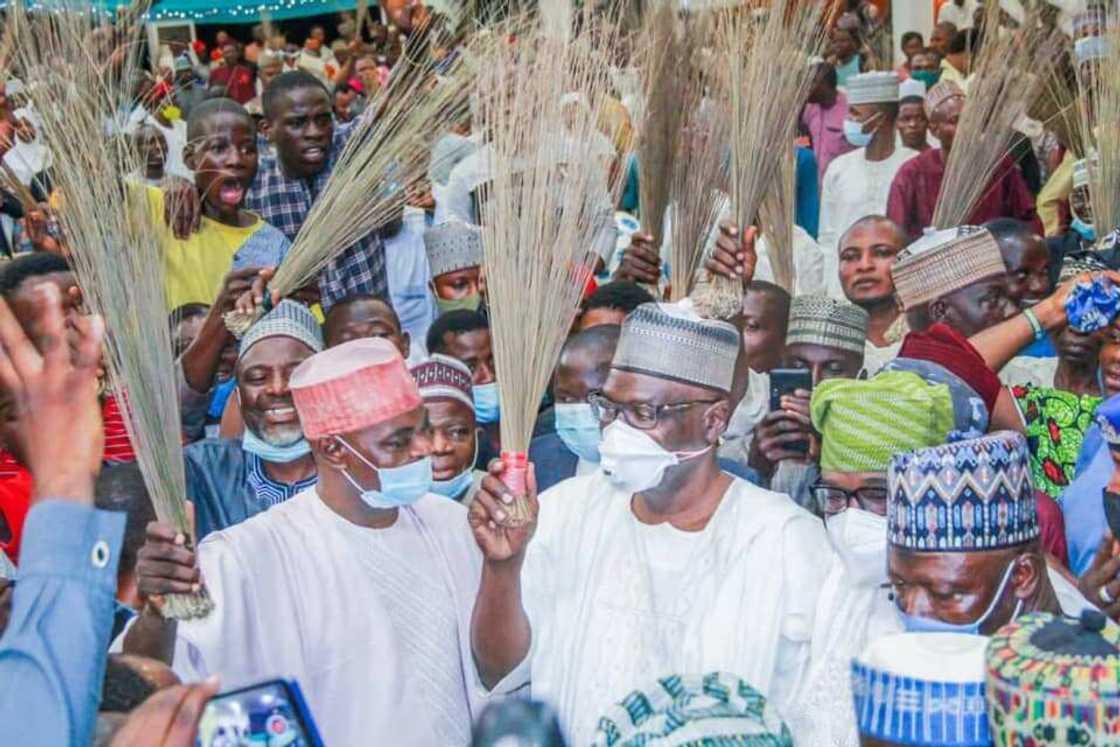
The same principle applies to media organisations. Photographs from older APC rallies or previous political clashes in Kwara should not be used as though they depict the November 2026 confrontation. Several images returned by current searches are from earlier campaigns in Ilorin and other parts of the state, including photographs from the 2023 presidential campaign. Those can be valuable as archive illustrations, but they must be labelled clearly.
A verified current image from the November 15 Offa rally would be preferable because it directly connects to the event under discussion. Trend Naija published a photograph described as showing an APC flag above a large crowd of supporters on a street in Offa in connection with its report on the rally. That is more relevant than older campaign photographs, although the image should still be credited to its source and not described as showing the actual moment of violence unless that can be verified.
The rally’s wider political background is also visible through the APC’s recent activity across the state. On November 8, supporters marched through Ilorin in an event billed by organisers as a 20,000-person mobilisation for Tinubu, AbdulRazaq and Danladi, while earlier rallies following the party primaries similarly drew large crowds. Premium Times reported in July that thousands took part in the “Kwara Ndupe Rally,” where party officials described the turnout as evidence of unity. Those events show that mass mobilisation has become central to the APC’s political strategy in the state.
The Offa episode therefore stands out because it disrupts that carefully cultivated narrative. A campaign built around repeated demonstrations of unity now has to answer questions about whether the organisational machinery behind those demonstrations is properly managed.
The controversy could fade quickly if the victims recover and authorities conclude that the confrontation was a limited personal dispute. It could also grow if investigations uncover evidence of a larger financial disagreement, additional injuries or involvement by senior organisers.
The coming days will therefore be important. Statements from the Kwara State Police Command, the APC state leadership, Danladi’s campaign or the families of the injured could materially change the current understanding of what happened.
VNTV will continue to distinguish those official updates from claims circulating online and will update the story as verifiable information becomes available.
For now, the central fact remains deeply troubling: a political rally intended to demonstrate party strength has been followed by reports that four members of the same party are in hospital, with two in critical condition, after a dispute over money allegedly connected to mobilising supporters.
Whatever the final investigation establishes about who was responsible for the funds or who initiated the fight, the incident has already exposed the risks created when political mobilisation, cash arrangements, organisational rivalry and inadequate dispute resolution collide.
As Nigeria approaches a highly competitive 2027 election season, that lesson extends beyond Kwara. Political parties across the country will increasingly assemble large crowds, move supporters between communities and spend heavily on campaign logistics. Without transparency, discipline and effective security, similar disagreements can quickly escalate.
The immediate priority, however, remains the condition of those injured and the need for an authoritative account of the confrontation. Until police, medical authorities or the party provide that clarity, allegations about the money should remain clearly attributed and claims of responsibility should not be treated as established fact.
The violence in Offa has already succeeded in doing what the APC rally itself was never intended to do: shifting attention away from endorsements, campaign slogans and crowd size and toward deeper questions about the mechanics of political mobilisation, the handling of money and the safety of ordinary supporters whose participation makes large political events possible.
Whether the incident ultimately becomes a defining controversy in the Kwara campaign will depend on what emerges next, but it has already become an early warning of how quickly the politics of 2027 can move from celebration and spectacle to confrontation and crisis.