CHINA AND THAILAND DEEPEN TRADE, INFRASTRUCTURE AND TECHNOLOGY TIES AS LI QIANG MEETS ANUTIN IN BANGKOK
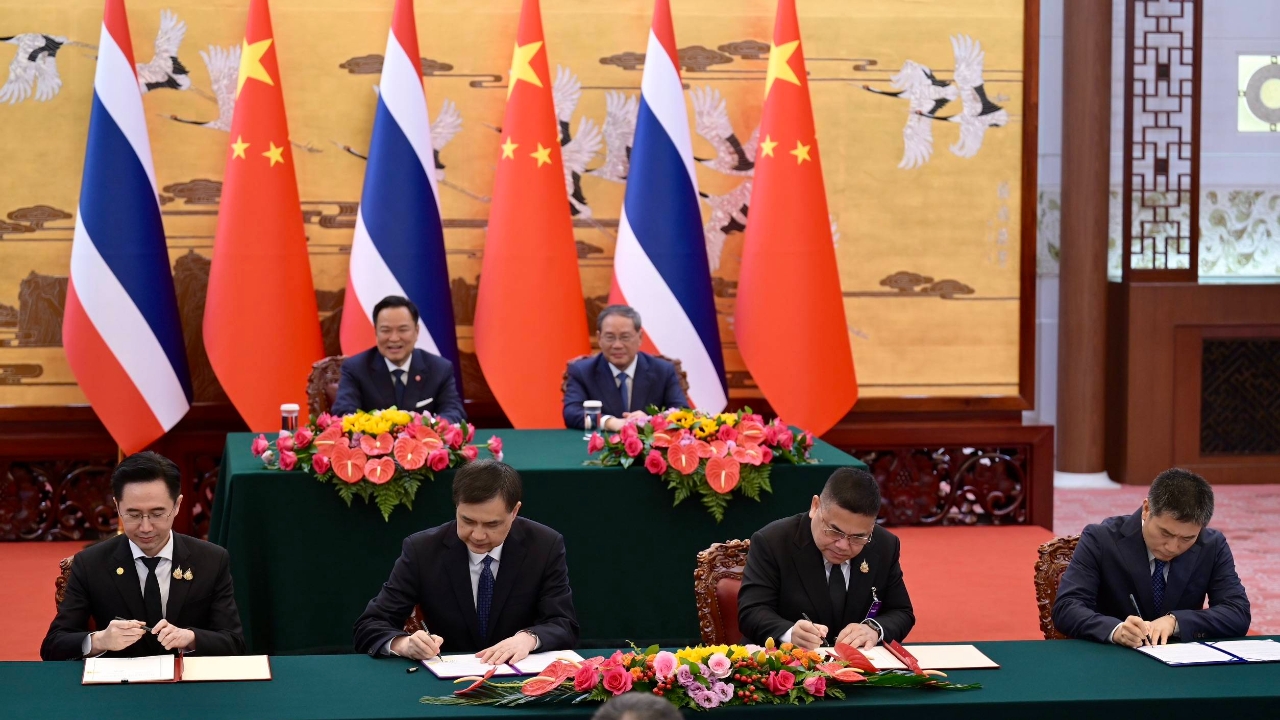
Chinese Premier Li Qiang and Thai Prime Minister Anutin Charnvirakul have agreed to deepen China-Thailand cooperation across trade, infrastructure, agriculture, electric vehicles, AI, semiconductors, finance and security during talks in Bangkok. The two leaders witnessed the signing of eight cooperation documents covering automotive industry development, vocational education, agriculture, food safety, security, metrology and consular affairs. Thailand also pushed for greater market access for agricultural products and MSMEs, while China called for stronger Belt and Road cooperation and progress on the China-Thailand railway.
China and Thailand have moved to deepen their strategic and economic partnership after Chinese Premier Li Qiang held high-level talks with Thai Prime Minister Anutin Charnvirakul in Bangkok, producing new agreements covering trade, agriculture, automotive manufacturing, education, security and future industries. The meeting at Thailand’s Government House on Friday, November 13, 2026, formed part of Li’s three-day official visit to the country and marked his first trip to Thailand as Chinese premier. Both governments presented the visit as an effort to translate long-standing political ties into more concrete economic cooperation at a time when Southeast Asian countries are competing aggressively for investment in electric vehicles, semiconductors, artificial intelligence and advanced manufacturing.
Li and Anutin met after an official welcome ceremony at Government House, where the Chinese premier reviewed a guard of honour before the two leaders led full delegations into bilateral talks. The meeting built directly on Anutin’s official visit to China in July, meaning the two prime ministers have exchanged visits within four months. Chinese officials described that pace of engagement as evidence of the high level of bilateral relations, while Thai officials framed the visit as an opportunity to secure more trade, higher-quality investment and deeper economic integration with Thailand’s largest trading partner.
The talks were broad in scope but strongly focused on economic delivery. China said it wanted to deepen political mutual trust while expanding cooperation in finance, new energy, semiconductors and artificial intelligence, areas increasingly central to both countries’ industrial strategies. Thailand, meanwhile, said it wanted stronger cooperation in agriculture, connectivity, electric vehicles, e-commerce, science and technology, while also ensuring that Chinese investment contributes more directly to Thai suppliers, local employment and technology transfer.
One of the clearest priorities from the Thai side was improving access to the Chinese market for agricultural goods. Anutin pushed for expanded opportunities for Thai agricultural products, processed foods and innovative products, while also seeking faster registration of Thai geographical indication products and better access for Thai MSMEs to Chinese e-commerce channels. The aim is to move beyond traditional bulk commodity exports and help smaller Thai businesses reach Chinese consumers more directly through digital platforms.
The agricultural agreements signed during Li’s visit included new phytosanitary arrangements covering fresh durian and salak, also known as snake fruit. These protocols are important because agricultural exports to China are highly sensitive to plant health and customs requirements, and even minor compliance problems can lead to delayed shipments or temporary restrictions. By establishing clearer rules, both governments hope to increase confidence in Thai exports and reduce the risk of disruptions affecting farmers and exporters.
Thailand also used the talks to follow up on a 500,000-ton rice purchase arrangement with China. Anutin said the first 40,000-ton batch had already been sold and urged continued implementation of the wider agreement. Rice remains economically and politically important in Thailand because export demand directly affects rural incomes, and stronger Chinese purchasing commitments can provide both market support and political reassurance to farming communities.
The automotive sector emerged as another major area of cooperation. Thailand has already become one of Southeast Asia’s most important production bases for electric vehicles, with Chinese manufacturers investing heavily in factories, battery systems and supply chains. The new automotive cooperation document is designed to deepen collaboration in EVs, smart vehicles, battery technology and industrial upgrading, while increasing opportunities for Thai manufacturers to become part of global production networks rather than remaining peripheral suppliers.
Thailand’s government has repeatedly said it wants foreign investment to generate stronger domestic spillovers. Anutin used the meeting to stress the importance of using local raw materials and components, developing Thai workers and encouraging technology transfer. He also said Thailand wants investment to be conducted transparently and lawfully, reflecting growing domestic concern that some foreign-backed businesses may use nominee structures or other arrangements that limit the benefits reaching local companies.
China’s interest in Thailand’s electric-vehicle sector reflects a wider regional trend. Chinese manufacturers have expanded rapidly across Southeast Asia as they seek new markets and production bases outside China, partly in response to trade restrictions and tariffs in the United States and Europe. Thailand’s established automotive industry, supplier network and regional location make it one of the most attractive destinations for that investment.
The next phase of competition will likely move beyond vehicle assembly into batteries, semiconductors, software and autonomous-driving systems. That explains why semiconductors and artificial intelligence featured prominently in Li’s discussions with Anutin. Both governments increasingly see digital and advanced industrial infrastructure as essential to long-term competitiveness rather than optional additions to traditional manufacturing.
China also wants greater cooperation through the Belt and Road Initiative, including progress on the China-Thailand railway. The rail project has long been regarded as one of the most strategically important infrastructure links between the two countries because it could eventually connect Thailand through Laos to China’s southern railway network. The project has progressed more slowly than originally envisioned, but Beijing continues to view it as a flagship connectivity initiative with major implications for trade, tourism and logistics.
Thailand’s interest in the railway is economic as much as political. Improved rail links could lower transport costs, expand freight movement and connect Thai production zones more closely with mainland Southeast Asia and southern China. At the same time, Bangkok has been cautious about financing terms, construction schedules and the balance between Chinese involvement and Thai control, making the project a recurring test of how both countries manage large infrastructure cooperation.
Li’s visit also produced agreements in vocational education, reflecting concern that industrial investment will create limited long-term value unless Thailand has enough skilled workers to support advanced manufacturing. The five-year vocational cooperation programmed is expected to expand technical training, student exchanges and practical education linked to industries such as EVs and modern manufacturing. Thai policymakers increasingly see workforce development as necessary to prevent the country from being locked into lower-value production while more advanced engineering and design functions remain elsewhere.
The economic relationship extends well beyond manufacturing. Thailand and China are also expanding cooperation in finance, digital services, tourism and e-commerce. Chinese digital platforms have become important channels for Thai businesses and consumers, while tourism remains one of the most visible connections between the two countries. Bangkok has repeatedly sought to restore and expand Chinese visitor numbers after the disruptions of the pandemic period and subsequent security concerns.
Security cooperation was therefore another important part of the talks. Thailand said it would work more closely with China to combat online gambling, telecommunications fraud and online scams, which have become major regional security problems affecting Chinese and Southeast Asian citizens. Criminal networks operating from compounds across parts of mainland Southeast Asia have attracted intense international scrutiny, and Beijing has pressured neighboring governments to take stronger action.
Thailand also pledged to continue improving safety for Chinese tourists. That issue carries significant economic importance because Chinese travelers historically represent one of Thailand’s largest tourism markets. Security incidents involving Chinese visitors can quickly affect travel sentiment and generate substantial economic losses for hotels, airlines, retailers and tourism operators.
The two governments are also strengthening formal security communication through mechanisms including a “2+2” strategic dialogue involving their foreign and defense ministers. Such structures allow both sides to coordinate on transnational crime, regional security and diplomatic issues while keeping economic cooperation connected to broader political trust.
The phrase “political mutual trust” featured prominently in China’s official description of the meeting. Li said Beijing wants both sides to support each other on core interests and major concerns, language commonly used in Chinese diplomacy to signal expectations of political sensitivity on issues such as Taiwan and relations with major powers. Thailand has historically maintained close economic ties with China while also preserving a long-standing security relationship with the United States.
That balancing strategy remains central to Thai foreign policy. Bangkok benefits economically from deep engagement with China but does not want to become dependent on a single major power. It therefore maintains strong relations with Washington, Beijing, Japan and other partners while emphasizing ASEAN centrality and strategic flexibility.
China views Thailand as an important partner within that wider regional strategy. Bilateral trade reached about $153 billion in 2025 according to Chinese official figures, making China Thailand’s largest trading partner. The relationship encompasses electronics, machinery, vehicles, agricultural goods and tourism, while Chinese investment has grown rapidly in advanced manufacturing and infrastructure.
The scale of that trade also creates vulnerabilities. Thailand runs a substantial trade deficit with China in several categories, and local businesses have raised concerns about competition from cheaper Chinese imports. Bangkok therefore wants deeper trade ties to include more opportunities for Thai exporters rather than simply increasing imports and Chinese investment.
That is why Anutin’s emphasis on agricultural exports, MSME access and local value creation matters politically. The Thai government needs to show that stronger ties with China create tangible benefits for farmers, workers and local businesses rather than only for multinational companies. The agreements signed during Li’s visit were therefore structured around sectors where the government can demonstrate direct economic impact.
The automotive agreement is particularly significant because Thailand is attempting to remain Southeast Asia’s leading car manufacturing base during the transition from internal-combustion vehicles to EVs. Chinese companies are central to that transition, but local manufacturers and suppliers risk being displaced if they cannot adapt quickly enough. Technology transfer and integration into Chinese-led supply chains could therefore determine whether the shift strengthens or weakens Thailand’s existing industrial base.
Semiconductors represent a similar opportunity. Global chip supply chains are being reorganized as governments seek greater resilience and as tensions between the United States and China reshape investment decisions. Thailand wants to capture more advanced semiconductor production and related electronics investment, but it must compete with Malaysia, Vietnam, Singapore and other regional economies.
AI and cloud infrastructure could become another major area of competition. Data centers require large amounts of reliable electricity, advanced telecommunications networks and predictable regulation. Thailand has been positioning itself as a regional technology hub, and Chinese investment could accelerate that development if the government can balance security, data governance and strategic dependence.
Energy cooperation also featured in the broader discussions. China is a major producer of solar panels, batteries and electric-vehicle components, while Thailand is expanding renewable energy and trying to reduce dependence on imported fuels. Cooperation in new energy could therefore reinforce both industrial and energy-security goals.
The relationship also intersects with broader ASEAN diplomacy. Li’s visit to Thailand came immediately before his scheduled travel to Manila for the China-ASEAN Summit, while Anutin was also due to participate in ASEAN meetings. That timing demonstrates how bilateral China-Thailand cooperation increasingly operates alongside regional frameworks rather than separately from them.
Thailand supports closer China-ASEAN cooperation but also wants ASEAN institutions to remain central to regional diplomacy. Smaller and medium-sized Southeast Asian states generally prefer a regional framework that prevents any major power from dominating bilateral relations and gives them greater collective influence.
Li and Anutin also discussed the Lancang-Mekong Cooperation framework, which brings China together with Mekong countries on water, infrastructure and development issues. Thailand said it was prepared to work with China to support the next Lancang-Mekong Cooperation Leaders’ Meeting, reflecting the importance of river management and connectivity to mainland Southeast Asia.
Water management itself emerged as another area for future cooperation. The two sides are preparing a memorandum on sustainable water management, an issue made increasingly important by climate change, drought, flooding and the effects of upstream infrastructure on the Mekong system. Water cooperation can be politically sensitive because river flows cross national borders and affect agriculture, energy and livelihoods.
The visit also carried symbolic weight because it was the first official trip to Thailand by a Chinese premier in seven years. Li’s presence followed Anutin’s July visit to Beijing and came after the two countries marked the 50th anniversary of diplomatic relations in 2025. Both governments have used the anniversary period to present the relationship as entering a new phase focused more heavily on advanced industries and regional strategic coordination.
The political messaging was deliberately warm. Chinese officials described the relationship as a comprehensive strategic cooperative partnership and repeatedly referred to building a China-Thailand community with a shared future. Thai officials, while using less ideological language, emphasized friendship, mutual benefit and the importance of maintaining a fair investment environment.
That difference in language reflects the two sides’ diplomatic styles but not necessarily a disagreement over economic cooperation. Thailand wants deeper Chinese investment while preserving policy autonomy, and China wants stronger political alignment alongside expanding commercial ties. The relationship works when both sides can advance those priorities without forcing the other into uncomfortable strategic commitments.
The signing of eight cooperation documents is therefore significant not because every document represents a major standalone breakthrough, but because together they show the breadth of the relationship. Agriculture, automotive technology, education, security, customs, food safety and consular affairs all involve different ministries and economic actors, making the partnership increasingly institutional rather than dependent on occasional high-level meetings.
The private sector will now be critical to implementation. Government agreements can establish frameworks, but companies must decide whether investments, exports and industrial projects are commercially viable. Li’s itinerary included meetings with Thai and Chinese business representatives, underlining Beijing’s effort to connect diplomatic agreements with private-sector activity.
For Thailand, implementation will be judged by how much new investment creates local jobs, increases exports and strengthens domestic companies. If Chinese firms build factories but rely overwhelmingly on imported components and management, the economic benefits may be narrower than policymakers hope. Bangkok’s repeated emphasis on local participation reflects awareness of that risk.
For China, Thailand offers a politically stable and strategically located base for expanding into ASEAN markets. Manufacturing in Thailand can provide access to regional trade agreements and reduce exposure to tariffs affecting goods exported directly from China. The country also offers established industrial clusters and logistics infrastructure that can support Chinese companies seeking overseas production.
The result is a relationship increasingly shaped by practical economic calculations rather than symbolism alone. Both sides want political stability because it reduces commercial risk, but they are also negotiating hard over market access, local content, supply chains and technology.
The China-Thailand railway will remain one of the clearest tests of whether major infrastructure cooperation can move from diplomatic language into faster delivery. Beijing continues to urge progress, while Bangkok wants infrastructure that supports Thai development without creating excessive financial or strategic dependence.
Agricultural trade will provide another test. Thai farmers will judge the relationship by whether agreements actually produce greater sales and fewer disruptions at Chinese customs points. The rice purchase arrangement and fruit protocols give the government specific benchmarks against which future progress can be measured.
The same applies to EVs and advanced manufacturing. Thailand already hosts major Chinese investment, but the next phase will depend on whether domestic suppliers and workers move up the value chain. Vocational education and technology transfer will therefore be as important as the headline value of new factories.
Li’s visit should also be seen in the context of wider competition for influence in Southeast Asia. China, the United States, Japan and other major economies are all increasing engagement with ASEAN countries as supply chains shift and geopolitical rivalry intensifies. Thailand benefits from that competition because it can attract investment and partnerships from multiple directions.
Bangkok’s strategy is therefore unlikely to become exclusively pro-China despite the warmth of the current visit. Thailand will continue working with the United States on security, with Japan on infrastructure and industry, and with other partners on trade and technology. The challenge is to deepen ties with Beijing without narrowing those other relationships.
China is aware of that strategy and appears focused on making its economic offer increasingly difficult to ignore. Market access for Thai products, investment in future industries and infrastructure cooperation give Beijing tools that can strengthen the relationship without requiring a formal alliance.
The latest talks show that economic diplomacy is doing much of the work. Instead of relying only on political declarations, both governments are linking high-level trust to specific agreements affecting exporters, factories, students, tourists and businesses.
That practical focus is likely to continue after Li leaves Thailand. Officials must now implement the eight signed documents, advance negotiations on the next five-year trade and economic cooperation plan and follow up on the railway, agricultural exports and industrial projects discussed during the visit.
The success of the visit will therefore be measured less by the ceremony at Government House than by what happens over the coming months. Thai exporters will want faster access to the Chinese market, manufacturers will want stronger participation in Chinese-led supply chains and investors will want predictable rules.
For China, the priorities will include protecting its companies, expanding Belt and Road cooperation and deepening coordination with Thailand across ASEAN and other regional platforms. Beijing also wants stronger cooperation against online crime and greater security for Chinese citizens and tourists.
The Bangkok meeting has therefore reinforced a relationship that is simultaneously commercial, strategic and regional. Trade remains the foundation, but infrastructure, technology, agriculture and security are increasingly binding the two countries together.
As Southeast Asia becomes more important to global supply chains, the China-Thailand partnership will carry consequences beyond the two countries themselves. Investment decisions made in Bangkok and Beijing can influence where EVs are built, where semiconductors are assembled, how agricultural goods move into China and how mainland Southeast Asia is connected by rail and digital infrastructure.
For Thailand, deeper cooperation offers major opportunities but also requires careful management of competition, dependence and local economic benefits. For China, the relationship strengthens its position in one of ASEAN’s largest economies and provides another route for expanding its regional industrial presence.
The November 13 meeting therefore represents more than another diplomatic exchange. It shows how China and Thailand are attempting to convert political trust into a broader economic partnership built around trade, infrastructure and future industries, while navigating the strategic pressures created by an increasingly competitive Asian order.