CHINA ANNOUNCES DEATH OF FORMER VICE PREMIER LIU YANDONG AT AGE 80
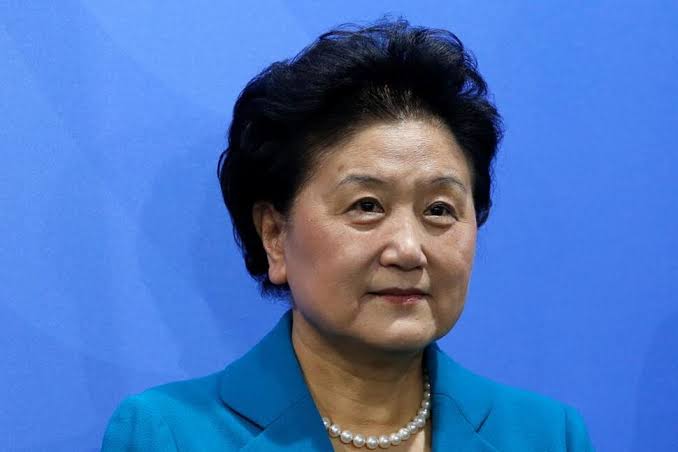
Liu Yandong, China’s former vice premier and a two term member of the Communist Party Politburo, died in Beijing on October 28, 2026, following an illness. She was 80 by international age calculation, although China’s official announcement listed her traditional age as 81. Liu was one of the most senior women in modern Chinese politics and held major responsibilities for education, science, health care, culture and international people to people exchanges before retiring in 2018.
China has announced the death of former Vice Premier Liu Yandong, one of the most prominent women to reach the upper ranks of the Chinese Communist Party and a senior official who for years helped oversee education, science, health, culture and international people to people exchanges. Liu died in Beijing on Wednesday, October 28, 2026, following an illness, according to an official announcement carried by the state news agency Xinhua. She was 80 under the internationally used calculation of age, having been born in November 1945, although the official Chinese announcement described her as having died at the age of 81 under the traditional Chinese age convention.
Xinhua said Liu died at 2:53 p.m. in Beijing and described her in the language traditionally used by the Chinese Communist Party for senior deceased officials as a loyal and long tested communist who had made important contributions to the party’s work as well as to the development of education, science and technology, health care and programs involving women and children. The announcement did not immediately provide extensive details about the illness that led to her death. It also did not initially set out detailed arrangements for memorial events or funeral ceremonies.
Liu’s death closes the life of a politician whose career stretched across several distinct periods of modern Chinese political history, beginning in the Mao Zedong era and continuing through the reform years associated with Deng Xiaoping, the leadership of Jiang Zemin and Hu Jintao, and the first years of President Xi Jinping’s administration. Unlike many Chinese officials whose careers were concentrated in provincial government or economic management, Liu built much of her influence through the Communist Youth League, the party’s United Front system and central government portfolios dealing with education, health, science and social policy.
Born in November 1945 in Jiangsu province, Liu joined the Chinese Communist Party in July 1964, several years before formally entering the workforce. She studied in the Department of Engineering Chemistry at Tsinghua University between 1964 and 1970, an institution that later produced several senior figures in China’s political establishment. Her early professional years included factory work and technical responsibilities at chemical facilities in Hebei and Beijing, followed by increasingly senior party positions.
Liu moved into political administration in Beijing before beginning a lengthy period in the Communist Youth League, an organization that historically served as an important training ground for party officials and a route into national leadership. During the 1980s she served in senior positions in the league’s central secretariat and later became a leader of the All China Youth Federation. That period placed her within a generation of officials who developed careers through party youth organizations as China accelerated economic reforms and expanded its engagement with the outside world.
Her trajectory shifted substantially in the early 1990s when she joined the Communist Party’s United Front Work Department, the powerful organization responsible for maintaining relationships with groups and individuals outside the party’s traditional structures, including non Communist political organizations, business figures, intellectuals, religious communities, ethnic groups and overseas Chinese communities. Liu rose through the department during the 1990s and ultimately became its head in 2002, placing her in charge of a politically sensitive institution with a wide domestic and international reach.
Her elevation to the leadership of the United Front Work Department significantly increased her standing within the party. She served as head of the department from 2002 until 2007 and also held senior positions connected with the Chinese People’s Political Consultative Conference, one of the institutions through which Beijing manages political consultation and relationships with groups outside the Communist Party’s formal membership. In 2003, she became a vice chairwoman of the national committee of the consultative conference.
Liu’s rise became particularly significant because of the limited representation of women in the highest levels of Chinese politics. Women have long held positions throughout China’s bureaucracy, provincial administrations and legislative bodies, but relatively few have entered the Communist Party’s Politburo, the elite body that sits immediately below the Politburo Standing Committee in the political hierarchy. Liu became a member of the Politburo in 2007 and remained on the body for two consecutive five year terms, serving through a period that covered the final years of Hu Jintao’s presidency and the beginning of Xi Jinping’s leadership.
Her presence in the Politburo made her one of the most senior women in the Chinese political system. For significant portions of her national career, Liu was widely regarded as the highest ranking female official in the country. Her position was particularly notable in a system where women have historically been underrepresented in the most powerful decision making institutions, despite official commitments to gender equality dating back to the founding of the People’s Republic in 1949.
Liu entered the State Council as a state councilor in 2008 under Premier Wen Jiabao, giving her a major role in the central government. Five years later, in March 2013, she was promoted to vice premier under Premier Li Keqiang. Her responsibilities covered several large areas of domestic policy, including education, scientific and technological development, health care, culture, sports and related social programs. These portfolios gave her influence over sectors directly affecting hundreds of millions of Chinese citizens and placed her at the center of government efforts to expand educational opportunities, improve health services and strengthen China’s research and innovation capabilities.
Her tenure coincided with a period of rapid expansion in Chinese higher education and scientific investment. China increased spending on research, expanded universities and pursued policies intended to move the country from dependence on lower cost manufacturing toward a more technologically advanced economic model. Although those developments involved numerous ministries, agencies and senior officials, Liu was among the central government figures charged with coordinating major policy areas connected to education and science.
Health policy was another important component of her government responsibilities. China was attempting to improve access to medical services, extend health insurance coverage and deal with uneven standards between wealthier cities and less developed regions. Liu served in senior leadership structures connected to health care reform, giving her a role in one of the most complicated areas of Chinese social policy as the country confronted the pressures created by an aging population, rising medical costs and growing expectations for higher quality public services.
She was also closely associated with China’s sporting and cultural diplomacy. Before reaching the vice premiership, Liu had served as a deputy leader of the organizing structure for the 2008 Beijing Olympic Games, an event regarded by China’s leadership as a landmark demonstration of the country’s emergence as a major global power. The Beijing Games were among the most visible international events held in China and became closely linked to the government’s effort to present a modern and increasingly influential image to the world.
Internationally, Liu frequently represented Beijing in high level exchanges, particularly in areas that extended beyond traditional diplomatic and security negotiations. She played a central role in educational, cultural, scientific and people to people engagement with foreign governments, including the United States. Her involvement placed her in direct contact with senior American officials during a period when Washington and Beijing maintained broad institutional dialogue even as disagreements over trade, security, human rights and regional influence continued to intensify.
In 2015, Liu visited the White House as a special representative of President Xi Jinping and met then President Barack Obama during preparations surrounding high level China United States engagement. Such assignments reflected the confidence placed in her to manage relationships in areas where political diplomacy intersected with education, culture and public exchanges. For years, those contacts formed an important part of the wider architecture of relations between the world’s two largest economies.
Liu also represented China at major events involving other countries. She attended the inauguration of South Korean President Park Geun hye in 2013 and later travelled to South Korea as Xi Jinping’s special representative for the closing ceremony of the 2018 PyeongChang Winter Olympics. Her engagements with South Korean leaders reflected Beijing’s efforts to manage a complex relationship shaped by trade, North Korea’s nuclear program, military tensions on the Korean Peninsula and disagreements over the deployment of the United States backed THAAD missile defense system.
Her political generation occupied an important transitional space in modern China. Senior leaders who began their careers in the 1960s and 1970s later administered a country transformed by market oriented reforms, globalization, urbanization and extraordinary economic growth. By the time Liu reached the State Council’s senior ranks, China had become the world’s second largest economy and was investing heavily in infrastructure, technology, higher education and global diplomacy.
At the same time, her career illustrated the enduring importance of party institutions in China’s system of government. Although she held prominent state positions, including state councilor and vice premier, much of her authority was rooted in Communist Party structures. Membership in the Politburo gave her a place within the elite body that considers major political and policy questions, while her earlier leadership of the United Front Work Department placed her within one of the party’s most politically important organizational networks.
Her position also stood out against the persistent scarcity of women in China’s most powerful leadership bodies. Liu was one of only a small number of women in the history of the People’s Republic to sit on the Politburo. Even during periods when women held ministerial, provincial and legislative posts, entry into the party’s highest decision making circles remained rare. Liu’s prominence therefore carried significance beyond the particular government portfolios she managed, even though China never elevated a woman to the Politburo Standing Committee during her career.
Liu left the Politburo after the Communist Party’s 19th National Congress in 2017 as part of the regular retirement of officials from her generation and completed her term as vice premier in March 2018. Her departure marked the end of roughly a decade at the highest levels of China’s party and state apparatus and more than five decades of political and administrative work.
Following retirement, she was no longer involved in day to day management of the Chinese government, but her name remained associated with an earlier phase of the country’s leadership in which figures from the Communist Youth League and other institutional networks held prominent national roles. China’s political structure has continued to evolve since then, with power increasingly concentrated around Xi Jinping and a leadership team shaped by the priorities of national security, technological competition, economic self reliance and intensified strategic rivalry with the United States.
The official response to Liu’s death reflects the status she retained within China’s political establishment after retirement. Xinhua’s announcement identified her contributions across the United Front, education, science and technology, health, and programs relating to women and children, areas that defined much of her senior career. The language used by state media also emphasized her long service to the Communist Party and the central government, consistent with official announcements following the deaths of former national leaders.
Her death comes as China continues to confront many of the same policy sectors she once helped oversee, although under markedly different domestic and international conditions. Beijing is seeking greater technological independence as competition with the United States intensifies, universities and research institutions remain central to the government’s industrial ambitions, and the health care system faces increasing pressure from an aging population and changing demographic structure. Education has also become closely tied to China’s long term competition in artificial intelligence, advanced manufacturing, semiconductors and other strategic industries.
The political environment has changed considerably since Liu’s years in office. During much of her senior government service, China maintained extensive official dialogue with Western countries across trade, science, education and culture even during periods of tension. Many of those relationships have since become more contested, with technology restrictions, national security concerns and geopolitical rivalry complicating academic and scientific exchanges that were previously treated as important channels of cooperation.
Against that changing backdrop, Liu’s career represents an era in which senior Chinese officials combined domestic administrative responsibilities with extensive international engagement. Her work brought together party politics, social policy and diplomacy, while her rise to the Politburo and vice premiership placed her among the relatively small group of women who reached the highest levels of political authority in the People’s Republic.
Chinese authorities had not, in the initial announcement, provided extensive information about the illness that caused Liu’s death or released complete details of memorial arrangements. Further official statements are expected to establish how the party and state will commemorate her career and which serving and retired leaders will participate in formal mourning activities.
Liu leaves behind a political legacy shaped by more than half a century inside the Chinese Communist Party system and by senior responsibility for some of the sectors that became central to China’s transformation into a major economic and technological power. Her death removes one of the best known female figures of her generation from China’s political establishment and is likely to prompt renewed attention to both her long government career and the continuing question of women’s representation at the highest levels of Chinese leadership.
For Beijing, the immediate focus will remain on the formal process of mourning and commemoration expected for a former vice premier and two term Politburo member. Beyond those ceremonies, Liu’s career will be remembered within the wider history of a generation of Chinese officials who entered public life before the country’s economic opening and later found themselves managing a state whose economic reach, scientific capacity and international influence had expanded on a scale almost unimaginable when they first entered politics.