COURT ORDERS INEC CHAIRMAN TO PRODUCE TINUBU’S 1999, 2023 ELECTION RECORDS IN SOWORE TRIAL
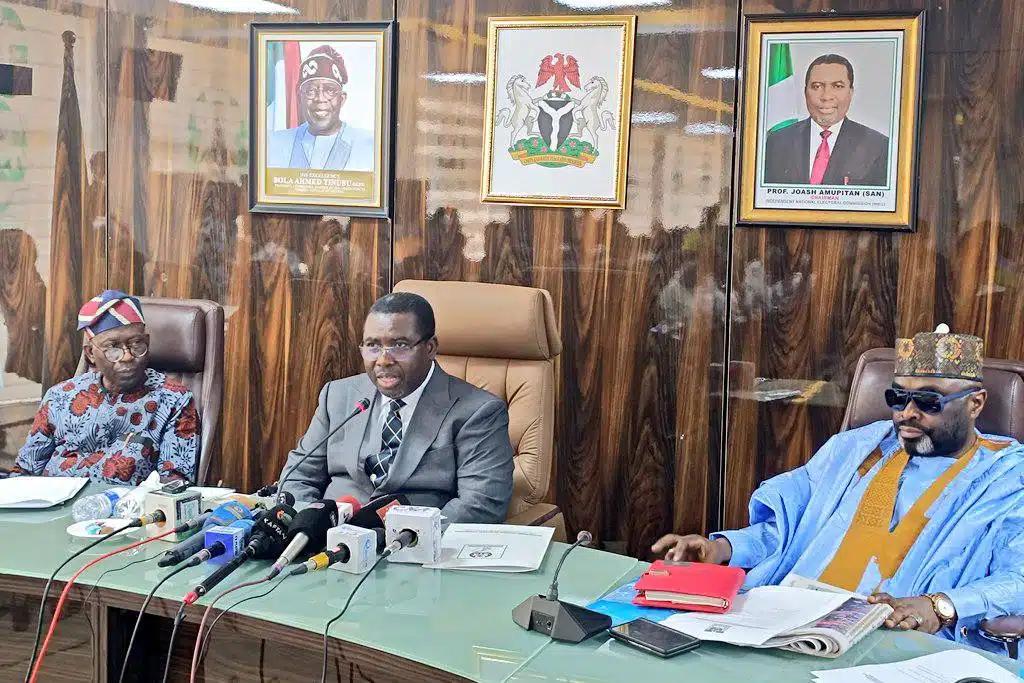
The Federal High Court in Abuja has ordered INEC Chairman Prof. Joash Amupitan to produce President Bola Tinubu’s nomination documents from the 1999 Lagos governorship election and the 2023 presidential election in Omoyele Sowore’s ongoing cybercrime trial. The subpoena specifically seeks Tinubu’s 1999 Form CF001, including an affidavit concerning lost certificates, and his 2023 Form CF001. Justice Mohammed Garba Umar also approved a subpoena for APC chieftain Joe Igbokwe and adjourned the trial until November 11 for the defense witnesses to appear. The order does not amount to a finding of wrongdoing against Tinubu.
A Federal High Court in Abuja has ordered the Chairman of the Independent National Electoral Commission, Professor Joash Ojo Amupitan, SAN, to appear before it and produce electoral nomination documents submitted by President Bola Tinubu during his 1999 Lagos State governorship campaign and his 2023 presidential bid, opening a potentially significant evidentiary phase in the criminal trial of activist and Sahara Reporters publisher Omoyele Sowore. Justice Mohammed Garba Umar granted the request on Monday after Sowore’s defense asked the court to compel the electoral commission’s chairman to testify and bring official records relating to Tinubu’s electoral declarations, including the Form CF001 submitted in 1999 together with an affidavit concerning lost certificates and the Form CF001 filed ahead of the 2023 presidential election. The court also approved a subpoena for All Progressives Congress chieftain Joe Igbokwe, with both proposed defense witnesses expected to appear when proceedings resume on Wednesday, November 11.
The order represents an important development in a trial that began with Sowore’s social-media criticism of the president but has gradually expanded into a broader legal contest over what evidence the defense may place before the court in support of its case. Sowore is being prosecuted over posts on X and Facebook in which he described Tinubu as a “criminal” while reacting to comments the president made about corruption during an official trip to Brazil in August 2025. The Department of State Services initially filed a five-count case that also listed X and Meta as defendants, but the prosecution later amended the information, removed the technology companies and reduced the case to two counts against Sowore alone.
Sowore has pleaded not guilty and has consistently argued that his statements fall within political criticism and public-interest commentary rather than unlawful cybercrime. The prosecution, on the other hand, alleges that the posts were false and were published in circumstances capable of generating public tension and disorder. The trial has therefore developed into a dispute not only over the meaning of Sowore’s words but over what material the defense should be permitted to introduce when challenging the government’s case and the characterization of his statements as criminal.
The subpoena issued to Amupitan is formally known as a subpoena duces tecum, a court order requiring a person to attend proceedings and produce specified documents. In this case, the documents sought are official INEC records relating to Tinubu’s candidacies in two elections separated by more than two decades. The first is the Form CF001 submitted when Tinubu contested the Lagos State governorship election in 1999, including what the subpoena describes as an affidavit in respect of lost certificates. The second is the corresponding Form CF001 submitted as part of his candidacy for president in the 2023 general election.
The defense has not publicly disclosed the full line of questioning it intends to pursue through those records, and the fact that the court has ordered their production should not be interpreted as a finding that the documents establish wrongdoing by Tinubu. Their legal significance will depend on how Sowore’s lawyers seek to use them, whether objections are raised by the prosecution and what weight Justice Umar ultimately considers them to have in resolving the charges before the court. A subpoena merely compels production and testimony; it does not determine the truth of any allegation that may later be advanced using the documents.
The case has attracted particular interest because Tinubu’s educational and electoral declarations have been the subject of political controversy at different points in his public career. Those controversies have included questions raised by political opponents and litigants about educational records and declarations contained in nomination documents, but courts have addressed different aspects of those disputes under different legal standards. The present criminal trial is not a direct election petition challenging Tinubu’s presidency, nor is Amupitan being summoned as a defendant. INEC is being asked to supply records in its custody because Sowore’s defense says those records are relevant to the criminal proceedings against him.
That distinction is important because politically charged court developments can easily be overstated. The Federal High Court has not ordered a fresh investigation into Tinubu’s qualifications, has not invalidated any election document and has not ruled that any declaration contained in the forms was false. The immediate order is evidentiary: the defense wants the documents placed before the court and wants the INEC chairman or the commission through him to authenticate and explain them.
The court’s decision followed an application made by defense counsel Ruben Adakole, who informed Justice Umar that Sowore intended to call both Amupitan and Joe Igbokwe as witnesses. Igbokwe is a long-standing APC figure and former publicity secretary of the party in Lagos. The defense did not fully spell out in open court Monday how his testimony would interact with the INEC records, but the judge granted the request and directed that subpoenas be issued to both men.
The ruling came during a session in which the defense suffered a separate setback. Sowore had previously sought to compel Akinlolu Kehinde, SAN, the lead lawyer prosecuting the case for the DSS, to appear as a defense witness. Justice Umar set aside that subpoena, holding that lawyers owe their clients a strict duty of professional confidentiality and generally cannot be forced to disclose communications connected to legal representation.
The judge said a lawyer may only be compelled to testify in limited circumstances, particularly where the evidence concerns an uncontested matter or would not prejudice the interests of the client. He accepted the prosecution’s argument that compelling its lead counsel to become a defense witness would improperly interfere with the lawyer-client relationship and also agreed that the application had the effect of delaying the proceedings.
The defense’s successful request for Amupitan and Igbokwe therefore came immediately after the court rejected its attempt to bring the DSS prosecutor into the witness box. Justice Umar adjourned the matter to November 11 for the appearance of the subpoenaed witnesses, making Wednesday’s hearing potentially important in determining how much of the documentary history surrounding Tinubu’s electoral declarations will become part of Sowore’s defense.
The criminal case itself dates back to August 2025, when Sowore posted a strongly worded response to remarks Tinubu made during a trip to Brazil. In the post, Sowore referred to the president as a “criminal” and accused him of making false claims about corruption in Nigeria. The DSS subsequently wrote to X and sought action against Sowore’s account, while also demanding that he retract the statement and issue a public apology.
When Sowore refused, the security agency filed criminal charges at the Federal High Court. The original five-count charge named Sowore, X Corp and Meta as defendants and alleged violations of Nigeria’s Cybercrimes legislation, alongside accusations linked to publication of defamatory material. The prosecution later amended the case, removed the social-media companies and reduced the counts to two, leaving Sowore as the sole defendant.
The amended case focuses on posts published on X and Facebook. Prosecutors allege that Sowore knowingly published a false statement about Tinubu and did so in circumstances capable of causing a breakdown of law and order among Nigerians holding differing political views. Sowore denies the allegations and has challenged both the factual and legal basis of the prosecution.
The defense has repeatedly sought to broaden the evidentiary record. At earlier stages, Sowore’s lawyers attempted to introduce media reports, historical political statements and other materials they said were relevant to his characterization of Tinubu. Some of those attempts were rejected because the documents were not properly certified or because prosecution witnesses were not considered competent to authenticate them.
Those rulings help explain why the defense is now seeking official custodians and witnesses rather than relying solely on documents obtained from public sources. If INEC’s chairman produces certified electoral records directly before the court, the defense may be in a stronger procedural position to ask questions about what Tinubu submitted and how those records were maintained by the commission.
That does not mean the court will automatically accept every inference the defense draws from them. The prosecution will be entitled to object to questions it considers irrelevant, prejudicial or outside the scope of the charges, while the judge retains authority to determine whether particular evidence is admissible and how much weight it deserves.
The proceedings have also raised wider questions about freedom of expression and the use of cybercrime laws against political critics. Civil liberties advocates have historically criticized provisions of Nigeria’s Cybercrimes Act that they say can be interpreted too broadly when applied to criticism of public officials. Government agencies, however, argue that online speech can cross the line into unlawful conduct where statements are knowingly false, threatening or capable of provoking serious public disorder.
Sowore’s defense is likely to argue that political speech about a sitting president deserves especially strong protection because elected leaders are subject to public scrutiny. The prosecution’s case is that the specific statement at issue was not merely harsh criticism but a false criminal characterization published in circumstances covered by the Cybercrimes Act.
The distinction will ultimately be for the court to decide. Political speech can be provocative, insulting or deeply offensive without necessarily becoming criminal, but Nigerian law also places limits on certain online communications. The trial will therefore test how those boundaries are applied when the person criticized is the president and the speaker is a prominent opposition politician, activist and media publisher.
Sowore has a long history of confrontation with Nigerian governments. As founder and publisher of Sahara Reporters, he built a public profile through investigative reporting, political activism and criticism of successive administrations. He later entered electoral politics and has contested presidential elections under the African Action Congress.
His relationship with state security agencies has also been contentious. During the administration of former President Muhammadu Buhari, Sowore was arrested in 2019 after calling for nationwide protests under the banner of RevolutionNow and faced charges including treasonable felony. Those proceedings and disputes over his detention became major human-rights controversies.
The current trial is legally separate from those earlier matters, but that history has contributed to the political attention surrounding the case. Supporters see the prosecution as another example of state pressure against an outspoken critic, while government lawyers insist that Sowore is being prosecuted under valid laws for specific conduct rather than for holding opposition views.
The introduction of Tinubu’s electoral records adds another politically sensitive dimension because it could shift part of the courtroom attention from Sowore’s post to the factual basis he claims for his language. Exactly how the defense intends to connect the president’s 1999 and 2023 nomination forms to the two cybercrime counts remains to be seen.
The 1999 document is particularly notable because the subpoena specifically requests an affidavit concerning lost certificates. Tinubu’s educational history has been debated publicly for years, and different election cycles have produced court cases and political allegations involving what he declared about schools attended and credentials held. None of that history should be treated as proof of criminal wrongdoing in the present case, but it helps explain why the defense considers the document potentially relevant.
The 2023 nomination form is similarly significant because it contains information submitted to INEC when Tinubu sought the presidency. During the 2023 election cycle, rival candidates and parties challenged aspects of Tinubu’s qualifications and eligibility in various proceedings, but the presidential election result ultimately stood after litigation reached Nigeria’s Supreme Court.
The current subpoena does not reopen those election cases. A Federal High Court criminal trial cannot simply transform into a new presidential election petition, and the validity of Tinubu’s 2023 election is not directly before Justice Umar. The issue is whether material contained in the INEC forms has probative value in determining Sowore’s defense to the criminal accusations.
The order also places Joash Amupitan in an unusual position. As INEC chairman, he is the head of the institution responsible for custody of electoral records, but the documents being sought predate his tenure. His role in court is therefore institutional rather than personal. He is not being accused of wrongdoing, and the subpoena does not imply that he participated in the preparation or acceptance of Tinubu’s earlier nomination forms.
Amupitan is expected to provide or authenticate records held by the commission and answer questions within the scope permitted by the court. Depending on the nature of the documents and INEC’s internal procedures, he could potentially rely on certified records maintained by the commission rather than personal knowledge of events that occurred in 1999 or 2023.
The same evidentiary principle applies to many institutional witnesses. Courts routinely summon public officials or records custodians to produce official documents even when the officeholder was not personally involved at the time the documents were created. Their function is often to establish that the records are genuine, properly kept and sourced from the institution’s official custody.
The court’s decision to subpoena Joe Igbokwe may produce a different type of testimony because he has long been associated with Lagos politics and the APC’s political structure. The defense may seek to question him about statements, events or political history connected to Tinubu, although the exact intended evidence has not been fully laid out publicly.
Any testimony from Igbokwe will also be subject to ordinary evidentiary rules. He can only testify about matters the court considers relevant and admissible, and the prosecution will have an opportunity to cross-examine him.
The Monday proceedings therefore reflected a broader strategic battle over what the defense can put before the judge. Sowore’s lawyers have repeatedly sought witnesses and documents that they believe provide context for the statement at the center of the prosecution, while DSS lawyers have attempted to keep the case focused tightly on the two social-media posts and their alleged effects.
That tension is common in defamation-related or speech-related criminal proceedings. A defendant may seek to establish truth, honest belief, context or public interest, while prosecutors may argue that large amounts of historical material risk distracting from the specific legal elements of the charge.
The trial judge will have to manage that balance while ensuring Sowore receives a fair opportunity to present his defense. Granting the subpoenas for Amupitan and Igbokwe suggests Justice Umar considers their proposed evidence sufficiently potentially relevant to justify requiring them to attend, but it does not predetermine how much of their testimony will ultimately be admitted or accepted.
Another important feature of the case is that Sowore’s earlier no-case submission was rejected, requiring him to enter a defense after prosecutors closed their case. A no-case submission asks the court to find that the prosecution has failed to establish even a prima facie basis requiring the defendant to respond. By allowing the case to continue, the court effectively determined that there was enough evidence to require a defense, not that Sowore was guilty.
That distinction remains central. Sowore continues to enjoy the presumption of innocence, and the prosecution must ultimately prove the charges beyond reasonable doubt. The defense is now presenting evidence intended to raise doubt, challenge prosecution witnesses and establish the context for the statements at issue.
The subpoena of INEC’s chairman may become one of the most closely watched parts of that defense because official electoral records involving a sitting president are politically sensitive and likely to generate intense public discussion outside the courtroom. That public interest, however, should not be confused with the narrower legal question before the judge.
If Amupitan appears on November 11 and produces the documents, the next stage will likely involve authentication, examination by the defense and objections or cross-examination by the prosecution. The judge may then determine whether all or part of the material is relevant to Sowore’s case.
If INEC raises concerns about confidentiality, custody, document format or compliance with the subpoena, those issues may also have to be resolved in court. There is currently no indication that Amupitan or the commission intends to defy the order.
The court’s request spans a remarkable period of Nigerian political history. The 1999 record dates from the beginning of the Fourth Republic, when Tinubu won election as governor of Lagos State, while the 2023 document relates to his eventual rise to the presidency more than two decades later. The defense is effectively seeking official records from both ends of that political trajectory.
Their appearance in Sowore’s criminal trial does not by itself change the legal status of either election. What it does is place them before a court considering whether Sowore’s controversial characterization of Tinubu crossed the line from political criticism into criminal cyber conduct.
That question has implications beyond the two men involved. Nigerian journalists, activists and opposition figures routinely make harsh allegations against public officials, while government agencies increasingly monitor online speech for threats, misinformation and potentially destabilizing content. The line between protected criticism and criminal communication is therefore likely to remain a significant legal and democratic issue.
The Sowore case may help define part of that boundary, although any judgment would still depend on the precise statutory provisions and evidence before the court. The Cybercrimes Act has been amended over time in response to criticism and judicial decisions, but debate continues over whether its speech-related provisions are sufficiently narrow and predictable.
The defense’s effort to obtain Tinubu’s official records also reinforces a separate principle: once a government chooses to prosecute speech as false, the factual basis for the contested statement can become relevant to the defense. That does not mean every accusation by a defendant automatically becomes admissible or true, but it can open the door to evidence that might otherwise have remained outside the case.
For INEC, the court order is primarily an obligation to provide records. For Tinubu, the documents may attract renewed political attention even though he is not standing trial. For Sowore, they represent part of an attempt to justify or contextualize language prosecutors say was unlawful.
The immediate next step is Wednesday’s hearing. Justice Umar has directed Amupitan and Joe Igbokwe to appear, and the court will then determine how their evidence fits within the defense case. The prosecution retains the right to challenge relevance, admissibility and interpretation, while Sowore remains entitled to present evidence the court permits.
The broader significance will depend on what the records actually show and, more importantly, how the judge treats them. The subpoena itself proves only that the court has agreed to compel production; it does not validate any allegation about Tinubu’s past or decide the cybercrime charges against Sowore.
For now, the legal position is clear. Nigeria’s electoral commission has been ordered to bring President Tinubu’s 1999 and 2023 nomination records into a criminal trial arising from Sowore’s description of him as a criminal, and the commission’s chairman has been summoned as a defense witness. The documents could become important evidence, but their meaning and relevance will only become clear after they are produced, examined and tested in open court.