DANGOTE EXPANDS EASTWARD WITH 25% STAKE IN KENYA PIPELINE AS AFRICA’S RICHEST MAN BUILDS MASSIVE ENERGY EMPIRE ACROSS THE CONTINENT
Aliko Dangote has expanded his East African energy business by acquiring approximately 25 per cent of Kenya Pipeline Company, the strategic infrastructure operator responsible for transporting petroleum products across Kenya. Kenyan market records place the actual block at roughly 24.76 per cent, with local reports valuing the shares at about Sh42.5 billion. The acquisition comes only weeks after Dangote broke ground on a $16 billion, 700,000-barrel-per-day refinery in Lamu, strengthening his ability to connect future fuel production with Kenya’s existing pipeline and storage network.
Nigerian billionaire Aliko Dangote has expanded his rapidly growing East African energy business by acquiring approximately a quarter of Kenya Pipeline Company, giving his industrial group a strategic position inside one of the region’s most important petroleum transportation networks only weeks after he broke ground on a multibillion-dollar oil refinery in Kenya. Dangote announced the transaction on Wednesday, October 21, during the Financial Times Africa Summit in London, saying his company had bought a 25 per cent interest in the pipeline operator used to transport petroleum products across Kenya. Kenyan market records place the precise block at about 24.76 per cent, making the Nigerian industrialist one of the largest individual strategic investors in the recently listed infrastructure company and significantly deepening his exposure to East Africa’s fuel supply chain.
The acquisition represents far more than a conventional portfolio investment because Kenya Pipeline Company controls critical infrastructure connecting imported and domestically distributed petroleum products with major consumption centres across Kenya and neighbouring markets. The company operates pipelines, storage terminals and related petroleum infrastructure connecting the coastal port of Mombasa with Nairobi and western Kenya, making it central to the movement of petrol, diesel, jet fuel and other products consumed not only inside Kenya but also by landlocked East African economies that depend heavily on Kenyan transport corridors. By acquiring a substantial shareholding in KPC, Dangote is positioning himself inside the distribution network that could eventually carry products from his planned Kenyan refinery to customers across the region.
Dangote confirmed the purchase only after several days of speculation in Nairobi over the identity of a foreign investor that had accumulated a huge block of KPC shares through the Nairobi Securities Exchange. Kenyan market data showed that approximately 24.76 per cent of the pipeline company had changed hands in a major block transaction involving shares previously held by state-backed institutions and pension funds. The buyer’s identity was initially undisclosed, leading to intense discussion in Kenya’s business and political circles before Dangote publicly revealed that his group was behind the transaction.
The investment is particularly significant because it comes less than eight months after Kenya Pipeline Company began trading publicly following one of Kenya’s largest privatisation exercises in years. The Kenyan government sold 65 per cent of the company through an initial public offering as part of President William Ruto’s broader effort to raise government revenue, deepen the Nairobi capital market and bring private investors into major state enterprises. The offering opened in January and KPC shares began trading on the Nairobi Securities Exchange on March 9, 2026, marking the first major Kenyan state asset sale of its kind in roughly two decades.
Kenya originally priced KPC shares at nine Kenyan shillings each, while the block associated with the latest transaction changed hands at around Sh9.02 per share, according to local market reporting. Business Daily reported that the shares transferred by public institutions were worth about Sh42.5 billion, while other deal estimates have placed Dangote’s investment at approximately $327 million to $335 million depending on the exchange rate and valuation methodology used. The precise economic value may vary slightly across reports, but the transaction clearly represents a major commitment by Dangote to infrastructure beyond his existing refining and manufacturing interests.
The exact stake reported by Kenyan market sources is 24.76 per cent rather than a mathematically exact 25 per cent, although Dangote himself publicly described the acquisition as a quarter of the business. That distinction matters because transactions reaching particular ownership thresholds can trigger additional capital-market requirements in Kenya. Local reporting noted that the share block remained just below the 25 per cent level associated with certain takeover and regulatory obligations, although Dangote’s economic influence remains substantial regardless of that technical difference.
Several Kenyan state-linked institutions had acquired significant KPC holdings during the original public offering. Those included the National Social Security Fund, the Public Servants Pension Scheme, county-worker pension funds and other public agencies, while the government of Uganda also became a significant investor because of that country’s dependence on Kenya’s petroleum infrastructure. Some of those institutions subsequently sold portions of their holdings in the block transaction now linked to Dangote, effectively transferring part of KPC’s ownership from Kenyan public entities to one of Africa’s largest private industrial groups.
The transaction places Dangote within a company whose strategic importance extends beyond Kenya’s borders. Uganda, Rwanda, Burundi, South Sudan and parts of eastern Democratic Republic of Congo rely to varying degrees on petroleum products moving through Kenya or competing regional corridors, while Uganda has been particularly interested in expanding pipeline links from western Kenya toward Kampala. Control or influence over regional distribution infrastructure could therefore become increasingly valuable as East Africa’s population, transport demand and industrial energy consumption continue growing.
For Dangote, the acquisition fits directly into a much larger strategy to build an integrated African petroleum business stretching from refining to storage and distribution. His massive refinery outside Lagos already gives the group a leading position in West African petroleum processing, while the new Kenyan refinery is intended to create a second major refining centre serving East Africa. A stake in Kenya Pipeline Company potentially gives the group access to the infrastructure required to move those refined products inland, reducing its dependence on third-party distribution systems and allowing different parts of the business to reinforce one another.
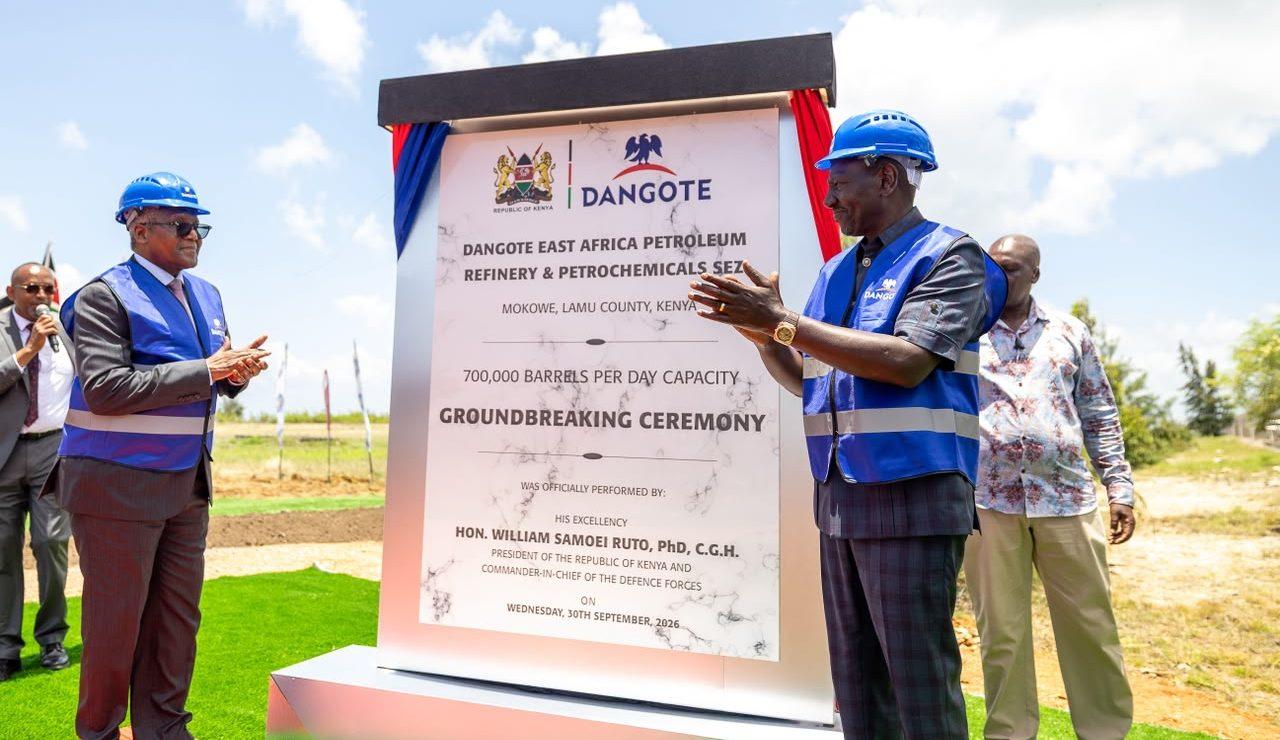
That strategy became much clearer in September when Dangote and Kenyan President William Ruto broke ground on the Dangote East Africa Petroleum Refinery and Petrochemicals project in Lamu. The planned facility is expected to process approximately 700,000 barrels of crude oil per day, placing it in the same broad capacity range as Dangote’s enormous refinery near Lagos. The Kenyan project has been valued at roughly $16 billion and is intended to serve not only Kenya but the wider East African market, potentially reducing the region’s heavy dependence on imported refined petroleum products.
The Lamu refinery is scheduled for completion around 2030 if construction proceeds according to plan. Dangote has offered governments in the region a combined stake of up to 30 per cent in the project, signalling his desire to build political and commercial partnerships around what would become one of the largest industrial investments ever undertaken in East Africa. The refinery is also expected eventually to list shares in Kenya, creating another direct connection between Dangote’s energy ambitions and Nairobi’s capital market.
The timing of the KPC acquisition therefore appears strategically aligned with the refinery rather than coincidental. A refinery produces value only if fuel can be transported efficiently to customers, and Kenya Pipeline Company already possesses infrastructure serving the country’s largest cities and important regional distribution routes. Dangote’s ability to participate in decisions involving pipeline expansion, storage capacity and regional connections could provide significant commercial advantages once his Lamu refinery begins production.
Kenya Pipeline Company currently operates a network extending roughly 1,300 kilometres across the country, linking the port of Mombasa with Nairobi, Nakuru, Eldoret, Kisumu and other important locations. Petroleum products imported through the coast are pumped through this system rather than relying entirely on road tankers, reducing transport costs and allowing much larger volumes to move inland. The network’s strategic position means any major change in Kenya’s fuel supply system will inevitably involve KPC.
The company is also profitable. Business Daily reported that KPC’s net profit increased by approximately 13 per cent to Sh11.58 billion in the financial year ending June 2026, allowing it to distribute about Sh5.81 billion in dividends. That profitability gives Dangote’s acquisition an investment case independent of his refinery project because the pipeline company already generates substantial earnings from the transportation and storage of petroleum products.
However, the strategic value could be significantly greater than the dividend income alone. If the Lamu refinery becomes operational and begins supplying large volumes of fuel to Kenya and neighbouring countries, KPC could become one of the most important distribution channels for those products. Ownership in both production and transportation infrastructure would give Dangote exposure to multiple stages of the petroleum value chain rather than leaving the group dependent entirely on refining margins.
Dangote has repeatedly argued that Africa should process more of its own natural resources rather than exporting raw commodities and importing expensive finished products. His Lagos refinery was built around that principle, with Nigeria historically exporting crude oil while importing significant quantities of petrol, diesel and other refined fuels despite being one of Africa’s largest crude producers. The Kenyan refinery represents an attempt to apply a similar model to East Africa, where many countries also rely heavily on imported finished petroleum products.
The businessman has framed the strategy as part of a broader effort to build African industrial capacity. At the Lamu groundbreaking, he argued that Africa should stop functioning primarily as an exporter of raw materials and instead build the manufacturing and processing infrastructure required to retain more economic value on the continent. A regional refinery connected directly to pipelines and storage terminals would fit that vision by creating a supply chain extending from crude processing through wholesale distribution.
Dangote’s ambition now appears to extend even further. Financial Times reporting says he plans to invest an additional approximately $1.5 billion in expanding KPC’s pipeline infrastructure, although the details and timetable of that proposed expenditure have not yet been fully disclosed. If implemented, that investment could increase transportation capacity and improve connections between Kenya’s existing network and regional markets, reinforcing the commercial logic of both the KPC stake and the Lamu refinery.
The expansion could also become significant for Uganda. Kampala has long depended on fuel transported through Kenya, often using road tankers after products reach western Kenyan terminals. Uganda has discussed extending pipeline infrastructure from Eldoret toward Kampala, which could lower transportation costs and improve fuel-supply reliability. Dangote’s involvement in KPC may give his group a commercial interest in accelerating projects that expand the network deeper into the regional market.
East Africa’s fuel market is large and growing, but it remains vulnerable to external disruptions. Kenya and many neighbouring countries import substantial quantities of refined products from international suppliers, exposing consumers to global shipping costs, foreign-exchange movements and geopolitical disruptions. A large regional refinery could reduce some of that dependence if it can source crude oil competitively and operate reliably.
Recent developments have highlighted that vulnerability. Kenya raised regulated fuel prices in October as the cost of imported petroleum increased amid instability in global energy markets and conflict in the Middle East. The country also faces foreign-exchange pressure because petroleum imports require large amounts of dollars, making domestic or regional refining economically attractive if it can reduce the amount of foreign currency used to purchase finished fuel.
Dangote has argued that his Kenyan refinery could save East African countries significant foreign exchange by replacing imported refined products with fuels processed within the region. Whether those savings materialise will depend on crude sourcing, refinery operating costs, taxation, transport charges and global prices, but the economic case has attracted significant interest from governments struggling with fuel-import bills.
The Lamu location gives the proposed refinery direct access to the Indian Ocean and the infrastructure being developed around the Lamu Port South Sudan Ethiopia Transport corridor. This could allow crude to arrive by tanker while refined products move by sea, road, rail or eventually expanded pipelines into Kenya and neighbouring states. Dangote’s stake in KPC strengthens that inland distribution component.
The acquisition also marks an important evolution in Dangote’s business empire. For decades, the group was best known for cement, sugar, flour and other large-scale manufacturing businesses before petroleum refining became its most ambitious investment. The move into Kenyan pipeline infrastructure shows that Dangote is no longer concentrating only on factories but is increasingly seeking ownership positions in the logistical networks through which commodities reach consumers.
Such vertical integration can produce major commercial advantages. A company that refines fuel but does not control storage or transport infrastructure may face bottlenecks or have to pay competitors for access. Ownership in pipelines and terminals can reduce those vulnerabilities and provide greater visibility into distribution costs, although KPC remains a publicly listed company with multiple shareholders and regulatory obligations rather than an asset Dangote controls outright.
That distinction is important. A roughly 25 per cent stake gives Dangote considerable influence but not unilateral control over Kenya Pipeline Company. The Kenyan government, institutional investors, Uganda and other shareholders retain significant holdings, while corporate decisions remain subject to board governance, Nairobi Securities Exchange rules and Kenyan regulation. Any suggestion that Dangote now owns Kenya’s pipeline system outright would therefore be inaccurate.
The shareholding could nevertheless give the group representation on KPC’s board and greater involvement in discussions about capital expenditure and expansion. Business Daily described Dangote as becoming the company’s second-largest shareholder, a position significant enough to give his representatives an influential voice in strategic decisions if normal corporate-governance procedures provide for board representation.
The acquisition has already attracted political attention in Kenya because the block was sold by public institutions only months after they were encouraged to participate heavily in KPC’s initial public offering. Some critics have questioned why state-backed investors acquired shares during the IPO and then sold a large portion of them so quickly to a foreign private investor. Those concerns are likely to remain part of Kenya’s domestic debate over privatisation and management of public assets.
President Ruto disclosed on Tuesday that private investors had purchased approximately 25 per cent of the pipeline company from public institutions but did not initially identify them. Dangote’s announcement in London the following day revealed that his group was the strategic buyer. The sequence has fuelled questions about how the transaction was structured and whether government-linked institutions were always expected to serve as temporary holders before the shares were transferred.
There is currently no established evidence that the transaction violated Kenyan securities laws. The shares were traded through the Nairobi market and the disclosed stake remained below the 25 per cent threshold highlighted in local reporting. Nevertheless, the scale of the block transaction and KPC’s strategic national importance mean regulators and political opponents may continue examining the deal closely.
The controversy also reflects wider tensions surrounding Kenya’s privatisation strategy. President Ruto’s government has argued that selling stakes in state companies can generate revenue, improve corporate governance and bring private investment into infrastructure at a time when Kenya faces significant debt and fiscal constraints. Critics worry that valuable national assets could be transferred too cheaply or allow private investors excessive influence over essential services.
KPC is particularly sensitive because pipelines are not ordinary commercial assets. They form part of the infrastructure through which Kenya’s economy receives fuel, meaning ownership questions can become matters of national energy security. A major foreign investor therefore attracts more attention than would a similar transaction involving an ordinary consumer business.
Dangote’s African identity may make the political conversation different from a takeover by a large European, American or Asian oil group, but the fundamental questions about ownership and infrastructure remain. Supporters may present the investment as an example of African capital moving across borders to build continental integration, while critics may focus on whether public institutions received sufficient value and whether one industrial group is becoming too influential across the fuel supply chain.
The investment certainly represents a notable example of cross-border African capital. Dangote built most of his fortune in Nigeria and West Africa, yet his current strategy increasingly treats the continent as a single industrial market. His group’s cement operations already span numerous African countries, and the energy business now appears to be following a similar path.
Beyond Kenya, Dangote is planning petroleum storage facilities in several strategic African locations. Financial Times reporting says his group intends to develop a 330-million-litre tank farm in Namibia to serve southern African markets and additional facilities in Djibouti and Cameroon designed to support distribution into Ethiopia and West and Central Africa. Combined with the Nigerian refinery, the planned Kenyan refinery and the KPC stake, these investments point toward a continent-wide petroleum logistics network.
If completed, that network could allow Dangote refined products to move from production centres in Nigeria and Kenya toward consumers across several regions. The approach resembles the integrated structures used by major international oil companies, which traditionally combine refining, shipping, storage, trading and distribution rather than relying on one activity alone.
Dangote has also defended his continued investment in petroleum at a time when global governments and investors are discussing transitions away from fossil fuels. His argument is that Africa still requires substantial conventional energy infrastructure because fuel demand remains high and many countries do not yet have alternatives capable of replacing petroleum across transport and industry. He has pointed to continued geopolitical instability and global demand for refined products as evidence that petroleum remains commercially important.
The Nigerian refinery has already begun exporting products outside Africa, including aviation fuel into international markets. Dangote has said the facility supplies a significant portion of jet fuel consumed in parts of Europe, demonstrating his ambition to operate as a global petroleum supplier rather than only as a domestic Nigerian producer.
The East African investment could eventually create a similar export platform on the Indian Ocean. A 700,000-barrel-per-day refinery at Lamu would produce far more fuel than Kenya alone requires, meaning regional exports would be essential to its economics. Uganda, Tanzania, Rwanda, Burundi, Ethiopia and other markets could therefore become important customers depending on transport costs and competition from existing suppliers.
Kenya Pipeline Company’s infrastructure gives the proposed refinery immediate access to an established domestic distribution system, although new links may be required between Lamu and the existing network. The additional pipeline investment discussed by Dangote could address those gaps and create new routes capable of handling greater volumes.
The economics will depend heavily on crude supply. Kenya has not yet developed sufficient domestic crude production to feed a refinery of the planned size, meaning Dangote will initially need to import substantial quantities through Lamu. Uganda is also developing its own oil production, while Kenya has explored crude resources in Turkana, but production timelines and volumes remain uncertain.
A large refinery requires reliable supplies running continuously because shutdowns or underutilisation can dramatically weaken profitability. Dangote’s Nigerian refinery has already demonstrated the logistical and commercial complexity involved in securing sufficient crude, making long-term supply contracts particularly important for the Kenyan project.
Regional governments may therefore become both investors and suppliers. Dangote has offered them ownership in the Lamu project, potentially aligning their interests with the refinery’s success while creating opportunities to supply crude or commit to purchasing finished products.
The KPC stake adds another layer to those relationships. Uganda is itself a significant shareholder in Kenya Pipeline Company, reflecting its strategic interest in the infrastructure, while Dangote is simultaneously offering regional states stakes in his refinery. The resulting ownership links could encourage closer energy integration across East Africa if commercial and political interests remain aligned.
For Kenya, the investment strengthens its position as a regional petroleum hub. Mombasa already serves as a major entry point for fuel consumed across East Africa, and Lamu has been developed as another strategic port intended to support trade with neighbouring countries. Combining a massive refinery with expanded pipeline infrastructure could significantly increase Kenya’s role in regional fuel processing and distribution.
The project could also create jobs, tax revenue and industrial activity, although the size of the economic benefits will depend on local procurement, staffing and how much of the refinery’s supply chain is developed inside Kenya. Large industrial projects can generate impressive headline investment figures without necessarily producing widespread employment if equipment and skilled labour are imported, making the local-content framework important.
Environmental concerns will also remain significant. A new refinery and expanded petroleum pipelines represent long-term investment in fossil-fuel infrastructure at a time when Kenya has developed a strong international reputation for renewable electricity and climate advocacy. The Lamu area is environmentally sensitive, and previous infrastructure projects there have faced opposition from community and environmental organisations.
Dangote and the Kenyan government will therefore need to navigate environmental approvals, land disputes and community concerns alongside financing and construction. The refinery’s September groundbreaking does not mean every regulatory or land issue has disappeared, and project timelines could change if legal or environmental disputes intensify.
Those challenges do not diminish the significance of the KPC acquisition, which involves an existing operating asset rather than a future construction project. Dangote now has an economic stake in Kenya’s current petroleum transport network regardless of how quickly the Lamu refinery advances.
That makes Wednesday’s announcement one of the clearest signs yet that his East African strategy is moving beyond promises. The refinery is under development, the pipeline stake has been purchased and additional infrastructure spending is being discussed. Together, those moves suggest Dangote intends to build a long-term energy platform in the region rather than merely export Nigerian fuel into East Africa.
The acquisition also links two of Africa’s largest economies more directly through private investment. Nigeria provides the capital and industrial group, while Kenya provides the strategic infrastructure and East African market access. If successful, the partnership could become an example of the deeper intra-African investment frequently promoted under the African Continental Free Trade Area.
Dangote has long argued that African businesses should invest more aggressively across the continent instead of allowing infrastructure, manufacturing and commodity processing to depend predominantly on foreign multinational corporations. His purchase of KPC shares fits that philosophy because the transaction places African private capital inside a strategically important African public infrastructure company.
Whether the model benefits consumers will ultimately depend on competition and regulation. Vertical integration can improve efficiency, but it can also create market power if one company controls too much of production, transportation and distribution. Kenyan regulators will therefore need to ensure that KPC continues providing fair access to different fuel marketers even if a major refinery owner becomes one of its largest shareholders.
This will become particularly important when the Lamu refinery begins producing fuel. Competitors importing products through Mombasa or purchasing from other suppliers must remain able to use pipeline infrastructure under transparent and non-discriminatory conditions. Dangote’s position as both a major supplier and a major KPC shareholder could create potential conflicts of interest that strong corporate governance will need to manage.
The investment therefore offers Kenya opportunities alongside regulatory challenges. The country gains a deep-pocketed strategic investor with experience building enormous industrial assets, while KPC could receive additional capital and benefit from increased volumes generated by a new refinery. At the same time, government and regulators must protect the pipeline company’s role as national infrastructure serving the entire petroleum market.
For Dangote, the strategic logic is easier to understand. His Nigerian refinery created a powerful production base in West Africa, but further growth requires larger markets. East Africa represents hundreds of millions of consumers across economies whose fuel demand is expected to grow as populations, transport networks and industrial output expand.
Kenya provides a natural gateway into that market because of its ports, pipelines, financial system and established role as an East African commercial hub. Buying nearly a quarter of KPC therefore gives Dangote something that simply selling fuel into the country could not provide: a permanent ownership position inside the infrastructure through which much of the regional market is supplied.
The transaction also shows how quickly Dangote’s Kenyan commitments are growing. Within a matter of weeks, he has moved from breaking ground on a $16 billion refinery to revealing a major shareholding in the pipeline company that could distribute its output. When combined with possible further investment of about $1.5 billion in pipeline expansion, the scale of the East African strategy could eventually exceed many of the group’s existing businesses outside Nigeria.
For Kenya, the deal comes at a moment when President Ruto’s government is aggressively courting private investment while simultaneously selling state assets to raise fiscal resources. The KPC privatisation was meant to demonstrate that Nairobi’s capital market could absorb large state-company offerings, and the arrival of Dangote as a major shareholder gives the company a globally recognised African investor only months after listing.
The political debate over how that stake changed hands is unlikely to disappear, particularly because state-linked pension and investment institutions were involved. However, from an industrial perspective, the strategic direction is increasingly clear. Dangote is attempting to connect refining capacity, storage, pipelines and regional distribution into one integrated African petroleum network.
The acquisition represents another step toward that goal. Aliko Dangote has publicly confirmed that his group bought roughly 25 per cent of Kenya Pipeline Company, local market data place the actual block at about 24.76 per cent, and the stake gives the Nigerian industrialist a major position in the infrastructure that moves fuel across Kenya and toward neighbouring markets. Coming only weeks after the groundbreaking of his 700,000-barrel-per-day Lamu refinery, the transaction makes East Africa a central part of Dangote’s next phase of expansion and brings his ambition to build a continent-spanning energy business much closer to becoming a physical reality.