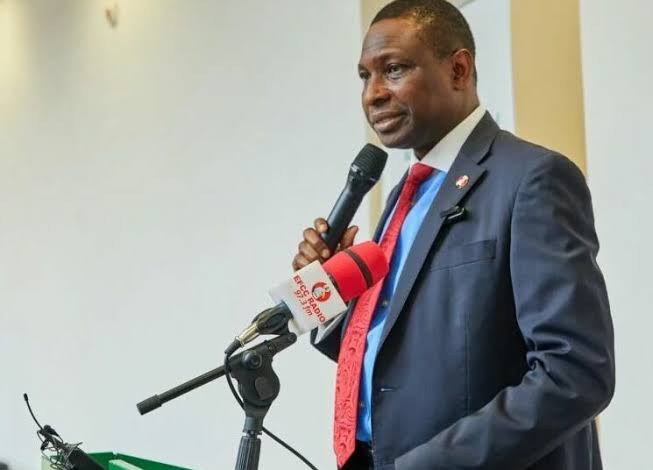
DINO MELAYE DENIES COMMENTING ON JUSTICE LIFU’S HEALTH, HITS BACK AT BUBA GALADIMA

Dino Melaye has denied making any comment about the reported illness of Federal High Court judge Justice Peter Lifu after Buba Galadima mentioned him during an AIT discussion about the judge and the ADC leadership crisis. Melaye said he was “extremely shocked” by the attribution and insisted he never discussed Lifu’s health. Available reports show Galadima referred to Melaye while discussing the ADC obtaining a certified copy of Lifu’s judgment, before separately criticizing some ADC members he said were celebrating reports of the judge’s illness. There is no verified evidence in the reports reviewed showing that Melaye himself celebrated or commented on Lifu’s health. Punch Newspapers
ABUJA, NIGERIA — Former Kogi West Senator Dino Melaye has denied making any comment about the reported illness of Federal High Court judge Justice Peter Lifu, rejecting remarks by elder statesman Buba Galadima that appeared to link him to political reactions surrounding the judge’s health. Melaye, an African Democratic Congress chieftain, said in a post on X on Saturday that he was surprised Galadima had mentioned his name while discussing Lifu’s reported condition, insisting that he had never commented on the matter and accusing the veteran politician of misremembering what had actually been said.
“I was extremely shocked to hear that Alhaji Buba Galadima mentioned that I made comments on Justice Lifu’s health,” Melaye said. “It is most unfortunate because I never made any comment on Justice Lifu’s health.” He then took a personal swipe at Galadima, saying old age might be affecting his recollection and adding that ageing could only be managed rather than cured. The remark sharpened what had begun as a disagreement over the interpretation of comments surrounding a politically sensitive court judgment into a direct exchange between two prominent opposition figures.
The dispute traces back to an interview Galadima gave to African Independent Television during the week, when he criticized some members of the ADC over what he described as their reaction to reports that Justice Lifu had fallen ill and could travel abroad for medical treatment. Galadima argued that any celebration of the judge’s reported illness was politically and legally shortsighted because Lifu had recently delivered a judgment adverse to the ADC in its ongoing leadership dispute, and the judge’s absence could complicate the party’s attempt to challenge that decision on appeal.
During the AIT discussion, Galadima referred to a report that Melaye had announced the ADC had obtained a certified true copy of Lifu’s judgment. He then moved from that point to criticize what he said was excitement among some ADC members over reports about the judge’s health. His comments were widely interpreted in subsequent reports as connecting Melaye to the broader reaction, although the available accounts do not establish that Melaye himself had celebrated the judge’s illness or made a direct statement about Lifu’s health.
That distinction is now at the center of Melaye’s response. His position is that Galadima incorrectly associated him with remarks he never made. Galadima, meanwhile, had framed his criticism more broadly around ADC members and their reported reaction to Lifu’s illness while mentioning Melaye in the same discussion because of the former senator’s comments about obtaining the certified judgment. The disagreement therefore appears to turn partly on attribution and context rather than on a direct clash over the judge’s medical condition itself.
The controversy is politically significant because Justice Lifu is the Federal High Court judge who on November 5 delivered a major ruling in the leadership crisis involving the ADC. The judgment set aside resolutions of the party’s 99th National Executive Committee meeting held on July 29, 2025, through which former Senate President David Mark and former Interior Minister Rauf Aregbesola emerged as senior national officers of the party.
The court also restrained the Independent National Electoral Commission from recognizing or dealing with the affected officials as national officers, creating new uncertainty around a party that has positioned itself as an important opposition platform ahead of the 2027 general election. The ruling has been challenged by the Mark-led faction, which has indicated its intention to pursue an appeal and preserve the leadership structure that has overseen the ADC’s recent political expansion.
Galadima’s legal argument was that if Lifu were to travel outside Nigeria for medical treatment, the records of proceedings needed for an appeal could be delayed because of the administrative steps required to authenticate and transmit the court record. He argued that ADC members should therefore be more concerned about securing the documentation needed to challenge the ruling than about the judge’s health difficulties.
However, reports surrounding Lifu’s medical condition remain limited, and there has been no detailed public statement from the Federal High Court establishing the exact nature of his illness, the severity of his condition or whether he will in fact travel abroad for treatment. Claims about his health should therefore be treated cautiously and should not be expanded beyond what has been publicly reported.
That uncertainty makes the political rhetoric around the matter particularly sensitive. Judges routinely become the focus of intense public commentary when their rulings affect major political parties, but personal health issues are separate from the substance of judicial decisions. Celebrating or speculating about a judge’s illness can quickly blur the line between legitimate criticism of a court judgment and personal attacks on the judicial officer who delivered it.
Melaye’s denial also demonstrates how quickly political statements can become detached from their original context once they move through television interviews, social media posts and secondary news reports. A comment about obtaining a court judgment can become linked to a separate discussion about the judge’s illness if both subjects appear in the same exchange, creating confusion over who said what and which remarks were actually attributable to a particular politician.
The former senator has long been one of Nigeria’s most outspoken political figures and has built much of his public profile around direct, often combative responses to opponents. His Saturday reaction followed that pattern, offering a categorical denial while simultaneously escalating the confrontation by suggesting Galadima’s age was affecting his memory. That part of Melaye’s response is a political insult rather than an established fact about Galadima’s health or cognitive condition and should be treated as such.
Galadima, for his part, remains a prominent elder statesman and opposition voice who frequently comments on elections, political alliances and governance. His criticism of the ADC came in the context of a broader argument about the party’s internal crisis and its capacity to operate effectively as an opposition force. He suggested that politicians who failed to consider the procedural implications of Lifu’s possible absence were demonstrating poor strategic judgment.
The leadership dispute itself has become one of the most consequential legal battles within Nigeria’s opposition ahead of the 2027 election. The ADC expanded rapidly after attracting major political figures seeking an alternative platform to the ruling All Progressives Congress and other established opposition parties. That expansion also intensified internal disagreements over whether the party’s existing structures had been lawfully replaced or reorganized.
Nafiu Bala Gombe, a factional ADC leader, has argued that the David Mark-led structure emerged through procedures inconsistent with the party’s constitution. The November 5 judgment strengthened his faction’s position at the Federal High Court level, but the ruling is being appealed, meaning the dispute remains unresolved. Until the appellate process is completed, competing claims about who legitimately controls the ADC will continue to shape the party’s political and legal strategy.
Those disputes have already affected questions surrounding candidate selection and the party’s broader preparations for 2027. The ADC is attempting to present itself as a credible national opposition force, but continuing litigation over its leadership risks consuming time and political attention that would otherwise be directed toward campaigning, organizing and coalition-building.
The Melaye-Galadima exchange therefore sits within a larger conflict rather than existing as an isolated personal quarrel. Galadima’s original criticism was aimed at what he saw as the ADC’s poor understanding of the legal consequences of Lifu’s possible absence. Melaye’s response, however, focused on the claim that his name had been wrongly attached to comments about the judge’s health.
There is no evidence in the verified reports reviewed by VNTV showing that Melaye directly celebrated Lifu’s illness or publicly wished the judge harm. Reports of his earlier remarks relate principally to the ADC obtaining a certified true copy of the judgment. That does not automatically establish that he endorsed comments reportedly made by other party members about the judge’s health.
Equally, Galadima’s comments should not be interpreted as an allegation that Melaye caused or influenced Lifu’s illness. His argument concerned political reaction to reports of the illness and the possible consequences for the ADC’s appeal. The dispute is therefore about political attribution and legal strategy, not about responsibility for the judge’s medical condition.
The disagreement also raises a broader question about responsible political rhetoric when the judiciary becomes involved in partisan disputes. Court decisions can have enormous political consequences, especially when they affect party leadership, candidate nominations or electoral participation. Politicians are entitled to criticize judgments and pursue appeals, but attacks on judges personally can undermine public confidence in judicial independence if they move beyond substantive legal criticism.
Nigeria has experienced repeated tensions between political actors and the judiciary, particularly after controversial election petitions and party disputes. Judges have sometimes faced accusations from politicians who believe rulings were politically motivated, while courts have defended the principle that decisions should be challenged through appeals rather than personal attacks. In that environment, rumors or reports about a judge’s health can easily become politicized.
Lifu’s November judgment is particularly sensitive because the ADC’s internal crisis has implications for nationally recognized political figures and potentially for the opposition landscape ahead of 2027. Every procedural development, from obtaining the certified judgment to filing the notice of appeal, has therefore attracted close political scrutiny.
Galadima’s argument that the judge’s absence could delay appeal documentation reflects concern about the practical operation of the court system, although the exact procedural consequences would depend on the status of the record, administrative arrangements within the Federal High Court and any directions from the relevant court registries. His comments should therefore be understood as his legal-political assessment rather than a definitive ruling on what would happen if Lifu were unavailable.
The ADC has already indicated that it intends to challenge the judgment, and the appellate process rather than public commentary will determine whether the Federal High Court decision survives. If the Court of Appeal overturns the ruling, the Mark-led leadership could retain its legal standing. If the judgment is upheld, the implications for the party’s leadership and potentially its political activities could become more serious.
For Melaye, the immediate objective of Saturday’s statement was narrower: to separate himself from any suggestion that he had commented on Lifu’s illness. His response made clear that he considers the attribution false and believes Galadima should not have mentioned him in that context.
For Galadima, the underlying message was that opposition politicians should pay closer attention to legal procedure rather than react emotionally to developments involving judges. That position was accompanied by harsh criticism of the ADC, including the suggestion that some of its members were not thinking carefully about their own legal interests.
The exchange also demonstrates the fragmentation that continues to characterize Nigeria’s opposition politics. Although many prominent figures share criticism of the governing APC, they remain divided across parties, factions and personal political networks. Disputes over strategy, leadership and credibility frequently become public, complicating attempts to present a unified alternative.
Melaye is aligned with the ADC, while Galadima has recently been identified in reports as a chieftain of the Nigeria Democratic Congress. Their confrontation therefore reflects both personal disagreement and wider competition among opposition actors seeking influence ahead of the next election.
The rhetoric may also prove politically costly if it distracts from the substantive legal issue surrounding the ADC judgment. Rather than focusing on the merits of Lifu’s ruling and the arguments likely to be raised on appeal, attention has shifted toward who said what about the judge’s health and whether Galadima accurately represented Melaye’s remarks.
That shift is common in highly personalized political environments, where disputes over language and respect can quickly dominate more technical questions of law and institutional procedure. Yet the underlying court case remains more consequential than the insults exchanged around it.
The Federal High Court ruling did not merely criticize the ADC leadership; it directly affected resolutions through which major national officers emerged and restricted INEC’s dealings with those officials. Any successful appeal would need to address the legal reasoning behind those findings rather than the political controversy surrounding Lifu personally.
As the ADC prepares its next legal steps, the party will also have to manage its public messaging carefully. Comments that appear to celebrate a judge’s illness could damage the party’s credibility and create an unnecessary impression of hostility toward the judiciary. At the same time, falsely attributing such comments to a politician could create an equally serious reputational problem.
Melaye’s denial therefore deserves to be stated clearly: he says he never made any comment about Justice Lifu’s health. The verified reports reviewed for this article do not provide evidence contradicting that denial by identifying a direct statement from him celebrating or discussing the illness.
Galadima’s original remarks remain important because they explain why Melaye’s name entered the controversy in the first place. The elder statesman referred to Melaye while discussing information that the ADC had obtained the certified judgment before broadening his criticism to party members allegedly celebrating the judge’s reported illness.
That sequence may account for some of the confusion. A viewer could interpret Galadima as saying Melaye himself made the health comments, while Galadima may have intended to connect Melaye only to the discussion about the certified judgment before moving to a wider criticism of ADC supporters. The public exchange has not produced a clarification from Galadima directly addressing Melaye’s denial.
Until such a clarification emerges, the most defensible conclusion is that Melaye rejects the attribution and there is no verified evidence in the available reports that he personally made the health-related remarks Galadima discussed. The dispute should therefore be presented as a disagreement over attribution rather than as proof that Melaye celebrated the judge’s illness.
The broader issue remains the ADC leadership crisis and the court battle surrounding it. Justice Lifu’s judgment is under challenge, the opposition party remains divided, and political actors are closely watching every procedural development because of the potential implications for the 2027 contest.
For the judiciary, the episode is another reminder of how political cases can place individual judges under intense scrutiny. Courts can and should be criticized through legal argument, but personal medical matters should remain separate from partisan point-scoring unless they directly affect procedural developments and are verified through credible information.
For Nigeria’s opposition, the exchange between Melaye and Galadima reflects a continuing pattern in which political disagreements become highly personal even when the underlying issue is institutional. Whether the ADC and other opposition groups can move beyond such conflicts and focus on the legal and organizational challenges ahead will become increasingly important as the country moves closer to the 2027 election.
Melaye has now made his position explicit. He says he never commented on Justice Lifu’s health and believes Galadima wrongly associated him with the controversy. Galadima’s criticism of the ADC remains on record, but without clear evidence that Melaye made the health-related comments attributed to him, the dispute is ultimately about political interpretation, attribution and the increasingly heated atmosphere surrounding one of the opposition’s most important court battles.