FRANCE AND JAPAN JUST DECLARED WAR ON INFANTINO AND WORLD FOOTBALL WILL NEVER BE THE SAME AGAIN
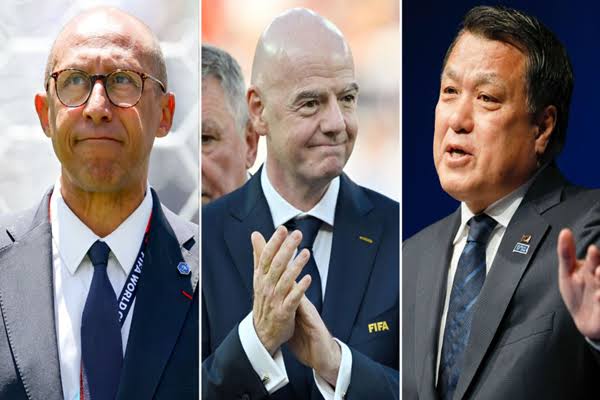
FIFA has confirmed it received two candidacy submissions to challenge Gianni Infantino in the next FIFA presidential election. Philippe Diallo, president of the French Football Federation, and Kohzo Tashima, the former head of the Japan Football Association, will run against the incumbent. Infantino has led world football since 2016 and was reelected without opposition in 2019 and 2023. His tenure has brought record revenues and the expansion of the World Cup to 48 teams. It has also drawn criticism over his closeness to political leaders, the awarding of the 2034 World Cup to Saudi Arabia and the way decisions are made at the top of the game. Both challengers must still clear FIFA's eligibility and integrity checks. Their entry turns a likely coronation into the first real contest for FIFA's top job in nearly a decade, and it raises a big question. Can anyone beat a president who has spent ten years building loyalty among the federations that hold the votes?
For almost a decade, Gianni Infantino has run world football with very little opposition. He won the FIFA presidency in 2016 and was handed two more terms without a single rival on the ballot. That era of easy victories may be over. FIFA has confirmed it received two candidacy submissions from men who want his job. Philippe Diallo, president of the French Football Federation, and Kohzo Tashima, the former president of the Japan Football Association, will run against the sitting FIFA president.
On paper, the challengers face a steep climb. Infantino is a seasoned campaigner with deep support across Africa, Asia, the Caribbean and Oceania. He controls a development budget that funds pitches, academies and offices in dozens of small football nations. Yet the simple fact that two serious figures from two major football countries have stepped forward tells a story of its own. Somewhere inside the corridors of world football, frustration has been building. And now it has a name on the ballot.
The announcement does not yet guarantee a three way race. Every candidate for the FIFA presidency must be backed by declarations of support from at least five member associations. Each one must also pass an eligibility and integrity check carried out by an independent review committee. Only after that process can a name be confirmed for the vote at the FIFA Congress. Still, the submissions alone mark a turning point. For the first time since Infantino took power, FIFA's 211 member associations may face a real choice.
To understand why this matters, you have to remember how Infantino arrived. In 2015, FIFA was in crisis. Swiss police raided a luxury hotel in Zurich and arrested several football officials on corruption charges linked to a United States investigation. Sepp Blatter, who had led FIFA since 1998, announced he would step down. He and UEFA president Michel Platini were later banned from football by FIFA's ethics committee. The organization was broke in reputation and badly in need of a reset.
Infantino, then the general secretary of UEFA, stepped in when Platini could no longer run. He was a relatively unknown administrator to many outside Europe, a Swiss Italian lawyer who had become familiar to fans as the man pulling balls out of bowls at Champions League draws. In February 2016, he won the presidency in a second round of voting, beating Sheikh Salman bin Ebrahim Al Khalifa of Bahrain. He promised reform, transparency and more money for the federations that make up FIFA.
On the money front, few can argue he has failed to deliver. Under Infantino, FIFA's revenues have climbed to record levels. The organization reported income of around $7.5 billion for the four year cycle ending with the 2022 World Cup in Qatar, and it projected even bigger figures for the cycle that included the 2026 tournament. Through the FIFA Forward program, he sharply increased the amount of development funding sent to member associations. For many small and poor federations, that money pays for coaches, women's football, youth competitions and basic infrastructure. It is also the foundation of Infantino's political strength.
He has reshaped the game's biggest events too. The World Cup grew from 32 to 48 teams, with the expanded tournament played across the United States, Canada and Mexico in 2026. More countries now have a realistic path to football's biggest stage, a change welcomed in Africa, Asia and beyond. He also launched an expanded 32 team Club World Cup, held in the United States in 2025, and pushed for more global women's football competitions. Supporters say he has made FIFA a truly global organization that shares its wealth more widely than ever before.
Critics see a very different picture. They argue that Infantino has concentrated power in the president's office and weakened the checks that were supposed to follow the 2015 scandal. They point to the speed and manner of key decisions. The 2030 World Cup was awarded to a joint bid from Spain, Portugal and Morocco, with opening matches in Uruguay, Argentina and Paraguay. That arrangement effectively cleared the way for Saudi Arabia to be the only bidder for 2034. Both hosts were confirmed together in December 2024 through a single vote by acclamation. Human rights groups condemned the outcome, citing concerns about migrant workers and freedom of expression in Saudi Arabia.
Infantino's relationships with powerful politicians have also raised eyebrows. He has built close ties with leaders in the Gulf and with United States President Donald Trump, appearing often at the White House and at political events. In May 2025, he arrived late to the FIFA Congress in Paraguay after traveling with Trump in the Middle East, prompting UEFA delegates to walk out of the hall in protest. Later that year, FIFA created a new peace prize and presented it to Trump at the World Cup draw. To supporters, these moves show a president who knows how to work with the world's most powerful people for football's benefit. To critics, they suggest an organization drifting too close to politics it should stay far away from.
His record has not been free of legal clouds either. Swiss prosecutors opened criminal proceedings tied to his undocumented meetings with the country's former attorney general, Michael Lauber. Infantino has always denied wrongdoing, and the matter did not stop him from leading FIFA. But it fed a wider sense among skeptics that the promised era of transparency never fully arrived. Even the question of how long he can stay in office has caused debate. FIFA's rules limit a president to three terms, yet Infantino has said his first term, which began in 2016 and ended in 2019, should not count as a full one. That reading would allow him to seek another mandate beyond the usual limit.
This is the world Philippe Diallo and Kohzo Tashima are stepping into.
Diallo became president of the French Football Federation in 2023, first as interim leader and then through election, after Noël Le Graët stepped down amid controversy. Before that, he spent years as a senior figure in the business side of French football, working closely with professional clubs and sitting at the top table of the federation as a vice president. He is known as a careful administrator rather than a showman. His supporters describe him as a steady hand who helped restore calm at a federation shaken by scandal. France is one of football's great powers. It is a two time world champion, a constant producer of elite players and home to one of the strongest football cultures in the world. A French candidate carries weight, especially in Europe, where frustration with Infantino has been loudest.
Yet his French roots may also be a challenge. Many voters in Africa and Asia see European football as already too powerful. Infantino has spent years presenting himself as the president who looks beyond Europe. Diallo will need to convince smaller federations that his leadership would not mean a return to European dominance. He will also need to show what he would offer them that Infantino has not already delivered in hard cash.
Tashima brings a different profile. He led the Japan Football Association from 2016 to 2024, a period in which Japanese football grew steadily on and off the pitch. Japan reached the knockout stage at the 2018 and 2022 World Cups, famously beating both Germany and Spain in Qatar. Its women's team remained among the strongest in the world. Tashima also served in senior roles in Asian football and sat on the FIFA Council, which gives him direct experience of how decisions are made at the very top. He is respected as a quiet, methodical leader who believes in long term planning, youth development and strong institutions.
An Asian candidate from a nation as organized as Japan could appeal to voters who want reform without losing the global focus Infantino has championed. But Asia is no single voting bloc. The Asian Football Confederation has strong links to the Gulf, where Infantino has deep relationships. Tashima will have to win support in his own region before he can hope to compete worldwide.
There is also the awkward reality that two challengers could split the opposition vote. In a FIFA election, a candidate needs a two thirds majority in the first round. If no one reaches that mark, a simple majority is enough in later rounds. With Infantino's base so large, a divided opposition may make his path easier. Observers will watch closely to see whether Diallo and Tashima coordinate, compete or eventually unite behind one name.
The arithmetic of FIFA politics explains why Infantino remains the clear favorite. Every member association has one vote. The Faroe Islands count the same as Brazil. Montserrat counts the same as Germany. Africa alone holds 54 votes. Asia has 47. Europe has 55, but its influence on the ballot is no greater than the sum of its members. This system rewards a president who supports small federations directly, and Infantino has done just that. Many football leaders in developing countries credit him with funding they never received before. Asking them to vote against him requires a powerful reason.
The challengers will need to offer that reason. Their likely message centers on governance. They can argue that FIFA should be run by its member associations, not by one office. They can promise greater transparency in how World Cups are awarded, stronger independence for ethics bodies and clearer rules on how long a president can serve. They can also tap into concerns from players, unions and clubs about a crowded calendar. The expansion of tournaments has added more matches to a schedule that many players say is already pushing their bodies to the limit. Player groups have raised concerns about fatigue and injuries, and some have taken legal action against FIFA over the calendar.
Money will also be part of the debate. Any challenger must reassure smaller nations that development funding will not shrink. Promising reform while protecting those payments is a difficult balance. Infantino will almost certainly frame the election as a choice between continued growth and risky change. He will remind voters of the money, the bigger World Cup and the opportunities his tenure has created.
For Africa, and for Nigeria in particular, this election carries real weight. The Confederation of African Football has historically voted strongly for Infantino, and its leadership has generally been close to FIFA's president. African federations depend heavily on FIFA support for infrastructure and administration. At the same time, many African fans and administrators have long complained that the continent's influence in world football does not match its talent. Nigeria, with its rich history of producing elite players, has a direct interest in how FIFA shares power, schedules tournaments and supports football development. The Nigeria Football Federation's vote is equal to that of any European giant, and how it chooses will matter.
A contested election also matters for fans everywhere. Competition forces candidates to explain their plans in public. It invites scrutiny of decisions that might otherwise pass quietly. It gives journalists, players and supporters a chance to ask hard questions about where FIFA is going. In the last two elections, there was no debate at all. Infantino's reelection was a formality. This time, he will have to defend his record against people who know the system from the inside.
Some will say this challenge is long overdue. They argue that no organization as wealthy and powerful as FIFA should go years without a meaningful contest at the top. Others will say it is a European backlash dressed up as reform, driven by federations unhappy that the center of gravity in football has shifted toward the Gulf, the Americas and the developing world. Both arguments contain some truth, and the campaign ahead will test which one wins more votes.
What happens next depends first on FIFA's review process. Both submissions must pass the eligibility checks, and each candidate must confirm the backing of at least five member associations. Once confirmed, the campaign will move quickly. Candidates will travel to confederation meetings, court regional leaders and make their pitches to federations large and small. Endorsements from confederations could shape the race early. If Africa or Asia publicly declares for Infantino, the challengers' path will narrow sharply.
Infantino has survived storms before. He has outlasted critics, investigations and walkouts. He has built a coalition that stretches across every continent, held together by money, access and a clear vision of a bigger, wealthier FIFA. Beating him would require one of the biggest upsets in the history of sports politics.
But elections rarely stay predictable for long. Diallo and Tashima have done what no one else dared to do in nearly ten years. They have put their names forward and forced the most powerful man in football to fight for his job. Whether they win or lose, the question they raise will not go away. Who really runs world football, and who should?