GEORGIAN POLICE CLASH WITH BEŞIKTAŞ FANS OVER PALESTINIAN FLAGS AS EUROPA LEAGUE MATCH DESCENDS INTO CHAOS
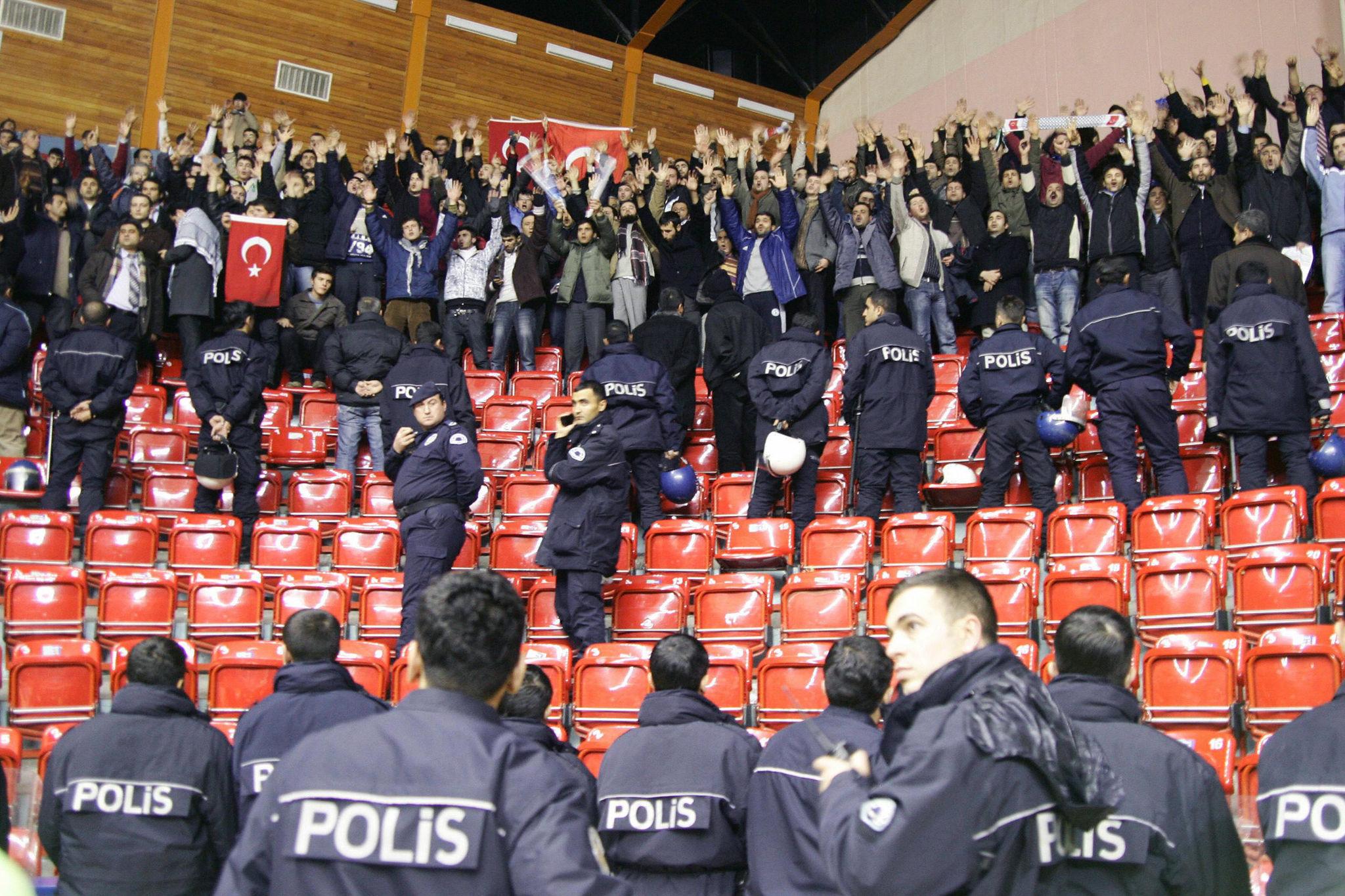
Georgian riot police clashed with Beşiktaş supporters during a UEFA Europa League match against Israeli club Hapoel Be’er Sheva in Batumi on November 26, 2026, following a confrontation involving Palestinian flags displayed inside the stadium. The disturbances forced officials to suspend the match for approximately 30 minutes, with Georgian authorities confirming 16 detentions and injuries to three police officers. Beşiktaş and the Turkish Football Federation condemned the alleged use of excessive force, while Turkish government officials contacted their Georgian counterparts over the incident. Georgia's Interior Ministry denied that police intervention was motivated by the Palestinian flags, maintaining that officers were responding to public disorder.
A UEFA Europa League match between Turkish football club Beşiktaş and Israel’s Hapoel Be’er Sheva descended into chaos on Thursday, November 26, 2026, after Georgian riot police clashed with Turkish supporters during a confrontation involving the display of Palestinian flags and solidarity banners inside Batumi Arena. The disturbances forced officials to temporarily suspend the match, left several people injured and triggered diplomatic intervention from Turkish authorities, who expressed serious concerns about the conduct of Georgian security personnel.
The confrontation occurred in the Georgian coastal city of Batumi, where the European football governing body UEFA had relocated the fixture after Turkish authorities raised security concerns about hosting the Israeli team in Istanbul. What had been intended as a precautionary arrangement to reduce the possibility of disturbances instead developed into a highly contentious international incident involving football supporters, law enforcement agencies and diplomatic representatives from neighboring countries.
Television footage and videos circulating on social media showed Georgian security personnel confronting Beşiktaş supporters in the stadium stands as Palestinian flags were displayed. Turkish media reported that officers attempted to remove the flags and deployed pepper spray during the ensuing confrontation, prompting angry reactions from sections of the crowd and forcing match officials to intervene as the situation deteriorated.
The referee suspended play during the first half while the disturbances were brought under control. The interruption lasted approximately 30 minutes, after which both teams returned to the field and completed the fixture. Beşiktaş eventually defeated Hapoel Be’er Sheva 2-1, although the result was largely overshadowed by the controversy surrounding the treatment of Turkish supporters and the subsequent diplomatic exchanges between Ankara and Tbilisi.
Georgia’s Ministry of Internal Affairs confirmed that 16 individuals had been detained in connection with disturbances surrounding the match and that three police officers sustained injuries. Georgian media also reported injuries among football supporters, although a comprehensive assessment of the number of spectators requiring medical treatment had not been independently established by Friday.
The Georgian government disputed reports suggesting that police intervention had been motivated by the display of Palestinian flags. In a statement issued following the incident, the Interior Ministry maintained that officers had responded to confrontations involving football supporters and other conduct that authorities considered a threat to public order. The ministry rejected accusations that the use of force had been directly connected to expressions of solidarity with Palestinians.
That account contrasts with reports from Turkish broadcasters and footage showing officers approaching individuals displaying Palestinian flags inside the stadium. Georgia Today reported that television images showed two supporters holding a Palestinian flag before police personnel moved toward them and removed it. The circumstances preceding that particular intervention, however, remain central to the disagreement between Georgian authorities and Turkish representatives.
The existence of footage showing the removal of a flag does not independently establish the complete sequence of events surrounding the broader disturbances. Georgian authorities maintain that their intervention was necessary to address disorder, while Turkish officials and football organizations have argued that security personnel subjected supporters to excessive and discriminatory treatment. Establishing whether individual police actions were justified will require a more comprehensive examination of the available evidence.
Beşiktaş issued a statement condemning the treatment of its supporters and accusing Georgian security personnel of employing excessive force before and during the fixture. The club expressed concern for individuals affected by the disturbances and announced that it had initiated discussions with UEFA and the Turkish Consulate General in Batumi.
The club's response elevated the controversy beyond the immediate confrontation inside the stadium. By formally approaching UEFA and Turkish diplomatic representatives, Beşiktaş indicated that it intended to pursue the matter through institutional channels capable of examining the organization of the fixture, the conduct of security personnel and the protection afforded to traveling supporters.
The Turkish Football Federation also condemned the incident, describing the treatment of Beşiktaş supporters as unacceptable and discriminatory. The federation indicated that it would seek an investigation into the circumstances surrounding the disturbances, adding further pressure on UEFA and Georgian authorities to address the allegations.
The Turkish government subsequently became directly involved in the controversy when Interior Minister Mustafa Çiftçi contacted his Georgian counterpart, Sulkhan Tamazashvili, to discuss the incident. According to Turkish official statements, the conversation focused on concerns surrounding the force used against Turkish citizens and the circumstances in which the confrontation developed.
Turkish diplomatic personnel from the country's embassy in Tbilisi and its consulate in Batumi were also involved in monitoring developments surrounding the fixture. Their responsibilities included assisting affected Turkish citizens and communicating with Georgian authorities concerning the treatment and legal status of individuals involved in the disturbances.
The intervention of senior government officials illustrates the extent to which the incident has developed beyond a conventional dispute over crowd management at a football match. Turkey and Georgia maintain substantial economic, diplomatic and commercial relationships, making the treatment of Turkish citizens within Georgian territory a matter of significance to both governments.
The Georgian Interior Ministry emphasized that individuals operating within its territory are required to comply with national laws regardless of their citizenship. Its statement reflected the government's position that authorities were acting to maintain public safety rather than attempting to suppress political expression connected to the Palestinian cause.
Georgian media reported that disturbances had also occurred outside the stadium before the fixture began, with confrontations involving police personnel and groups of traveling supporters. Reports indicated that some supporters threw objects toward officers, while damage to stadium seating was subsequently recorded during the disturbances inside the venue.
Those allegations are relevant to assessing the broader security situation surrounding the match, although they do not necessarily establish that every police intervention inside the stadium was justified. Investigators examining the incident would need to distinguish between individuals engaged in violent conduct and spectators whose involvement may have been limited to displaying flags or expressing political views.
The distinction between peaceful expression and unlawful behavior is particularly important in circumstances involving large crowds. Security personnel have a responsibility to protect spectators, players, officials and stadium infrastructure, but questions can arise when interventions affecting peaceful supporters occur alongside legitimate efforts to prevent disorder.
The decision to relocate the match to Georgia had itself reflected the increasingly complicated security environment surrounding international sporting fixtures involving Israeli teams. UEFA had moved the encounter after Turkish authorities indicated that hosting the match in Istanbul presented safety concerns, leading organizers to select Batumi as a neutral venue.
Spectators were permitted to attend the fixture despite restrictions imposed during some previous European matches involving Hapoel Be’er Sheva. The decision allowed supporters to travel to Georgia and participate in an international football occasion that ultimately became the subject of substantial political and diplomatic controversy.
Relations between Turkey and Israel have experienced considerable deterioration amid continuing disagreements over Israeli military operations in Gaza and the wider Middle Eastern conflict. Turkish President Recep Tayyip Erdoğan has repeatedly criticized Israeli government policies toward Palestinians, while Israeli authorities have rejected accusations advanced by Ankara concerning their conduct.
Those diplomatic disagreements have extended into the wider public environment, where demonstrations, consumer campaigns and expressions of solidarity with Palestinians have become prominent throughout Turkey. Football stadiums have frequently served as venues for such expressions, reflecting the broader political and humanitarian concerns held by sections of Turkish society.
Beşiktaş supporters have previously organized large displays of solidarity with Palestinians during domestic football fixtures. During the club's Istanbul derby against Fenerbahçe on November 2, 2025, supporters displayed Palestinian flags and a large banner calling for Palestinian freedom, attracting widespread attention across Turkish and international media.
The latest confrontation in Georgia therefore occurred against an established background of political expression among sections of the club's supporter community. However, the fact that Beşiktaş fans have previously participated in similar demonstrations does not establish the intentions or conduct of every individual attending Thursday's match.
Football has historically provided a platform through which supporters express identities, political opinions and solidarity with communities affected by conflict. Stadium crowds often display national flags, commemorative symbols and banners addressing humanitarian concerns, reflecting the relationship between sporting institutions and the societies in which they operate.
The increasing visibility of demonstrations connected to the Palestinian cause has nevertheless created regulatory challenges for football governing bodies. UEFA and other sporting organizations must balance freedom of expression against regulations concerning public safety, discriminatory conduct, political messaging and the potential for confrontations between opposing supporters.
UEFA's disciplinary framework contains provisions addressing offensive messages and demonstrations of a political, ideological or religious nature considered inappropriate for sporting events. The interpretation and application of those provisions can become controversial, particularly when supporters argue that their displays represent humanitarian solidarity rather than hostility toward opposing players or spectators.
The Palestinian national flag is not automatically prohibited at every European football fixture. Whether a particular display violates applicable regulations depends on the circumstances, the wording or imagery accompanying it and the specific security arrangements established for the event. The distinction between a national flag and a banner containing prohibited material remains important when assessing the legitimacy of any intervention.
No evidence reviewed for this report established that UEFA had issued a blanket instruction prohibiting Palestinian flags at Thursday's fixture. Consequently, the precise legal or regulatory basis for removing the flag shown in television footage remains an unresolved aspect of the controversy.
The involvement of an Israeli football club added further sensitivity to the circumstances surrounding the demonstration. Supporters expressing solidarity with Palestinians may regard international sporting events involving Israeli teams as opportunities to draw attention to humanitarian concerns, while organizers must ensure that Israeli players and spectators are protected from intimidation, discrimination and physical harm.
Those responsibilities are not inherently incompatible. Football authorities can recognize peaceful expressions of political or humanitarian concern while maintaining firm restrictions against antisemitism, anti-Muslim hatred, racial discrimination, threats and violence. The challenge lies in applying those standards consistently without treating national identity or peaceful solidarity as sufficient evidence of unlawful conduct.
The events in Batumi also raise questions about the responsibilities assumed by countries selected to host international football matches on neutral territory. Relocating a fixture does not necessarily eliminate the political tensions that led to the original security concerns, and host authorities must develop arrangements capable of managing the behavior of spectators while protecting their legitimate rights.
Neutral venues are frequently used when political disputes, armed conflicts or security conditions prevent sporting organizations from hosting matches in their usual locations. Such arrangements can allow competitions to continue, but they depend heavily on effective coordination between governing bodies, participating clubs, diplomatic representatives and local security institutions.
The presence of thousands of traveling supporters can create considerable logistical challenges for host cities. Authorities must coordinate transportation, crowd movement, stadium access and emergency medical services while ensuring that security personnel understand the specific sensitivities surrounding the fixture.
In Batumi, the disturbances outside and inside the stadium suggest that the security operation encountered difficulties despite the precautionary measures associated with hosting the match. Whether those difficulties resulted from inadequate planning, unlawful supporter conduct, disproportionate police intervention or a combination of factors remains a matter requiring further examination.
The controversy has also renewed attention to the use of chemical irritants within crowded sporting environments. Police agencies sometimes deploy pepper spray when responding to confrontations, but its use in confined or densely populated areas can affect individuals who were not directly involved in violent activity. Spectators with respiratory conditions and other medical vulnerabilities may face particular difficulties when exposed to such substances.
Assessing whether the deployment of pepper spray was proportionate requires consideration of the immediate circumstances confronting officers, the availability of alternative responses and the risks posed to surrounding spectators. Video footage can provide important evidence, although a comprehensive investigation would also need to consider security instructions, witness testimony and other records documenting the incident.
The Beşiktaş case illustrates how quickly crowd-management decisions can produce consequences extending beyond the stadium. Images of confrontations between police and supporters circulated internationally, generating public criticism and placing additional pressure on Turkish and Georgian officials to explain their respective positions.
For UEFA, the incident presents questions concerning the organization of a fixture that had already been relocated because of security concerns. Any formal disciplinary or administrative review could examine the behavior of supporters, the actions of participating clubs and the effectiveness of arrangements established by the host authorities.
UEFA's disciplinary procedures are separate from criminal investigations conducted under Georgian law. Individuals accused of damaging property, assaulting officers or committing other offenses may face proceedings before Georgian authorities, while football organizations can independently examine whether competition regulations were breached.
Similarly, allegations of excessive force by police personnel require consideration through the appropriate investigative and accountability mechanisms. The fact that supporters were detained does not establish their guilt, just as accusations against security officers do not automatically establish that their actions were unlawful.
The Turkish government has an interest in ensuring that its citizens receive appropriate consular assistance and fair treatment under Georgian law. Georgia, meanwhile, has a responsibility to investigate alleged offenses committed within its territory while addressing legitimate concerns surrounding the conduct of its security personnel.
Maintaining communication between the two governments could help prevent the controversy from creating unnecessary damage to their broader bilateral relationship. Turkey and Georgia share important commercial interests, transportation connections and energy infrastructure, with cooperation extending across numerous areas of regional economic development.
Both countries also occupy important positions within international transportation networks connecting Europe, the Caucasus and Asia. Their relationship has developed through trade agreements, cross-border investment and infrastructure projects, making sustained diplomatic cooperation valuable beyond the immediate circumstances of Thursday's football match.
For the supporters who traveled to Batumi, the confrontation transformed what was intended to be an international football experience into an incident involving allegations of mistreatment, injuries and police detention. The experiences of those individuals will be important to any investigation, particularly when assessing whether security interventions affected spectators who were not participating in violent conduct.
The players also found themselves competing in circumstances substantially different from those normally associated with a European football fixture. Beşiktaş representatives reportedly communicated with sections of the crowd during the interruption as efforts were made to restore order and allow the match to resume.
Despite the temporary suspension, the fixture was eventually completed, with Beşiktaş securing a 2-1 victory. The sporting result, however, has received comparatively less attention than the confrontation in the stands, demonstrating how political tensions and security failures can overshadow the competitive purpose of international football.
The incident also reflects the growing challenges facing sporting institutions as conflicts outside football increasingly influence the environment in which matches are played. Supporters remain members of wider societies affected by humanitarian crises, diplomatic disagreements and international political developments, making it difficult for sporting organizations to completely separate football from contemporary public affairs.
Attempts to enforce political neutrality within stadiums can themselves generate controversy when supporters believe that certain national symbols or humanitarian messages receive different treatment. Consistent and transparent regulations are therefore important to maintaining confidence among clubs, spectators and participating countries.
At the same time, supporters attending international fixtures remain responsible for complying with applicable laws and regulations. Peaceful demonstrations should be distinguished from physical confrontations, destruction of property and conduct that endangers other spectators, regardless of the political message associated with a particular gathering.
As of Friday, November 27, the immediate focus remained on the circumstances surrounding the detention of 16 individuals, the treatment of injured supporters and officers, and the concerns formally raised by Turkish football authorities. No final independent determination establishing whether Georgian police used disproportionate force had been publicly confirmed.
The competing explanations offered by Georgian authorities and Turkish representatives remain central to the developing controversy. Georgia maintains that its officers responded to disorder rather than the display of Palestinian flags, while Beşiktaş and the Turkish Football Federation contend that supporters were subjected to unacceptable treatment. The available footage has intensified demands for clarification, but a complete assessment will require evidence extending beyond isolated recordings.
For UEFA, the confrontation represents another reminder that relocating politically sensitive matches does not necessarily remove the underlying tensions surrounding them. The effectiveness of future security arrangements will depend on whether football authorities and host governments can protect all participants, respond appropriately to genuine threats and distinguish peaceful political expression from unlawful behavior.
The eventual outcome of investigations into the Batumi disturbances could influence how similar international football fixtures are organized and policed. Until the circumstances are independently established, the incident remains a disputed confrontation involving allegations of excessive force, reported supporter misconduct and unresolved questions about the treatment of Palestinian symbols within European football stadiums.