HUANG SPY ALLEGATIONS INTENSIFY WASHINGTON FIGHT OVER NVIDIA CHIP EXPORTS TO CHINA
Allegations that Nvidia CEO Jensen Huang had an affair with a woman U.S. intelligence reportedly suspects of ties to Chinese intelligence are intensifying pressure in Congress for tighter restrictions on advanced chip exports to China. Lawmakers including Elizabeth Warren, Jim Banks and Bill Foster are backing legislation that would increase congressional oversight of AI-chip exports, require stronger chip-tracking measures and push U.S. allies to align their semiconductor-equipment controls with Washington. Nvidia has opposed parts of the legislative push and says it complies with U.S. export rules, while its board says there is currently no evidence that national-security information or company secrets were compromised.
Allegations that Nvidia chief executive Jensen Huang had an intimate relationship with a woman U.S. intelligence officials suspect of links to Chinese intelligence are rapidly intensifying a long-running battle in Washington over whether the United States should further restrict the sale of advanced artificial-intelligence chips to China, with lawmakers from both parties arguing that the controversy strengthens the case for tighter controls on one of America’s most strategically important technology companies. The political fallout has moved beyond questions about Huang’s personal judgment and Nvidia’s corporate governance and into a broader debate over national security, artificial intelligence, semiconductor smuggling and the degree to which U.S. companies should be allowed to maintain commercial access to the Chinese market while Washington tries to prevent Beijing from acquiring the computing power needed for advanced military and intelligence applications.
The latest congressional pressure comes as Nvidia’s board conducts an independent investigation into the circumstances surrounding Huang’s admitted extramarital affair. Huang has apologized publicly for the relationship, but he has not admitted knowingly dealing with a Chinese intelligence operative or providing sensitive information to Beijing. U.S. intelligence officials reportedly believe the woman involved may have been gathering information for China, while Beijing has rejected those allegations as unsubstantiated. Nvidia says it currently has no evidence that corporate secrets or national-security information were compromised, and Huang remains chief executive while the inquiry continues.
Despite those unresolved questions, the allegations have given new momentum to lawmakers who have been pushing for stronger controls on advanced semiconductor exports to China for years. Reuters reported that three legislative measures are now at the center of the debate: the AI Overwatch Act, the Chip Security Act and the MATCH Act. Each addresses a different part of the technological competition between the United States and China, but together they would significantly tighten Washington’s ability to monitor, restrict and enforce exports involving advanced chips and semiconductor manufacturing equipment.
The AI Overwatch Act would give Congress a stronger role in reviewing or potentially blocking the export of advanced artificial-intelligence processors, limiting the executive branch’s ability to loosen restrictions without legislative scrutiny. Supporters argue that technologies with clear national-security implications should not be subject to policy swings based solely on the priorities of one administration, particularly when the chips involved can be used to train sophisticated artificial-intelligence systems with military, surveillance and intelligence applications.
The Chip Security Act takes a different approach by focusing on tracking and diversion. It would require chipmakers and technology companies to implement stronger technical safeguards designed to identify where advanced processors are being used and to reduce the risk that restricted chips are rerouted through third countries into China. The issue has become increasingly important because U.S. officials have repeatedly warned that export restrictions can be undermined when chips are legally sold into markets such as Southeast Asia or the Middle East and then diverted to Chinese end users.
The MATCH Act would place more pressure on U.S. allies to align their own semiconductor-equipment export restrictions with Washington’s controls. Advanced chips require extraordinarily complex manufacturing tools, many of which are produced not only by American firms but by companies in countries such as the Netherlands and Japan. Washington has therefore increasingly sought coordinated controls so that Chinese companies cannot simply replace restricted American technology with equivalent equipment from allied countries.
All three measures have already advanced through the House Foreign Affairs Committee and are now part of the wider defense-policy debate in the Senate. The Huang controversy has provided their supporters with a new and politically potent argument: that the United States faces not only the risk of technology transfers through normal commerce but also potential attempts by foreign intelligence services to cultivate relationships with executives who have extraordinary access to U.S. technology policy.
Senator Elizabeth Warren, a Democrat from Massachusetts, Senator Jim Banks, a Republican from Indiana, and Representative Bill Foster, a Democrat from Illinois, are among the lawmakers who have publicly argued that the allegations involving Huang strengthen the national-security case for tighter semiconductor controls. Their positions illustrate the unusually bipartisan nature of Washington’s concern about China’s technological rise. Democrats and Republicans remain deeply divided on many economic and foreign-policy issues, but restricting Beijing’s access to the most advanced chips has become one of the areas where substantial overlap exists.
The controversy is especially sensitive because Huang has spent years lobbying for a more flexible approach to China. He has repeatedly warned that cutting American chipmakers off from one of the world’s largest technology markets could ultimately weaken U.S. leadership by encouraging Chinese companies to accelerate development of domestic alternatives. Nvidia has argued that maintaining commercial relationships with Chinese customers, where legally permitted, allows American technology to remain the global standard and generates revenue that can be reinvested in research and development.
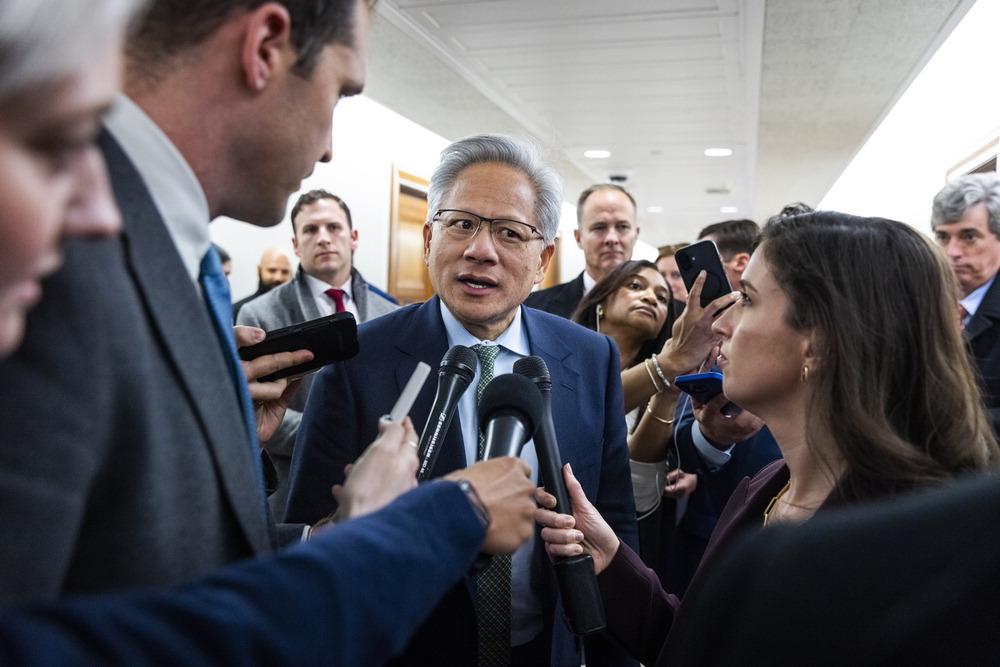
That position has placed Huang at the center of Washington’s policy debate. He has met with presidents, senior White House officials, Cabinet members and lawmakers from both parties and has become one of the most influential corporate voices shaping U.S. artificial-intelligence policy. Photographs of Huang walking through Capitol Hill surrounded by reporters and congressional aides have become increasingly common, reflecting how closely Nvidia’s business strategy is tied to decisions made in Washington.
The allegations involving his personal life have therefore landed at a particularly damaging moment. They do not merely affect the reputation of a technology executive; they intersect directly with a policy battle in which Huang has personally argued for loosening or adjusting restrictions that some lawmakers believe are essential to national security.
Critics of Nvidia’s position are now asking whether the company’s advocacy for continued Chinese market access should receive the same weight in Washington while questions remain about Huang’s relationship with a woman U.S. intelligence reportedly suspects of links to Beijing. No public evidence has established that Nvidia’s lobbying was influenced by the relationship, and there is no confirmed indication that Huang altered corporate policy or government advocacy because of it. Nonetheless, the optics have given restriction advocates a powerful new talking point.
That does not mean the export-control debate began with the scandal. The United States has been tightening restrictions on advanced chips to China for years, beginning with measures aimed at limiting Beijing’s access to processors capable of training large-scale artificial-intelligence models and other high-performance computing systems. Nvidia responded to earlier restrictions by developing modified chips designed to comply with U.S. rules while remaining commercially attractive to Chinese customers.
Those efforts produced a recurring cycle. Washington imposed tighter limits, Nvidia redesigned products to remain under the threshold, and U.S. officials later revised restrictions again when they concluded the modified chips were still too powerful. The company has argued that this constant tightening risks driving Chinese buyers toward domestic competitors and reducing American influence over global technical standards.
Supporters of stricter controls reject that logic. They argue that the central issue is not market share but whether Chinese military, intelligence and surveillance systems gain access to computing power that could improve weapons development, cyber capabilities, autonomous systems and large-scale data analysis.
Artificial-intelligence processors have therefore become a strategic resource rather than a conventional commercial product. Their importance is comparable in some respects to other technologies historically subject to export controls, but the scale of the AI market and Nvidia’s dominance make the policy challenge unusually complex.
Nvidia’s most advanced processors are used throughout the global AI ecosystem. They power data centers, scientific research, cloud-computing systems and generative AI models. Their performance advantage has given the company enormous economic influence and made it one of the most valuable corporations in the world.
That success also means that restrictions on Nvidia can have consequences far beyond the company itself. U.S. cloud providers, overseas customers, chip distributors and governments all depend on access to advanced Nvidia technology, while any change in policy can affect billions of dollars in investment.
The Trump administration has at times taken a more flexible approach than some congressional hawks. President Donald Trump has emphasized American technological dominance and has also shown a willingness to consider commercial arrangements that preserve U.S. companies’ access to China under certain conditions. That has created tension with lawmakers who believe national-security restrictions should be stricter and less vulnerable to political negotiation.
Reuters reported that one of the main obstacles facing the current legislative push is whether the White House will support measures that reduce executive flexibility. The administration has not yet formally endorsed the three bills now gaining momentum, and that uncertainty could determine whether the legislation becomes law.
The Huang controversy may alter that political calculation. Trump said Monday that the FBI was “looking into” the Nvidia chief executive’s situation and acknowledged the seriousness of the allegations, though he also expressed sympathy for Huang and suggested he believed the executive would ultimately be “in good shape.” That response did not indicate that the administration had turned against Nvidia, but it confirmed that the issue had reached the federal investigative level.
The FBI’s involvement does not mean Huang has been charged with or accused of espionage. Counterintelligence investigations often examine whether American executives, researchers or officials may have been targeted by foreign intelligence services without concluding that the individuals knowingly cooperated.
That distinction is especially important here. Huang’s admitted affair is established. The intelligence allegation is not. U.S. officials reportedly suspect that the woman may have gathered information for Beijing, but China denies that claim, and no criminal conviction has established that she was acting as a spy.
The legal and political questions therefore remain separate. Congress can decide that the broader risk environment justifies stronger export controls even if Huang himself is never accused of wrongdoing beyond the personal misconduct he has already acknowledged.
That appears to be where some lawmakers are heading. Their argument is that the episode demonstrates the strategic vulnerability created when a small number of corporate leaders have extraordinary access to both sensitive government discussions and critical technologies. Even if no secrets were compromised in this instance, they contend that foreign intelligence services have strong incentives to target such individuals.
The semiconductor industry pushes back against that reasoning. Nvidia and trade groups warn that overly restrictive rules could damage American companies, reduce revenue available for innovation and encourage foreign competitors to develop alternative technology stacks that eventually displace U.S. dominance.
Industry advocates also argue that export controls are most effective when narrowly targeted at clearly defined military risks rather than used to restrict broad categories of commercial technology. They warn that if China is denied access to American processors indefinitely, Chinese firms will accelerate their investment in domestic semiconductor capabilities.
That process is already underway. Chinese technology companies and state-backed research programs have been investing heavily in domestic chip design, manufacturing and AI systems in response to U.S. restrictions.
The strategic debate therefore revolves around time. Restriction advocates believe denying China access to the most advanced U.S. chips can slow its progress enough to preserve an American advantage. Nvidia and some industry voices argue that broad restrictions may only delay China temporarily while sacrificing U.S. market influence and revenue.
Huang has been one of the most prominent advocates of the second view. He has argued publicly that the United States should avoid policies that effectively force half the world’s AI developers into a separate technological ecosystem.
That argument has not disappeared because of the scandal, but it may now be more difficult politically for Huang to make it with the same authority. Lawmakers who already distrusted Nvidia’s China strategy can now point to the intelligence allegations as evidence that commercial access and national-security risks are more intertwined than the company has acknowledged.
The timing is also important because Congress is considering the measures as part of the fiscal 2027 National Defense Authorization Act, one of the few major legislative vehicles that reliably moves through Congress every year. Attaching export-control provisions to the defense bill can significantly increase their chances of passage.
If the measures survive negotiations between the House and Senate, they could give Congress a much stronger role in semiconductor policy and create new compliance obligations for chipmakers.
The AI Overwatch Act would particularly alter the balance of power between Congress and the executive branch. Supporters argue that decisions involving the most advanced processors should not be made through opaque licensing decisions that can change from one administration to another.
Opponents warn that congressional review could slow export decisions and reduce the government’s ability to adapt quickly to changes in technology.
The Chip Security Act raises a different set of technical challenges. Requiring companies to track chip locations could help detect diversion, but implementing such systems across global supply chains is difficult. Chips can be resold, incorporated into servers or routed through multiple distributors before reaching their final users.
Technology companies would therefore need mechanisms capable of identifying or disabling unauthorized deployments without creating cybersecurity risks of their own.
The MATCH Act depends heavily on diplomacy. U.S. export controls are less effective if allied countries continue selling comparable semiconductor manufacturing equipment to China. Washington has therefore spent years pressing the Netherlands, Japan and other partners to align their rules with American restrictions.
That effort has produced partial cooperation but also frustration. Allied governments want to protect national security while avoiding unnecessary damage to their own companies.
The Huang affair is unlikely to resolve those policy debates by itself, but it has changed the political atmosphere in which they are being conducted.
Before the scandal, the argument over Nvidia’s China business could be framed primarily as a contest between national security and commercial competitiveness. Now it also involves counterintelligence, executive access and the possibility that foreign intelligence services may target the individuals influencing policy.
That shift gives restriction advocates a stronger emotional and political narrative. Rather than discussing abstract computing thresholds, lawmakers can now point to a real-world case involving the CEO of the company most affected by export rules.
Nvidia’s response has been cautious. The company has said it complies with export laws and has not publicly endorsed the intelligence allegations. Its board has opened an independent investigation into the circumstances surrounding Huang’s relationship and has said it currently sees no evidence that company or national-security secrets were compromised.
Huang has also said he will cooperate fully.
Those steps are intended to separate the personal scandal from the company’s business and policy positions, but that separation may prove difficult in Washington because Huang has always been central to Nvidia’s public advocacy.
Unlike many major technology companies, where government relations are handled largely by professional lobbyists and policy executives, Nvidia’s strategy has often depended heavily on Huang himself. His personal credibility with policymakers has therefore been a significant corporate asset.
If that credibility weakens, Nvidia may have to rely more heavily on institutional arguments rather than the influence of its founder.
The financial markets are also watching closely. Nvidia shares fell more than 4% on Monday amid uncertainty surrounding the scandal and the board investigation. That decline does not necessarily reflect investor belief that Huang committed wrongdoing, but it shows how closely the company’s valuation is tied to both his leadership and Washington’s regulatory decisions.
Any significant tightening of exports could affect Nvidia’s future revenue from China, though the precise impact would depend on which products are restricted and whether the company can continue selling modified processors.
China remains an important technology market, even though U.S. controls have reduced Nvidia’s ability to sell its most advanced products there.
Beijing has also sought to limit its dependence on foreign chips. Chinese authorities have encouraged domestic companies to use locally developed alternatives and have invested heavily in state-supported semiconductor projects.
That means Washington’s policy decisions may shape not only what China can buy today but how quickly it builds its own alternatives tomorrow.
The larger question is therefore whether stronger controls preserve U.S. leadership or accelerate the creation of a rival Chinese ecosystem.
Supporters of tighter rules believe security must take priority. They argue that even if China eventually develops alternatives, delaying access to top-tier American technology buys valuable time for U.S. companies, researchers and defense institutions.
Nvidia and some technology analysts argue that maintaining controlled commercial engagement gives the United States more leverage than complete technological separation.
The Huang allegations have made that second argument politically harder but have not disproved it.
That distinction matters because policymaking based on scandal can create long-term consequences unrelated to the facts of the individual case. Congress will need to decide whether the legislation under consideration makes sense on its own merits rather than simply as a reaction to allegations involving one executive.
At the same time, the episode has exposed a genuine structural issue: the concentration of strategic influence in a small number of technology leaders who operate at the intersection of private business, national policy and geopolitical competition.
Huang’s role is a particularly striking example. He leads the dominant supplier of AI processors, advises policymakers, advocates for export rules that affect his own company and maintains business interests in a country the United States increasingly treats as its principal strategic competitor.
That does not imply misconduct, but it creates unavoidable questions about access, influence and counterintelligence.
The U.S. government has long warned executives and researchers working in sensitive sectors that foreign intelligence services may attempt to cultivate them through professional, financial or personal relationships.
If U.S. intelligence ultimately confirms that Huang was deliberately targeted, the case could become a textbook example of those risks.
If the allegation proves unfounded, however, lawmakers will have to be careful not to build policy around an intelligence claim that was never substantiated publicly.
For now, the woman’s alleged intelligence role remains disputed. U.S. intelligence reportedly believes she was gathering information for Beijing, while China says the accusation is false. Nvidia says it has no evidence sensitive information was compromised.
That uncertainty should remain central to coverage.
What is no longer uncertain is the effect on Washington’s semiconductor debate. The scandal has given fresh momentum to legislation designed to reduce China’s access to advanced AI chips and chipmaking equipment, and lawmakers who have long argued for tighter controls are now using the controversy to press their case with greater urgency.
The House Foreign Affairs Committee has already advanced the three key measures, and the Senate’s defense-bill negotiations will determine whether they survive into final legislation.
The White House remains the most important variable. If Trump endorses the restrictions, congressional momentum could accelerate dramatically. If the administration resists, arguing that existing export rules provide sufficient flexibility, the measures could face a difficult path.
Trump’s relationship with Huang adds another layer of uncertainty. The president has publicly praised the Nvidia chief executive and has repeatedly highlighted Nvidia’s role in U.S. AI leadership and domestic investment.
His sympathetic comments after acknowledging the FBI inquiry suggest he is not yet prepared to treat Huang as a national-security liability.
That could create a gap between the White House and lawmakers who want to use the moment to lock in more permanent restrictions.
The outcome will matter well beyond Nvidia. The legislation under debate could establish a framework for how the United States controls an entire generation of artificial-intelligence technology and how much authority Congress exercises over those decisions.
It could also affect relations with allies whose semiconductor companies are increasingly being asked to follow U.S. restrictions.
For China, tighter controls would reinforce Beijing’s longstanding argument that Washington is attempting to contain its technological development rather than simply protect specific national-security interests.
For American companies, the measures could reshape one of the world’s largest technology markets.
And for Huang, the controversy has transformed a deeply personal scandal into a policy crisis touching some of the most consequential questions in U.S.-China relations.
The next developments will come on several fronts at once. Nvidia’s board must determine whether the relationship created any corporate or security exposure. Federal investigators will continue examining whether foreign intelligence activity was involved. Congress will decide whether the controversy justifies stronger statutory controls, and the White House will have to choose whether to support or resist those efforts.
Until those investigations are complete, there is no basis for saying Huang knowingly assisted Chinese intelligence or compromised American secrets. But the political effect is already clear: the allegations have weakened the case for a more permissive approach to China inside Washington and strengthened lawmakers who argue that access to advanced U.S. AI chips should be treated primarily as a national-security question rather than a commercial one.
That policy fight is likely to outlast the scandal itself. Even if Huang is ultimately cleared of any security wrongdoing, the controversy has exposed how vulnerable Washington’s semiconductor strategy is to questions of trust, influence and foreign intelligence. The debate over Nvidia’s role in China is therefore no longer only about what chips the company should be allowed to sell; it is increasingly about who should control those decisions, how they should be enforced and how much risk the United States is prepared to tolerate as artificial intelligence becomes one of the defining technologies of global power.