INTERPOL OPERATION ARRESTS 262 SUSPECTS, IDENTIFIES 41 MIGRANT-SMUGGLING NETWORKS ACROSS 16 COUNTRIES
INTERPOL says Operation Communis Maris resulted in 262 arrests and the identification of 41 organized criminal groups involved in migrant smuggling across the Mediterranean and West African Atlantic routes. The October 5–8 operation involved 16 countries, opened 434 new investigations, identified 109 potential human-trafficking victims and detected 1,715 irregular migrants. Of those arrested, 221 are accused of migrant smuggling, 16 of human trafficking and 25 of related offenses including document fraud.
An INTERPOL-led international operation targeting migrant-smuggling networks across the Mediterranean and the West African Atlantic route has resulted in 262 arrests, the identification of 41 organized criminal groups and the opening of 434 new investigations, exposing the scale of a transnational industry that authorities say is increasingly combining maritime smuggling, human trafficking, document fraud, extortion and online recruitment. Operation Communis Maris, conducted over four days from October 5 to October 8, brought together thousands of police officers, border officials and specialized investigators from 16 countries across North and West Africa, southern Europe and the Middle East, with enforcement teams intercepting boats, arresting suspected organizers, disrupting suspected trafficking operations and examining the financial and digital infrastructure used to move people across borders.
INTERPOL said 262 suspects were arrested during the operation, including 221 people accused of migrant-smuggling offenses, 16 suspected of human trafficking and 25 accused of other crimes connected to the movement of migrants, including the production and use of fraudulent travel documents. Authorities also identified 109 potential victims of human trafficking and detected 1,715 irregular migrants during checks and enforcement operations conducted at sea, ports, airports, border crossings and other locations regarded as migration or smuggling hotspots.
The operation mobilized 7,660 officers who conducted checks on more than 378,000 people during the four-day enforcement period. INTERPOL said participating authorities made 210,594 queries against its international policing databases as investigators attempted to identify wanted persons, fraudulent documents, known smugglers and links between individuals encountered in different countries. An Operational Coordination Unit was established in Athens to allow investigators and border agencies to share intelligence in real time and coordinate actions across jurisdictions that would otherwise have been separated by national borders.
The operation was led by INTERPOL with operational support from Europol, Frontex, AFRIPOL, the International Organization for Migration and the United Nations Office on Drugs and Crime. The 16 participating countries were Algeria, Cyprus, France, The Gambia, Greece, Italy, Libya, Malta, Mauritania, Morocco, Portugal, Senegal, Spain, Syria, Tunisia and Türkiye, creating an enforcement corridor that covered major departure countries, transit points and European destinations associated with irregular migration across the Mediterranean and Atlantic.
INTERPOL described the operation as an effort not simply to intercept migrants but to identify and disrupt the criminal structures profiting from their movement. Migrant smuggling and human trafficking are legally distinct crimes, although the same criminal organizations can become involved in both. Smuggling generally involves facilitating a person’s irregular entry into another country for financial or material benefit, while trafficking involves exploitation through force, fraud, coercion or abuse of vulnerability. A migrant who initially agrees to pay a smuggler can later become a trafficking victim if the journey develops into forced labor, sexual exploitation, extortion or other forms of coercion.
That distinction was visible in the results of Operation Communis Maris. INTERPOL said 41 organized criminal groups involved in migrant smuggling were identified during the four days, but the operation also uncovered cases where suspected smugglers were accused of trafficking and extortion. The agency did not say that every one of the 41 groups had been completely dismantled, and the 434 new investigations indicate that much of the intelligence gathered during the operation will continue to be examined by national authorities.
One of the most significant cases occurred in Libya, where authorities rescued 34 people identified as potential victims of human trafficking and arrested three suspects allegedly linked to an organized criminal group involved in human trafficking, migrant smuggling and extortion. INTERPOL said the arrests reflected the increasingly blurred lines between smuggling networks that initially offer transportation and criminal groups that later exploit vulnerable migrants once they are under their control.
Libya has for years been one of the most dangerous transit points on migration routes from sub-Saharan Africa toward Europe. Migrants traveling through the country have repeatedly reported kidnapping, extortion, forced labor, sexual violence and detention by traffickers, criminal groups and other armed actors. International organizations have documented cases in which migrants who initially paid for assistance crossing borders later became trapped in exploitative arrangements and were forced to demand money from relatives to secure their release or continue their journeys.
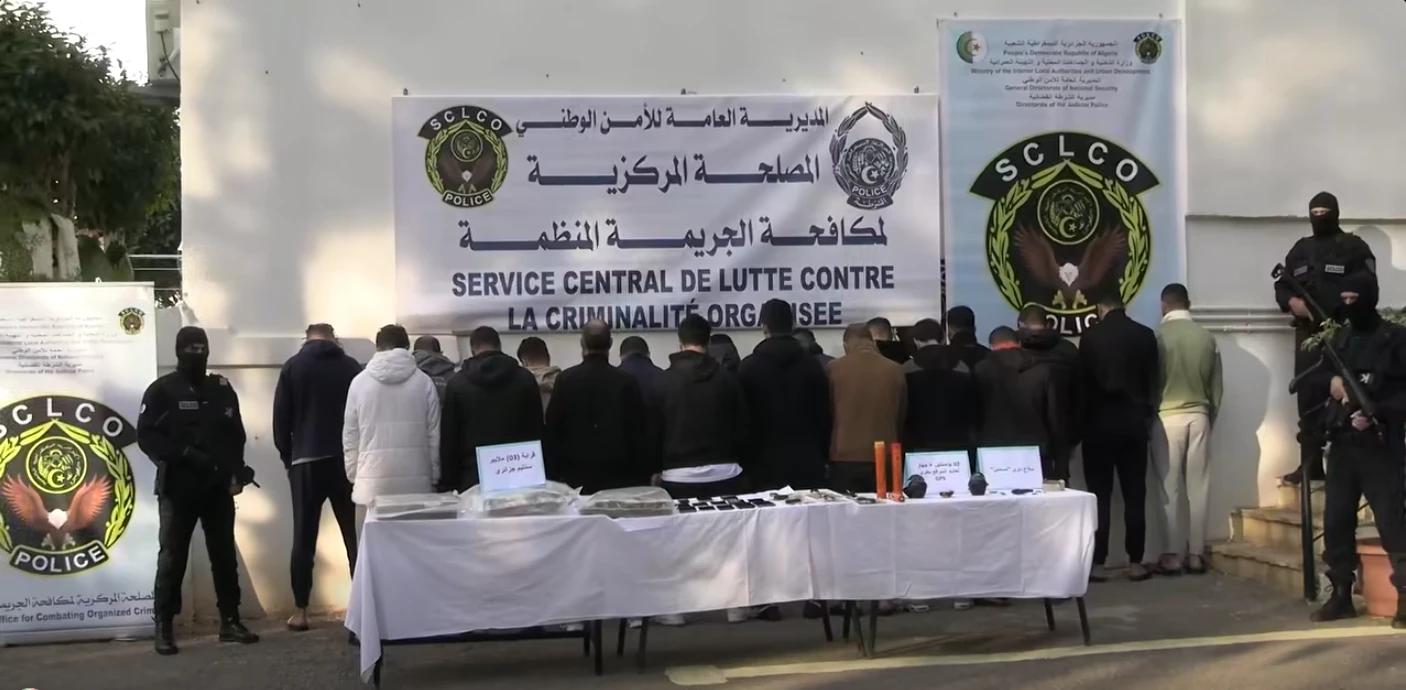
The October operation also produced significant arrests in Algeria, where authorities detained six suspects during an investigation into an alleged migrant-smuggling network. INTERPOL said the suspects face accusations not only of facilitating irregular migration but also of endangering minors, illustrating the particular risks faced by children traveling on clandestine routes.
Algerian authorities also seized a vessel believed to have been connected to migrant-smuggling operations. North African coastal states have increasingly become departure points for both nationals and migrants from other regions seeking to reach southern Europe, particularly Spain and Italy, while enforcement pressure in one location can cause smugglers to shift routes quickly to another.
In Syria, coordinated maritime patrols and surveillance involving several national agencies led authorities to raid premises allegedly used by migrant smugglers. Seven suspects were arrested, including a person described by investigators as the alleged ringleader, while 22 irregular migrants were intercepted. Authorities increased maritime patrols and surveillance during the operation as part of attempts to detect departures before vessels reached open water.
Tunisia also reported preventive action before boats could leave its coast. Authorities stopped an attempted crossing and arrested three Tunisian nationals accused of people smuggling, while seizing a boat, marine engine and other equipment allegedly intended for the journey. INTERPOL said enforcement teams in Tunisia also recovered devices, inflatable boats and fuel connected to suspected smuggling activity.
Preventing departures has become an increasingly important part of European and North African migration enforcement because maritime rescues often begin only after overcrowded vessels have already entered dangerous waters. Authorities argue that identifying boats, fuel supplies, recruitment operations and organizers before departure can reduce the likelihood of mass-casualty incidents, though migration-rights groups have also called for broader legal pathways that reduce demand for smugglers.
A major interception in southern Morocco demonstrated the scale of some voyages. Authorities stopped a vessel carrying 70 people, including 30 minors, who had already spent six days at sea. INTERPOL did not identify the final intended destination in its public statement, but Morocco is a major departure point for routes toward Spain, the Canary Islands and other parts of the European Union.
Another maritime case involved close cooperation between Senegal and Mauritania. Senegalese authorities alerted neighboring countries after a wooden pirogue left Senegalese territorial waters. Mauritanian officials intercepted the vessel the following day with 80 passengers aboard, including two children, and arrested three suspected organizers.
That case illustrates how migrant-smuggling operations often cross several jurisdictions within a single journey. A boat may depart from one country, travel through another country’s waters and eventually attempt to reach a destination thousands of kilometers away, making cooperation between national police, coast guards and border authorities essential if organizers are to be identified rather than merely the passengers they transport.
West Africa’s Atlantic route toward Spain’s Canary Islands has become an especially dangerous alternative to Mediterranean crossings. Boats frequently leave Senegal, The Gambia, Mauritania and neighboring countries and travel hundreds of kilometers through Atlantic waters, where strong currents, mechanical failures, inadequate fuel and overcrowding can turn journeys into disasters.
The danger has been demonstrated repeatedly in recent years by cases in which vessels disappeared entirely or were found drifting days or weeks after departure. Unlike organized passenger transport, clandestine departures often occur without reliable passenger manifests, meaning authorities may never know exactly how many people were lost when a boat fails to arrive.
David Caunter, INTERPOL’s Director of Organized and Emerging Crime, said the Mediterranean remained one of the world’s deadliest migration corridors and warned that smugglers were exploiting people who were already vulnerable. He said criminal networks frequently expose migrants to abuse, extortion and trafficking while placing them aboard overcrowded and unseaworthy vessels.
The October operation also moved beyond maritime routes and focused heavily on document fraud. Authorities in Cyprus and Greece made arrests at airports involving people allegedly attempting to use forged travel documents, while investigators in Morocco arrested a suspect accused of supplying fraudulent passports and recruiting people for irregular migration.
Fraudulent documents are a crucial part of many smuggling networks because they allow migrants to bypass conventional border controls or travel by air rather than attempting dangerous sea or land crossings. Forged passports, altered visas, stolen identity documents and genuine documents belonging to other people can all be used by criminal networks, often at substantial additional cost to the migrant.
Investigators also targeted the financial structures supporting the networks. In France, police arrested six people suspected of money laundering, facilitating irregular migration and housing a vulnerable or dependent person in conditions described by authorities as incompatible with human dignity. The allegations remain subject to investigation and prosecution, and the suspects have not been reported as convicted.
Money laundering is becoming an increasingly important part of migrant-smuggling investigations because organized networks may collect large sums from hundreds or thousands of travelers. Payments can move through informal transfer systems, cash couriers, bank accounts, cryptocurrency or intermediaries operating in multiple countries, making financial investigations essential to identifying organizers higher in the network.
INTERPOL said Operation Communis Maris also uncovered dozens of social-media posts, groups and accounts promoting irregular migration and advertising smuggling services. The findings highlight the degree to which an activity once organized largely through local brokers and personal contacts has moved onto digital platforms.
Smugglers can now advertise routes, prices and supposed guarantees through messaging applications and social networks while communicating directly with potential customers hundreds or thousands of kilometers away. Some accounts publish videos claiming to show successful arrivals in Europe, creating an impression that journeys are safer or more predictable than they actually are.
Authorities are increasingly treating those digital communications as evidence. Accounts can reveal payment instructions, telephone numbers, recruitment networks and relationships between organizers in departure and destination countries. They can also help investigators identify people who repeatedly advertise journeys or coordinate groups traveling from particular communities.
At the same time, officials warn that social-media advertising often conceals the dangers migrants face after payment. Smugglers may promise safe boats, experienced pilots or guaranteed arrivals but provide vessels with inadequate fuel, navigation equipment or safety gear. In some cases, passengers are forced to pilot boats themselves after smugglers leave before departure or abandon vessels once they move away from shore.
Operation Communis Maris comes as governments across Africa and Europe face sustained pressure over irregular migration. European states have increasingly sought agreements with countries in North and West Africa aimed at preventing departures, disrupting smugglers and returning migrants who do not qualify for protection.
Those arrangements have generated political debate over whether Europe is placing too much responsibility for border enforcement on poorer neighboring states while failing to create sufficient legal migration pathways. Human-rights groups have also raised concerns about conditions faced by migrants intercepted or detained in some transit countries.
Law-enforcement organizations argue, however, that criminal smuggling groups must be targeted regardless of broader disagreements over migration policy because the networks profit directly from dangerous journeys and can expose people to violence, exploitation and death.
INTERPOL’s role is particularly important because the organization does not operate as a supranational police force capable of independently arresting suspects. Instead, it coordinates intelligence and cooperation between its 196 member countries, allowing national agencies to search databases, exchange information and act on investigative leads generated elsewhere.
That structure was central to Operation Communis Maris. Officers in Athens supported real-time intelligence sharing while national police and border agencies carried out the actual arrests, inspections, patrols and seizures under their domestic legal authorities.
The 210,594 database checks conducted during the four-day operation illustrate the scale of that coordination. Those searches could involve names, travel documents, wanted persons and other records that help officers determine whether an individual encountered at a border crossing is connected to an investigation in another country.
The 434 new investigations opened during the operation may ultimately be more significant than the immediate arrests because they could expose additional layers of the criminal networks. INTERPOL said intelligence gathered during the action days is expected to produce further investigative leads and arrests in the coming weeks and months.
That means the total number of suspects connected to the operation could rise considerably. Some of the 41 identified organized criminal groups may operate across multiple countries, requiring investigators to trace communications and finances before determining who occupies leadership, recruitment, transportation or document-fraud roles.
The arrests also do not amount to convictions. The 262 people detained are suspects accused of different offenses under the laws of the countries where they were arrested, and their cases will proceed through national criminal justice systems. Prosecutors will have to establish individual responsibility through evidence, and suspects retain the presumption of innocence unless and until convicted.
The operation was financed by the European Union through Project Himaya, an initiative supporting efforts against human trafficking and migrant smuggling. EU funding reflects Europe’s strategic interest in disrupting migration routes before vessels reach its external borders, particularly as irregular arrivals remain a major political issue across several member states.
The operation also comes amid renewed concern over deaths along the same routes targeted by investigators. Maritime disasters involving wooden pirogues and overloaded boats continue to be reported off West Africa and throughout the Mediterranean, reinforcing the humanitarian consequences of the criminal networks that organize unsafe crossings.
For authorities, the immediate results of Communis Maris demonstrate the value of simultaneous enforcement across departure, transit and destination countries. A smuggling network can quickly replace a driver, boat or local recruiter if the wider organization remains intact, but coordinated operations can expose connections that would be difficult for a single national police force to identify.
The challenge now is converting those intelligence gains into sustained prosecutions. Investigators must determine which of the 41 criminal groups have identifiable command structures, how payments moved through their networks, which vessels or vehicles they controlled, how passengers were recruited and whether officials or legitimate businesses knowingly assisted them.
Authorities will also need to separate migrant-smuggling cases from human-trafficking investigations because the evidentiary requirements and victim-protection obligations are different. The 109 people identified as potential trafficking victims will require further assessment to determine the forms of exploitation they experienced and whether they can provide evidence against suspected traffickers.
Protecting those witnesses can be difficult because victims may fear retaliation, deportation or prosecution for immigration offenses. International standards encourage authorities to treat trafficking victims primarily as people requiring protection rather than merely as immigration violators.
The operation’s findings also show that the business model of migrant smuggling continues to adapt to law-enforcement pressure. Networks operate through boats, vehicles, forged documents, airports, cash transfers and social-media recruitment, allowing them to shift methods when one route becomes more difficult.
That adaptability explains why large enforcement actions rarely eliminate irregular migration by themselves. As long as there are people willing to pay substantial sums to reach other countries and limited legal pathways available to them, criminal networks retain a market for their services.
The law-enforcement objective is therefore narrower but still significant: make those networks more difficult to operate, identify organizers rather than merely migrants, prevent exploitation and reduce the number of dangerous journeys that end in death.
Operation Communis Maris produced one of the clearest recent examples of that strategy, combining maritime patrols, airport checks, border screening, intelligence analysis, document examination and financial investigations across 16 countries during the same four-day period.
INTERPOL’s November 10 announcement provides a substantial snapshot of the operation but not its final outcome. The 262 arrests represent people detained during the coordinated enforcement phase, while the 434 newly opened investigations remain active and the 41 organized criminal groups identified have not all been described publicly in detail.
Further arrests are therefore possible as national authorities analyze seized mobile phones, documents, financial records and information obtained during interviews. Investigators may also seek international notices or extradition proceedings if suspected organizers are located outside the countries conducting the investigations.
The immediate figures nevertheless demonstrate the scale of the networks authorities are confronting. More than 378,000 people were screened, 210,594 INTERPOL database checks were conducted, 1,715 irregular migrants were detected and 109 potential trafficking victims were identified in only four days.
Those numbers also show why migrant smuggling cannot be understood solely as a border-control issue. The criminal activity extends from recruitment in communities and online advertising to document forgery, financial transfers, maritime transport, accommodation, exploitation and final movement into destination countries.
For INTERPOL and the participating governments, the next stage will be measured less by how many people were stopped during the four-day operation than by how many of the identified criminal groups can ultimately be prosecuted and disrupted over the longer term. The organization says the intelligence generated during Communis Maris is already feeding hundreds of new investigations, meaning the enforcement consequences are likely to continue well beyond the October action period.
The confirmed position as of November 10 is that 262 suspects have been arrested across the participating countries, 41 organized crime groups have been identified and 434 investigations have been opened. Authorities have also found potential trafficking victims, intercepted dangerous maritime crossings and uncovered document-fraud and online recruitment networks. What remains unresolved is how many of those investigations will produce additional arrests, how many of the identified networks will be dismantled completely and how effectively law enforcement can disrupt a criminal market that continues to evolve alongside the migration routes connecting Africa, the Middle East and Europe.