ISHOWSPEED JOINS BARACK AND MICHELLE OBAMA TO BRING GHANA’S HIDDEN INDEPENDENCE HISTORY TO THE BIG SCREEN
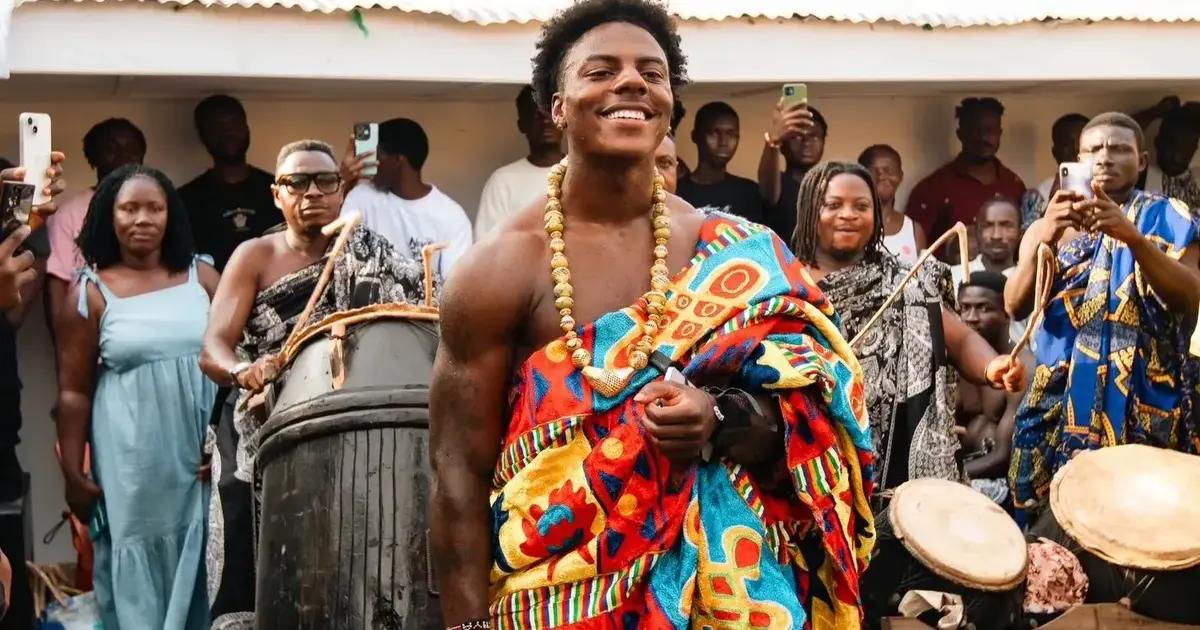
IShowSpeed has joined The Eyes of Ghana as a producer alongside Breakwater Studios, while Barack and Michelle Obama serve as executive producers through Higher Ground. Directed by two-time Academy Award winner Ben Proudfoot, the 90-minute documentary follows 93-year-old Ghanaian cinematographer Chris Hesse as he works to preserve and repatriate more than 1,300 films documenting Ghana and Africa’s independence era. The film premiered at the 2025 Toronto International Film Festival and will receive a special one-night theatrical release across the United States and Canada on October 28, 2026, with Ghana and UK screening announcements expected separately.
American streaming superstar IShowSpeed has joined former United States President Barack Obama and former First Lady Michelle Obama on The Eyes of Ghana, a major documentary project built around one of the most extraordinary surviving visual records of Ghana’s independence era, bringing together one of the world’s biggest young internet personalities, one of America’s most influential political families and the decades-long work of veteran Ghanaian cinematographer Chris Hesse. IShowSpeed, whose real name is Darren Watkins Jr., has come on board as a producer, while Barack and Michelle Obama serve as executive producers through their production company Higher Ground, giving the film a new global push ahead of a special theatrical release across North America later this month.
The 90-minute documentary, directed by two-time Academy Award winner Ben Proudfoot, follows 93-year-old Ghanaian cinematographer Chris Hesse as he works to preserve and repatriate more than 1,300 reels and films containing rare footage from Ghana’s independence struggle and the wider African liberation movement of the 1950s and 1960s. Hesse served as the personal cinematographer of Ghana’s first President, Dr Kwame Nkrumah, and spent years filming a generation of political leaders who were attempting to transform Africa after colonial rule. Much of that archive remained hidden for decades, particularly following the 1966 overthrow of Nkrumah, leaving one of the continent’s most important collections of historical moving images largely unseen by the public.
The film places Hesse at the center of a race against time. Now in his 90s and dealing with deteriorating eyesight, he is trying to ensure that the material he spent decades recording does not disappear with him. The archive contains images of political meetings, independence celebrations, state visits and moments connected to the emergence of Ghana as the first sub-Saharan African colony to gain independence from British rule in 1957. It also reaches beyond Ghana, documenting the atmosphere of African decolonization at a time when liberation movements were spreading rapidly across the continent.
The involvement of IShowSpeed gives the project an unusually powerful bridge between historical documentary filmmaking and a generation of viewers who consume most of their content through livestreams, social media and online entertainment rather than conventional history programming. Speed announced his role during a livestream on October 15, telling followers that his trip to Ghana earlier this year had left a strong impression on him and influenced his decision to become involved with the film. He said Ghana felt like home to him and explained that after learning about the documentary he reached out to the filmmakers to ask how he could support the project, leading to his appointment as a producer.
His connection to Ghana had already become part of his public identity before the documentary announcement. During his Speed Does Africa tour earlier in 2026, he visited Ghana and attracted large crowds while livestreaming his experiences around the country. One of the most symbolic moments of that visit came at the Kwame Nkrumah Memorial Park in Accra, where he recreated the famous posture associated with Nkrumah’s statue and spoke enthusiastically about Ghana and his connection to the country. That visit now carries additional relevance because Nkrumah’s political life and the footage captured by Hesse form the historical foundation of The Eyes of Ghana.
Speed said joining the film was a significant honor because Hesse’s camera had recorded what he described as the birth of African independence. He praised the veteran cinematographer’s determination to protect those images so future generations could witness them and said he was proud to help introduce Hesse’s work to his own audience. For a creator whose fan base is heavily concentrated among teenagers and young adults, the decision to attach his name to a historical documentary represents a notable expansion beyond the gaming, football, travel and entertainment content that made him famous.
IShowSpeed has become one of the world’s most recognizable digital personalities, with a combined following running into the hundreds of millions across YouTube and other platforms. His livestreams regularly attract huge audiences, and his global travel content has turned him into an international celebrity whose appearances can draw thousands of people onto streets with little advance notice. That reach gives The Eyes of Ghana access to an audience that a traditional documentary about colonial history might otherwise struggle to reach.
The Obamas’ involvement gives the project a different form of global influence. Barack and Michelle Obama are executive producers through Higher Ground Productions, the company they founded after leaving the White House. Higher Ground has developed and backed films and documentaries focused on history, democracy, culture and social issues, and The Eyes of Ghana fits closely within that approach because it uses personal history and archival filmmaking to examine a broader political transformation.
Higher Ground’s involvement also places Ghana’s independence story before an international audience already familiar with Barack Obama’s personal and political connection to Africa. During his presidency, Obama visited Ghana in 2009 on his first trip to sub-Saharan Africa as U.S. president, where he addressed Parliament and spoke about democratic institutions, development and Africa’s future. He and Michelle Obama also visited Cape Coast Castle during that trip, making Ghana one of the most symbolically important African countries in their public history.
The Eyes of Ghana does not center on the Obamas, however. Its story is anchored firmly in Hesse, Nkrumah and the historical images preserved by Ghanaian filmmakers. The international celebrity attached to the project is being used to amplify a story that remains fundamentally about Ghanaian memory, African independence and the question of who controls and preserves the visual record of a nation’s past.
The film’s title reflects that purpose. Hesse was one of the people literally behind the camera as Ghana’s independence story unfolded. His footage documented Nkrumah at a time when the Ghanaian leader was not simply governing a newly independent country but attempting to position Ghana as a center of Pan-African political thought. Nkrumah believed that Ghana’s independence would be incomplete unless it was connected to the liberation of the rest of Africa, and Accra became an important meeting point for anti-colonial activists and leaders from across the continent.
The documentary reportedly draws heavily on the visual material Hesse accumulated during that period. Some of the footage shows political events that became foundational to Ghana’s national identity, while other images offer more intimate glimpses of the people surrounding the independence movement. Because much of the material has not been widely seen, the archive carries historical value beyond what can be found in conventional textbooks or still photography.
The fact that so much of the collection remained inaccessible for decades is one of the film’s central themes. After Nkrumah was overthrown in February 1966 while on a diplomatic trip to Asia, many symbols and records associated with his government became politically sensitive. The country entered a period of military rule and political realignment, and material connected to the former president did not always receive institutional protection. According to the film’s account, Hesse safeguarded footage that could easily have been lost, damaged or destroyed.
The preservation problem has become more urgent because physical film deteriorates. Old reels stored under imperfect conditions can suffer from chemical breakdown, mold, fading and physical damage. Preserving such material requires specialized restoration, digitization and archival storage, all of which are expensive and technically demanding. The Eyes of Ghana therefore presents Hesse’s mission not simply as an act of nostalgia but as an urgent attempt to prevent irreversible loss.
The film also follows younger Ghanaian filmmaker Anita Afonu, who becomes part of the effort to preserve the archive and carry Hesse’s work into another generation. Her presence gives the documentary an intergenerational structure, connecting someone who personally filmed the independence era with younger filmmakers trying to understand and protect that history decades later. The relationship reinforces one of the film’s central ideas, that historical memory survives only when one generation deliberately passes it to the next.
The project first reached major international audiences at the Toronto International Film Festival in 2025, where it premiered as part of the festival’s 50th edition. The documentary subsequently appeared at other festivals and received praise for both its historical material and its treatment of Hesse’s personal story. Its next phase is significantly larger because the partnership involving IShowSpeed, Breakwater Studios and Higher Ground is taking the film into commercial theaters rather than limiting it to festival audiences.
The Eyes of Ghana is scheduled to screen for one night only on Wednesday, October 28, at participating cinemas across the United States and Canada. Major theater operators including AMC, Regal and Cinemark are among the chains expected to participate, alongside selected independent cinemas. The one-night format gives the release the character of a special event rather than a standard theatrical run, and the producers are using the involvement of Speed and the Obamas to drive attention toward that date.
The official film campaign has also indicated that screening announcements for Ghana and the United Kingdom are expected separately. That detail is particularly important for Ghanaian audiences because the subject matter is rooted directly in the country’s national history. As of the current announcement, a confirmed Ghana screening date had not yet been released, meaning local viewers will have to wait for further information from the producers and distributors.
The documentary was shot partly on IMAX 65mm film, an unusual and expensive format associated with large-scale cinematic presentation. That choice gives the project a visual ambition beyond what might normally be expected from an archival documentary and reinforces the filmmakers’ argument that Ghana’s historical material deserves to be experienced on the biggest possible screen rather than treated as niche educational footage.
Director Ben Proudfoot has built a career around documentary storytelling and has won two Academy Awards. His involvement adds another major creative credential to the project and helps explain why the documentary has attracted high-profile producers. Proudfoot reportedly came to Hesse’s story through a chance encounter several years ago, eventually earning enough trust for the veteran cinematographer to allow his personal history and archive to become the basis of a feature film.
The production team extends well beyond the celebrity names now receiving public attention. Producers include Proudfoot, Nana Adwoa Frimpong, Moses Bwayo, Anita Afonu, Brandon Somerhalder, Ethan Lewis and Vinnie Malhotra, while the executive producer list includes Barack and Michelle Obama alongside other filmmakers, cultural figures and supporters. Ghanaian involvement within the production remains central, particularly through the filmmakers and historical figures whose work forms the documentary’s foundation.
The film also arrives at a moment of renewed global interest in archival ownership and the repatriation of African cultural material. Museums, universities and governments across Europe and North America are increasingly facing demands to return artifacts, human remains, artworks and historical records taken from African countries during colonial rule. The Eyes of Ghana places film archives within that same broader conversation by asking where Africa’s visual memory is stored, who has access to it and who ultimately determines how it is preserved and interpreted.
For Ghana, those questions are particularly significant because the independence period is not distant history. Many institutions, political movements and national debates still trace directly back to the Nkrumah era. The country’s relationship with Pan-Africanism, its place in continental diplomacy and its political divisions over Nkrumah’s legacy continue to shape public life more than six decades after independence.
Nkrumah remains one of Africa’s most recognized political figures, but his legacy is complex. He is celebrated internationally for leading Ghana to independence and advocating continental unity, yet his government also became increasingly centralized and authoritarian before his overthrow. A serious historical documentary therefore has to navigate both the symbolic power of his leadership and the political controversies surrounding his rule.
The Eyes of Ghana approaches that history through Hesse rather than through a conventional biography of Nkrumah. That choice allows the documentary to explore what it meant to be the person filming events as they happened and what responsibility comes with preserving those images decades later. Hesse is not simply a witness interviewed about the past. His physical archive is itself part of the historical evidence.
That perspective may prove particularly powerful for younger viewers. Historical events can feel distant when encountered through names, dates and political speeches, but moving images can make the people involved appear immediate and human. Footage of crowds, ceremonies, private meetings and daily activity can reveal details that written records cannot, making archival film one of the most valuable tools for understanding political history.
Speed’s involvement could greatly increase the number of young people encountering that material. His audience follows him primarily for entertainment, and many may have little prior familiarity with Ghanaian independence or Kwame Nkrumah beyond general references. By attaching his platform to The Eyes of Ghana, he is effectively introducing the subject to millions of viewers who might never independently seek out a historical documentary.
That does not mean Speed created the film or originated the preservation project. His role is as a producer joining an established documentary that had already premiered publicly in 2025. The distinction matters because the film’s historical research, production and festival life predate his involvement. His contribution comes at the stage when the producers are attempting to expand the documentary’s reach and bring it to larger commercial audiences.
Likewise, Barack and Michelle Obama are executive producers rather than the documentary’s directors or principal creators. Their Higher Ground company is helping back and distribute the project, while Proudfoot and the core production team remain responsible for the film itself. The celebrity collaboration therefore combines different roles around a project whose central subject remains Ghanaian.
The announcement has generated significant reaction in Ghana because it brings together names from very different worlds. IShowSpeed represents the newest generation of online global celebrity, while Barack and Michelle Obama represent political and cultural influence on an international scale. Chris Hesse, meanwhile, represents a generation that witnessed Ghana’s independence firsthand and preserved it through film. The unusual combination has helped turn what might otherwise have remained a specialist documentary into a major entertainment and cultural story.
It also reflects the changing ways historical material is being promoted. Traditional documentaries once depended heavily on broadcasters, festivals and educational institutions. Today, creators with enormous personal followings can dramatically expand a film’s reach by sharing trailers, discussing projects during livestreams and encouraging audiences to attend screenings. Speed’s participation is a clear example of that new distribution power.
His announcement during a livestream was especially effective because it reached his followers directly rather than through a conventional press conference. He told viewers that his experience in Ghana had been personal and meaningful and framed the documentary as something he wanted his community to see. That personal endorsement may prove more influential among his younger fan base than a traditional marketing campaign.
For Ghanaian cultural institutions, the film could also create renewed attention around the preservation of national archives. Many African countries face chronic challenges in storing film, photographs, government records and other historical material because preservation requires sustained funding and technical expertise. A high-profile documentary centered on one endangered archive could prompt broader discussion about what other collections remain at risk.
The film’s emphasis on repatriation is equally important. Preserving historical footage is not only about keeping physical reels from deteriorating but also about making sure they remain accessible to the communities whose history they document. An archive can technically survive while still being effectively lost if it sits in a foreign institution, private collection or inaccessible storage facility.
Hesse’s effort therefore raises questions about ownership as much as preservation. The images he captured belong to a historical period that shaped Ghana and influenced liberation movements across Africa. Ensuring that those films can be seen, studied and preserved within Ghana is part of the broader attempt to restore control over African historical memory.
The theatrical release will provide the next major test of public interest. Documentary films rarely compete with blockbuster entertainment on equal terms, but this project has several advantages, including the Obamas’ name recognition, Proudfoot’s awards record, Speed’s massive fan base and the strong cultural importance of its subject. The one-night event format could also create urgency among viewers who know they may have only a limited opportunity to see the film in theaters.
The decision to release the documentary in the United States and Canada first reflects both commercial distribution realities and the reach of the production partners. However, the absence of an immediately confirmed Ghanaian date is likely to generate pressure for local screenings because the people and history at the heart of the film are Ghanaian. Producers have indicated that Ghana will receive screening information, suggesting the current North American announcement is only the first stage of a wider rollout.
The project may also increase international interest in Chris Hesse himself. Despite his extraordinary career, he is far less globally recognized than the political figures he filmed. The Eyes of Ghana gives him a central place in the historical record and reframes the story of independence around the person documenting it rather than only the leaders appearing before his lens.
That shift matters because camera operators, photographers, archivists and technicians often remain invisible despite shaping how history is remembered. Hesse’s footage influenced what later generations could see of Nkrumah and the independence era, making his work part of the construction of national memory even when his own name was less widely known.
At 93, Hesse now represents a living connection to a period that is increasingly passing out of personal memory. Many people who directly experienced Ghana’s transition to independence are no longer alive, meaning archives and recorded testimony are becoming more important with each passing year. The documentary recognizes that urgency by framing preservation as a race against both physical deterioration and human mortality.
The collaboration with IShowSpeed could therefore prove significant beyond entertainment. If even a fraction of his audience becomes curious about Ghanaian history, Nkrumah, African independence or archival preservation after seeing the film, the project will have reached people traditional historical institutions often struggle to engage.
The involvement of Barack and Michelle Obama adds another layer to that international reach. Higher Ground has built its reputation by supporting stories with broad cultural significance, and the decision to back The Eyes of Ghana signals that the company sees Hesse’s archive not simply as a Ghanaian story but as part of a wider global history of freedom, decolonization and political change.
The documentary’s central message is ultimately about the fragility of memory. Nations often assume that their most important history has already been safely recorded, but film reels can decay, archives can disappear and political upheaval can erase or suppress material that later generations desperately need. Hesse’s collection survived because individuals made deliberate choices to protect it.
The Eyes of Ghana turns that preservation effort into a story about responsibility across generations. Hesse safeguarded the images, younger Ghanaian filmmakers are helping carry the work forward, Proudfoot and the production team have shaped it into a feature documentary, the Obamas have helped elevate it internationally and IShowSpeed is now introducing it to an enormous digital audience.
The October 28 theatrical event will determine how strongly that combination translates into public attention, but the project has already achieved something unusual by placing a Ghanaian independence archive at the center of a major global entertainment conversation. A story rooted in film reels recorded more than half a century ago is now being promoted by one of the youngest and most influential streaming stars in the world.
For Ghana, the significance goes beyond celebrity involvement. The real subject is the preservation of a visual record of the country’s birth as an independent nation and the broader African struggle that followed. The documentary gives audiences an opportunity to see history not simply retold by later generations but captured by a man who was physically present with a camera as that history unfolded.
The next development will be the one-night North American theatrical release on October 28 and the expected announcement of screening dates for Ghana and the United Kingdom. If the international attention surrounding IShowSpeed and the Obamas succeeds in bringing large audiences to the film, The Eyes of Ghana could introduce Chris Hesse’s archive to more people than at any point since the footage was originally recorded.
What remains most important is that the attention ultimately returns to the archive itself. Celebrity producers may bring audiences through the door, but the enduring value of the project lies in the images Hesse preserved and the historical record they contain. Those films document a moment when Ghana stood at the front of Africa’s independence movement and when leaders across the continent believed political liberation could be transformed into a larger project of African unity.
More than six decades later, The Eyes of Ghana is attempting to ensure that those images do not disappear into damaged film cans or forgotten storage. With Hesse’s eyesight fading, a younger generation of filmmakers taking responsibility for the collection and global figures now helping bring the story to cinemas, the documentary has become both a film release and a broader effort to preserve a chapter of African history that might otherwise have been lost.