ISRAEL ELECTION HEADS FOR COALITION DEADLOCK AS NETANYAHU, EISENKOT FALL SHORT OF MAJORITY
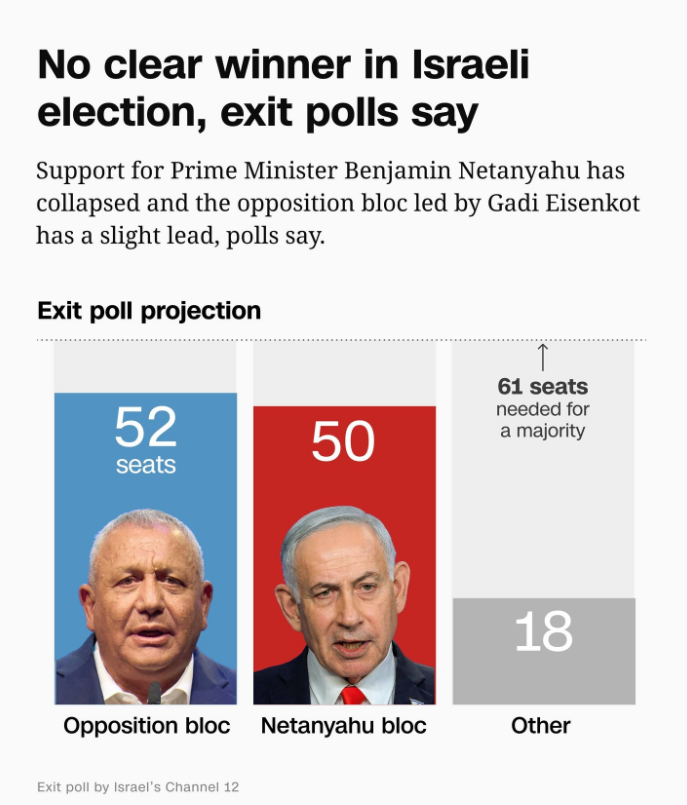
Israel’s first election since the October 7 attacks has produced no clear winner, with both Prime Minister Benjamin Netanyahu and challenger Gadi Eisenkot short of the 61 Knesset seats needed for a majority. Initial Channel 12 exit polling gave Eisenkot’s bloc 52 seats, Netanyahu’s bloc 50 and Arab parties 18, but revised polls and partial official counting later improved Netanyahu’s position without delivering a majority. Turnout reached 77.7%, the highest in more than two decades, while coalition negotiations are expected to determine who ultimately forms the next government. Reuters
Israel has entered a period of intense political uncertainty after its first national election since the October 7, 2023 Hamas-led attacks produced no immediate parliamentary majority for either Prime Minister Benjamin Netanyahu or his principal rival, former military chief Gadi Eisenkot. Exit polls released after voting ended on Tuesday initially gave Eisenkot’s opposition bloc a narrow advantage, but updated projections and early official counting shifted the picture overnight, leaving both camps well short of the 61 seats required to control the 120-member Knesset and pointing toward potentially difficult coalition negotiations.
The election recorded turnout of 77.7 percent, the highest level seen in Israel in more than two decades and a significant increase from the 2022 contest. The unusually high participation reflected the extraordinary political and security environment surrounding the vote, which followed three years shaped by the October 7 attacks, the war in Gaza, fighting with Hezbollah in Lebanon, confrontation with Iran and continuing disputes over military service, judicial reform and responsibility for the security failures that preceded the Hamas assault.
The first mainstream television exit polls produced a striking setback for Netanyahu’s governing alliance. Channel 12 initially projected 52 seats for the bloc of parties seeking to replace him, 50 seats for Netanyahu and his allies and 18 seats for Arab-led parties. Channels 11 and 13 produced broadly similar early projections, with the opposition between 52 and 53 seats, Netanyahu’s bloc around 50 and Arab parties between 17 and 18.
Those numbers immediately made clear that neither Netanyahu nor Eisenkot had secured an outright governing majority. In Israel’s parliamentary system, voters choose political parties rather than directly electing a prime minister, and a government normally requires the support of at least 61 members of the Knesset. That means even the largest individual party cannot govern alone unless it can assemble enough coalition partners after the results are certified.
The early projections also suggested a major decline for Netanyahu’s bloc compared with the outgoing parliament. His coalition had held 68 seats in the previous Knesset, giving it a comfortable majority before the election. The first exit polls suggested that strength had fallen dramatically, even though Likud remained on course to emerge as the largest individual party.
Eisenkot’s Yashar party also performed strongly enough to establish him as the central challenger to Netanyahu. The former Israel Defense Forces chief of staff built his campaign around a message of leadership change, national unity and institutional reform, while presenting his military background as an alternative to Netanyahu’s long experience in office.
However, the early exit-poll advantage did not translate into an obvious route to government. Even with 52 or 53 seats among the principal opposition parties, Eisenkot remained several seats short of a majority and would require support, cooperation or abstention from parties outside his core bloc.
Arab parties therefore emerged as potentially decisive actors. Early projections gave the Joint List and Ra’am a combined 17 to 18 seats, with some updated television polls putting them as high as 19. That represented one of the strongest combined performances ever projected for Arab-led parties in an Israeli election and reflected especially high turnout among Arab citizens.
Channel 12 reported Arab voter turnout at approximately 80 percent, a particularly significant development because participation among Arab citizens has varied considerably in previous elections. The strong turnout gave Arab parties greater parliamentary weight and increased the likelihood that their decisions after the election could influence which candidate is able to assemble a government.
Their position is complicated by the fact that both major camps have placed limits on cooperation with Arab parties. Netanyahu and several of his allies have rejected forming a government dependent on them, while Eisenkot has also been reluctant to commit to a formal coalition partnership. That leaves open a range of less direct possibilities, including external support for a minority government, abstention during confidence votes or selective parliamentary cooperation.
As the night progressed, revised exit polls narrowed and in some cases reversed the opposition’s initial advantage. Updated Channel 12 projections later gave Netanyahu’s bloc 52 seats and the principal opposition 49, with Arab parties holding the remaining seats. Other mainstream broadcasters moved closer to an effective tie, projecting approximately 51 seats for each major bloc.
Those shifts demonstrated the limitations of exit polling in an exceptionally close election. The initial projections were based on samples of voters leaving polling stations, while later updates incorporated additional data and adjustments. Even relatively small changes around the electoral threshold can move several Knesset seats from one bloc to another.
The official count then began producing another evolving picture. Early Wednesday morning, partial results from Israel’s Central Elections Committee showed Likud leading the individual party vote. With around 40 percent of ballots counted, Likud had approximately 21.7 percent of the vote compared with roughly 15.7 percent for Eisenkot’s Yashar.
Seat projections based on the incomplete count temporarily put Netanyahu’s bloc further ahead than the mainstream exit polls. At one stage, with approximately 42 percent of ballot boxes counted, projections based on the partial results gave Netanyahu’s allies about 57 seats, the opposition 47 and Arab parties 16.
As counting progressed beyond the halfway point, that gap narrowed. Updated projections from the partial tally placed the pro-Netanyahu bloc around 55 seats, the opposition around 50 and Arab parties around 15. None of those figures represents a final result, and the distribution can still change substantially as additional polling stations and special ballots are counted.
The late-count ballots are especially important because soldiers, diplomats and other voters who cast ballots in so-called double envelopes are counted separately and can differ politically from ballots counted earlier. Parties close to Israel’s 3.25 percent electoral threshold can also dramatically alter the final distribution if they either cross or fall below the line required to enter parliament.
This means neither Netanyahu nor Eisenkot can responsibly be declared the winner while counting remains incomplete. The election determines the composition of the Knesset, but the identity of the next prime minister will ultimately depend on coalition negotiations and recommendations made to President Isaac Herzog after the official results are certified.
Herzog will consult representatives of the parties elected to parliament and ask the lawmaker he believes has the best chance of forming a government to try to assemble a coalition. That person normally receives 28 days to do so and can potentially receive an additional two weeks.
If the first candidate fails, another political leader can be given an opportunity. If no candidate can secure sufficient parliamentary support after the available procedures are exhausted, Israel could eventually face another election.
That scenario would not be unprecedented. Between 2019 and 2022, Israel held five national elections in just three and a half years as political blocs repeatedly failed to establish durable parliamentary majorities.
The possibility of another prolonged deadlock is particularly significant because Israel faces major decisions on security, the economy, military recruitment and its relationships with the United States and neighbouring states. A caretaker government can continue exercising authority, but difficult coalition negotiations could delay domestic policy decisions and deepen political uncertainty.
Netanyahu has already framed the election as evidence that Israel’s right-wing electorate remains substantial. Addressing supporters after the vote, he called for the formation of what he described as a strong right-wing government and highlighted military operations carried out under his leadership since October 2023.
Eisenkot, meanwhile, argued that the election demonstrated public demand for political change. He urged Netanyahu to accept responsibility for the result and promoted his own bloc as an alternative government, although his ability to turn that argument into a majority will depend on the final numbers and his willingness to negotiate with parties outside his core alliance.
The contest is deeply connected to Israel’s security crisis. It was the first national election since Hamas fighters attacked southern Israel on October 7, 2023, killing around 1,200 people and taking approximately 250 hostages according to Israeli figures. The attack triggered the Gaza war and fundamentally reshaped Israeli politics.
Netanyahu’s supporters have focused heavily on Israel’s subsequent military operations against Hamas, Hezbollah and Iran and argue that the government demonstrated determination against regional threats. His critics have focused on the government’s responsibility for the failures that allowed the October 7 attack to occur and on the social, military and diplomatic costs of the wars that followed.
The election campaign was also shaped by the issue of ultra-Orthodox military service. Secular and national-religious Israelis have increasingly demanded wider conscription among ultra-Orthodox men as the military carries a heavy burden after years of conflict. Netanyahu’s traditional reliance on ultra-Orthodox parties has made the issue particularly sensitive within his coalition.
Eisenkot, who lost his son Gal during the Gaza war, made military service and equal national responsibility prominent parts of his campaign. His personal experience and former position as military chief gave the issue additional political weight.
Economic pressures also affected the vote. Years of military mobilisation, defence spending and uncertainty have weighed on Israel’s economy, while households have faced concerns over living costs, taxation and the long-term financial consequences of the conflict.
The political environment was further complicated by Netanyahu’s long-running corruption trial and continuing disputes over the judiciary. His opponents have accused previous governments of trying to weaken institutional checks on executive power, while Netanyahu and his allies have argued that judicial changes are necessary to correct what they consider excessive influence by unelected judges.
Against that background, the surge in Arab participation may prove one of the election’s most consequential developments. Arab citizens comprise roughly one-fifth of Israel’s population, but political participation has often fluctuated depending on party unity, confidence in the political system and disagreements over whether Arab lawmakers should cooperate with Zionist parties.
The projected 17 to 19 seats for Arab parties would give them substantial parliamentary leverage if the final count remains close. Even without entering a coalition, their votes or abstentions could influence whether a minority government survives confidence motions.
Such arrangements are politically controversial. Netanyahu and his far-right partners have campaigned strongly against dependence on Arab parties, while some opposition voters are also uncomfortable with a government reliant on outside Arab support.
At the same time, Arab political leaders argue that their voters are Israeli citizens entitled to full political participation and that excluding their representatives from coalition calculations undermines democratic representation.
The high Arab turnout therefore has implications beyond seat arithmetic. It demonstrates a high level of political mobilisation among communities that have often expressed frustration over discrimination, violence in Arab towns, policing, housing and government investment.
Another important feature of the result is the continued strength of Likud as an individual party. Even though Netanyahu’s wider bloc appears far weaker than its outgoing 68-seat majority, Likud remains projected as the largest single faction in the Knesset.
That could strengthen Netanyahu’s argument to President Herzog that he should receive the first opportunity to form a government, although the president is not required simply to select the leader of the largest party. Herzog will instead examine which candidate appears most capable of commanding parliamentary support.
Eisenkot can make a competing case if parties representing more lawmakers recommend him. The recommendations made by Arab parties could therefore become central even if they do not formally join his coalition.
Coalition arithmetic will also depend on smaller parties that may find themselves under intense pressure from both camps. A party with only a handful of seats can become decisive when neither major bloc is close to 61.
Political negotiations could therefore involve ministerial appointments, policy concessions, agreements on military service, judicial issues, economic programmes and security strategy. Such talks in Israel frequently last weeks and sometimes fail entirely.
The final result is expected to become clearer over the next 48 hours, although formal certification will take longer. Even after every vote is counted, the country may still not know who will become prime minister because parliamentary negotiations rather than the raw vote alone determine the government.
The current partial results therefore should be treated differently from the first exit polls. The initial Channel 12 projection showing Eisenkot’s bloc at 52 seats, Netanyahu at 50 and Arab parties at 18 was a credible snapshot when voting ended, but it is no longer the latest available picture.
Updated counting has produced a somewhat stronger showing for Netanyahu’s bloc, although it remains below the 61 seats required for a majority. That makes the central conclusion unchanged: neither major camp currently has a clear route to govern alone.
The final tally may alter the relative strength of Netanyahu and Eisenkot, but unless one camp unexpectedly reaches 61, coalition building will determine the outcome.
Israel therefore enters the post-election period with three distinct political forces: Netanyahu’s right-wing and religious bloc, Eisenkot’s opposition alliance and a strengthened Arab parliamentary presence capable of influencing government formation.
That configuration creates multiple possibilities but no simple majority. A Netanyahu-led coalition would require additional lawmakers beyond his traditional allies. An Eisenkot-led government would similarly require support beyond his current bloc and could depend, directly or indirectly, on Arab parties.
A unity government is another theoretical possibility, although major political and personal divisions would make negotiations difficult. Israel has previously used unity and rotating-premiership arrangements when elections produced fragmented parliaments, but no agreement of that kind has been announced.
Until coalition negotiations begin in earnest, the most accurate description of the election is therefore a parliamentary deadlock rather than a victory for either Netanyahu or Eisenkot.
The scale of turnout demonstrates that Israelis treated the election as exceptionally consequential. Nearly four out of every five eligible voters participated, reflecting the political intensity surrounding national security, leadership and the direction of the country after the October 7 attacks and years of regional conflict.
The election has also significantly reduced the parliamentary dominance Netanyahu’s outgoing coalition enjoyed, even if the final official count ultimately gives his bloc more seats than the opposition. Moving from 68 seats in the previous Knesset to the low-to-mid 50s would represent a major change in the balance of power and force Netanyahu to seek partners he did not previously require.
For Eisenkot, strong opposition numbers establish him as a serious contender for government but do not automatically hand him the premiership. His challenge will be converting electoral dissatisfaction with Netanyahu into a workable parliamentary majority among parties with substantial ideological differences.
Arab parties may hold the key to that process, but their participation would require difficult decisions on all sides. Whether they become formal coalition partners, outside supporters or remain in opposition could determine whether Israel forms a government quickly or returns to prolonged instability.
For now, officials continue counting ballots, and the numbers remain fluid. The final composition of the Knesset is expected to become substantially clearer by Thursday or Friday, after which President Herzog will begin the formal process that could ultimately determine who leads Israel’s next government.
What is already clear is that Israel’s first election since October 7 has not delivered the straightforward mandate either major camp wanted. Netanyahu remains politically competitive, Eisenkot has built a substantial opposition bloc and Arab parties have emerged with unusual leverage after historically high turnout.
The decisive phase may therefore begin only after the votes are counted. Israel’s voters have chosen a highly fragmented parliament, and the battle over who governs next will now move from polling stations to negotiations between party leaders.