ISRAELI ROADBLOCKS ISOLATE BEIT ULA INDUSTRIAL ZONE, PUTTING THOUSANDS OF PALESTINIAN JOBS AT RISK
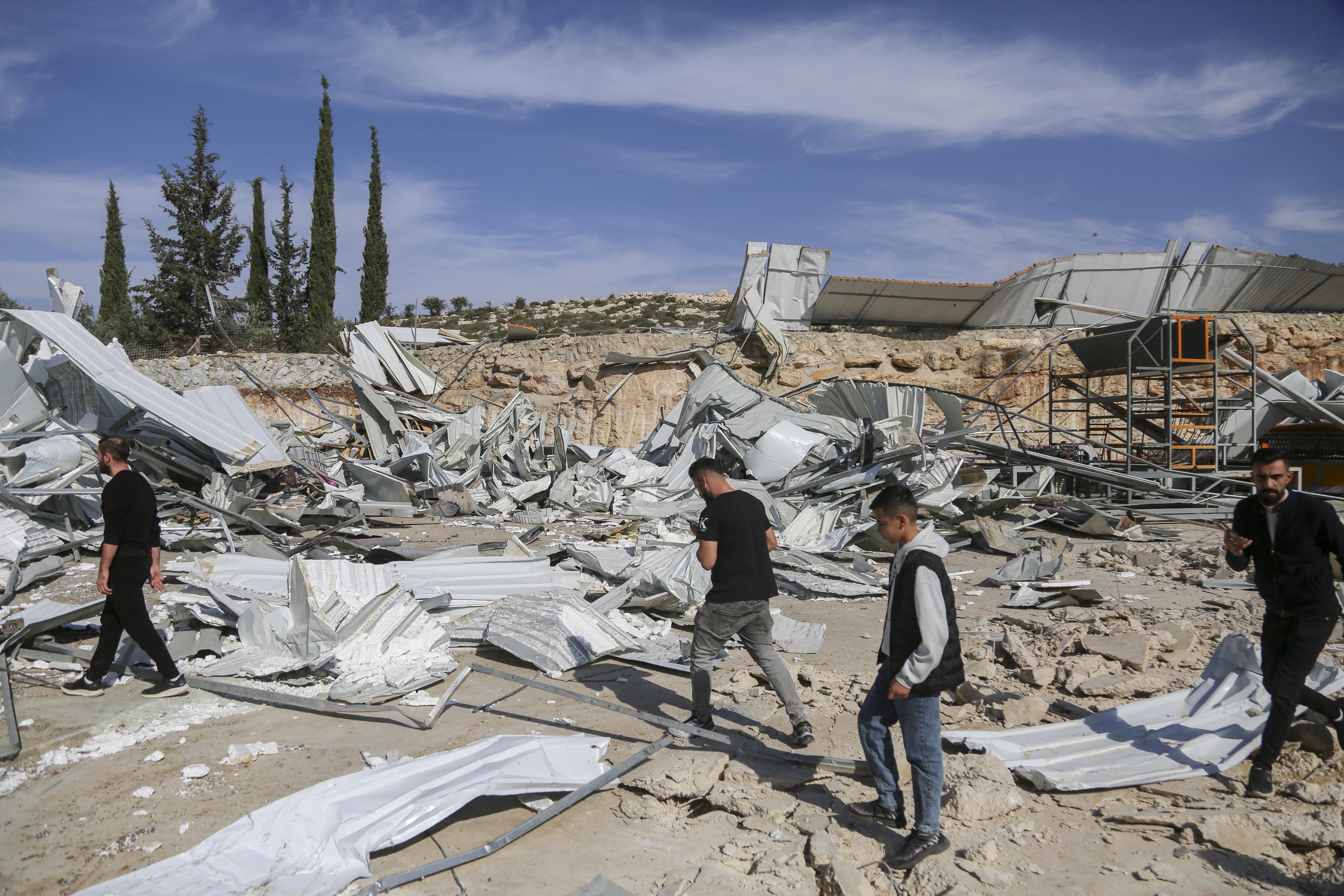
Israeli forces blocked roads leading to the Beit Ula industrial zone west of Hebron on November 4, using earth mounds and large stones. Palestinian business officials say the area contains more than 60 factories and industrial facilities employing approximately 2,500 workers, while the restrictions have disrupted truck access, raw-material supplies and movement of finished products.
HEBRON, OCCUPIED WEST BANK — Israeli forces have effectively cut off one of the most important industrial areas west of Hebron by blocking roads leading to the Beit Ula industrial zone with earth mounds and large stone barriers, disrupting factories, preventing workers and commercial vehicles from reaching businesses and placing thousands of Palestinian livelihoods under growing pressure. Local business leaders say more than 60 factories and industrial enterprises operate in the zone and collectively provide income for about 2,500 workers, while United Nations humanitarian officials have independently confirmed that the November restrictions have affected access to livelihoods, agricultural land and industrial facilities in the area.
The closures began on November 4 when Israeli military vehicles accompanied by a bulldozer entered Beit Ula, northwest of Hebron, and blocked several roads leading west from the town. Palestinian news agency WAFA reported that the barriers cut access not only to the industrial zone but also to agricultural land and a local electricity facility, while business owners said trucks carrying raw materials and finished goods were immediately prevented from reaching or leaving factories. The restrictions remained in place for days afterward, prompting demonstrations by factory owners, employees, commercial organizations and local officials demanding that the roads be reopened.
The United Nations Office for the Coordination of Humanitarian Affairs confirmed in its November 13 humanitarian report that Israeli forces had closed roads leading to Beit Ula’s industrial zone and surrounding farmland, affecting the livelihoods of hundreds of families and access to at least 15 industrial facilities directly assessed by humanitarian monitors. OCHA said Israeli forces reportedly attributed the restrictions to efforts to prevent Palestinians without permits from crossing into Israel through openings in the separation barrier, providing the clearest available account of the Israeli security rationale behind the measure.
That explanation has not satisfied Palestinian business owners, municipal officials or commercial organizations, which argue that sealing the industrial area imposes sweeping economic consequences on companies and workers who are not accused of attempting unauthorized crossings. Mahmoud Allan, head of the North Hebron Chamber of Commerce, Industry and Agriculture, said the industrial zone contains more than 60 large factories and other businesses operating across metalworking, stone and marble, timber, agricultural trade and related sectors, with approximately 2,500 people dependent on employment there.
Allan said the closure had caused daily losses running into millions of shekels because factories could not bring in raw materials, employees were unable to reach workplaces normally and companies could not transport completed products to customers. One of the affected businesses is described as a major animal-feed producer supplying roughly one-fifth of West Bank demand, meaning disruption in Beit Ula has the potential to extend beyond the immediate industrial area into agricultural supply chains and livestock production elsewhere in the territory.
Local manufacturer Mohammad al-Amleh told Arab media that his construction-products factory alone employs around 70 workers in addition to engineers and truck drivers. He said many of them had been unable to reach the facility after the main access route was closed, while transport restrictions prevented the routine movement of commercial goods necessary to maintain production.
The dispute is particularly sensitive because Palestinian business owners say the industrial area lies in territory classified as Area B under the Oslo framework, where the Palestinian Authority maintains civil administration while Israel retains overriding security powers. According to local owners, the zone sits hundreds of meters from Area C, where Israel exercises both civil and security control, strengthening their argument that industrial operations should not be effectively paralyzed by a barrier associated with movement toward Israel.
The Israeli authorities have long argued that movement restrictions, roadblocks and barriers in the West Bank are necessary to prevent attacks and unauthorized entry into Israel, particularly where gaps in the separation barrier have been used by Palestinian workers lacking Israeli permits. Israel sharply reduced the number of Palestinian workers permitted to enter its labor market after October 2023, and unauthorized crossings have remained a persistent security concern for Israeli authorities.
Palestinians, humanitarian organizations and rights groups, however, argue that broad movement restrictions frequently extend far beyond targeted security enforcement and have major consequences for people who are not suspected of any offence. The Beit Ula closure illustrates that tension particularly clearly because a measure described as preventing unauthorized crossings has simultaneously restricted access to workplaces, farms and commercial supply chains used by thousands of people.
The economic consequences arrive at an especially difficult moment for the West Bank economy. World Bank figures show that economic activity in the West Bank contracted by 5.2 percent in the first quarter of 2026 as restrictions on movement, the withholding of Palestinian clearance revenues and dramatically reduced employment opportunities inside Israel continued to weigh on households and businesses. Unemployment stood at 27.9 percent in the second quarter, remaining far above pre-war levels despite a partial recovery in Palestinian employment in Israel.
That environment makes the potential loss of thousands of industrial jobs in one locality particularly consequential. Manufacturing jobs provide relatively stable domestic employment compared with the increasingly uncertain system under which many West Bank Palestinians historically traveled to work inside Israel or Israeli settlements. When industrial zones are blocked, the impact therefore extends beyond company owners to workers who may have few alternative sources of income.
The Beit Ula industrial zone is not facing restrictions for the first time. Throughout 2025 and 2026, Israeli authorities have carried out demolitions against industrial and agricultural structures in and around the town, generally citing the absence of Israeli-issued construction permits. In December 2025, Israeli forces demolished a factory of approximately 3,000 square meters in the area, while additional workshops and industrial structures were demolished during operations in 2026.
In April, Israeli forces demolished wood and metal workshops in Beit Ula, and in July they demolished another factory producing metalwork and solar-panel supports along with agricultural structures and sections of cultivated land. Local residents said the July operation destroyed machinery, stock and office facilities before owners could remove them, while Beit Ula officials said the cumulative loss from repeated factory demolitions amounted to millions of dollars.
Those earlier demolitions were justified on planning and permit grounds and should be distinguished from the current road closure, which the UN says Israeli forces linked to unauthorized entry through the barrier. For Palestinian businesses, however, the different measures form part of a cumulative pattern in which construction restrictions, demolitions and movement controls increasingly affect economic activity around the town.
The municipality has also faced restrictions affecting agricultural land. OCHA reported in October that access to approximately 1,500 dunums around Beit Ula had become severely constrained and that the municipality was informed in January that roughly 1,300 dunums had been declared a closed military zone for one year. The affected land includes olive groves, seasonal farmland and grazing areas, meaning restrictions have touched both industrial and agricultural income streams.
OCHA said Beit Ula demonstrates how military orders, settlement expansion, settler activity and barrier-related restrictions can combine to isolate Palestinian land and reduce access to established livelihoods. That assessment provides a wider context for the industrial-zone dispute because workers and business owners are confronting the road closures in a locality already dealing with extensive access limitations.
The current restrictions also fit into a much larger West Bank system of movement obstacles. In an April 2026 survey, OCHA documented 925 permanent or intermittent physical barriers restricting the movement of approximately 3.4 million Palestinians across the West Bank, including East Jerusalem, the highest figure it had recorded and 43 percent above the average of the previous two decades. Those obstacles included checkpoints, road gates, earth mounds, trenches, roadblocks and other barriers.
Earth mounds such as those used at Beit Ula are among the simplest but most effective forms of road closure because they can be erected rapidly by military bulldozers and are extremely difficult for ordinary vehicles to cross. Unlike staffed checkpoints, they provide no regular mechanism through which workers or commercial traffic can seek permission to pass, forcing drivers either to abandon the route or use potentially lengthy alternative roads where such alternatives exist.
For an industrial zone, that distinction can be financially devastating. Manufacturing operations depend on predictable truck access for fuel, raw materials, packaging, maintenance equipment and finished products. Even when some workers can reach factories on foot or via indirect routes, production may still stop if heavy vehicles cannot enter.
The closure can therefore create losses long before businesses physically shut down. Manufacturers may miss delivery deadlines, lose clients, pay employees for idle time, face penalties under supply contracts and incur additional storage costs as finished products accumulate inside factories. Raw materials can also spoil or become unavailable, particularly in agricultural and food-related industries.
Local Palestinian officials have described those consequences as a direct threat to the regional economy. At a protest on November 5, factory owners, employees and representatives of public and private institutions called on Israeli authorities to remove the barriers immediately, arguing that workers and businesses should not collectively bear the cost of a security measure directed at people attempting to cross elsewhere.
Beit Ula Mayor Mahmoud al-Sarrahin said the closure had isolated both the industrial area and surrounding Palestinian land. He described the economic zone as a significant source of income for the town and surrounding communities and warned that prolonged restrictions could push workers already facing economic hardship into unemployment.
The head of the North Hebron chamber of commerce went further, arguing that the measure was damaging the Palestinian private sector and weakening its ability to sustain employment. That claim represents the view of Palestinian business organizations rather than a stated Israeli policy objective, and there is no public evidence reviewed by VNTV showing that Israeli authorities have formally described the closure as an economic measure.
The available Israeli rationale, as reported by the United Nations, remains security-related: preventing unauthorized Palestinian workers from reaching Israel through openings in the barrier. Israeli authorities have not publicly provided detailed information establishing how many unauthorized crossings had taken place in the area, whether specific factories were suspected of involvement or why complete road closures were considered necessary rather than narrower enforcement measures.
The absence of such detail makes it difficult to independently assess the proportionality of the response. Preventing unauthorized border crossings is a legitimate security and immigration enforcement objective, but international humanitarian organizations have repeatedly argued that restrictions imposed in occupied territory should be necessary, proportionate and designed to minimize harm to civilian life.
The West Bank has experienced a substantial expansion of movement restrictions since October 2023. OCHA says checkpoints and road gates now form the backbone of an access regime that affects employment, healthcare, education, agriculture and commerce across Palestinian communities. Hebron governorate has been particularly affected because of its complicated geography, Israeli settlements, military zones and the divided status of Hebron city itself.
Within Hebron’s H2 area, where several hundred Israeli settlers live among thousands of Palestinians under direct Israeli security control, new gates and movement restrictions have progressively reduced Palestinian access to the Old City, markets, the Ibrahimi Mosque and residential neighborhoods. OCHA reported in July that approximately 7,000 Palestinians in H2 were subject to a tightly regulated checkpoint system.
Beit Ula lies outside that urban H2 system, but the wider Hebron restrictions affect its economy indirectly because businesses depend on roads linking communities throughout the governorate. A factory that remains technically open may still struggle if workers, customers or suppliers face checkpoints elsewhere along the route.
The restrictions are also occurring amid escalating Israeli settler violence in other parts of the West Bank. OCHA recorded 52 settler attacks causing casualties or property damage during the week of November 3 to 9 alone and said October produced the highest monthly number of such incidents since the UN began documenting them in 2006. The UN documented 467 attacks during October.
Those attacks and access restrictions are separate phenomena and should not automatically be conflated, but both contribute to an increasingly difficult operating environment for Palestinian farmers and businesses. In neighboring parts of the West Bank, industrial and agricultural equipment has been vandalized or burned in settler attacks, while military restrictions have limited farmers’ access to olive groves and other land.
On November 9, for example, Israeli settlers attacked the industrial zone in Beita, south of Nablus, burning bulldozers, vehicles and equipment belonging to stone-cutting businesses. Palestinian sources said Israeli forces entered the town during the incident, while the Israeli military’s detailed account of the episode was not immediately available in the reporting reviewed by VNTV.
Such incidents heighten the concerns of industrial operators in Beit Ula because their businesses represent large fixed investments that cannot simply relocate when security conditions deteriorate. Factories contain machinery, warehouses, specialized electrical systems and production lines worth millions of dollars, making even temporary isolation financially damaging.
The animal-feed factory cited by local commercial officials illustrates that broader economic importance. If a plant supplying an estimated 20 percent of West Bank feed demand cannot move products normally, farmers outside Hebron may face higher costs or shortages, creating secondary effects on poultry, dairy and livestock production.
Metalworking businesses are similarly connected to construction throughout the Palestinian economy. Beit Ula factories produce doors, frames, construction components and other products used on building sites, while stone and marble industries form an important component of Hebron’s commercial identity and export activity.
Hebron is one of the West Bank’s principal industrial centers, with manufacturing ranging from stone cutting and metalwork to leather, footwear, food products and furniture. Restrictions affecting factories around the governorate therefore have consequences extending beyond the immediate town.
The Palestinian economy has little capacity to absorb prolonged industrial shutdowns. World Bank analysis has warned that domestic job creation in the West Bank remains structurally inadequate, while employment inside Israel has not returned to anything approaching pre-October 2023 levels. Before the conflict, more than 177,000 Palestinians worked in Israel and settlements; by late 2025, the figure remained only a fraction of that level.
That makes local private-sector employers increasingly important. Each factory job may support an entire household, meaning the 2,500 workers cited by Palestinian commercial officials represent potentially many thousands more dependents.
The phrase “2,500 workers affected” should nevertheless be understood carefully. It does not mean all 2,500 have permanently lost their jobs. Business leaders say approximately that number are employed across the industrial zone and their access and income are threatened by the restrictions. Some may continue working intermittently or reach factories by alternative means, while others may be unable to work at all depending on the specific location of their employer.
Similarly, the claim that the zone contains more than 60 factories comes from Palestinian business and municipal representatives rather than an independent UN inventory. OCHA’s November 13 report directly verified impacts on at least 15 industrial facilities during its reporting period, while local organizations give a substantially larger figure for the entire industrial area.
Those figures are not necessarily contradictory. The UN report describes facilities directly affected in its humanitarian assessment, whereas Palestinian chambers of commerce are referring to the full industrial cluster and broader workforce.
The continuing closure is also affecting agricultural areas west of Beit Ula. Farmers have reported difficulty reaching olive groves and other cultivated land, adding another layer of economic pressure during a period in which the annual olive harvest is a major source of household income.
OCHA says movement restrictions and settler violence have already disrupted the 2026 olive harvest across numerous West Bank communities, with farmers facing denied permits, shortened access periods and physical attacks. In some areas, access that was formally coordinated with Israeli authorities was still interrupted by settlers or military restrictions.
The impact on agriculture is particularly important in Beit Ula because the town’s western lands overlap with areas already affected by a closed military zone and the separation barrier. The latest roadblocks therefore compound restrictions that existed before November.
The separation barrier itself remains one of the most consequential physical features shaping Palestinian movement. OCHA says approximately 85 percent of its planned or constructed route lies inside the West Bank rather than along the internationally recognized Green Line, separating many Palestinian communities from farmland, workplaces and neighboring towns. Israel says the barrier was built primarily as a security measure after suicide bombings during the Second Intifada and credits it with helping reduce attacks.
Palestinians and international bodies have long challenged the route where it extends inside occupied territory. The International Court of Justice concluded in a 2004 advisory opinion that sections built inside the West Bank and the associated regime violated international law, a position Israel rejected, arguing that the barrier was a temporary security measure responding to attacks rather than a political border.
The present Beit Ula dispute connects directly to that long-running controversy because the Israeli rationale reported by OCHA centers on Palestinians entering Israel through openings in the barrier. Business owners are effectively arguing that a security problem at the barrier should be addressed at the crossing points themselves rather than by blocking industrial access roads.
Whether Israeli authorities eventually adopt a narrower measure remains unclear. No timetable for reopening the routes was included in the UN report, and Palestinian officials said the barriers remained in place days after the initial operation.
The duration will determine much of the eventual economic damage. A closure lasting several days may create lost production and delayed shipments but remain recoverable for larger companies. A closure lasting weeks could force factories to suspend contracts, reduce working hours, furlough employees or shut down entirely.
Smaller companies are particularly vulnerable because they often lack significant cash reserves and depend on daily production to meet wages and operating expenses. An inability to move goods can quickly become a liquidity crisis even if machinery and buildings remain undamaged.
The Palestinian Authority has limited capacity to offset those losses because it is experiencing one of its most serious fiscal crises in years. Israel has withheld significant Palestinian clearance revenues, while economic contraction has reduced domestic tax receipts and forced the PA to make partial salary payments to public employees.
That financial weakness makes local private enterprise even more important as a source of income that does not depend directly on public-sector salaries. Disruption of industrial areas therefore compounds both household hardship and broader fiscal pressure.
Israel argues that security needs must remain paramount in the West Bank, particularly amid continuing attacks against Israeli civilians and soldiers. Israeli authorities have repeatedly increased checkpoints and road closures following security incidents, describing them as necessary to prevent attackers from moving freely and to protect Israeli communities.
Palestinians counter that broad restrictions frequently amount to collective punishment because entire towns can lose access to work and services following incidents for which most residents have no responsibility. International humanitarian organizations have regularly called on Israel to ensure security measures do not unnecessarily restrict civilian movement.
The legal context remains contested. Israel captured the West Bank from Jordan in the 1967 Arab-Israeli war and maintains military control over much of the territory, while Palestinians seek the West Bank, Gaza and East Jerusalem as the basis of an independent state. Most of the international community considers Israeli settlements in the West Bank illegal under international law, a position Israel disputes.
Under the Oslo arrangements of the 1990s, the West Bank was divided into Areas A, B and C, with varying combinations of Palestinian civil authority and Israeli security control. Those arrangements were intended as transitional but remain largely in effect decades later.
Beit Ula’s industrial-zone dispute therefore takes place within an administrative system where Palestinian businesses can operate under Palestinian civil jurisdiction while surrounding roads, security arrangements and access routes remain heavily influenced by Israeli military authority.
That fragmentation creates recurring commercial uncertainty. Businesses can hold local licenses, employ workers and invest in facilities yet still depend on access controlled through Israeli security measures, making transportation and logistics vulnerable to sudden closures.
For international investors, that unpredictability is one reason the Palestinian private sector struggles to attract long-term capital. Companies considering expansion have to account not only for ordinary commercial risk but also for road access, permitting, customs arrangements and the possibility of military restrictions disrupting operations.
The current closure thus has significance beyond the immediate value of goods delayed in Beit Ula. It reinforces a wider perception among Palestinian businesses that investment can be jeopardized by decisions over which they have limited influence or legal recourse.
The human impact is more immediate. Employees told local media that they feared losing wages needed for rent, food, school costs and debt repayments if production remained suspended. In an economy with unemployment approaching 28 percent, finding alternative work quickly is difficult.
Workers who previously held permits to work inside Israel have already experienced years of instability after those permits were revoked or reduced following October 2023. For some families, factory work in towns such as Beit Ula became an alternative source of income after access to the Israeli labor market disappeared.
The closure therefore risks removing one of the few remaining economic buffers available to households already dealing with reduced earnings and rising costs.
Palestinian officials are pressing international organizations and diplomatic missions to intervene. Business leaders have called for pressure on Israel to reopen the roads and have framed the industrial zone as civilian economic infrastructure rather than a security site.
There has been no indication that foreign governments have yet secured a change in the Israeli position. The United Nations has documented the impact but does not possess authority to compel the military to remove the barriers.
Humanitarian agencies can sometimes negotiate temporary access arrangements, but industrial traffic requires regular and predictable movement rather than occasional humanitarian coordination. A factory dependent on daily truck movements cannot operate sustainably through exceptional access requests.
That distinction separates Beit Ula from some purely humanitarian access disputes. The central question is not only whether food or medical aid can enter but whether an ordinary commercial economy can function under prolonged physical restriction.
The case also illustrates the broader economic dimension of the Israeli-Palestinian conflict, which receives less international attention than military operations and casualties. Roads, permits, checkpoints and industrial access can determine whether thousands of people work even when no shots are fired.
For businesses in Beit Ula, the consequences are already measurable in halted production and delayed transport. Palestinian commercial officials say losses have reached millions of shekels each day, although VNTV could not independently audit those estimates.
The reported scale is plausible given the number and size of the facilities involved, but final losses would depend on the duration of closure, whether production continued at reduced levels and whether delayed orders are eventually fulfilled rather than permanently lost.
If the restrictions remain in place, the economic damage will increasingly move from temporary disruption to structural loss. Customers may shift to alternative suppliers, workers may leave in search of income elsewhere and companies may hesitate to invest further in facilities whose access can be interrupted without warning.
The situation could also affect prices. If important feed, metal, construction or agricultural products become less available, businesses elsewhere in the West Bank may have to purchase alternatives at greater cost.
For Israel, the policy question is whether the security benefit obtained by blocking the industrial roads outweighs those broader civilian consequences and whether less economically disruptive enforcement measures are available. The Israeli military has not publicly provided enough operational detail for that calculation to be independently assessed.
For Palestinians, the closure has become another example of how movement restrictions increasingly shape daily economic life. The protest by workers and factory owners on November 5 was therefore not only a demand to remove physical barriers but a warning that the viability of an entire local industrial economy is at stake.
As of the latest verified reporting, the roads remain subject to restrictions, and there is no publicly announced date for normal access to resume. Palestinian officials continue to demand removal of the earth mounds and stone barriers, while the UN says the closures are already affecting livelihoods and agricultural land.
The strongest verified picture is consequently one of substantial economic disruption but an unresolved security dispute. Israeli forces say the restrictions are connected to attempts to prevent unauthorized entry through the barrier, while Palestinian businesses say the measures have effectively isolated legitimate factories and placed thousands of workers at risk.
What happens next will depend largely on how long that isolation lasts. If access is restored quickly, businesses may still be able to recover much of the lost production. If the roadblocks become prolonged or permanent, Beit Ula could face a deeper industrial contraction at a time when the wider West Bank economy is already struggling with high unemployment, shrinking activity and a record level of movement restrictions.
For the approximately 2,500 workers whose livelihoods are tied to the industrial zone, that distinction is not theoretical. Their income depends on trucks being able to reach factories, factories being able to operate and finished goods being able to leave. More than a week after Israeli forces raised earth mounds across the roads west of Beit Ula, those basic conditions of ordinary economic activity remain under threat.