
IT’S RIDICULOUS. MOURINHO DEFENDS MBAPPÉ OVER PARIS FASHION WEEK AND CYCLING CONTROVERSY
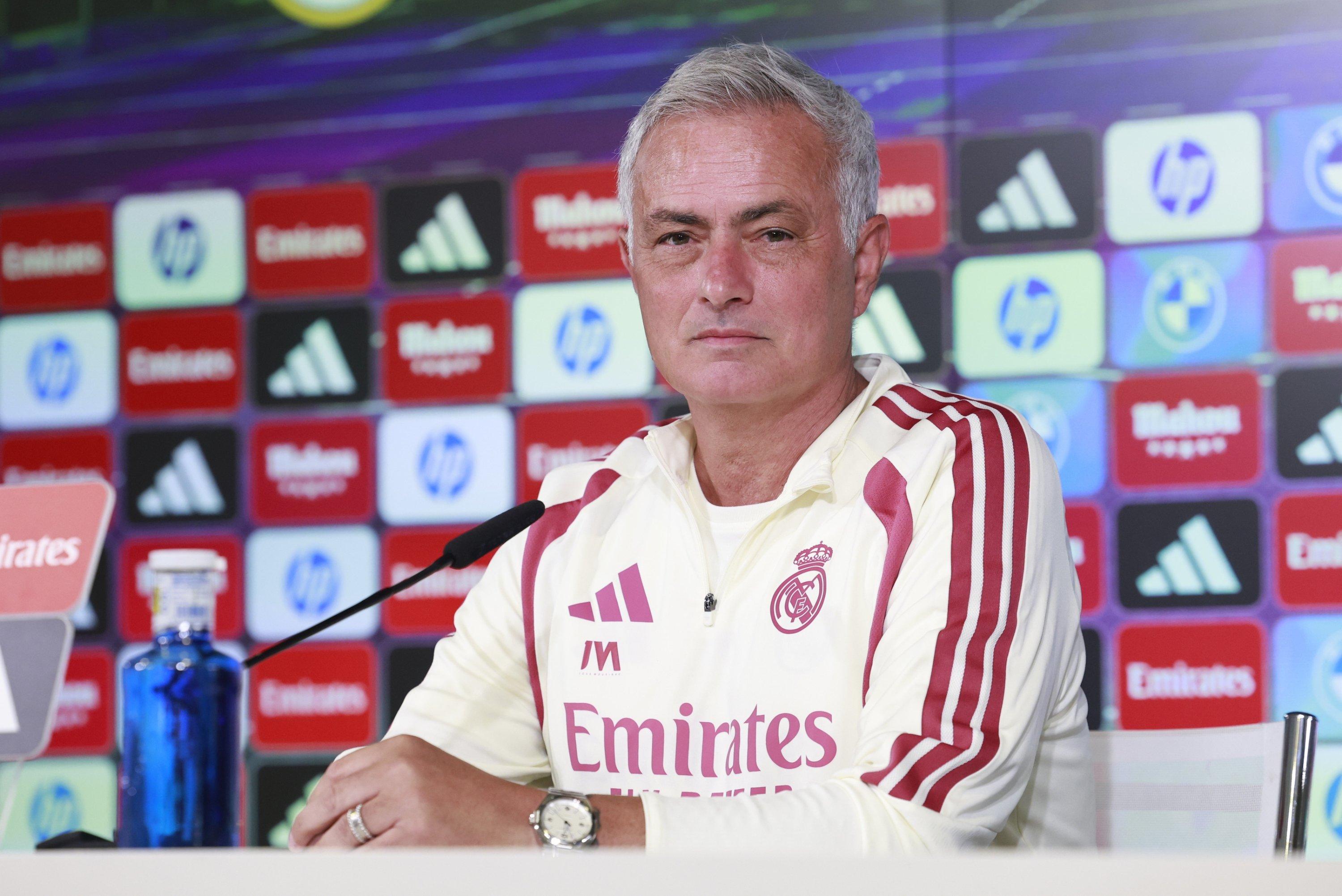
José Mourinho has strongly defended Kylian Mbappé after the France captain was criticized for attending a Paris Fashion Week event and appearing on a bicycle while recovering from a knee injury. Mourinho says Mbappé returned to Real Madrid for assessment, obtained a second medical opinion and complied fully with the club’s recovery plan. He described the controversy as “ridiculous” and said Mbappé’s expected selection against Villarreal proves he has not failed in his responsibilities to Real Madrid.
Real Madrid manager José Mourinho has launched a forceful defense of Kylian Mbappé after the France captain came under criticism for attending a private event during Paris Fashion Week and later appearing on a bicycle while recovering from a knee injury, dismissing the controversy as exaggerated and insisting the forward had fulfilled every obligation expected of him by the club.
Speaking at Real Madrid’s Valdebebas training base on Friday ahead of the club’s La Liga match against Villarreal, Mourinho said Mbappé had behaved professionally throughout the international break, returned to Madrid for assessment after suffering the injury with France and followed the recovery program established by the club. He argued that the controversy surrounding the forward’s activities away from the training ground had grown far beyond what the actual circumstances justified.
Mbappé injured his left knee while playing for France against Turkey in the UEFA Nations League on September 25, scoring the only goal of the match before leaving the field shortly afterward. The French Football Federation subsequently confirmed that the forward would withdraw from the remainder of the international camp and return to Madrid for further treatment. Medical staff from France and Real Madrid communicated over his condition, and Mbappé was placed under the supervision of his club after leaving the national team.
The injury immediately became the subject of intense scrutiny because Mbappé was later seen away from Madrid during his recovery period. Images circulated showing the forward attending an event in Paris associated with Fashion Week, while another video posted to his social-media account showed him riding a bicycle. That second image attracted additional attention because Mourinho had previously spoken publicly about the risks posed by cycling to professional footballers, warning that players had to be careful about activities that could create unnecessary injury risks.
Mourinho, however, rejected the suggestion that Mbappé had ignored club instructions. He said the striker had first returned to Valdebebas, undergone medical examinations and then sought a second opinion on his knee because the problem required careful assessment. According to the Madrid coach, both diagnoses were consistent and the player’s recovery arrangements were properly defined.
The Portuguese manager said the wider debate had become an exercise in what he described as “problem hunting.” He explained that the venue described in some reports as a nightclub was actually being used for a private Paris Fashion Week event and said the bicycle Mbappé used was available at a quiet hotel complex where guests moved between small villas, spa facilities and common areas.
For Mourinho, those details fundamentally changed the way the situation should be understood. The issue, he argued, was not whether Mbappé had been photographed outside his home but whether he had violated the medical or professional responsibilities placed on him by Real Madrid. Mourinho’s answer was unequivocal: he said the forward had not failed the club.
The manager went further by offering what amounted to a public guarantee to Real Madrid supporters. He said any player who failed to behave according to the standards expected of a Real Madrid footballer, either professionally or as a citizen, would not be selected to play. Mbappé’s expected involvement against Villarreal, he said, was therefore proof that he considered the player to have met those standards.
Mourinho’s intervention is significant because it closes off speculation that the club’s coaching staff were privately furious with Mbappé over his activities during the international break. Some reports had suggested the player’s behavior had caused irritation within Madrid, particularly because he was recovering from an injury at the time. Mourinho’s public comments directly challenge that interpretation.
He acknowledged that professional footballers remain responsible for what they do outside formal training hours and said he considers a player to be a player “24 hours a day.” That philosophy has been a recurring feature of Mourinho’s management throughout his career, with the coach often emphasizing discipline, preparation and personal responsibility away from the pitch.
However, he distinguished between genuine misconduct and ordinary personal activity. His argument was that Mbappé’s actions did not cross that line. The forward had returned for treatment, complied with medical instructions and had not undertaken any activity that the coaching staff considered a breach of club rules.
The cycling video had become particularly sensitive because of Mourinho’s earlier comments about players taking unnecessary risks on bicycles. On October 4, Mbappé posted footage showing himself cycling while wearing a helmet, prompting renewed discussion because Mourinho had warned days earlier that cycling could be dangerous for elite players.
The timing of that video was initially unclear, and the footage itself did not establish exactly when or where the ride had taken place. That uncertainty fueled speculation that Mbappé had ignored Mourinho’s advice while recovering from a knee injury.
On Friday, Mourinho provided his own explanation, saying the bicycle was part of the transport arrangements inside a peaceful hotel resort consisting of small houses and communal areas. His description suggested the activity was recreational and limited rather than a demanding road-cycling session.
That distinction matters because professional clubs routinely differentiate between light movement and activities carrying a meaningful risk of injury. A short bicycle ride inside a controlled hotel environment is very different from high-speed cycling on public roads or intense endurance training, particularly for a player undergoing rehabilitation.
Mourinho’s reaction also reflects the unusually intense media environment surrounding Real Madrid. The Portuguese coach said that when it comes to the Spanish giants, ordinary situations often acquire a different scale because of the club’s global profile. He suggested that incidents involving Real Madrid players are magnified in ways that similar events elsewhere might not be.
That argument is hardly new. Madrid remains one of the most closely followed clubs in world football, and Mbappé is arguably its most globally recognizable player. His arrival from Paris Saint-Germain transformed an already heavily scrutinized team into an even greater focus of international attention, meaning almost every injury, goal, public appearance and social-media post can become part of a wider debate.
Mourinho himself is particularly familiar with that environment after returning to Real Madrid for a second spell as manager in 2026. His first period at the club between 2010 and 2013 was marked by enormous media pressure, intense rivalry with Barcelona and frequent public confrontations. His return has once again placed him at the center of one of football’s most demanding jobs.
That experience appears to have shaped the way he responded to the Mbappé controversy. Instead of attempting to distance himself from the issue, Mourinho confronted it directly and accused sections of the media of creating narratives where he believed none existed.
He made a similar point while discussing another Madrid player, Dean Huijsen, saying an apparently innocuous situation involving the defender sitting in a stationary car and sending a message had been transformed into a far more dramatic account. Mourinho used that example to argue that isolated incidents involving Madrid players were being exaggerated.
The broader theme of his press conference was control. Mourinho repeatedly emphasized that Madrid had clear rules governing player recovery, rest and professional conduct during the international break. Players who remained in Spain had specific training or rehabilitation schedules, while those who traveled with national teams were expected to report back according to agreed plans.
He cited Arda Güler as an example, saying the Turkish midfielder received additional rest because he was suspended for one of his country’s matches. Other injured players, including Federico Valverde and Ibrahima Konaté, were expected at Valdebebas for treatment.
Mbappé, Mourinho said, followed the same structure. The forward was assessed in Madrid, obtained an additional medical opinion and continued his recovery. The manager refused to disclose the precise details of the rehabilitation plan, arguing that such medical information did not need to be made public.
The underlying injury remains important to Madrid because Mbappé has become central to the club’s attacking structure. His scoring record since joining the Spanish giants has made him one of the team’s most important players, and any extended absence would create significant tactical problems.
France also relies heavily on him as captain and primary attacking threat. His withdrawal from the Nations League camp therefore attracted attention in both Spain and France, particularly because national-team absences involving high-profile players often produce tension between clubs and federations.
In this case, however, there has been no public indication of a dispute between Real Madrid and the French Football Federation over the injury. France confirmed the knee problem after the Turkey match and released Mbappé from the squad, while Madrid subsequently managed his treatment.
Mourinho’s comments suggest the club is satisfied with how the player handled the situation after returning from international duty. That position is reinforced by his statement that Mbappé is expected to play against Villarreal.
The possibility of the forward being whistled by sections of the Santiago Bernabéu crowd was also raised during Friday’s press conference. Mourinho responded by saying supporters had the right to react however they wished but warned that criticism based on misleading narratives would represent a victory for those who created the controversy.
His message to supporters was essentially that team selection should be read as an indication of his trust. If Mbappé were guilty of serious misconduct, Mourinho said he would not be involved. The fact that he is available for selection means the manager believes he has done nothing deserving internal punishment.
That stance places Mourinho firmly between his player and the criticism surrounding him, something that has often characterized his relationship with key players throughout his managerial career. While he can be highly demanding internally, Mourinho has frequently defended players publicly when he believes criticism from outside the club is unfair.
Mbappé’s case also comes at a sensitive moment for Real Madrid. The team is attempting to build consistency under Mourinho while managing injuries and integrating players after a disrupted international period. Preparations for Villarreal have been complicated by the staggered return of internationals, leaving Mourinho with limited time to train with his full squad.
The Real Madrid coach acknowledged that preparation for the fixture had been difficult because only a small number of players remained at the club throughout the break. Most of the squad returned at different times after representing their national teams, meaning the team had only a short period together before the match.
Despite those difficulties, Mourinho said the squad’s overall professional conduct had been exemplary. He also pointed to the relative absence of new injuries as evidence that the club’s medical and conditioning work had improved, noting that several players currently unavailable were carrying problems dating from the previous season rather than injuries suffered under the current program.
That broader context helps explain his frustration over the focus on Mbappé’s bicycle ride and Fashion Week appearance. From Mourinho’s perspective, the more important story is that Madrid managed the international period without losing multiple players to new injuries and that those requiring treatment followed club instructions.
The manager’s comments also reveal how quickly debates around athlete professionalism can become symbolic. A photograph of a player at a social event or a short video of a bicycle ride can become evidence for competing narratives: one portraying the player as irresponsible, another portraying the criticism as excessive.
In Mbappé’s case, Mourinho has decisively chosen the second interpretation.
There remains a legitimate discussion about the responsibilities of injured players during recovery. Elite clubs invest enormous sums in their squads, and injuries can have major sporting and financial consequences. Coaches therefore routinely restrict activities considered dangerous, particularly skiing, motorcycling and other sports carrying an elevated risk.
Cycling falls into a more ambiguous category because it can be used as part of rehabilitation and conditioning but can also involve accident risk depending on the setting. That makes context critical.
Mourinho’s description of Mbappé’s ride suggests the club did not consider it a meaningful violation. Had Madrid’s medical staff believed the activity endangered his recovery, it is unlikely the manager would have defended it so strongly or immediately restored the player to the matchday plan.
The Fashion Week appearance raises a different issue because it concerns perception rather than physical risk. Injured players are sometimes criticized for attending social events while unavailable for matches, particularly when supporters interpret public appearances as evidence that an injury is not serious.
That interpretation can be misleading. A player being medically unable to compete at elite level does not necessarily mean he must remain confined to bed or avoid all public activity. Knee injuries can prevent sprinting, changing direction and absorbing contact while still allowing ordinary walking, travel and attendance at events.
Mourinho’s argument is essentially that Mbappé’s public appearances should be judged against his rehabilitation obligations rather than against an expectation that an injured player disappear from public life.
The episode also highlights the enormous scrutiny attached to Mbappé personally. As France captain, a Real Madrid superstar and one of the most commercially prominent athletes in the world, his activities generate attention that extends far beyond football.
Every public decision is therefore interpreted through multiple lenses: sporting performance, professionalism, celebrity culture and the expectations that accompany representing both club and country.
Mourinho appears determined to protect Mbappé from what he considers unnecessary distraction. His Friday comments were unusually detailed, offering explanations for each of the main controversies rather than simply saying the matter was internal.
That level of detail suggests the club wanted to shut down speculation decisively before the return of La Liga. Instead of allowing questions about Mbappé’s recovery to continue into the Villarreal fixture, Mourinho used the press conference to draw a clear line under the issue.
His position can be summarized simply: Mbappé was injured playing for France, returned to Madrid for medical assessment, followed the club’s instructions and did nothing that Mourinho considers a breach of his professional responsibilities.
The dispute is therefore likely to move back toward football once Mbappé returns to the pitch. His performance against Villarreal will inevitably shape the next phase of the discussion, particularly if he scores or appears fully fit after the controversy surrounding his recovery.
For Mourinho, however, that should not change the underlying judgment. He has already said his selection decision reflects complete confidence in the player’s conduct.
The controversy also serves as another reminder of how Mourinho manages pressure at Real Madrid. Rather than allowing criticism to remain focused on one of his most important players, he redirected attention toward what he sees as exaggerated media scrutiny and defended the internal standards of his squad.
Whether supporters and Spanish media accept that explanation remains to be seen, but there is little ambiguity about the manager’s position.
Mourinho believes Mbappé met his obligations, believes the criticism surrounding his Fashion Week appearance and bicycle ride has been overblown, and considers the wider controversy “ridiculous.” Most importantly for Real Madrid, he has made clear that the forward remains trusted and available for selection as the club resumes its domestic campaign.