
KIM JONG UN OVERSEES TEST OF NEW COMBAT WEAPON SYSTEM
North Korea says it successfully tested a new combat weapon system on Sunday under the supervision of Kim Jong Un, with the test publicly announced Tuesday. South Korea detected two short range ballistic missiles launched from Wonsan, while analysts say imagery suggests the system could involve an upgraded Hwasong 11 missile with hypersonic capabilities.
North Korea says it has successfully tested a new combat weapon system under the supervision of leader Kim Jong Un, in the latest demonstration of Pyongyang's expanding military capabilities.
The test was conducted on Sunday by North Korea's Missile Administration but was publicly announced by state media KCNA on Tuesday.
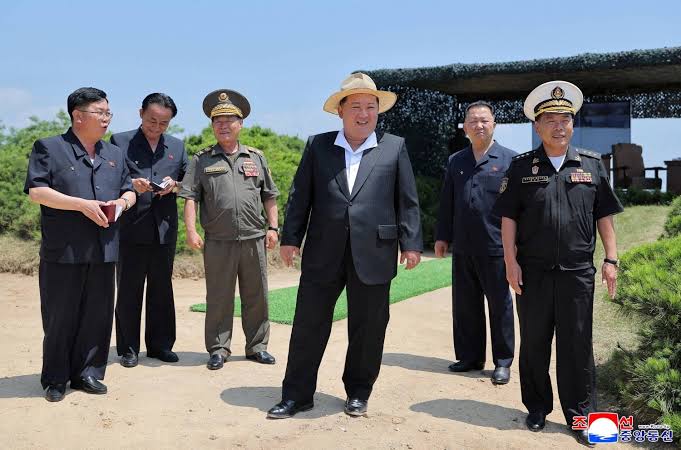
Kim personally observed the test alongside his daughter as North Korea presented the launch as an important development in the modernisation of its armed forces.
KCNA did not formally identify the weapon system tested.
However, photographs released by North Korean state media appeared to show information associated with the Hwasong 11 series of short range ballistic missiles.
TWO MISSILES DETECTED
South Korea's military independently detected two short range ballistic missile launches from North Korea's eastern coastal city of Wonsan on Sunday.
According to South Korea's Joint Chiefs of Staff, the first missile travelled approximately 450 kilometres.
A second missile launched roughly three hours later travelled more than 600 kilometres before falling into the sea.
Japan also detected the launches and said the missiles landed outside its exclusive economic zone.
The launches did not cause any reported damage.
NORTH KOREA CLAIMS ADVANCED TECHNOLOGY
North Korean state media described the test as demonstrating advanced defence technology and said it represented significant progress in the country's weapons development.
Kim said the new system would strengthen North Korea's ability to fight and improve the country's war readiness.
He also warned that advances in North Korea's weapons technology would create serious difficulties for its adversaries.
Those statements were reported by KCNA and North Korea's technical claims have not been independently verified.
POSSIBLE HYPERSONIC CAPABILITY
Although KCNA did not specify the exact type of weapon, images released following the test have provided clues about the system.
The photographs appeared to show a flight trajectory associated with the Hwasong 11 missile family.
Analysts cited by Reuters said the projectile appeared to be an upgraded missile potentially equipped with a hypersonic glide vehicle.
Such vehicles are designed to manoeuvre during flight, potentially making them more difficult for conventional missile defense systems to track and intercept.
However, independent analysts have not been able to fully verify the performance characteristics claimed by North Korea.
TEST COMES AMID REGIONAL TENSIONS
The weapons test comes amid renewed tensions between North Korea and the United States and its regional allies.
Pyongyang has recently criticized military exercises involving the United States, South Korea and Japan, accusing Washington of increasing tensions on the Korean Peninsula.
Washington, Seoul and Tokyo maintain that their military cooperation is defensive and necessary because of North Korea's expanding nuclear and missile programmed.
North Korea has continued developing ballistic missiles, nuclear capabilities, naval forces and other weapons despite international sanctions.
DIPLOMATIC EFFORTS REMAIN STALLED
The latest test also comes as Washington and Seoul continue discussing possible ways to restart diplomacy with Pyongyang.
US President Donald Trump has expressed interest in meeting Kim again and has reduced some military exercises with South Korea as part of an effort to encourage renewed engagement.
North Korea has so far shown little indication that it is prepared to abandon its nuclear weapons programmed.
Pyongyang maintains that its status as a nuclear armed state is irreversible.
South Korean President Lee Jae Myung has meanwhile advocated a gradual approach in which North Korea could initially freeze expansion of its nuclear programmed in exchange for concessions before broader disarmament negotiations.
US SOUTH KOREA AND JAPAN COORDINATE RESPONSE
The foreign ministers of the United States, South Korea and Japan met on the sidelines of the United Nations General Assembly in New York following the latest launches.
The three governments agreed to continue coordinating on peace, stability and denuclearization of the Korean Peninsula.
The latest weapons test underscores the challenge facing those diplomatic efforts.
While Washington and Seoul explore possible paths towards negotiations, North Korea continues to expand and demonstrate weapons systems that it says are essential to its national defense.