KRAKOW GUNMAN DIES IN HOSPITAL AS POLAND MOURNS SIX KILLED IN MASS SHOOTING
The 24-year-old gunman who killed six people and wounded 15 in Krakow’s Main Market Square has died in hospital after being critically wounded by police during Saturday’s attack. The suspect wore military-style clothing and body armour and reportedly held radical ultranationalist and far-right views, although prosecutors say his exact motive remains under investigation. Authorities are also investigating the deaths of his parents and 21-year-old sister, whose bodies were found at the family home. Poland is observing the second of two days of national mourning. AP News
The 24-year-old gunman who opened fire in Krakow’s historic Main Market Square, killing six people and wounding 15 others in one of the deadliest mass shootings in modern Polish history, has died in hospital after spending two days in critical condition from injuries sustained during a gun battle with police. Polish authorities confirmed the death on Monday morning as the country entered the second day of national mourning for the victims of Saturday’s attack, which shattered the calm of one of Europe’s most famous tourist squares and left Poland confronting difficult questions about extremist ideology, access to firearms and whether warning signs surrounding the attacker had been missed before he drove into the centre of Krakow and began shooting at people seemingly at random.
The attacker, a Polish national whose full identity has still not been officially released by authorities, had undergone multiple operations after police shot him while responding to the attack. He had remained in critical condition since Saturday, and investigators had hoped to question him directly about his motive, preparations and whether anyone else had inspired or assisted him. His death now means prosecutors must reconstruct the events without the possibility of a full interrogation, placing even greater importance on digital evidence, witness accounts, surveillance footage, weapons records and material recovered from his vehicle and family home.
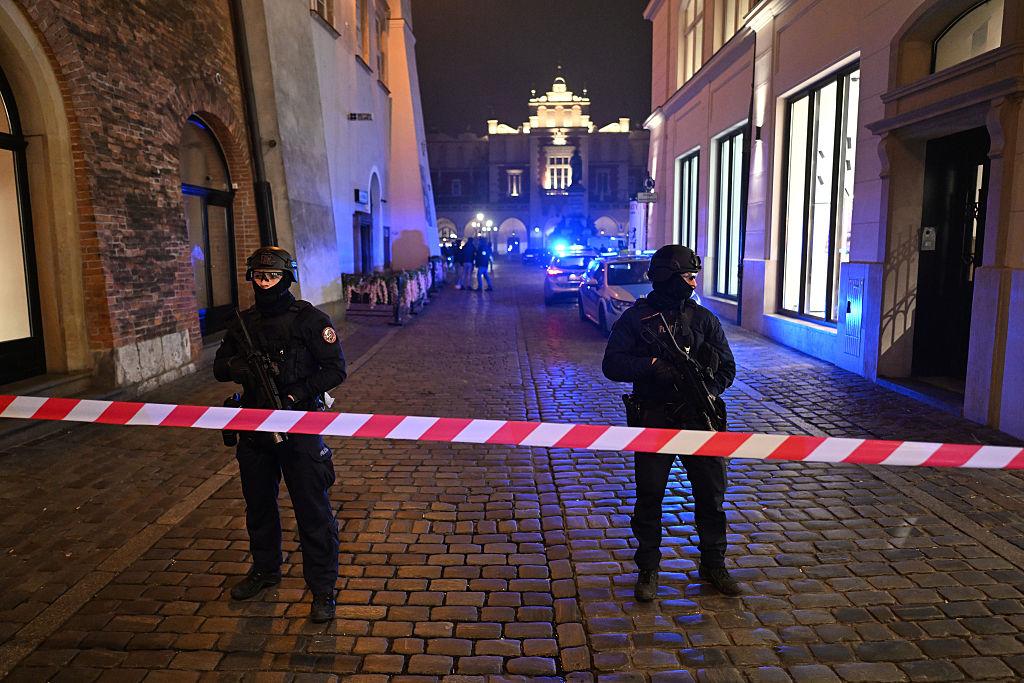
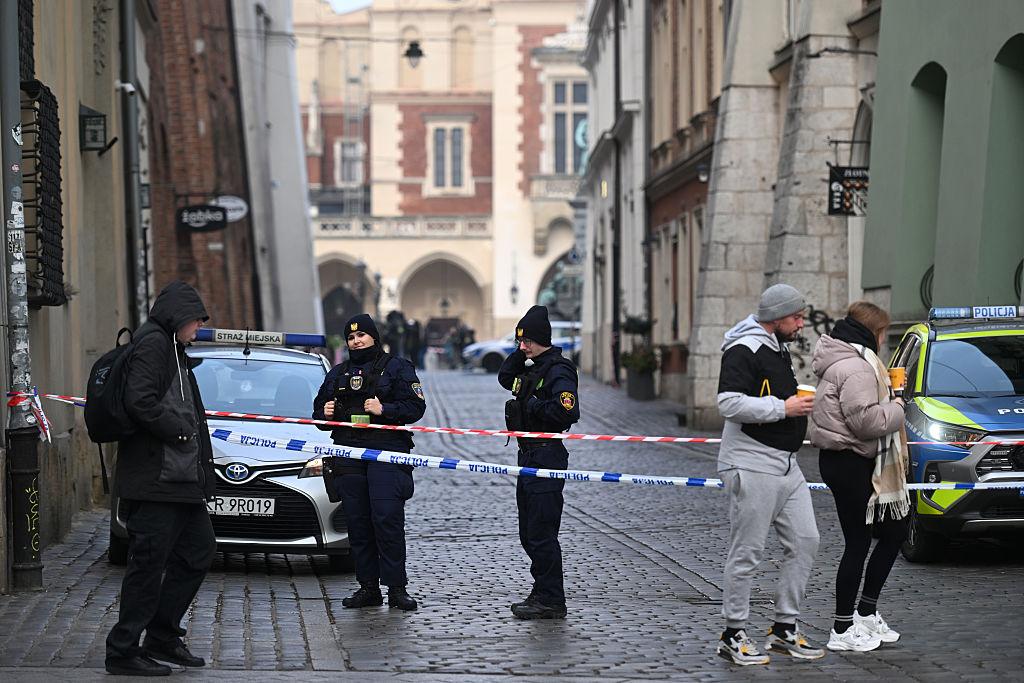
The shooting began on Saturday afternoon when the gunman, dressed in military-style clothing and wearing a bulletproof vest, drove into Krakow’s Main Market Square in the heart of the Old Town and opened fire. The square, normally filled with residents, tourists, restaurants and street activity, quickly descended into panic as people ran for cover inside shops, cafés and historic buildings. Police arrived within minutes and exchanged fire with the attacker, eventually shooting and critically wounding him before taking him into custody. Two officers were injured during the confrontation, and one of them remained seriously ill on Monday, according to Polish officials.
Six people were killed in the attack, including four women and two men, while 15 others were wounded. Authorities have confirmed that foreign nationals were among both the dead and injured, reflecting Krakow’s position as one of Poland’s most heavily visited international destinations. The victims included Polish citizens as well as a British man and an Austrian woman, while several foreign nationals were among those receiving hospital treatment. By Monday, officials said most of the surviving victims were in stable condition, though the seriously wounded police officer continued to require intensive care.
The death of the gunman does not end the investigation. Prosecutors are continuing to examine the attack under provisions relating to terrorism and are trying to determine whether the shooter acted entirely alone, whether he was influenced by extremist networks or online communities and whether anyone helped him plan the assault. Authorities have said he held radical ultranationalist and far-right views, but investigators have also cautioned against drawing final conclusions before completing their examination of his electronic devices, communications and personal history.
That caution has become important because the political debate over the attacker’s ideology intensified almost immediately after the shooting. Some government officials initially suggested that far-right beliefs may have influenced the attack, while nationalist opposition figures pushed back strongly against any attempt to link the killings to organised conservative or nationalist movements. Prosecutors have since emphasised that although extremist views are part of the evidence being examined, they have not yet established a definitive ideological motive or a connection to any organised extremist group.
Investigators are also trying to understand the significance of emblems and markings found on the attacker’s clothing. Such symbols can sometimes provide clues about political influences, extremist subcultures or personal beliefs, but they do not necessarily prove membership in a specific organisation. Authorities are expected to compare those symbols with material found on his computers, mobile devices and online accounts to determine whether the attack was intended to send a political message or whether extremist imagery formed only one part of a more complicated personal history.
The case became even more disturbing when police searching the attacker’s family home discovered the bodies of his father, mother and 21-year-old sister. All three had suffered apparent gunshot wounds, and authorities believe the same attacker may have killed them before travelling to Krakow, although prosecutors are still reconstructing the precise sequence of events. If that conclusion is confirmed, the number of deaths connected to the gunman would extend beyond the six people killed in the market square and transform the investigation into a wider series of killings that began before the public attack.
The family deaths are likely to become central to understanding the attacker’s state of mind and planning. Investigators will examine ballistic evidence to determine whether the weapons used at the family home match firearms connected to the Krakow shooting, while phone records, travel data and surveillance footage may help establish when he left the residence and how long the attack had been planned. Authorities are also investigating whether any conflict within the family preceded the killings or whether the deaths were part of a deliberate sequence leading toward the mass shooting.
Police have recovered a substantial number of firearms connected to the attacker and his family. Authorities said both the gunman and his father legally possessed gun permits, and a total of 11 firearms were found across the family residence, the attacker’s vehicle and the shooting scene. That discovery has immediately prompted renewed scrutiny of Poland’s firearms licensing system, particularly because mass shootings of this scale are extremely rare in the country and because the attacker was legally able to access multiple weapons despite holding views that authorities now describe as radical.
The Polish government has already signalled that gun-permit regulations may be reviewed. Investigators want to know when the attacker obtained his firearms licence, what background checks were carried out, whether any behavioural or ideological warning signs were known to authorities and whether existing rules provide sufficient mechanisms for withdrawing weapons from individuals who later become a security concern. The case is likely to intensify debate over how Poland balances relatively strict gun ownership laws with the rights of sport shooters and other licensed firearms users.
Questions have also emerged over the gunman’s apparent proficiency with weapons. A member of a shooting club the attacker joined in 2022 told Reuters that he appeared highly skilled in military-style marksmanship, particularly techniques involving shooting while moving or operating near a vehicle. The club member said those methods were not normally taught as part of ordinary sport shooting and suggested the attacker’s ability appeared more advanced than what he had observed during routine club participation. Investigators are now expected to examine whether the gunman received additional training elsewhere and whether that training played a role in the effectiveness of Saturday’s assault.
The rapid police response is being credited with preventing an even higher death toll. Officers arrived only minutes after the first emergency calls and confronted the shooter while he was still firing in the square. Two officers were wounded in the exchange, but their intervention stopped him from continuing through a location that was crowded with residents and tourists. Polish leaders have repeatedly praised the police response, emergency medical teams, surgeons and ordinary bystanders who helped the injured while gunfire was still being reported nearby.
The Main Market Square, one of the largest medieval public squares in Europe, has become the emotional centre of Poland’s mourning. In the hours and days after the attack, residents returned to lay candles, flowers and handwritten messages near the locations where victims fell. The normally crowded square reopened under heightened security, but the atmosphere remained subdued as police continued forensic work and residents attempted to process the scale of what had happened.
One of Krakow’s most recognisable traditions was also suspended in response to the tragedy. The hourly trumpet call from the tower of St. Mary’s Basilica, a centuries-old ritual that has become synonymous with the city, was paused during the mourning period in an extraordinary gesture reflecting the severity of the attack. The suspension carried particular symbolic weight because the trumpet call is rarely interrupted and has long represented continuity in a city whose history has survived war, occupation and political upheaval.
Poland declared two days of national mourning, with flags lowered and public events adjusted or cancelled across the country. Churches held services for the victims, government officials attended memorial events and residents gathered in Krakow and other cities to honour those killed. Monday marked the second day of that mourning period, meaning the news of the attacker’s death came as the country was still focused primarily on the victims rather than on the fate of the man responsible.
The attack has profoundly unsettled Poland because mass shootings remain extremely uncommon compared with some other countries. Polish society has historically associated large-scale public shootings with events elsewhere, and the violence in one of Krakow’s most recognisable public spaces shattered that sense of distance. The fact that the gunman was able to enter a crowded tourist destination wearing body armour and carrying firearms has raised new questions about public-space security, emergency response and the ability of authorities to detect potential lone-actor threats before they become violent.
The terrorism investigation reflects those concerns. Prosecutors are examining whether the attack was intended to intimidate the wider population, whether ideology played a decisive role and whether the shooter sought publicity through the choice of a famous location. Krakow’s Main Square carries enormous cultural and symbolic value, and any deliberate decision to attack civilians there could be relevant to determining whether the gunman intended to create fear beyond the immediate victims.
At the same time, prosecutors are resisting pressure to declare the motive settled. The attacker’s far-right and ultranationalist views are part of the case, but authorities have not yet established that those beliefs alone explain why he killed six people. Investigators must still determine whether personal grievances, family circumstances, mental or emotional factors, extremist ideology or some combination of these influences contributed to the attack.
The gunman’s death makes those unanswered questions more difficult to resolve because investigators can no longer confront him directly with the evidence. There will be no formal confession, no interrogation about his political beliefs and no opportunity to ask whether he deliberately selected particular victims. Instead, the case will depend on reconstruction through evidence left behind.
His digital devices could therefore become some of the most important material in the investigation. Police will examine internet searches, messaging applications, social-media accounts, stored documents and communications with other individuals to determine whether he discussed violence beforehand or consumed extremist propaganda. Investigators will also look for any manifesto, drafts or notes capable of explaining his intentions.
Travel records and surveillance footage are expected to help reconstruct his movements before the shooting. Authorities want to establish when he left the family home, whether he stopped at other locations, when he entered Krakow and whether he conducted prior reconnaissance of the market square. Evidence that he visited the location before Saturday could support the conclusion that the attack was planned well in advance rather than carried out spontaneously.
The weapons themselves will undergo forensic examination. Investigators must determine which firearms were used at the family residence, which were taken to Krakow and whether the same weapons were involved in both sets of killings. Ballistic analysis can compare bullets and cartridge casings from the family home with those recovered from the market square, potentially linking the incidents with a high degree of certainty.
Police will also investigate how ammunition was obtained and whether any unusually large purchases should have triggered scrutiny. Licensed gun owners may legally purchase ammunition, but patterns of acquisition can become significant when investigators reconstruct planning for a mass shooting. Authorities may examine whether the attacker recently increased his purchases, acquired body armour or made other preparations consistent with a planned attack.
The broader security response across Poland has already intensified. Police increased their presence in Warsaw, Krakow and other major cities, particularly around crowded public spaces, transport hubs and national commemorations. The attack occurred only days before major Independence Day events, creating additional concern that public gatherings could become vulnerable to copycat violence or exploitation by extremists.
Security officials have therefore encouraged organisers to review access routes, vehicle barriers and emergency response procedures. The fact that the Krakow attacker drove into the square before opening fire has made vehicle access a particular focus, especially in pedestrianised locations where barriers may stop ordinary traffic but still require access for emergency or authorised vehicles.
The attack has also renewed concern about lone actors who may radicalise without formal membership in extremist organisations. European security agencies have repeatedly warned that individuals can absorb violent ideology through online communities without ever meeting organised extremist leaders. Such people may leave few conventional intelligence indicators before carrying out an attack, making prevention especially difficult.
If investigators ultimately confirm that the Krakow gunman acted entirely alone, the case may become an important example of that type of threat. A person with legal access to firearms, familiarity with weapons and extremist beliefs could potentially prepare an attack without the communications or organisational structure that would normally attract intelligence attention.
That possibility makes the investigation into his background particularly important. Authorities will want to know whether teachers, employers, relatives, shooting-club members or acquaintances observed changes in his behaviour. Even seemingly minor warning signs can become significant when examined after an attack, although officials must also avoid assuming that unusual beliefs automatically indicate an intention to commit violence.
The political dispute over motive has already demonstrated how quickly such attacks can become part of wider ideological conflict. Poland’s political environment has been sharply divided for years, and any suggestion that the gunman was influenced by far-right ideology immediately created accusations and counteraccusations between government and opposition figures. Prosecutors have therefore urged public restraint while evidence is still being examined.
For the families of the victims, those political arguments are secondary to the scale of their loss. Six people were killed while visiting or moving through one of Krakow’s most familiar public spaces. Their families are now dealing with sudden bereavement while survivors face physical injuries and psychological trauma that may continue long after the national mourning period ends.
The presence of foreign victims has also widened the tragedy beyond Poland. British and Austrian nationals were among those killed, and several foreign citizens were among the wounded. Embassies and consular officials are working with Polish authorities to support families and assist with identification, hospital access and other arrangements.
The seriously injured police officer has become another focus of public concern. Authorities have praised the officers who confronted the attacker for continuing toward the gunfire while civilians were fleeing. Their actions likely reduced the number of casualties, but the incident also demonstrates the risks facing first responders during mass-casualty attacks.
Medical teams in Krakow were forced to respond rapidly to multiple gunshot victims arriving within minutes of one another. Hospitals activated emergency procedures, surgeons were called in and trauma teams worked through Saturday night treating the wounded. Officials said the majority of surviving victims were stable by Monday, an outcome that reflects the speed of emergency response despite the severity of the attack.
The attacker’s death will also affect the legal process. Because he can no longer be prosecuted, there will be no criminal trial against the person police believe carried out the killings. Prosecutors will nevertheless continue the investigation because they must establish the complete facts, determine whether anyone else was involved and decide whether other individuals committed offences connected to the attack.
If investigators discover that someone knowingly provided weapons, assistance or encouragement, those individuals could still face criminal proceedings. The inquiry will therefore continue even though the principal suspect is dead.
Authorities also have a responsibility to produce a detailed account for the victims’ families and the public. In cases where an attacker dies before trial, the investigative findings become especially important because a courtroom will never hear the evidence in full. Prosecutors may eventually release a comprehensive report explaining the sequence of events, motive and any institutional failures identified during the investigation.
Poland’s government has promised that the inquiry will be thorough and transparent while avoiding premature conclusions. Officials say the goal is not only to determine what happened on Saturday but to identify lessons that could prevent another attack.
Those lessons may include changes to gun licensing, extremist monitoring, information sharing and security at major public spaces. Whether reforms follow will depend on what investigators discover about the shooter’s background and whether existing institutions had information that could reasonably have led to earlier intervention.
For Krakow, the immediate challenge is more emotional than legislative. Residents are trying to reclaim a square that for centuries has represented commerce, culture and public life but is now associated with gunfire, emergency sirens and mourning. The return of visitors and everyday activity will eventually restore some normality, but the attack will remain part of the city’s memory.
The death of the gunman closes one chapter of the tragedy but leaves many of the most important questions unanswered. Investigators still need to establish why he targeted the square, what connection his extremist views had to the attack, whether the deaths of his parents and sister were part of the same plan and whether anyone else knew what he intended to do.
What is already established is devastating enough. A 24-year-old man drove into one of Poland’s most famous public spaces, opened fire on civilians, killed six people and wounded 15 before police shot and stopped him. Three members of his family were later found dead, multiple firearms were recovered and authorities discovered evidence of radical ultranationalist views.
Two days later, the attacker himself is dead, Poland remains in mourning and the investigation has entered a new phase in which prosecutors must reconstruct the full story without ever being able to question the man at its centre.
For the country, the focus now shifts from stopping the gunman to understanding how the attack became possible and whether anything could have prevented it. For the families of those killed, however, no investigation can reverse what happened in Krakow’s Main Market Square on Saturday afternoon.
Six people are dead, 15 others were wounded and a city known around the world for history, tourism and culture has been forced to confront a type of violence Poland had long considered exceptionally rare. The gunman’s death may end his own story, but the consequences of what he did will remain with Krakow and the victims’ families for years to come.