
LIONEL MESSI ENDS 21-YEAR ARGENTINA CAREER WITH GOAL AND TWO ASSISTS IN EMOTIONAL FAREWELL
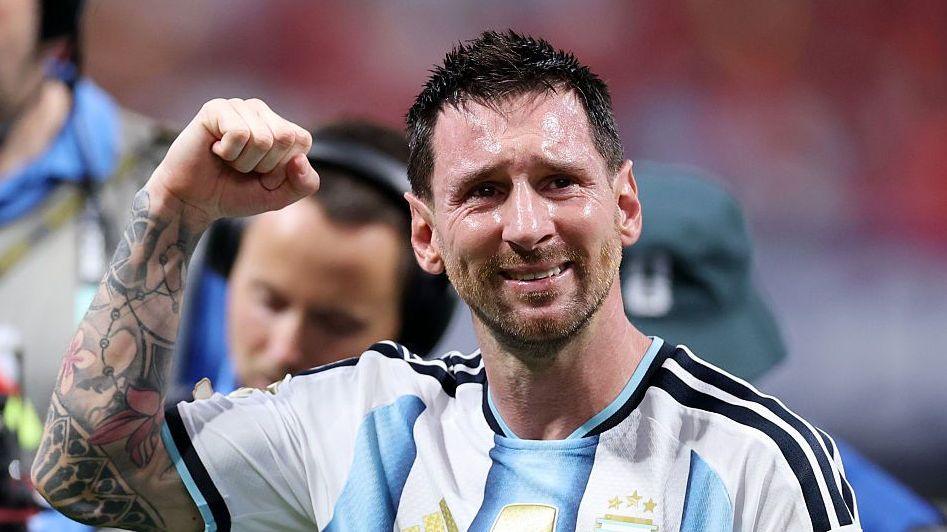
Lionel Messi has ended his 21-year Argentina career with one goal and two assists in a 3–0 victory over Benin at the Monumental Stadium, finishing with 208 appearances and 126 international goals. More than 85,000 supporters witnessed an emotional farewell that included a 10th-minute standing tribute, fireworks and celebrations honoring the World Cup-winning captain.
Lionel Messi has brought his Argentina career to an end after 21 years, signing off with a goal and two assists as the world champions defeated Benin 3–0 at the Monumental Stadium in Buenos Aires in a farewell that became less a friendly match and more a national tribute to the player who carried Argentina through one of the most important eras in its football history.
More than 85,000 supporters filled the Monumental for Messi’s final appearance in the blue and white shirt, and the night unfolded as a celebration of a career that began in 2005 and ultimately delivered the trophies that had eluded him for so long. Argentina won comfortably, but the result was almost secondary to the occasion. Messi created the opening goal, supplied another assist for the second, and then scored the third himself from the penalty spot to finish his international career with 208 appearances and 126 goals.
Veteran defender Nicolás Otamendi, who was also making his final appearance for Argentina, opened the scoring after Messi provided the opportunity, giving two departing members of the 2022 World Cup-winning generation an early moment to share. Nico Paz then added Argentina’s second from another Messi assist, before the captain completed the evening by converting from the spot and walking away with one final goal in the shirt he had worn for more than two decades.
The tribute had begun before kickoff. A giant number 10 shirt carrying the word “Gracias” was displayed as supporters gathered to mark the end of Messi’s international career, while tributes also appeared in Rosario, the city where he was born. Former teammates, members of Argentina’s World Cup-winning generation and Messi’s family were present as the national team prepared to say goodbye to a player whose relationship with the country had once been complicated but had ultimately become one of the strongest bonds in modern Argentine sport.
The most symbolic moment of the match arrived in the 10th minute, when play was deliberately stopped and the entire stadium rose to applaud Messi. Fireworks were set off as supporters stood in tribute to the number he had made inseparable from his identity with Argentina. The decision to stop the game at that exact minute was deliberate, turning the match itself into part of the farewell and giving the crowd a formal moment to acknowledge the captain while he was still on the field.
Messi, now 39, had announced that he would bring his Argentina career to a close after more than two decades with the national team. His final numbers underline the scale of what he achieved. He leaves as Argentina’s most-capped player and its record goalscorer, with 208 appearances and 126 goals, along with a long list of assists and individual records accumulated across World Cups, Copa América tournaments, qualifiers and international friendlies.
Those numbers alone, however, do not fully explain why the farewell carried so much emotion. Messi’s Argentina career was never a straightforward story of immediate national adoration. For years, he was compared relentlessly with Diego Maradona, criticized for appearing more dominant with Barcelona than with his country and accused by some supporters of not displaying the same emotional connection to the national team as players who had grown up entirely within Argentina’s domestic football culture.
Messi had left Argentina for Barcelona as a teenager and developed into the best player in the world in Spain. That background became part of the criticism directed at him during the early and middle years of his international career. Whenever Argentina fell short in a major tournament, the question returned. He could win everything for Barcelona, critics argued, but could he do the same for Argentina?
That criticism intensified because of the number of near misses. Argentina lost the 2014 World Cup final to Germany, with Messi coming painfully close to the trophy that many believed would define how his international career was remembered. Further defeats in Copa América finals increased the pressure, and after Argentina lost the 2016 Copa América Centenario final to Chile on penalties, Messi announced that he was retiring from international football.
At the time, the decision appeared to mark the end of a relationship that had become exhausting for both player and country. Messi had carried the burden of expectation through one tournament after another, while Argentina had repeatedly reached finals without completing the final step. His temporary retirement triggered an enormous public reaction, with supporters, politicians, teammates and football officials urging him to return.
He eventually did, and that decision changed the course of his international legacy.
Under coach Lionel Scaloni, Argentina gradually built a team that was less dependent on Messi carrying every attacking responsibility and more capable of supporting him structurally and emotionally. The squad developed a stronger collective identity, and Messi appeared increasingly comfortable within a group that treated him not simply as the superstar expected to solve every problem but as the leader of a team capable of sharing the burden.
The breakthrough came at the 2021 Copa América, when Argentina defeated Brazil at the Maracanã in Rio de Janeiro to give Messi his first major senior international trophy. The significance of that victory extended far beyond the tournament itself. It ended years of frustration, removed one of the strongest arguments used by his critics and transformed the emotional relationship between Messi and many Argentine supporters.
That success was followed by the Finalissima against Italy and then the 2022 World Cup in Qatar, where Messi delivered the defining international tournament of his career. Argentina recovered from a shock opening defeat to Saudi Arabia and advanced through an increasingly dramatic series of matches before defeating France on penalties in a final that became one of the most celebrated games in World Cup history.
Messi scored twice in that final and converted his penalty in the shootout, lifting the World Cup trophy that had remained the major missing piece of his career. For Argentina, it ended a 36-year wait for the title. For Messi, it changed the way his international story would be told permanently.
The player who had once been accused of not delivering for Argentina had become the captain who led the country to the biggest prize in football.
Argentina went on to win another Copa América, extending a period of success that turned the final years of Messi’s international career into the opposite of the frustration that had defined so much of the earlier period. By the time he arrived at the Monumental for his farewell against Benin, the debate over whether he had done enough for his country had effectively disappeared.
The crowd was therefore saying goodbye not only to Argentina’s record scorer but to the central figure in a generation that restored the national team to the top of world football.
The farewell was also shared with Otamendi, another senior member of the squad that won the World Cup in Qatar. His opening goal from Messi’s assist gave the night an additional layer of symbolism, with one departing veteran setting up another during a match designed around transition from the old generation to the next.
That transition has already begun.
Argentina has introduced younger players who will be expected to carry the national team through the next cycle, while established figures such as Cristian Romero, Alexis Mac Allister, Enzo Fernández, Julián Álvarez and Lautaro Martínez will now assume greater responsibility. The question of who inherits Messi’s leadership role is clearer than the question of who could ever replace what he provided as a player.
Scaloni had already acknowledged before the match that Messi’s number 10 would not simply be reassigned casually. The shirt has become one of the most recognizable symbols in international football, and Argentina will now have to decide how the number is handled in the post-Messi era.
The captaincy is also moving on. Romero is expected to become one of the central leadership figures, with other senior players moving higher in the hierarchy. Yet Argentina’s challenge is not simply finding a new captain. It is rebuilding an attacking identity without the player around whom so much of the national team has revolved for more than two decades.
Messi made his senior international debut in 2005, entering as a teenager and beginning a career that would eventually span five World Cups and multiple generations of Argentine football. He played alongside some of the country’s biggest names, survived several coaching changes and remained the central figure as Argentina moved from repeated disappointment into sustained success.
His statistics reflect that longevity. More than 200 appearances for one national team is an achievement few players in football history have reached, and his 126 goals place him among the highest scorers international football has produced. His influence, however, extended beyond goals. He became Argentina’s principal creator, its most dangerous dribbler, its most closely marked player and, in later years, the figure around whom the team’s attacking rhythm was organized.
Even in his final match, that pattern remained visible. Messi did not simply appear for a ceremonial few minutes. He remained decisive, creating two goals before scoring one himself and showing why Argentina continued to build its attack around him until the final night.
The nature of the performance gave the farewell a competitive quality that might otherwise have been missing. Benin arrived knowing that the event would be dominated by Messi’s retirement but still treated the match as an international fixture. Argentina nevertheless controlled the game and ensured that the night remained celebratory rather than becoming complicated by an unexpected result.
The final goal carried particular significance. Messi stepped up from the penalty spot and converted for the 126th and last international goal of his career, giving supporters one final opportunity to celebrate the sight that had become familiar over more than two decades.
After the match, the stadium remained focused on Messi as teammates, staff and supporters continued the farewell. The evening included chants, visual displays and further tributes, while the player appeared emotional as he acknowledged a crowd that had once demanded more from him than almost any Argentine footballer before eventually embracing him as the defining figure of the modern national team.
That transformation is one of the most important parts of his international story.
Messi was never rejected by Argentina in a simple sense, but the relationship was often more complicated than the way he was received at Barcelona. Maradona’s status as a national hero created an almost impossible comparison, particularly because Maradona’s 1986 World Cup victory remained the reference point against which every Argentine star was measured.
Messi spent years living inside that comparison.
Winning the 2022 World Cup did not merely add another trophy to his career. It ended the comparison as a criticism. Supporters could debate styles, personalities and eras, but Messi had finally achieved the one success that critics had repeatedly used to separate him from Maradona.
The farewell at the Monumental reflected how completely the national mood had changed. The player who had once been questioned for not appearing Argentine enough was now being honored as one of the country’s greatest sporting symbols, with an entire stadium stopping in the 10th minute simply to applaud him.
His departure also marks a broader shift in world football. Messi and Cristiano Ronaldo defined an era in which individual statistical records, Champions League dominance, Ballon d’Or battles and international achievements reshaped expectations of what elite players could sustain over long careers. Messi’s retirement from international football removes one of the last major links to that period from the highest level of the international game.
He is not retiring from football entirely. Messi remains connected to Inter Miami and has continued to make plans away from international competition, including investments and ownership interests in football. His departure from Argentina therefore closes one part of his career rather than ending his involvement in the sport.
For the national team, however, the break is final.
Argentina must now enter its first full cycle without Messi since before his debut more than two decades ago. The team remains talented, experienced and capable of competing at the highest level, but the psychological adjustment will be significant. For years, every Argentina squad announcement, every major tournament and every tactical discussion eventually returned to the same question: where would Messi play and how would the team be built around him?
That question no longer exists.
The next version of Argentina will have to find goals, creativity, leadership and attacking control through a broader group of players rather than relying on the individual who provided all four for so long. Scaloni and his staff have already started that transition by integrating younger players and giving them larger roles, but the emotional reality of the change only became complete when Messi walked off the field for the final time.
His departure also closes one of the longest continuous national-team careers of the modern era. Twenty-one years separated his debut from his farewell, covering enormous changes in football and in Messi himself. He arrived as a teenage prodigy carrying expectations based largely on what he was doing in Barcelona’s youth system and left as a World Cup-winning captain, Argentina’s record scorer and its most-capped player.
The numbers provide the permanent record. The trophies provide the clearest summary of the later years. The reaction inside the Monumental explained everything else.
For Argentina, Messi’s farewell was ultimately about the distance between where the story began and where it ended. His international career started under pressure, passed through years of criticism and repeated final defeats, survived a temporary retirement and finished with the country having won the World Cup, multiple Copa América titles and the Finalissima during his final era as captain.
His final match followed the same pattern that defined the strongest years of that run. Argentina won, Messi created goals, Messi scored, and the crowd spent the evening celebrating him rather than questioning him.
The 3–0 victory over Benin will matter little in Argentina’s long competitive history, but the night itself will remain significant because it marked the moment the national team formally moved beyond the player who had defined it for more than two decades. Messi leaves with 208 appearances, 126 goals, a World Cup, two Copa América titles, the Finalissima and a relationship with Argentina that eventually became far more powerful because of how difficult it had once been.
The next Argentina team will begin without him, and the number 10 will eventually appear on another player’s back. What will not be replaced is the particular career that ended at the Monumental: 21 years between a teenage debut and a farewell in front of more than 85,000 people, with one final goal and two final assists before Lionel Messi walked away from international football as the most decorated and statistically dominant player Argentina has ever produced.