MAHAMA APPOINTS TWO NEW DEPUTY EC CHAIRS AS HE WARNS THEM NOT TO FAVOR HIS GOVERNMENT OR PARTY
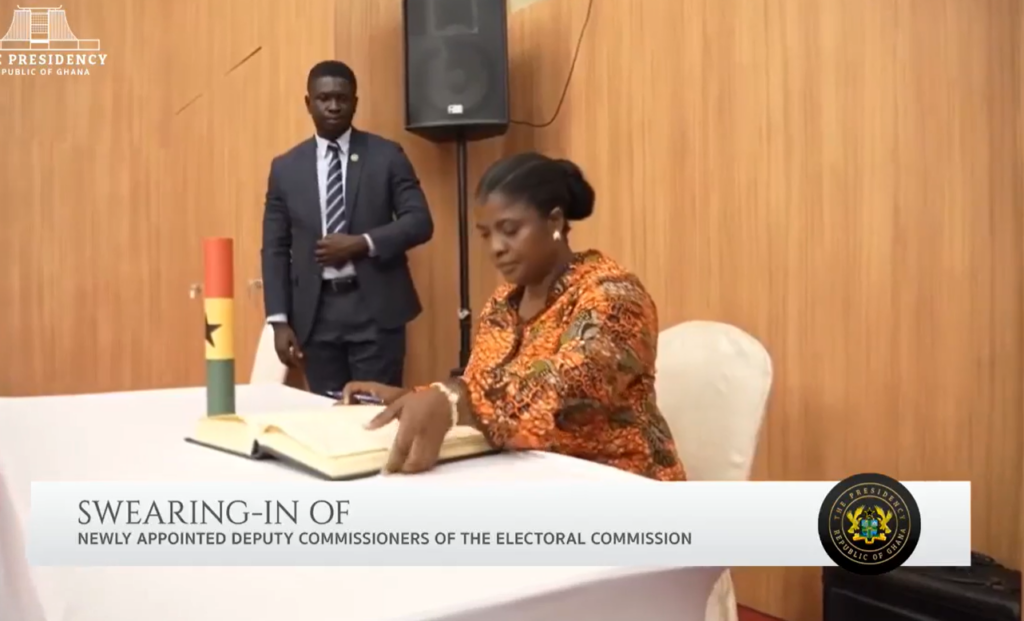
President John Dramani Mahama has appointed Dr Joseph Kwaku Asamoah and Emelia Afi Agbenyo as Deputy Chairpersons of Ghana’s Electoral Commission, filling vacancies created by the departure of Bossman Asare and Samuel Tettey. Mahama told the new officials that neither his government nor his political party should receive preferential treatment and urged them to protect the independence and credibility of the Commission.
President John Dramani Mahama has appointed Dr Joseph Kwaku Asamoah and Emelia Afi Agbenyo as Deputy Chairpersons of Ghana’s Electoral Commission, filling two senior vacancies at one of the country’s most politically sensitive constitutional institutions while publicly warning the new officials that neither his government nor his political party should receive preferential treatment from the Commission.
The appointments restore the Electoral Commission’s two deputy chair positions following the departure of Dr Bossman Eric Asare and Samuel Tettey. Asare resigned from the Commission to return to academia, while Tettey left after reaching the mandatory retirement age. Their exits created vacancies in positions that are central to the Commission’s administration, electoral operations and internal management.
Mahama formally swore in Asamoah and Agbenyo and used the ceremony to emphasize that their responsibility is to Ghana’s Constitution rather than to the political authority that appointed them. The President said the Electoral Commission must remain impartial in its dealings with political parties and candidates and made clear that his administration should not expect any special treatment.
The President’s comments are significant because appointments to the Electoral Commission have historically attracted political scrutiny in Ghana. Although the President appoints members of the Commission in accordance with the Constitution and acting on the advice of the Council of State, commissioners are expected to operate independently once in office and are constitutionally protected from direction or control by the executive.
Mahama told the newly appointed deputies that the integrity of Ghana’s elections depends heavily on public confidence in the institution responsible for managing them. He urged them to apply electoral laws consistently and ensure that political actors are treated equally regardless of whether they belong to the governing party or the opposition.
Dr Joseph Kwaku Asamoah enters the position with extensive previous experience inside the Electoral Commission. He has served the institution in several senior capacities, including as Director of Finance, Director of the Commission’s Training Centre and Head of Audit, giving him direct knowledge of the administrative, financial and operational systems that support Ghana’s electoral process.
Asamoah is also a law lecturer at the Kwame Nkrumah University of Science and Technology and has professional experience spanning law, electoral administration, public finance and institutional governance. His return to the Electoral Commission now places him at the policy and executive level of an institution where he previously worked as a senior administrator.
His previous work included participation in major electoral exercises and internal management processes, including budgeting, training and financial oversight. That background could prove important as the Commission prepares for future electoral activities and continues managing the administrative demands associated with voter registration, polling operations and election logistics.
Emelia Afi Agbenyo joins the Commission from the Ghana TVET Service, where she served as Deputy Director responsible for Operations. Her appointment brings administrative and operational experience from another major public institution into the Electoral Commission’s senior leadership.
The two appointments restore the constitutional structure of the Commission, which consists of a Chairperson, two Deputy Chairpersons and four other members. The deputy chairpersons are not ceremonial officers. They form part of the Commission’s leadership and are involved in operational planning, administration, policy implementation and the management of national electoral activities.
The Commission is currently chaired by Jean Mensa, who has served as Electoral Commission Chairperson since 2018. Asamoah and Agbenyo will now work alongside her and the other commissioners as Ghana continues preparing for future elections and as debate continues over electoral reforms and the independence of constitutional institutions.
The appointments come at a time when public trust in election management remains an important political issue. Ghana has built a reputation for competitive elections and peaceful transfers of power, but disagreements over voter registration, election results, constituency administration and decisions of the Electoral Commission have frequently generated political tension.
Both major political parties have, at different times, challenged the impartiality of the Commission while in opposition and defended it while in government. That recurring pattern has increased calls from civil society organizations and governance experts for stronger institutional safeguards and broader consensus around appointments to independent constitutional bodies.
Mahama’s decision to publicly tell his appointees not to favor his government appears intended to address some of those concerns. His remarks establish an explicit standard against which the conduct of the two new deputy chairpersons is likely to be judged, particularly when the Commission begins making politically sensitive decisions.
The Constitution requires the Electoral Commission to operate independently in performing its functions. That independence is especially important because the institution manages elections in which the President, members of Parliament and political parties have direct interests.
The Commission’s responsibilities include compiling and maintaining the voters register, conducting presidential and parliamentary elections, supervising referendums and district level elections, regulating political parties and declaring official election results.
It also manages the recruitment and training of thousands of temporary election officials, the distribution of ballot papers and biometric equipment, the establishment of polling stations and the coordination of logistical arrangements across all regions of the country.
Because of those responsibilities, the conduct of the Commission’s senior leadership can directly influence confidence in the electoral process. Even administrative decisions involving voter registration centers, polling arrangements or candidate documentation can become politically contentious if parties believe they are being treated differently.
The appointment of Asamoah may therefore attract particular attention because of his previous relationship with the Commission. Supporters of the appointment may point to his institutional experience as an advantage, while critics will likely examine whether his return produces continuity or changes within the Commission’s management structure.
Agbenyo’s appointment will also be closely watched as she moves from the TVET administration into electoral management. Her operational background could be relevant to the Commission’s nationwide logistical responsibilities, but her performance will ultimately be assessed through decisions taken after she assumes full responsibilities.
The government has not yet publicly detailed how specific responsibilities will be divided between the two new deputies. Traditionally, the Commission’s deputy leadership has included portfolios covering Operations and Corporate Services, but the exact assignments for Asamoah and Agbenyo will depend on decisions made within the institution.
The appointments also reopen wider discussion about how members of the Electoral Commission are selected. Some governance advocates have proposed greater parliamentary involvement or a more consultative appointment process, arguing that broader participation could reduce perceptions that a sitting President has excessive influence over appointments to the institution that manages elections.
Under the current constitutional arrangement, however, the President remains responsible for appointments after receiving advice from the Council of State. Once appointed, the commissioners are expected to exercise their powers independently.
That distinction is central to Mahama’s message to the two new deputies. Their appointments were made by the President, but their future decisions are not supposed to be directed by him, his Cabinet, his party or any other political authority.
The issue becomes particularly important during periods of intense political competition. Electoral disputes in Ghana have previously reached the Supreme Court, and decisions by the Electoral Commission have become central to some of the country’s most significant constitutional cases.
Senior EC officials therefore operate in an environment where their administrative decisions can quickly become legal and political controversies. The ability to explain decisions clearly and apply rules consistently will be crucial to maintaining confidence.
The departures of Bossman Asare and Samuel Tettey also mean the new deputies are replacing officials with considerable institutional knowledge. That creates a transition challenge because the Commission must preserve continuity while incorporating new leadership perspectives.
Asamoah’s previous EC experience may help reduce that transition period, while Agbenyo will need to familiarize herself with the specialized legal and operational demands of election administration.
Their appointments come well before Ghana’s next general election, providing time for the two deputies to settle into their roles and participate in preparations ahead of the next major national polls. That timing could give the Commission an opportunity to establish a stable leadership structure before election related political activity intensifies.
The political significance of the appointments will nevertheless extend beyond the technical work of the Commission. Every major decision taken by the EC in the coming years will be examined against questions of neutrality, fairness and the degree of independence the institution demonstrates from the government.
Mahama has effectively placed that issue at the center of the appointments by publicly stating that his own political interests should not influence the new commissioners. Whether that promise of noninterference translates into public confidence will depend on how the Commission handles future disputes involving the government and opposition parties.
The new deputy chairpersons will also face pressure to strengthen transparency. Political parties and civil society organizations have repeatedly asked the Commission to communicate decisions more clearly, release information promptly and engage stakeholders before major electoral changes are implemented.
Improved communication could help reduce suspicion around technical decisions that might otherwise be interpreted through partisan lenses. However, transparency alone will not resolve all disagreements because parties can still contest decisions even when the reasoning behind them is fully explained.
The broader challenge is ensuring that electoral rules are applied predictably and consistently. That includes voter registration, nomination procedures, ballot preparation, polling station management, vote counting and the declaration of results.
The Commission must also maintain professional relationships with the security agencies responsible for protecting election officials and voters without allowing security arrangements to create perceptions of intimidation or partisan advantage.
Asamoah and Agbenyo will therefore assume office at a time when election management has become increasingly complex. Technology has expanded the use of biometric identification and digital systems, while misinformation and social media can rapidly amplify disputes over isolated incidents.
The Commission will have to manage those challenges while maintaining confidence among voters and political parties. Senior leadership will play an important role in determining how quickly the institution responds to controversies and how effectively it communicates with the public.
The two appointments also underline the importance of continuity in constitutional bodies. Electoral institutions cannot function effectively if major leadership vacancies remain unresolved for extended periods, particularly when preparations for elections require long term planning.
By filling both deputy positions, the government has restored the Commission’s complete senior structure. The next question is how the two appointees will work with Jean Mensa and the other commissioners and whether the leadership team can maintain a unified institutional approach despite the political scrutiny surrounding the Commission.
The appointments do not alter the constitutional powers of the EC Chairperson or fundamentally change the Commission’s mandate. They instead replace two departing deputies and ensure that the institution again has the leadership configuration envisaged by the Constitution.
Public attention will now turn toward the portfolios given to Asamoah and Agbenyo and the decisions they make once they become fully involved in the Commission’s work. Their professional backgrounds provide relevant administrative experience, but their credibility will ultimately depend on their conduct in office rather than the qualifications cited at their appointment.
For President Mahama, the public instruction that they should not favor him or his political party also creates a political accountability test. Any future controversy involving the Electoral Commission and the governing party is likely to revive his statements and generate questions over whether the Commission is operating independently.
For the Electoral Commission itself, the appointments provide an opportunity to reinforce institutional stability after the departure of two senior officials. The Commission now has a restored leadership team and sufficient time to prepare for future national electoral exercises without the immediate pressure of a general election.
The unresolved issue is whether the appointments will strengthen public trust across Ghana’s political divide. That will not be determined by the swearing in ceremony or by assurances from the President, but by how the new deputy chairpersons handle difficult decisions when the interests of governing and opposition parties directly collide.
Asamoah and Agbenyo therefore begin their tenure with a clear constitutional mandate and an equally clear political expectation. They have been appointed by the President, but their duty is to an institution whose credibility depends on demonstrating that no President, government or political party receives special treatment.