
MAHAMA SAYS GLOBAL FINANCIAL SYSTEM IS RIGGED AGAINST AFRICA AS BILLIONS FLOW OUT
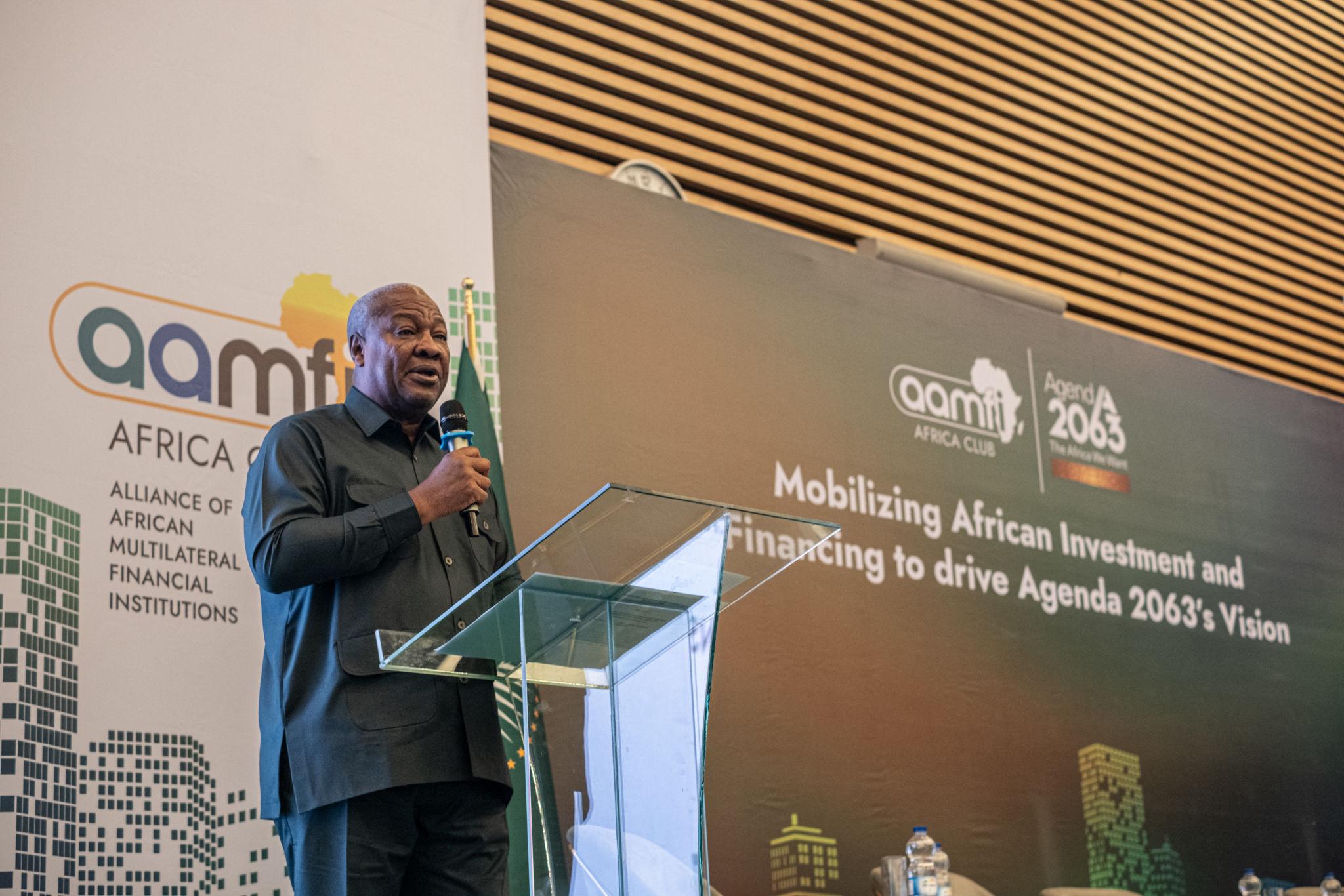
Ghanaian President John Dramani Mahama has renewed calls for sweeping reforms to the international financial system, arguing that African countries are losing far more money through illicit financial flows, debt servicing and borrowing costs than they receive in development assistance. Speaking during a high level discussion in New York, Mahama said roughly $30 billion in official development assistance entered Africa in 2025 while more than $200 billion was leaving the continent through various financial channels. He also argued that African governments face borrowing costs many times higher than wealthier economies, describing expensive financing as one of the forces pushing vulnerable countries deeper into debt. Independent data supports the broader concern that African governments face unusually high financing costs, although Mahama's claim that borrowing is eight times more expensive should not be interpreted as a single uniform rate applying to every country or every loan.
Ghanaian President John Dramani Mahama has delivered one of his strongest criticisms yet of the global financial system, arguing that Africa is trapped in an economic structure in which hundreds of billions of dollars leave the continent while governments struggle to secure affordable financing for development.
Speaking during a conversation in New York, Mahama argued that discussions about Africa's debt problems often begin too late.
Instead of focusing only on debt restructuring after countries run into difficulty, he said governments and international institutions should examine why many African countries become vulnerable to unsustainable debt in the first place.
At the center of his argument is the cost of borrowing.
Mahama said African countries often have to borrow at rates far above those available to richer economies.
He described the gap as one of the fundamental causes of debt distress.
"Africa borrows eight times more expensive than the rest of the world," Mahama said.
He argued that the problem begins before a country enters formal debt restructuring.
In his view, the combination of high interest rates, risk premiums, illicit financial flows and limited access to concessional financing leaves governments paying increasingly large amounts simply to maintain existing obligations.
THE $30 BILLION IN AND MORE THAN $200 BILLION OUT ARGUMENT
Mahama illustrated his position using what he described as the financial imbalance between money entering and leaving Africa.
He said official development assistance to Africa was about $70 billion in 2023 but fell sharply to roughly $30 billion in 2025.
At the same time, he pointed to several major categories of financial outflow.
He estimated illicit financial flows from Africa at roughly $90 billion annually.
He also cited around $80 billion in interest and debt servicing costs and approximately $40 billion associated with risk premiums.
Taken together, those figures produce an outflow of more than $200 billion a year.
Mahama used that comparison to argue that the development debate should not focus only on how much aid African countries receive.
It should also examine how much wealth leaves the continent through debt payments, tax losses, profit shifting, trade misinvoicing and expensive financing.
ILLEGAL AND ILLICIT FINANCIAL FLOWS ARE A MAJOR PROBLEM
The figure Mahama cited for illicit financial flows has substantial historical support from international research.
The United Nations Conference on Trade and Development has estimated that approximately $88.6 billion leaves Africa every year in illicit capital flight.
Such flows can occur through several channels.
They include trade misinvoicing, corruption, smuggling, tax evasion, illegal markets and the movement of proceeds from criminal activity.
Commercial practices can also play a significant role.
One example is transfer pricing abuse.
A company operating in Africa may sell commodities or services to an affiliated company in another jurisdiction at an artificially low price.
The profit can then appear in a lower tax jurisdiction instead of the African country where the economic activity occurred.
The result is that governments can lose tax revenue even when valuable natural resources are being extracted and exported.
Mahama specifically referred to this problem while discussing how multinational companies structure transactions involving African commodities.
WHY TRADE MISINVOICING MATTERS
Trade misinvoicing occurs when the value, quantity or nature of goods involved in international trade is deliberately misstated.
Exports may be undervalued.
Imports can be overvalued.
Companies may also manipulate invoices between related businesses.
Such practices can allow profits to be shifted outside the country where they were generated.
For African governments, this means lost tax revenue.
The effect can be especially severe in countries heavily dependent on minerals, oil, gas and other primary commodities.
When governments cannot collect the full taxes due from economic activity within their borders, they often have to find revenue elsewhere.
That can mean higher domestic taxes, reduced public spending or additional borrowing.
BORROWING HAS BECOME MUCH MORE EXPENSIVE
Independent research also supports Mahama's broader concern about rising borrowing costs.
ONE Data found that the average borrowing cost for African countries increased by 91 percent between 2020 and 2024.
The average rate across the creditors included in its analysis increased from around 2.7 percent in 2020 to approximately 5.1 percent in 2024.
Some countries faced substantially higher market rates.
Governments unable to access normal bond markets during periods of financial stress faced implied borrowing costs exceeding 10 percent on average.
For countries already carrying large debt burdens, those rates can quickly become difficult to manage.
A government borrowing at 10 percent must dedicate substantially more future revenue to interest payments than a government borrowing at 2 or 3 percent.
That difference compounds over many years.
MAHAMA'S EIGHT TIMES CLAIM NEEDS CONTEXT
Mahama's statement that Africa borrows at eight times the cost of the rest of the world reflects his broader criticism of what he sees as an excessive African risk premium.
It should not, however, be interpreted as a fixed mathematical relationship that applies to every African government.
Borrowing costs vary widely.
Countries with stronger credit ratings can borrow more cheaply than states experiencing political instability, high inflation or debt distress.
Loan terms also differ depending on whether financing comes from private bond markets, commercial banks, China, the World Bank, the International Monetary Fund or other development institutions.
The underlying concern remains significant.
Many African governments pay considerably more to access international capital than advanced economies.
WHAT IS THE AFRICAN RISK PREMIUM?
Investors demand higher interest rates when they believe a borrower presents greater risk.
That additional cost is commonly described as a risk premium.
Several factors affect it.
These can include inflation, currency volatility, government debt levels, political instability, fiscal deficits, economic growth and a country's history of repaying debt.
Mahama and other African leaders have argued that investors and international credit rating systems sometimes exaggerate African risk.
They say this increases borrowing costs beyond what economic fundamentals alone would justify.
Institutions including the United Nations Development Program have also examined structural problems affecting sovereign credit ratings in Africa.
The debate has intensified as governments search for ways to finance infrastructure, energy and industrial development without accumulating unsustainable debt.
CREDIT RATINGS CAN HAVE ENORMOUS CONSEQUENCES
Sovereign credit ratings influence the interest rates governments must pay when issuing bonds.
A downgrade can rapidly increase borrowing costs.
Investors may demand higher returns to compensate for what they perceive as increased risk.
This can create a difficult cycle.
Higher interest payments weaken government finances.
Weaker finances can then contribute to additional credit rating concerns.
The government may then face even higher borrowing costs.
For countries that borrow in dollars or euros but collect most of their revenue in local currency, exchange rate depreciation adds another layer of risk.
If the local currency loses value, the amount of domestic revenue required to repay foreign currency debt increases.
GHANA KNOWS THE CONSEQUENCES OF DEBT DISTRESS
Mahama's comments carry additional significance because Ghana recently experienced one of the continent's most closely watched debt crises.
Ghana suspended payments on much of its external debt in late 2022 after rising borrowing costs, high public debt and worsening economic conditions made its obligations unsustainable.
The country entered a major debt restructuring process and turned to the International Monetary Fund for support.
Ghana secured a $3 billion IMF program while negotiating restructuring agreements with domestic and external creditors.
The process required difficult adjustments and prolonged negotiations.
Mahama argues that restructuring addresses the consequences of debt distress but not necessarily its underlying causes.
He described debt treatment as palliative.
His argument is that simply restructuring debt does not solve the structural problem if countries return to international markets and again face extremely high borrowing costs.
DEBT PAYMENTS COMPETE WITH SCHOOLS, HOSPITALS AND INFRASTRUCTURE
The cost of debt is ultimately reflected in government budgets.
Every dollar spent servicing debt is money that cannot simultaneously be spent elsewhere.
Mahama emphasized that Ghana is using billions of dollars to repay obligations that could otherwise support education, health care and infrastructure.
This tradeoff affects many heavily indebted countries.
Governments still need to build roads.
Schools need teachers.
Hospitals require medicine and equipment.
Electricity systems need investment.
Water networks need maintenance.
But when debt service consumes a growing share of government revenue, policymakers have fewer resources available for those priorities.
CLIMATE CHANGE ADDS ANOTHER LAYER
Mahama also linked financing inequality to climate change.
Africa has contributed a relatively small share of historical global greenhouse gas emissions.
Yet many African countries are highly exposed to droughts, floods, extreme heat and other climate related shocks.
When a disaster strikes, governments may need emergency financing.
If that financing is available only at high interest rates, climate disasters can increase debt burdens.
This creates what African governments increasingly describe as a climate finance problem.
Countries vulnerable to events they contributed relatively little to causing may have to borrow heavily to rebuild damaged infrastructure and support affected communities.
AID ALONE CANNOT SOLVE THE PROBLEM
Mahama's argument also challenges traditional discussions about international aid.
Development assistance remains important, particularly for health, humanitarian relief and poverty reduction.
But Mahama says focusing only on aid can hide the much larger financial flows moving in the opposite direction.
If tens of billions of dollars enter Africa in assistance while significantly larger amounts leave through debt payments and illicit financial flows, aid alone cannot close the development financing gap.
This is why African governments increasingly emphasize domestic revenue mobilization, tax reform, regional trade and stronger financial institutions alongside demands for changes to the global system.
AFRICA ALSO HAS RESPONSIBILITY FOR ITS OWN DEBT PROBLEMS
The international financial system is only part of the story.
Domestic policy decisions also play a major role in debt crises.
Poorly designed borrowing, corruption, wasteful spending, weak tax collection and politically motivated projects can all contribute to unsustainable debt.
Governments that borrow heavily without investing in projects capable of generating economic growth can make future repayment more difficult.
Weak institutions and lack of transparency can also increase investor concerns and raise borrowing costs.
A balanced assessment therefore requires acknowledging both sides.
African countries can face disadvantages in the global financial system while governments within Africa can simultaneously make policy mistakes that worsen those disadvantages.
Reforming international institutions would not remove the need for fiscal discipline, accountability and stronger domestic governance.
MAHAMA WANTS A BIGGER AFRICAN VOICE
Mahama has called for greater African representation in major international financial institutions.
He has argued that African countries should have a stronger voice in institutions such as the International Monetary Fund and World Bank.
The debate is partly about voting power.
African countries collectively account for a large share of the institutions' membership but have historically held a much smaller proportion of voting influence than advanced economies.
Mahama argues that reforms should give Africa a larger role in decisions affecting debt, development finance and the global economy.
THE CONTINENT NEEDS TRILLIONS FOR DEVELOPMENT
Africa's financing challenge extends far beyond debt repayment.
Governments need enormous amounts of capital to build power systems, roads, railways, ports, digital networks and housing.
Millions of young Africans enter the labor market every year.
Creating enough jobs will require significant investment in manufacturing, agriculture, technology and services.
At the same time, governments must finance climate adaptation and energy transitions.
If borrowing remains expensive, those investments become harder to make.
Projects that would be economically viable at a 3 percent borrowing rate can become far more difficult at 10 percent.
That is why the cost of capital has become one of the central development debates facing Africa.
AFRICA'S OWN CAPITAL COULD ALSO PLAY A BIGGER ROLE
Mahama has previously argued that African countries should mobilize more of their own financial resources.
Pension funds, insurance companies, sovereign wealth funds and banks collectively manage large pools of capital.
Those funds could potentially support infrastructure and industrial development if appropriate investment structures are created.
Regional institutions such as the African Development Bank and African Export Import Bank also play an increasingly important role.
Greater African financial integration could reduce dependence on external borrowing.
The African Continental Free Trade Area is another part of that strategy.
Larger integrated markets could make African economies more attractive to long term investors and allow companies to operate across national borders more easily.
REFORMING THE SYSTEM WILL NOT BE SIMPLE
Changing the international financial architecture would require agreement among governments with very different interests.
Advanced economies hold significant voting power within major global institutions.
Private investors determine much of the price at which governments can borrow in bond markets.
Credit rating agencies make their own assessments of risk.
Multinational corporations operate through complex international tax structures.
Addressing the problem therefore requires changes across several areas at once.
Possible reforms include expanding concessional lending, improving debt restructuring mechanisms, strengthening international tax cooperation, increasing African representation in global financial institutions and developing better ways of assessing sovereign risk.
African governments would also need to strengthen public finances and reduce opportunities for corruption and capital flight.
THE DEBATE IS SHIFTING FROM AID TO FINANCIAL STRUCTURE
Mahama's comments reflect a broader shift in the way African leaders increasingly discuss development.
The central question is no longer simply how much aid wealthy countries provide.
It is increasingly about the rules governing international finance.
Who has access to cheap capital?
Who pays the highest interest rates?
Where are profits taxed?
How quickly can debt be restructured?
Who controls decision making in institutions such as the IMF and World Bank?
Those questions determine whether developing countries can finance long term investment without repeatedly falling into debt crises.
WHAT HAPPENS NEXT
Mahama's comments add Ghana's voice to a growing African campaign for changes to the global financial system.
The political argument is clear.
African governments want cheaper financing, fairer risk assessments, stronger representation in global institutions and greater action against illicit financial flows.
But the challenge is translating those demands into concrete reforms.
International lenders will continue to assess credit risk.
Investors will continue demanding returns based on perceived risk.
African governments will still be expected to maintain sustainable budgets and transparent institutions.
The next stage of the debate will therefore focus on whether global institutions and African governments can agree on reforms that lower financing costs without weakening financial discipline.
Mahama's central message is that Africa's debt crisis cannot be understood only by examining how much the continent owes.
It must also examine how money enters Africa, how money leaves, who sets the price of capital and why countries with some of the world's greatest development needs often face some of its most expensive financing.