MULTIPLE CRASHES TRIGGER HOURS-LONG GRIDLOCK ON KADUNA–ABUJA HIGHWAY, LEAVING TRAVELLERS STRANDED
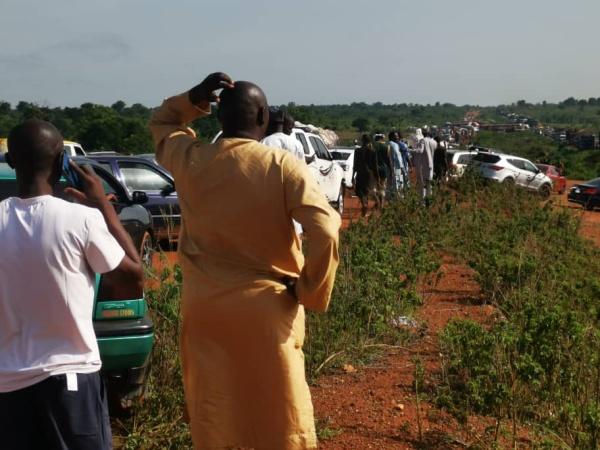
Multiple crashes involving heavy-duty vehicles caused hours of gridlock around Gidan Busa, shortly before Katari on the Kaduna–Abuja highway on Monday, leaving travelers, passengers and freight operators stranded. Ongoing reconstruction and narrow diversions worsened the disruption, while some motorists turned back toward Kaduna or sought alternative routes. A fashion designer traveling to Abuja, Sarah Monday, said she missed an important contract meeting because of the standstill.
Thousands of motorists and passengers were caught for hours in a massive traffic gridlock on the Kaduna–Abuja highway on Monday after multiple crashes involving heavy-duty vehicles blocked movement around Gidan Busa, shortly before Katari, exposing once again the vulnerability of one of northern Nigeria’s most important road corridors to accidents, unfinished reconstruction and the pressure of long-distance freight traffic. The congestion stretched far beyond the immediate crash points, trapping commercial buses, private cars, fuel tankers, cattle trucks and lorries carrying goods under intense heat, while travelers missed appointments, deliveries were delayed and some motorists eventually abandoned their journeys entirely. The disruption came less than a day after heavily loaded containers reportedly fell on the highway around the Katari–Jere axis on Sunday, compounding an already difficult traffic situation along sections where construction work has forced vehicles onto narrower diversions.
The standstill around Gidan Busa became so severe that travelers could see lines of stationary vehicles disappearing into the distance, with passengers eventually leaving their cars and buses to wait beside the road because there was little indication of when movement would resume. NAN reporters described trucks carrying livestock standing bumper to bumper with fuel tankers and lorries loaded with sacks and other cargo, while saloon cars and commercial minibuses were squeezed into whatever space remained. Some passengers sat on top of goods and truck frames as the delay continued, while others found shade beside the unfinished carriageway or stood in small groups trying to understand what had caused the blockage and how long they might remain trapped.
For Sarah Monday, a fashion designer traveling to Abuja for a contract meeting, the disruption had an immediate economic consequence. She said the standstill caused her to miss the appointment she had traveled to attend, turning what should have been an ordinary trip between Kaduna and Abuja into a lost business opportunity. Her experience reflected the wider frustration of travelers who use the highway for work, commerce, family obligations and essential appointments and who have increasingly complained that unpredictable delays make planning journeys on the corridor difficult.
Monday appealed to the Federal Government to accelerate completion of the highway, particularly ahead of periods such as Christmas, Sallah and other major holidays when traffic volumes increase significantly. Her concern is shared by many motorists who argue that ongoing reconstruction, diversions and reduced road space amplify the consequences of crashes that might otherwise be cleared more quickly. When a trailer overturns or suffers a mechanical failure on a narrowed section of road, there may be insufficient room for other vehicles to pass, allowing traffic to build rapidly in both directions.
Another driver, Abubakar Lawal, blamed part of Monday’s gridlock on impatience among motorists. He said drivers attempting to force their way through limited spaces or overtake stationary traffic often make congestion worse, creating multiple competing lanes where only one or two are supposed to exist and preventing recovery vehicles or traffic officers from reaching the original crash scene. In such situations, a single accident can evolve into a much larger road-management crisis because motorists driving against traffic or using shoulders block the limited space available for authorities to clear damaged vehicles.
Yusuf Aliyu, another motorist caught in the traffic, said he would not have started the journey to Abuja had he known conditions on the highway would deteriorate so severely. His reaction illustrates the uncertainty travelers face when information about highway disruptions is limited or arrives only after they have already entered congested sections. Some motorists eventually began turning back toward Kaduna, while others considered traveling through the Kachia–Bwari route despite the additional distance and the different road and security considerations associated with alternative corridors.
Reports from Monday also showed some motorists leaving the main highway altogether and attempting to navigate rough bush tracks in an effort to bypass the blockage. Video circulating online showed vehicles moving through narrow and unfamiliar terrain, with at least one motorist admitting that drivers did not know exactly where the improvised route would lead. Such attempts carry their own dangers, particularly for drivers unfamiliar with the area, and road safety authorities generally advise motorists to remain on approved routes rather than create unofficial detours that may expose them to accidents, mechanical breakdowns or security risks.
The immediate trigger for Monday’s gridlock was reported as multiple accidents involving long vehicles, but the disruption cannot be separated from the larger condition of the Kaduna–Abuja highway. Reconstruction of the route has been underway for years, with delays, contract disputes and changes in contractors repeatedly extending the completion timeline. Sections remain under construction, and diversions place vehicles that would ordinarily have more road space onto narrower temporary routes where heavy trucks, tankers, buses and cars must compete for limited room.
The Abuja–Kaduna highway is strategically important because it connects Nigeria’s federal capital with Kaduna and forms part of a broader road network linking Abuja to major northern commercial centers. Thousands of people use the route daily, while trucks carrying fuel, food, livestock, construction materials and manufactured goods depend on it to move between regions. A serious blockage therefore affects far more than passenger travel; it can interrupt supply chains, delay perishable goods and increase operating costs for businesses whose vehicles and drivers spend hours consuming fuel or sitting idle.
Adewale Usman, a businessman caught in Monday’s congestion, argued that the heavy reliance on road transport for freight is one of the fundamental causes of recurring problems. He said more fuel tankers and bulk cargo should be moved by rail rather than placing such a large volume of heavy vehicles on highways. His argument reflects a long-running policy debate in Nigeria over the imbalance between road and rail freight, particularly for petroleum products and high-volume goods.
Nigeria’s road network carries a disproportionate amount of commercial freight because rail capacity has historically been insufficient to provide a reliable alternative across much of the country. That means highways designed for mixed traffic frequently carry large numbers of articulated trucks and tankers, vehicles that require more stopping distance, occupy more road space and can be extremely difficult to recover after crashes. When one overturns across a carriageway, cranes and specialized equipment may be required before traffic can resume normally.
The Federal Government has been investing in railway projects intended partly to reduce that pressure, including the standard-gauge network connecting Abuja, Kaduna, Kano and other northern corridors. The extent to which rail becomes a practical alternative for freight will depend on completion of lines, freight terminals, operational capacity and whether businesses can move goods reliably and economically between the rail network and final destinations. Until those systems mature, highways such as Kaduna–Abuja will continue carrying enormous quantities of both passenger and commercial traffic.
Monday’s disruption also came shortly after another serious obstruction on Sunday. Reports said three heavily loaded containers fell around the Katari–Jere section at approximately 3 p.m., obstructing movement and creating a traffic buildup that continued to affect the corridor. By Monday, additional accidents involving heavy vehicles around Gidan Busa created another major blockage, leaving motorists who had already endured one day of disruption facing renewed delays.
An unnamed road safety official quoted by NAN said crashes involving heavy vehicles are frequent on the route and claimed that no fewer than 20 accidents involving long vehicles occur every month, with fatalities and livestock losses sometimes recorded. That figure has not been independently confirmed by the Federal Road Safety Corps and should therefore be treated as an official’s reported estimate rather than an established monthly statistic. Even without relying on that exact number, repeated reports of overturned trucks, collisions and severe gridlock along Katari, Jere and nearby sections demonstrate that the problem is recurrent rather than unique to Monday.
Heavy vehicles create distinctive risks on routes undergoing reconstruction. Their weight affects braking distance, tire and suspension stress and the consequences of losing control, while narrow diversions can leave little margin for driver error. A trailer attempting to maneuver around unfinished roadworks may also have difficulty recovering if one side leaves the paved surface, increasing the risk of rollover or complete blockage of the road.
Driver behavior remains another important factor. Road safety officials have repeatedly warned against dangerous overtaking, excessive speed and impatient attempts to bypass traffic on shoulders or opposing lanes. Once vehicles begin forming unauthorized lanes, the traffic pattern becomes more difficult to control and emergency access can disappear. Drivers attempting to save a few minutes can therefore contribute to delays lasting several hours for everyone else.
The economic effects are often invisible in official crash statistics. A traveler such as Sarah Monday may not have been physically injured, but missing a contract meeting can still represent real financial loss. Truck operators pay drivers for hours in which vehicles are not moving, refrigerated or perishable cargo may deteriorate, livestock can remain exposed to heat and stress, and businesses waiting for deliveries may lose customers or production time.
Fuel tankers trapped in gridlock create additional concerns because a secondary collision or fire can produce a much more dangerous emergency. Nigeria has experienced several fatal tanker explosions on highways in recent years, particularly when crowds gather around damaged vehicles or when fuel spills after crashes. Keeping heavy petroleum vehicles moving through safe, well-designed transport corridors is therefore both an economic and public-safety issue.
Passengers stranded under the sun face different risks, particularly children, older travelers and people with health conditions. Long-distance buses may not carry sufficient water or food for hours of unexpected delay, while access to toilets and medical assistance can be limited on rural sections of the highway. A traffic jam caused by a crash can therefore become a broader humanitarian inconvenience even when the original collision does not produce large numbers of casualties.
The condition of the reconstruction project has increasingly become part of public frustration surrounding the route. The Abuja–Kaduna road was originally awarded for rehabilitation years ago, but implementation has experienced delays and contractual changes. The Federal Government terminated aspects of its arrangement with Julius Berger in 2024 following disagreements over revised costs and remobilization, after which sections of the project were reassigned and new completion plans announced.
Such delays matter because temporary diversions are not designed to function as permanent high-volume highways. The longer construction continues, the longer motorists must use sections that may have reduced capacity, uneven surfaces and complicated lane transitions. Every additional heavy-vehicle crash can then create congestion out of proportion to the scale of the original accident.
Federal authorities have argued that reconstruction is necessary precisely because the highway requires a safer and more durable design, but motorists increasingly judge the project not by engineering plans but by how long they remain exposed to disruptions. Monday’s standstill reinforced that frustration because travelers could physically see sections of completed or partly completed concrete road beside the rougher diversion they were forced to use.
The route also has a difficult recent security history. For several years, the Kaduna–Abuja highway became notorious for kidnappings and armed attacks, discouraging road travel and pushing some passengers toward rail services. Security improvements have restored greater confidence in road movement, but severe gridlock presents a different type of vulnerability because hundreds of stationary vehicles concentrated in one location can create security and emergency-management challenges.
That context makes rapid traffic clearance particularly important. Authorities must not only prevent secondary crashes but also avoid leaving large numbers of travelers stationary in isolated areas for longer than necessary. Traffic-management plans for the corridor therefore require coordination among the FRSC, police, construction contractors and recovery operators capable of removing overturned trucks quickly.
As of the period covered by Monday’s reports, there was no confirmed casualty figure directly linked to the Gidan Busa accidents. The reports focused primarily on the scale of the traffic disruption rather than deaths or injuries. It would therefore be inaccurate to attach a casualty number to the incident unless the FRSC or another competent authority releases one.
The absence of a confirmed casualty toll does not reduce the seriousness of the disruption. The photographs and eyewitness accounts describe a corridor effectively immobilized for hours, with travelers abandoning schedules, freight operators absorbing delays and motorists beginning to improvise alternative routes. The incident demonstrates how infrastructure, heavy-vehicle traffic and driver behavior can combine to turn individual crashes into a regional transport problem.
For motorists considering the route after such incidents, the safest approach remains to check verified traffic updates before departure and follow instructions from road safety or police personnel rather than attempting dangerous shortcuts. Conditions can change quickly once damaged trucks are recovered, but they can also deteriorate rapidly when additional vehicles continue entering an already blocked corridor.
The Federal Government now faces renewed pressure to accelerate completion of the highway and improve management of freight traffic through the corridor. Completing reconstruction would increase available road space and reduce dependence on temporary diversions, but it would not eliminate the need for enforcement against dangerous driving or better maintenance standards for heavy vehicles.
Longer-term relief may also depend on whether Nigeria succeeds in shifting more bulk freight onto rail. Tankers and articulated trucks will remain necessary for final distribution, but reducing the number traveling hundreds of kilometers on major highways could lower congestion, road damage and the frequency of incidents capable of shutting down entire routes.
Monday’s experience at Gidan Busa is therefore more than another frustrating traffic story. It illustrates the economic consequences of an unfinished strategic highway and the vulnerability created when heavy freight, passenger vehicles and construction diversions all converge on the same corridor. The missed appointments and delayed deliveries reported by travelers are the everyday costs of infrastructure problems that rarely appear in national budget figures.
The immediate priority is restoring normal movement whenever crashes occur and preventing motorists from worsening congestion through dangerous overtaking or unauthorized diversions. The longer-term challenge is completing the highway, improving freight alternatives and ensuring that incidents involving one or two heavy vehicles cannot repeatedly paralyze a route connecting the federal capital with one of northern Nigeria’s most important cities.
For Sarah Monday and the other travelers trapped for hours on Monday, those broader policy questions were experienced in much simpler terms: journeys that did not reach their destinations on time, business that could not be completed and hours spent waiting under the sun without knowing when the road ahead would reopen. Their frustration is likely to persist as long as the Kaduna–Abuja corridor remains vulnerable to the same combination of crashes, roadworks and heavy traffic that brought movement around Gidan Busa to a standstill again.