NIGERIA CANNOT PROGRESS UNTIL IT ABANDONS ‘PRIMITIVE’ LEADERSHIP SELECTION — JONATHAN
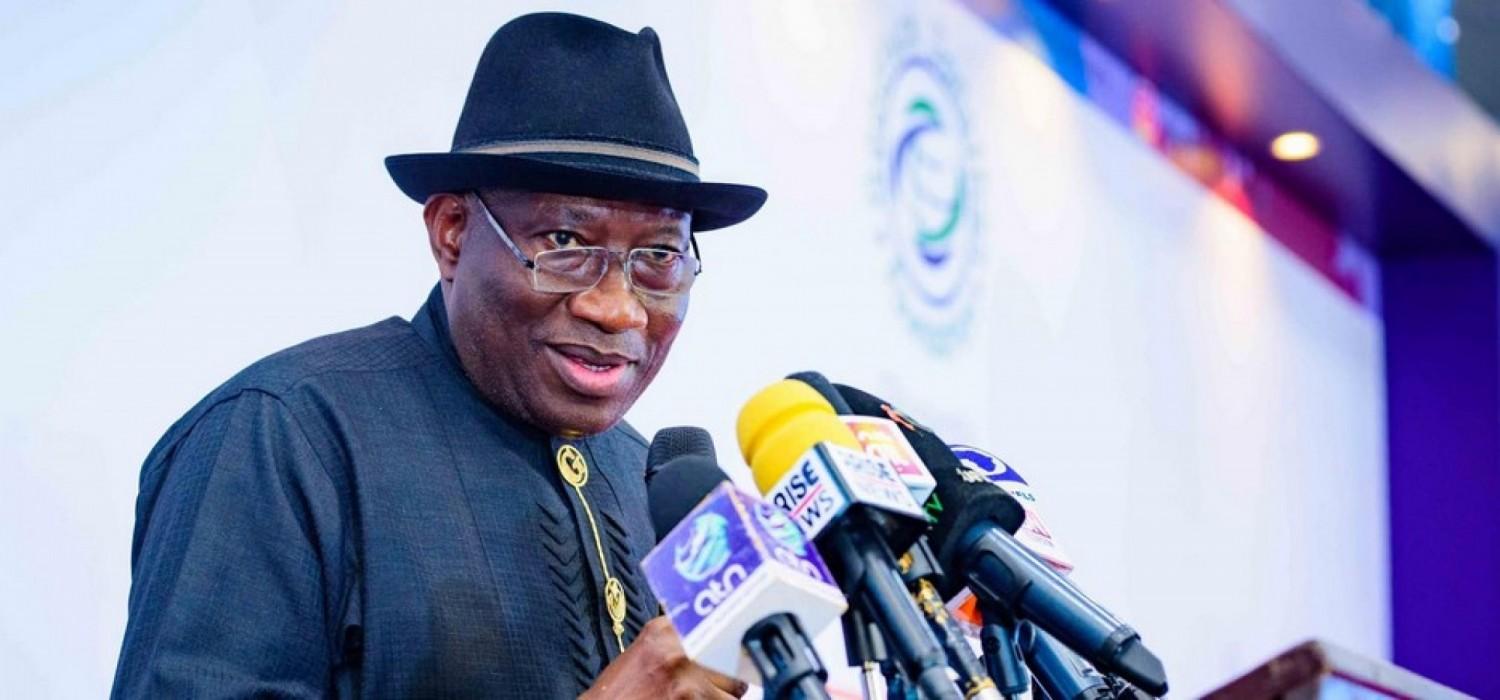
Former President Goodluck Jonathan has called for fundamental reform of Nigeria’s political recruitment system, warning that the country cannot achieve meaningful development while religion, ethnicity, language and denominational considerations continue to influence who can become a political leader. Speaking as chairman of the Herbert Macaulay Memorial Colloquium in Lagos on November 14, Jonathan also described Nigeria’s democratic system as “opaque and amorphous” and called for stronger popular participation, judicial independence, accountability, human rights and the rule of law. He identified weak leadership, corruption, institutional weakness, policy inconsistency, infrastructure deficits and insecurity as development obstacles and urged Nigeria to build research-intensive universities capable of competing globally. New Telegraph
LAGOS, NIGERIA — Former President Goodluck Jonathan has warned that Nigeria will continue struggling to achieve its development potential unless it abandons what he described as primitive methods of choosing political leaders according to religion, ethnicity, language, denomination and other sectional considerations instead of competence, character and capacity. Speaking on Saturday at the Herbert Macaulay Memorial Colloquium in Lagos, Jonathan argued that the country’s political recruitment system remains one of the central weaknesses undermining national development, saying Nigeria cannot reasonably expect better governance while qualified citizens can be excluded from leadership because they belong to the wrong ethnic group, speak the wrong language or worship within a religious denomination considered politically unacceptable in a particular state or community.
Jonathan, who chaired the November 14 event at the Nigerian Institute of International Affairs in Victoria Island, made the remarks as political leaders, scholars, traditional figures and members of Herbert Macaulay’s family gathered to commemorate the 162nd anniversary of the nationalist’s birth. Macaulay, born on November 14, 1864, became one of the most important figures in Nigeria’s early nationalist movement, opposing British colonial rule and helping establish organized indigenous political participation decades before independence. Jonathan used the anniversary not simply to celebrate Macaulay’s historical contribution but to question whether Nigeria had fulfilled the broader expectations of the nationalist generation 66 years after gaining independence in 1960.
The former president said one of the country’s most persistent problems is that political recruitment frequently begins with considerations unrelated to whether a prospective leader has the ability to govern effectively. He referred to a predominantly Christian state in southern Nigeria where, according to him, political calculations can become so denominational that a person who does not belong to a particular Christian tradition may struggle to emerge as governor, even where virtually the entire population professes the same broader faith. Jonathan did not identify the state, and his assertion about its political practices represents his assessment rather than an independently established rule governing eligibility for office.
His broader argument was that Nigeria undermines itself whenever identity becomes more important than capability. Jonathan said leadership selection shaped by religion, language, ethnicity and similar considerations narrows the pool from which public officials can emerge and can prevent competent citizens from reaching positions where their knowledge and experience might contribute to development. He said abandoning those considerations did not mean ignoring Nigeria’s diversity but creating a political culture in which identity does not automatically determine access to public office.
“Until we move away from this primitive way of recruiting political leaders, this country cannot go forward,” Jonathan said, summing up one of the strongest arguments in his address. His comments were not directed at a single political party or administration but at a pattern he said had persisted across Nigeria’s political system, including the processes through which political parties select candidates and communities decide which identities they consider acceptable for leadership.
The remarks arrive as Nigeria moves steadily toward the 2027 general election cycle, when parties and political blocs will again confront debates over regional balance, religious representation, zoning, ethnicity and candidate selection. Those considerations have long been embedded in Nigerian politics, with political parties frequently calculating electoral tickets according to geographic and religious balancing in an attempt to assemble broad coalitions across the country’s diverse population. Supporters of balancing arrangements argue that they can promote inclusion in a multi-ethnic federation, while critics say they can become rigid systems that elevate identity over competence and encourage political elites to treat public office as an entitlement of particular groups.
Jonathan’s criticism therefore raises a longstanding dilemma in Nigerian democracy: how to ensure representation for different communities without allowing representation itself to become the principal qualification for leadership. Nigeria has more than 250 ethnic groups, multiple major religious communities and significant regional differences, creating legitimate concerns about political exclusion. At the same time, the persistent expectation that offices must rotate among groups can create circumstances in which party calculations focus first on origin, faith or geopolitical zone and only later on whether candidates have the administrative capacity required for the role.
The former president argued that reforming political recruitment must form part of a much broader effort to redesign Nigeria’s democratic practice. He described the existing democratic system as “opaque and amorphous,” saying it needed to be aligned more closely with principles that include popular participation, the rule of law, respect for human rights, judicial independence, accountability, pluralism, separation of powers and a vibrant civil society. His criticism suggested that holding periodic elections alone is insufficient to establish a strong democracy where institutions remain weak or citizens lack confidence in how political decisions are made.
Jonathan has spent much of his post-presidency period involved in democracy promotion, election observation and mediation across Africa, frequently arguing that credible institutions are more important than the ambitions of individual leaders. His own 2015 decision to concede Nigeria’s presidential election to Muhammadu Buhari before the final declaration of results became a defining part of his political legacy and has frequently informed his subsequent public interventions on peaceful transfers of power and democratic accountability.
At the Lagos colloquium, however, his focus extended beyond elections. Jonathan said Nigeria’s development weaknesses could be traced to a combination of poor leadership, fragile institutions, corruption, policy inconsistency, inadequate infrastructure, insecurity and excessive dependence on raw-material exports. Those challenges, he said, have prevented a resource-rich country with a large and talented population from translating its advantages into living standards comparable with countries that were once at similar stages of development.
He contrasted Nigeria’s trajectory with countries including South Korea, India and Singapore, pointing to their progress in manufacturing, technology, education, healthcare and institutional development. South Korea, which emerged from war and severe poverty in the 1950s, became one of the world’s major industrial and technological economies. Singapore transformed from a relatively poor trading settlement into a high-income international business and logistics center, while India has developed significant capabilities in software, pharmaceuticals, engineering, space technology and advanced services.
Jonathan did not argue that the histories or political systems of those countries were identical to Nigeria’s. Instead, he used them to illustrate how sustained national planning, strong institutions and investment in human capital can produce structural transformation over several decades. His question was why Nigeria, despite extensive oil and gas reserves, agricultural resources and a population of more than 200 million people, has struggled to generate a comparable level of transformation.
That question has occupied successive Nigerian governments since independence. The country has experienced periods of strong economic growth, an expanding telecommunications sector, major financial services development, a rapidly growing technology ecosystem and globally successful creative industries. Yet it continues to face high poverty, unreliable electricity, infrastructure deficits, insecurity, unemployment and significant inequality, while dependence on oil revenues has made public finances vulnerable to fluctuations in global energy markets.
For Jonathan, the problem cannot be separated from the quality of institutions responsible for implementing policy. Governments can announce ambitious plans, he argued, but sustained development requires public institutions capable of carrying policies across political administrations. Nigeria has frequently changed economic priorities, development strategies and institutional structures when governments change, creating uncertainty for businesses and weakening continuity in major infrastructure and social programs.
The former president therefore urged the country to begin planning around a longer historical horizon rather than treating development as a sequence of four-year political cycles. He pointed to 2060, when Nigeria will celebrate 100 years of independence, and asked what kind of country Nigerians expect to see by that anniversary. A child born in 2026 will be approximately 34 years old by then, meaning the decisions being made now will shape the economy, institutions and society that an entire generation inherits.
Jonathan said those questions should become the basis of a genuine national development agenda containing measurable objectives, defined responsibilities and realistic timelines. He said political leaders would need to provide direction, public institutions would have to operate efficiently, businesses should invest in productive capacity and educational institutions must prepare Nigerians for technological and economic changes that will define the coming decades.
Education occupied a particularly important part of his address. Jonathan argued that Nigeria cannot achieve the scale of economic transformation it seeks while its universities and other educational institutions remain comparatively weak in global research and innovation. He referred to the Times Higher Education 2027 rankings and said Nigeria needed universities capable of competing among the top 200 or 300 institutions globally rather than accepting consistently modest international rankings.
His criticism was not an assertion that Nigerian universities produce no competent graduates. Jonathan, who earned his own university qualifications in Nigeria, acknowledged that the country has strong academics and continues producing capable engineers, lawyers, scientists, historians and professionals across numerous disciplines. His concern was that universities should become stronger producers of original knowledge, technology and research rather than functioning primarily as institutions that consume knowledge generated elsewhere.
“You can’t go anywhere with weak educational institutions,” he said, arguing that national competitiveness ultimately depends on the quality of the people and ideas produced by universities, research centers and technical institutions. His position reflects a broader development argument that countries able to build domestic research capacity are better positioned to move from exporting commodities toward producing higher-value manufactured goods, technology and intellectual property.
Nigeria’s universities have for years faced challenges including inadequate research funding, aging infrastructure, staff shortages, repeated industrial disputes and the migration of academics to institutions abroad. Although several Nigerian universities have improved their international standing and research output, they remain far behind institutions in countries that invest heavily in science, technology and advanced research.
Jonathan argued that Nigeria must deliberately identify and invest in its strongest intellectual talent, giving researchers and students institutions capable of competing internationally. That would require more than constructing new university buildings; it would involve sustained funding for laboratories, postgraduate training, international collaboration, research commercialization and links between universities and industry.
His education argument also connected directly with his criticism of political recruitment. A country can spend billions educating skilled citizens, he suggested, but it wastes part of that investment if political and administrative opportunities remain determined principally by identity, patronage or personal connections rather than ability. Merit-based political recruitment would therefore complement a stronger educational system by creating a pathway through which talented Nigerians could participate more effectively in national governance.
Jonathan also framed his remarks within the historical aspirations of Herbert Macaulay and other early nationalists. Macaulay was trained as a surveyor and civil engineer and became a journalist, political organizer and outspoken critic of colonial administration. In 1923, he helped establish the Nigerian National Democratic Party, widely regarded as Nigeria’s first political party, creating an organized platform through which indigenous political interests could contest elections in Lagos under the limited colonial franchise then available.
Macaulay later became closely associated with the nationalist movement that eventually produced figures such as Nnamdi Azikiwe and helped lay the political groundwork for independence. He died in 1946, 14 years before Nigeria became an independent country, meaning he never witnessed the transfer of sovereign authority for which his activism helped prepare the way.
Jonathan told the gathering that the ambitions of Macaulay and other nationalist leaders went well beyond replacing colonial administrators with Nigerians. They envisioned political independence producing economic freedom, industrialization, quality education, accessible healthcare, employment, social justice and a country in which citizens could determine their future and benefit from the resources around them.
The former president said Nigeria must therefore assess independence not only by the existence of national institutions and elected leaders but by the practical condition of citizens. His questions included whether Nigerians have achieved the level of economic opportunity, social justice and institutional strength that the nationalist generation would have expected and whether the country is satisfied with its position more than six decades after independence.
That framing is significant because Nigeria has often commemorated its political history through anniversaries while arguments continue over whether the promises associated with independence have been fulfilled. Jonathan recalled similar debate during the 2014 centenary of Nigeria’s amalgamation, which took place while he was president. Critics at the time questioned the value of celebrating the 1914 amalgamation amid poverty, insecurity and unresolved national divisions, but Jonathan defended the commemoration as an opportunity to understand the country’s history and evaluate its progress.
At the Macaulay event, he returned to the same idea: historical remembrance should function as a tool for assessing the present rather than simply celebrating the past. The most meaningful tribute to the nationalist generation, he said, would be building a country that reflects the values of freedom, dignity, opportunity and responsible government for which they struggled.
Jonathan also placed particular responsibility on younger Nigerians. He said the nationalist struggle did not end with independence because political freedom must be followed by economic emancipation, technological advancement and strong institutions. Young people, he argued, should pursue those objectives through innovation, enterprise, responsible citizenship and active civic participation rather than assuming that nation-building is exclusively the responsibility of political officeholders.
His comments came alongside another notable development at the colloquium involving Macaulay’s descendants. Chief Bode George, a former Deputy National Chairman of the Peoples Democratic Party and a relative of Macaulay, appealed to President Bola Tinubu and the Federal Government to return the Lagos property where the General Post Office stands to Macaulay’s family so that it can be converted into a permanent memorial.
George said Macaulay’s home had stood on the property before being demolished after his death and alleged that the General Post Office was subsequently built on the site. The family says it is prepared to construct a memorial hall dedicated to Macaulay’s life and nationalist work if the property is returned. That historical ownership claim is the family’s position and would require consideration of the relevant land, government and archival records before any transfer could occur.
The request added a physical dimension to Jonathan’s argument about preserving history. Nigeria has numerous monuments and sites associated with independence leaders, but historians and preservation advocates have repeatedly complained that important buildings, documents and locations connected to the nationalist struggle have been neglected, demolished or poorly maintained. Jonathan warned that a country that forgets its history risks weakening its identity and its understanding of how present institutions emerged.
The former president’s call for democratic reform also carried contemporary political weight because Nigeria is approaching another general election. Questions about internal party democracy, candidate selection, campaign financing, electoral administration and judicial intervention remain central to public debate after the contentious 2023 election and subsequent litigation. Jonathan did not use his colloquium address to endorse a candidate or party for 2027, and his remarks should not be interpreted as an electoral endorsement.
Instead, his argument focused on the rules and culture through which leaders emerge. A credible political recruitment process, in his view, should make it possible for Nigerians with competence and integrity to contest leadership regardless of religion, ethnicity or denomination while ensuring that public institutions remain strong enough to constrain any individual who reaches office.
That distinction between leaders and institutions is particularly important in presidential systems. Even a highly capable president cannot personally manage every ministry, court, regulator, state government and public agency. Sustainable development therefore depends on institutions with professional personnel, clear rules and continuity strong enough to survive changes in political leadership.
Jonathan’s criticism of corruption similarly fits within that institutional argument. Corruption diverts public resources, distorts procurement and creates incentives for political office to become a source of private enrichment. Weak institutions can allow those practices to continue even when governments publicly declare anti-corruption priorities, while strong auditing, judicial and enforcement systems can make abuse more difficult regardless of who holds power.
Insecurity is another obstacle he identified, and it has become one of Nigeria’s most persistent national challenges. The country continues to contend with insurgency, banditry, kidnapping, communal violence and other threats that affect farming, investment, education and movement across parts of the federation. Security failures can undermine economic development even where other reforms are functioning because businesses and households cannot invest confidently in areas where lives and property remain at risk.
Jonathan’s inclusion of infrastructure and overdependence on raw materials also reflects weaknesses long identified in Nigeria’s economic structure. Poor electricity supply, transport bottlenecks and inadequate logistics raise costs for businesses, while reliance on oil and commodity exports exposes the economy to external price movements. Moving toward higher-value manufacturing and technology would require the education and institutional reforms he discussed alongside substantial infrastructure investment.
The challenge is that none of those reforms can be completed by one administration. Building research universities, transforming electricity supply, strengthening the judiciary, improving political parties and diversifying an economy are generational projects. Jonathan’s choice of 2060 as a planning horizon was therefore an argument for development policy that survives election cycles and changes of government.
Nigeria has adopted numerous development frameworks over the decades, from rolling plans and Vision 2010 to Vision 20:2020 and more recent national development strategies. The difficulty has often been implementation, policy continuity and the ability to translate ambitious targets into measurable improvements. Jonathan’s proposal for clearly defined objectives and responsibilities implicitly acknowledges that a new vision without effective institutions would reproduce many of the weaknesses he criticized.
His remarks about political identity may prove among the most debated parts of the speech because Nigeria’s diversity makes some form of inclusion unavoidable. Federal-character principles were designed precisely to prevent a small number of regions or ethnic groups from monopolizing state institutions. The challenge is ensuring those protections do not become substitutes for merit or mechanisms through which political elites distribute offices without regard to competence.
Jonathan’s position suggests a model in which inclusion and competence are treated as complementary rather than competing goals. Nigeria can seek representative government while still demanding minimum standards of ability, integrity and administrative experience from those seeking leadership. What he rejected was a system in which identity becomes a veto against otherwise qualified candidates.
The debate is especially relevant to political parties, which act as the principal gatekeepers to elected office. Candidate selection frequently occurs through primaries, consensus arrangements, zoning agreements and negotiations among powerful party blocs long before voters encounter names on a general-election ballot. Reforming leadership recruitment would therefore require change inside parties as much as change among voters.
Civil society also featured in Jonathan’s description of a functioning democracy. Independent media, civic organizations, professional associations and advocacy groups can provide scrutiny between elections, challenge abuses and create channels through which citizens participate in governance outside party structures. A vibrant civil society, he argued, is not an obstacle to government but one of the mechanisms that makes democratic government accountable.
Judicial independence was another pillar he identified. Nigeria’s courts regularly decide disputes involving elections, public policy and political office, making public confidence in judicial neutrality central to democratic legitimacy. Where citizens believe political disputes are settled through influence rather than law, distrust can spread beyond individual judgments to the democratic system itself.
Jonathan’s address therefore amounted to a broader warning that Nigeria’s development problems cannot be solved by economic policy alone. Roads, industrial projects and investment programs matter, but their effectiveness depends on the political system that decides who leads institutions, how public funds are spent and whether citizens can hold officials accountable.
The former president’s message also carried an implicit historical challenge. Macaulay and his contemporaries fought a colonial system in which Nigerians had limited control over their own political future. Six decades after independence, Jonathan argued that the central task is no longer simply obtaining the right to govern but determining whether Nigerians are using that sovereignty to construct institutions capable of producing prosperity and equal opportunity.
His comparison with other developing countries reinforces that urgency. South Korea and Singapore are frequently invoked in Nigerian development discussions because both achieved dramatic economic transformations within roughly the period since Nigerian independence. India, meanwhile, illustrates how a large, diverse post-colonial society can develop internationally competitive sectors despite persistent internal challenges. None offers a simple model that can be copied directly, but each demonstrates that national trajectories can change substantially within a generation when institutions, education and productive investment align.
Nigeria’s own strengths remain considerable. It has Africa’s largest population, extensive energy and agricultural resources, a large consumer market, significant entrepreneurial activity and globally influential cultural industries. Nigerian professionals operate across medicine, engineering, finance, technology and academia around the world. Jonathan’s argument was that the problem is therefore not an absence of human or natural capacity but the systems through which that capacity is organized and governed.
The choice of Herbert Macaulay’s anniversary as the setting for that argument gave the speech a historical frame that extends beyond contemporary party politics. Macaulay challenged the racial hierarchy and political exclusion of colonial Lagos, helping create political organizations through which Nigerians could demand greater representation. Jonathan’s warning is that modern Nigeria risks creating new forms of exclusion if ethnicity, religion and narrow group interests determine who is considered politically eligible.
Whether Nigeria can reform those practices will depend on political parties, voters, institutions and the incentives surrounding elections. Identity remains powerful because politicians can mobilize it effectively, particularly where communities fear exclusion from resources or government appointments. Replacing those incentives with competition based more heavily on policy and performance will require trust that citizens do not lose access to government simply because someone from another group wins office.
That is ultimately why Jonathan connected leadership recruitment to institutional reform. Strong institutions can reduce the fear that political power must be controlled by one’s own ethnic or religious group because laws and public agencies protect citizens regardless of who occupies office. Weak institutions have the opposite effect, making control of government appear essential because political winners may be perceived as possessing unrestricted access to state resources.
The former president’s warning therefore goes beyond the familiar appeal to “choose competent leaders.” It raises a deeper question about whether Nigeria’s political system can create institutions strong enough for citizens to judge leaders primarily by performance without fearing domination by rival groups. That challenge has existed in different forms since independence and remains unresolved as another election cycle approaches.
Jonathan concluded that remembering Macaulay and other founding nationalists should involve more than ceremonies, statues and anniversaries. Their sacrifices, he said, should be measured against the kind of country Nigeria creates for future generations. By 2060, another generation will judge whether today’s leaders and citizens strengthened education, institutions, democracy and economic opportunity or simply passed forward many of the same problems.
For Nigeria, the immediate political debates will continue to revolve around candidates, parties, regions and the 2027 elections. Jonathan’s message at the Herbert Macaulay Colloquium was that the more consequential question lies underneath those contests: whether the country can change the criteria by which political leadership is produced and build institutions that reward capability rather than identity. In his assessment, Nigeria’s abundant resources and talented population will remain insufficient if the political system continues elevating sectional considerations above competence, leaving the country with the same fundamental development questions when it reaches its centenary of independence in 2060.