NIGERIA HAS NEARLY 240 PRIVATE JETS, KEYAMO SAYS, AS LUXURY AVIATION BOOM EXPOSES GAPS IN DOMESTIC AIRCRAFT MAINTENANCENIGERIA HAS NEARLY 240 PRIVATE JETS, KEYAMO SAYS, AS LUXURY AVIATION BOOM EXPOSES GAPS IN DOMESTIC AIRCRAFT MAINTENANCE

Nigeria has approximately 240 private jets operating within the country, making it Africa's largest business aviation market according to Aviation and Aerospace Development Minister Festus Keyamo. The minister originally disclosed the figure in July 2026 during discussions with Canadian aircraft manufacturer Bombardier in Montreal, where he explored opportunities to establish a major aircraft maintenance facility in Nigeria. Renewed reporting on November 26 and 27 highlighted the industry's substantial expansion from an estimated 100 aircraft in 2021, alongside concerns about foreign exchange expenditure on overseas maintenance. While earlier independent aviation estimates ranked South Africa higher, differences in aircraft registration and fleet-counting methodologies complicate direct comparisons. The expansion presents opportunities for domestic engineering, employment and investment but also highlights regulatory challenges, economic inequality and persistent difficulties within Nigeria's commercial aviation sector.
Nigeria's private aviation industry has experienced substantial growth over the past five years, with nearly 240 private jets reportedly operating within the country, according to Minister of Aviation and Aerospace Development Festus Keyamo. The minister has described Nigeria as Africa's largest business aviation market, highlighting the increasing demand for executive aircraft alongside concerns about the substantial foreign exchange spent on maintaining them overseas. Keyamo originally disclosed the figure in July 2026 during a working visit to Canadian aircraft manufacturer Bombardier in Montreal, with renewed reports on November 26 and 27 bringing the industry's expansion back into national discussion. The development has also intensified debate over the striking contrast between Nigeria's expanding luxury aviation market and the financial, operational and infrastructural difficulties confronting its commercial airline industry.
Keyamo led a delegation comprising government representatives and major Nigerian private jet operators to Montreal to explore opportunities for establishing a major aircraft maintenance and servicing facility in Nigeria. Discussions with Bombardier focused on the possibility of developing domestic technical capabilities that would reduce the need for aircraft owners to send their jets overseas for servicing. The minister identified the country's substantial private aircraft population as an important commercial justification for attracting investment from internationally recognized aircraft manufacturers. Establishing such a facility could potentially allow Nigeria to retain a greater proportion of the expenditure currently directed toward foreign maintenance companies while developing specialized employment opportunities within its aviation industry.
The minister expressed concern about the amount of foreign currency leaving Nigeria every week to finance maintenance activities involving privately operated aircraft. Although he did not establish a comprehensive monetary estimate of the weekly expenditure in the reports reviewed, the financial implications are significant for an economy that has experienced considerable pressure on its foreign exchange market. Aircraft maintenance involves specialized technical services, internationally sourced components and regulatory compliance procedures that can generate substantial costs for owners. Where those services are obtained abroad, a considerable proportion of the associated expenditure supports foreign aviation industries rather than domestic businesses.
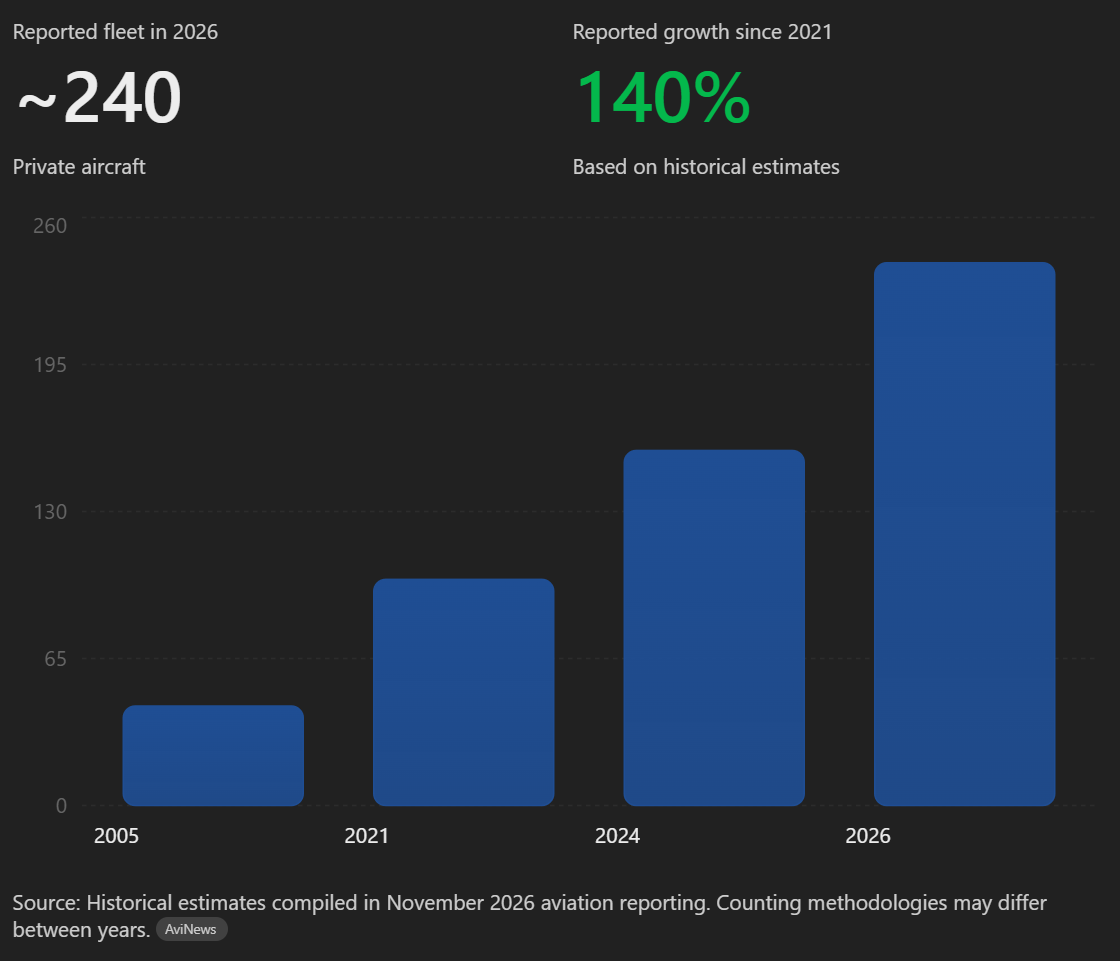
Nigeria's growing private jet market reflects a broader transformation in the demand for executive aviation services across the country. Historical figures cited in recent aviation reporting suggest that the fleet increased from approximately 44 aircraft in 2005 to around 100 in 2021, before reaching an estimated 240 by 2026. Although those figures come from different periods and may not have been compiled using identical counting methods, they indicate a considerable expansion in business aviation over the past two decades. The acceleration recorded in recent years has attracted attention because it has occurred during a period in which many Nigerian households and businesses have confronted inflation, currency depreciation and rising transportation costs.
The reported increase from approximately 100 aircraft in 2021 to 240 in 2026 suggests that Nigeria's private aviation market has more than doubled in size within five years. That expansion has created opportunities for aircraft management companies, charter operators, aviation fuel suppliers, maintenance providers and businesses specializing in executive passenger services. However, the full economic contribution of the industry depends on the proportion of those activities undertaken within Nigeria rather than through foreign service providers. A growing aircraft fleet does not automatically translate into equivalent growth in domestic employment, tax revenue or technical expertise if essential services remain concentrated overseas.
The claim that Nigeria possesses Africa's largest private jet fleet nevertheless requires an important distinction between aircraft operating within the country and those officially registered under its national aviation system. Independent aviation industry estimates have previously identified South Africa as the continent's largest business aircraft market based on fleet data compiled using different methodologies. Aviation International News reported in June 2024 that South Africa had approximately 137 business aircraft out of an estimated continental fleet of 418 business jets, placing it ahead of Kenya and Nigeria in that assessment. Keyamo's subsequent figure of approximately 240 aircraft operating in Nigeria reflects a later period and potentially a broader measurement of aviation activity.
Aircraft registration, ownership, operational location and commercial availability are distinct characteristics that can produce substantially different fleet estimates. An aircraft may be owned by a Nigerian individual or company but registered in another jurisdiction, while spending much of its operational life within Nigeria. Other aircraft may enter the country temporarily for business engagements, charter operations or specialized assignments without becoming permanently based there. Establishing an accurate comparison between African countries consequently requires consistent definitions concerning which aircraft are included and the period over which their activities are assessed.
Data published by aviation intelligence provider ch-aviation in June 2025 identified 73 business jets based in Lagos or Abuja, of which only 25 carried Nigerian registrations. That assessment covered aircraft based at the country's two principal business aviation centers and should not be interpreted as a comprehensive count of every private aircraft operating throughout Nigeria. The difference between that figure and Keyamo's estimate illustrates the challenges associated with comparing aircraft databases that measure different aspects of the industry. It also reinforces the importance of developing a comprehensive national inventory capable of distinguishing resident aircraft, temporary visitors and commercially operated business jets.
Recent flight activity data nevertheless provides additional evidence of Nigeria's substantial executive aviation market. According to aviation intelligence platform Avi-Go, approximately 14,890 departure operations involving business-flight-capable aircraft were recorded in Nigeria between January 1 and November 11, 2026. Lagos accounted for 5,525 departures, while Abuja recorded 4,626, demonstrating the concentration of executive aviation activity around the country's principal commercial and administrative centers. The data provides an indication of operational demand, although it does not independently establish the total number of permanently based private jets or the number of flights undertaken for commercial charter purposes.
Lagos remains an important center for business aviation because of its concentration of financial institutions, multinational companies, industrial enterprises and wealthy private individuals. The city serves as Nigeria's principal commercial gateway and maintains extensive connections with international business centers. Executive aircraft can provide passengers with greater scheduling flexibility and access to destinations that may not be adequately served by regular commercial flights. For companies operating across multiple regions, the ability to coordinate travel independently of scheduled airline services can constitute an important business consideration.
Abuja's position as the federal capital creates a different but equally significant source of demand. Government institutions, diplomatic missions, corporate organizations and political activities generate substantial travel requirements involving destinations throughout Nigeria and beyond. The approaching 2027 general elections have also contributed to industry expectations of increased charter demand as political organizations and candidates prepare for nationwide campaign activities. However, the number of private aviation operations associated specifically with political travel has not been independently established, and aggregate flight activity should not be treated as evidence of individual passenger identities or purposes.
The Guardian reported in October 2026 that private aircraft operators were anticipating increased business associated with election preparations and campaign travel. Its reporting identified charter rates ranging from approximately $5,000 to $7,000 per flight hour, depending on aircraft characteristics, passenger capacity, destination and operating conditions. Such prices place executive aviation beyond the financial reach of most Nigerian travelers, illustrating the extent to which the sector serves a relatively affluent clientele. The ultimate cost of a charter can also include additional expenses associated with airport handling, aircraft positioning, crew arrangements and other operational requirements.
Private aviation serves several categories of customers beyond individuals purchasing aircraft primarily for personal luxury. Corporations may operate executive jets to facilitate business travel, while charter companies provide aircraft to customers requiring flexible transportation arrangements. Specialized aviation services can also support medical evacuation, industrial operations and travel to destinations where scheduled airline services are limited. Consequently, the economic significance of business aviation cannot be assessed exclusively through assumptions about conspicuous consumption, even though expensive privately operated aircraft remain prominent symbols of wealth.
Nevertheless, the growth of the industry has generated debate about economic inequality in Nigeria. The acquisition and operation of private aircraft requires substantial financial resources at a time when many households are struggling with rising living expenses. Commercial passengers have also faced higher airfares as airlines contend with increases in fuel costs, aircraft maintenance expenses and other operational pressures. The contrast between the expansion of luxury aviation and the transportation difficulties experienced by ordinary Nigerians has become an important component of public discussions surrounding the country's economic development.
In July, BusinessDay reported that some aviation stakeholders regarded the expansion of private aircraft ownership as evidence of deeper weaknesses within the commercial transportation system. Samuel Caulcrick, a former rector of the Nigerian College of Aviation Technology, argued that the withdrawal of wealthy individuals from shared public services could undermine incentives to improve those systems. His observations reflected concern about the consequences of increasingly separate transportation arrangements for different segments of society. Other industry perspectives emphasize that business aviation can create employment, attract investment and support economic activity when appropriately integrated into the broader aviation sector.
The two perspectives highlight the importance of distinguishing private wealth creation from the institutional consequences of an expanding luxury aviation market. The existence of private jets does not independently establish wrongdoing by their owners, nor does their acquisition necessarily explain the financial difficulties confronting scheduled commercial airlines. However, the rapid growth of executive aviation alongside persistent challenges in public transportation raises legitimate questions about whether the sector's economic benefits are being retained within Nigeria. Developing domestic maintenance capabilities could provide one mechanism through which private aviation expenditure contributes more directly to national industrial development.
Aircraft maintenance, repair and overhaul, commonly referred to within the industry as MRO, represents one of the most important commercial opportunities associated with Nigeria's growing private jet fleet. Modern aircraft require regular inspections, servicing and component replacement to maintain their airworthiness. More comprehensive maintenance activities may involve specialized facilities equipped to undertake complex technical work under internationally recognized regulatory standards. The availability of such facilities within Nigeria could reduce some of the logistical and financial difficulties associated with obtaining services abroad.
Sending aircraft overseas for maintenance can impose costs beyond the price charged by the maintenance company. Aircraft positioning flights, fuel consumption, crew accommodation and the time during which an aircraft remains unavailable can contribute to the overall expenditure. Depending on the maintenance requirements and availability of specialized facilities, an aircraft may remain outside Nigeria for an extended period. Domestic servicing could reduce certain expenses associated with those arrangements, although internationally sourced components and specialized equipment would continue to require foreign currency in many circumstances.
Keyamo's engagement with Bombardier was therefore focused on more than attracting a prestigious international aerospace company to Nigeria. Establishing a manufacturer-backed service center could provide access to specialized technical knowledge, approved maintenance procedures and training opportunities for Nigerian aviation professionals. It could also improve the country's attractiveness as a destination for business aircraft requiring maintenance within West Africa. However, the discussions announced in July do not independently establish that Bombardier has signed a binding construction agreement or committed to a specific investment timetable.
Bombardier is among the world's prominent manufacturers of business aircraft, with its Challenger and Global product families widely used in executive aviation markets. The company also provides technical services and aftermarket support for operators of its aircraft. Its participation in a Nigerian maintenance initiative could be particularly relevant to owners whose aircraft require manufacturer-approved servicing arrangements. The potential benefits would depend on the nature of any eventual agreement, the categories of aircraft covered and the regulatory approvals obtained by the proposed facility.
Nigeria already possesses some aircraft maintenance capabilities, and the proposed Bombardier development should not be interpreted as evidence that the country lacks all domestic technical services. Established maintenance providers have developed capabilities covering particular aircraft categories and levels of servicing, while other organizations have announced plans to expand their facilities. In January 2025, aviation company XEJet held a groundbreaking ceremony for a hangar and aircraft engineering facility at Nnamdi Azikiwe International Airport in Abuja. International maintenance providers have also pursued regulatory approvals and expanded their activities in the Nigerian market.
Those developments provide an indication of growing interest in the commercial opportunities associated with domestic aircraft servicing. Nevertheless, the maintenance needs of modern business aircraft can vary considerably according to their manufacturers, models and technical requirements. A facility approved to undertake particular maintenance activities may not possess authorization to service every aircraft operating in the country. Expanding Nigeria's technical capacity therefore requires a combination of infrastructure investment, regulatory certification, manufacturer cooperation and sustained workforce development.
The employment implications could be substantial if additional maintenance operations become commercially sustainable. Aircraft engineering facilities require licensed technicians, avionics specialists, quality assurance personnel, logistics professionals and other workers possessing specialized skills. Establishing such operations could create opportunities for graduates of Nigerian technical and aviation training institutions while encouraging experienced professionals working abroad to participate in domestic industrial development. The actual number of jobs created would depend on the scale of the investment and the volume of maintenance activities secured by individual facilities.
Workforce development remains especially important because aviation maintenance operates under demanding safety and regulatory requirements. Technical personnel must receive appropriate training and demonstrate the competencies necessary to perform authorized maintenance activities. Manufacturers may also require additional qualifications specific to particular aircraft systems. Developing those capabilities within Nigeria would require cooperation between maintenance providers, aviation regulators, training institutions and international aerospace companies.
The expansion of domestic technical services could also benefit parts of Nigeria's commercial airline industry. Although private business jets and passenger airliners have different maintenance requirements, investment in aviation engineering can contribute to the development of broader technical capabilities, specialist supply chains and regulatory expertise. Commercial airlines frequently face difficulties associated with the cost and availability of aircraft maintenance, particularly where essential services must be obtained outside the country. Developing additional domestic facilities could help address some of those challenges, provided the facilities obtain authorization for the relevant aircraft categories.
Nigeria's foreign exchange environment makes those considerations particularly significant. Aviation is an internationally connected industry in which many operating expenses are denominated in foreign currencies, including aircraft purchases, leased equipment, spare parts, insurance and specialized technical services. Airlines and private aircraft operators earning revenue in naira may therefore experience financial pressure when the domestic currency depreciates against currencies used to settle international obligations. Expanding the availability of local services could reduce certain foreign currency requirements, although it would not eliminate the industry's dependence on international suppliers.
The regulatory structure surrounding private aircraft operations presents another important challenge. Nigeria's private aviation market includes aircraft operated for personal use, those managed on behalf of corporate owners and aircraft available for commercial charter. These activities may require different authorizations, and the distinction between private and commercial operations carries implications for safety oversight, insurance, taxation and passenger protection. Effective enforcement is necessary to ensure that operators comply with the requirements applicable to their activities.
In June 2024, Keyamo established a ministerial task force to investigate unauthorized commercial charter operations within Nigeria. Authorities expressed concern that some aircraft authorized for private use were allegedly being employed to provide commercial transportation without the appropriate approvals. Such activities can create unfair competition for licensed charter operators while potentially depriving the government of revenue associated with regulated commercial operations. However, the existence of unauthorized operators does not establish that every privately registered aircraft is involved in unlawful activities.
Customs compliance has similarly emerged as an area of concern, particularly in relation to aircraft registered outside Nigeria. In June 2025, aviation industry reporting indicated that the Nigeria Customs Service temporarily grounded around 60 foreign-registered business jets at Lagos and Abuja airports over outstanding import duty issues. The development highlighted disagreements concerning the legal and financial obligations associated with aircraft operating within Nigeria while remaining registered abroad. The resolution of individual cases depends on the applicable customs arrangements, import documentation and specific circumstances of each aircraft.
Foreign registration is not inherently unlawful, and aircraft may operate outside their country of registration under internationally recognized arrangements. Nevertheless, operators must comply with applicable requirements concerning their activities, customs status and aviation authorizations. Establishing a clearer regulatory framework for aircraft spending extended periods within Nigeria could improve the accuracy of national fleet estimates and strengthen public revenue administration. Consistent enforcement would also help protect legitimate operators from unfair competition.
The growth of Nigeria's private aviation industry presents an opportunity to develop the country as a regional center for executive aircraft services. Its geographical position, substantial domestic demand and existing airport infrastructure provide a potential foundation for attracting aircraft operators from neighboring West African countries. If internationally certified maintenance facilities become available, some regional aircraft owners could choose Nigeria for servicing rather than sending their aircraft to more distant destinations. That outcome would depend on the competitiveness, reliability and regulatory reputation of the services provided.
Countries such as Ghana could also benefit from the development of a stronger regional maintenance network. Accra's position as an international aviation gateway and its connections with regional commercial markets create demand for reliable aviation support services. Closer cooperation between West African aviation industries could encourage the development of specialized facilities serving customers beyond individual national markets. However, no specific Ghanaian investment or cross-border maintenance agreement has been announced as part of Keyamo's engagement with Bombardier.
Environmental considerations represent another dimension of the expanding business aviation market. Private aircraft generally carry fewer passengers than commercial airliners, meaning that the environmental impact associated with individual passenger journeys can be substantial. The expansion of executive aviation has consequently attracted international attention from organizations concerned about greenhouse gas emissions and the environmental responsibilities of affluent travelers. Developing more efficient aircraft, improving operational practices and expanding access to appropriate alternative aviation fuels are among the issues confronting the wider industry.
Nigeria's aviation policy must also address the needs of commercial passengers who depend on scheduled services for business, employment, education and family travel. Domestic airlines operate within a challenging environment involving aircraft acquisition costs, fuel prices, airport infrastructure and access to financing. Improving those conditions requires a broader strategy extending beyond the development of private aviation facilities. Investments attracted through the executive aircraft market could contribute to that strategy if they are accompanied by initiatives supporting commercial airline operations and affordable passenger transportation.
The absence of an operational national flag carrier has added another dimension to discussions surrounding the country's aviation industry. Recent commentary has contrasted the estimated 240 private aircraft with Nigeria's longstanding difficulties establishing a sustainable national airline. While private aircraft ownership and the operation of a national carrier involve substantially different business models, the comparison illustrates the uneven development of different segments of the aviation sector. Establishing a financially sustainable airline requires a viable commercial strategy, reliable aircraft access, effective management and appropriate regulatory arrangements rather than simply the availability of private wealth.
Several important questions remain unanswered following the renewed reporting of Keyamo's private jet estimate. No comprehensive, independently audited inventory has been identified establishing the ownership, registration and operating status of all 240 aircraft. The total foreign exchange expenditure associated with overseas maintenance has also not been publicly quantified in the reports reviewed. Similarly, the outcome of discussions with Bombardier remains uncertain because no confirmed construction timetable or binding investment commitment has been established. Those details will be important in determining whether the government's engagement produces measurable industrial benefits.
Nigeria's estimated private aircraft population nevertheless represents a substantial commercial opportunity for an aviation industry seeking to expand its technical and manufacturing capabilities. The growth recorded over recent years indicates increasing demand for executive transportation services, while the concentration of maintenance expenditure overseas highlights an area where domestic investment could potentially generate additional economic value. Attracting internationally recognized manufacturers, strengthening regulatory compliance and developing local engineering expertise could help translate that demand into more sustainable industrial activity.
The longer-term significance of Nigeria's private aviation boom will ultimately depend on the extent to which it benefits the wider economy rather than simply increasing the number of luxury aircraft operating within the country. A competitive maintenance industry could conserve foreign exchange, create specialized employment and strengthen aviation safety, while transparent regulation could improve public revenue administration and protect legitimate businesses. At the same time, continued investment in commercial aviation remains necessary to address the transportation needs of ordinary Nigerians. The country's reported fleet of nearly 240 private jets presents both an opportunity and a reminder that the strength of an aviation industry must be measured not only by the wealth of its aircraft owners but also by the quality of its infrastructure, technical capabilities and accessibility to the broader population.