NIGERIAN TROOPS KILL TWO BOKO HARAM/ISWAP FIGHTERS, RECOVER AK-47 RIFLES AFTER ADAMAWA ATTACK
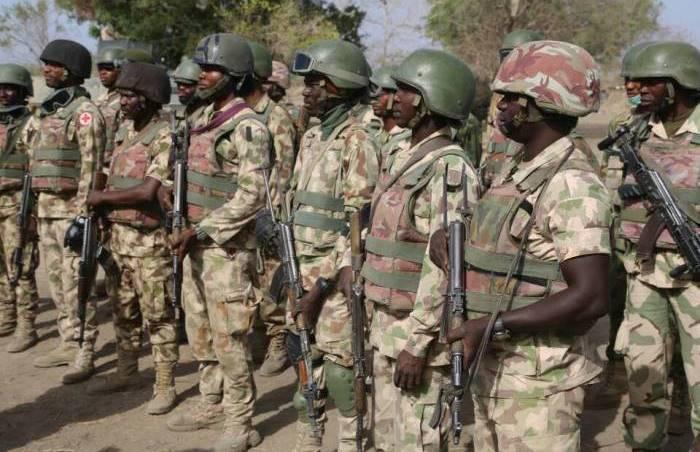
Troops of Sector 4, Joint Task Force North East, Operation Hadin Kai, killed two suspected Boko Haram/ISWAP fighters after repelling an attempted attack on their position at Zangula Kilba Junction in Gombi Local Government Area of Adamawa State. The military said troops recovered two AK-47 rifles, four magazines, 115 rounds of ammunition, ammunition links, locally fabricated explosive devices and other items. Search operations are continuing for the fleeing attackers, while security sources reported no casualties among the troops.
Nigerian troops have killed two suspected Boko Haram/Islamic State West Africa Province fighters after repelling an attempted attack on a military position in Adamawa State, recovering AK-47 rifles, ammunition, locally fabricated explosive devices and other equipment as security forces continued operations against insurgent networks operating across the northeastern region. The clash occurred at Zangula Kilba Junction in Gombi Local Government Area on November 8, according to the Joint Task Force North East, Operation Hadin Kai, which said soldiers deployed in the area responded to the assault, forced the surviving attackers to withdraw and immediately began follow-up operations intended to prevent the militants from regrouping.
Captain Mohammed Goni, Acting Media Information Officer of the Joint Task Force North East, said the troops were serving under Sector 4 of Operation Hadin Kai when the attackers attempted to overrun their position. In the military’s account, soldiers responded with sustained firepower and tactical coordination, killing two of the assailants before the remaining fighters withdrew from the area. Separate security reporting placed the initial attack shortly after midnight, although the military statement itself focused primarily on the outcome of the engagement rather than providing a detailed minute-by-minute account of the fighting.
A search of the area after the confrontation led troops to recover two AK-47 rifles, four AK-47 magazines and 115 rounds of ammunition, along with three belts of empty ammunition links and two cases containing locally fabricated explosive devices. Soldiers also recovered a pair of desert boots, a camelback-style backpack, an Android mobile phone, a wristwatch and ₦15,000 in cash, according to the military. The recovered materials are expected to be examined for intelligence that could help authorities identify the fighters, their logistics network and possible routes used by those who escaped.
Security sources separately reported that no Nigerian soldier was killed or wounded in the engagement. The military said exploitation operations were continuing in surrounding areas as troops searched for the fleeing attackers and attempted to prevent them from reconnecting with other insurgent cells. Such post-engagement searches are particularly important in the northeast because militant units often split into smaller groups after failed attacks, using rural tracks, forest corridors and difficult terrain to withdraw before attempting to regroup.
The attack at Zangula Kilba Junction is the latest in a series of confrontations involving security forces and insurgent groups operating in parts of Adamawa, Borno and Yobe states. Although Borno remains the principal center of Nigeria’s long-running jihadist insurgency, militant cells have repeatedly attempted to exploit rural areas of Adamawa State, particularly communities and transport corridors connected to Gombi, Hong, Madagali and neighboring local government areas.
The Nigerian military often refers to attackers in these operations collectively as Boko Haram/ISWAP terrorists when fighters’ exact factional allegiance cannot immediately be established on the battlefield. Boko Haram and ISWAP are distinct organizations with different command structures and histories, even though they emerged from the same broader insurgency and operate across overlapping parts of northeastern Nigeria and the Lake Chad Basin. For that reason, the military’s characterization of the Zangula Kilba attackers should not be reduced to ISWAP alone unless further intelligence establishes that the fighters belonged specifically to that faction.
ISWAP emerged after a major split within Boko Haram and developed into one of the most capable armed groups operating around Lake Chad. It has often concentrated attacks on military installations, security forces and government-linked targets, while Boko Haram factions have historically been associated with a wider range of attacks on both civilian and military targets. The boundaries can nevertheless be difficult to determine in rapidly developing encounters, especially where units move between territories or cooperate tactically.
Adamawa State has experienced several significant counterterrorism operations during 2026. On October 13, troops repelled a coordinated attack on Forward Operating Base Garaha in Hong Local Government Area, with the military reporting six attackers killed and several weapons recovered. That assault followed other operations across Sector 4 in late September and early October in which the Joint Task Force said soldiers killed multiple militants and recovered rifles, magazines and ammunition.
In one operation in the Boima area of Gombi Local Government Area, troops reported killing 16 suspected terrorists during an ambush and recovering three AK-47 rifles, two pump-action firearms, a locally made gun and ammunition. The military also reported using aerial surveillance and strike capabilities against insurgent concentrations elsewhere in the sector. Those earlier operations indicate that security forces have been tracking militant activity across the wider Gombi-Hong axis for several weeks before the latest attempted attack.
In August, Operation Hadin Kai also reported killing more than 20 Boko Haram/ISWAP fighters during an offensive around the Kopre Mountain area of Hong Local Government Area. That operation involved troops and security personnel acting on intelligence about militant movements in difficult terrain. Authorities said at the time that the objective included disrupting insurgent networks and locating abducted civilians believed to be held in the area.
The persistence of those operations demonstrates that Adamawa’s security situation remains closely connected to the broader northeastern insurgency despite substantial territorial losses suffered by jihadist groups since the height of Boko Haram’s expansion more than a decade ago. Insurgents no longer openly control large towns in Adamawa in the manner seen during the most intense phases of the conflict, but cells remain capable of carrying out ambushes, raids, kidnappings and attacks on military positions.
Military commanders have increasingly emphasized aggressive patrols and intelligence-led operations designed to deny militants freedom of movement between communities and forest hideouts. The strategy relies heavily on local information because insurgents often move in small groups and may blend into rural populations or use routes that are difficult to monitor continuously.
The military credited community cooperation as one of the factors supporting recent operations and has repeatedly urged residents to provide information about suspicious movements, unfamiliar armed groups, explosives and logistics activity. For communities living close to areas where insurgents operate, however, cooperation can carry significant risks because militants may retaliate against residents suspected of helping security forces.
The Zangula Kilba encounter was not the only security operation reported in Adamawa over the same period. On November 9, troops deployed around Mubi responded to the kidnapping of a farmer identified by the military as Happiness Dama Dauda near Dutse-Uku in Mubi South Local Government Area. The woman was reportedly seized while working on her farm, and the attackers also took her motorcycle.
Soldiers working with local hunters pursued the suspected kidnappers and pressured them into abandoning Dauda, according to Operation Hadin Kai. Continued pursuit later led to the recovery of two additional residents believed to have been abducted earlier, bringing the number of rescued civilians to three.
Troops also recovered property belonging to farmers in the area, including a motorcycle, a tricycle carrying 15 bags of beans and a small pickup truck loaded with 13 bags of groundnuts. The military said village heads identified the recovered items and they were returned to their owners.
The two operations highlight the range of security threats confronting forces in Adamawa. Counterinsurgency units are required to respond not only to organized jihadist attacks on military positions but also to kidnapping, armed robbery and other criminal activity affecting farmers and travelers. The distinction between terrorism and conventional criminality can become blurred in areas where armed groups compete for territory, taxation, supplies and ransom payments.
Agricultural communities are particularly vulnerable because farmers frequently work several kilometers from populated settlements and may spend long periods in relatively isolated fields. Kidnapping gangs can exploit those conditions, while fear of abduction can force farmers to abandon land or restrict the hours during which they work, creating economic consequences that extend beyond individual security incidents.
Adamawa’s agricultural economy depends heavily on crops including maize, beans, groundnuts and rice, meaning insecurity in farming areas can affect food production and local markets. The recovery of bags of beans and groundnuts during the Mubi operation illustrates how criminal activity can directly disrupt rural livelihoods even when no mass-casualty attack occurs.
The military has said it is maintaining expanded patrols and surveillance across affected areas to reassure communities and prevent militants and criminal gangs from establishing freedom of movement. Such operations can reduce immediate threats, but sustaining security across a large rural landscape remains difficult because insurgents can relocate rapidly when pressure increases.
The situation also reflects the wider evolution of Nigeria’s northeast conflict. Boko Haram began its violent insurgency in 2009 and eventually seized significant territory across Borno, Adamawa and Yobe states. At the insurgency’s peak, militants occupied towns, attacked military installations and displaced millions of civilians across Nigeria and neighboring countries.
A large military counteroffensive later pushed insurgents out of most population centers, but the conflict evolved rather than ended. ISWAP strengthened around parts of Lake Chad and became particularly focused on military and government targets, while rival Boko Haram factions continued operating from remote areas.
The death of longtime Boko Haram leader Abubakar Shekau in 2021 further reshaped the militant landscape, with many fighters surrendering, joining ISWAP or moving into smaller cells. The Nigerian military has since reported large numbers of insurgents and family members surrendering, but combat operations continue throughout the northeast.
Operation Hadin Kai remains the principal military campaign responsible for counterinsurgency operations in the region. Its forces operate across several sectors and coordinate ground troops, air assets, intelligence units and local security partners.
The campaign has increasingly emphasized targeting insurgent commanders and logistics networks in addition to defending communities. Disrupting fuel, ammunition, food supplies, communications and recruitment channels can limit militants’ ability to mount complex attacks even when individual fighters remain active.
The materials recovered after the Zangula Kilba attack could therefore prove useful beyond their immediate military value. The Android phone may contain communications, contact lists, photographs, navigation data or other information that investigators can analyze, while the weapons and explosive materials can potentially be linked to supply routes or previous attacks.
Locally fabricated explosives remain a serious concern throughout northeastern Nigeria. Insurgent groups have repeatedly used improvised explosive devices against military patrols and civilians, including devices planted on roads or carried by suicide attackers. Recovering explosive components before they can be deployed reduces immediate danger but also provides intelligence on bomb-making methods and materials.
The seizure of AK-47 rifles and ammunition is similarly significant because assault rifles remain central to militant operations across Nigeria. Weapons can circulate for years through smuggling networks, battlefield captures and illegal markets, making tracing their origin difficult.
Authorities have not publicly disclosed whether the rifles recovered at Zangula Kilba carried identifiable markings that could help establish their source. The military has also not released the identities of the two slain fighters or said whether they were known commanders.
That means the strategic importance of the encounter remains limited by the information currently available. The attack was successfully repelled, two militants were killed and weapons were recovered, but there is no evidence yet that the operation eliminated a major commander or dismantled an entire insurgent cell.
The military’s immediate focus is therefore on preventing the surviving attackers from regrouping. Continued patrols, tracking and intelligence collection will be necessary to determine whether the assault was conducted by a small local cell or formed part of a broader plan to test military defenses in Gombi.
Previous attacks on military positions in Adamawa suggest insurgents remain interested in probing defensive locations for weapons, ammunition and tactical opportunities. A successful overrun of a military post can provide militants with equipment and propaganda value, which is why forces place particular emphasis on repelling assaults before attackers gain access to installations.
The failure of the November 8 attack prevented such an outcome. According to the military’s account, troops maintained control of the position and forced the militants to retreat while leaving weapons and other items behind.
There has been no independently verified civilian casualty report connected directly to the Zangula Kilba engagement, and security sources said troops also suffered no casualties. Those figures remain based primarily on military and security reporting because independent access to active counterterrorism areas is often limited.
That limitation is important in reporting the wider conflict. Battlefield casualty claims from governments and armed groups can be difficult to verify independently, particularly immediately after clashes in remote areas. The military’s figure of two militants killed should therefore be attributed to Operation Hadin Kai rather than treated as a count independently confirmed by VNTV.
The same caution applies to claims about the attackers’ affiliation. The military described them collectively as Boko Haram/ISWAP terrorists, and there has been no separate public evidence establishing that they belonged specifically to one faction.
What is firmly established from the military statement is that troops at Zangula Kilba Junction came under attack, repelled the assault, recovered two AK-47 rifles, four magazines, ammunition, explosive devices and personal items, and launched follow-up operations afterward.
The incident reinforces the continuing security challenge facing communities in northeastern Nigeria even after years of sustained military pressure. Insurgent groups have lost much of the territorial control they once exercised, but their ability to launch raids, ambushes and attacks on security positions has not disappeared.
For Adamawa residents, the immediate concern is whether the militants who escaped the Zangula Kilba clash remain in the surrounding area and whether they will attempt retaliatory attacks against troops or civilians. Operation Hadin Kai says patrols and surveillance have been intensified, while searches are continuing along possible withdrawal routes.
The broader challenge for the military will be to convert tactical successes such as the repelled attack into sustained improvements in security. Killing individual fighters and recovering weapons can weaken insurgent cells, but lasting stability also depends on intelligence, border control, community protection, economic recovery and preventing armed groups from recruiting or rebuilding their logistics networks.
Tuesday’s military statement suggests troops intend to maintain pressure across Sector 4 rather than treat the Zangula Kilba encounter as an isolated event. With three kidnap victims also rescued in Mubi South within the same period, security forces are confronting overlapping terrorist and criminal threats across Adamawa.
The immediate operational picture therefore remains active. Troops hold the Zangula Kilba position, two attackers are reported dead, the remaining fighters are being pursued and recovered weapons and electronic devices are available for intelligence analysis. What remains unresolved is the identity and exact factional affiliation of the attackers, the size of the group that launched the assault and whether the fleeing militants retain enough capability to mount another attack elsewhere in the area.
For communities across Gombi and neighboring local government areas, those unanswered questions will determine whether the latest clash represents another contained attack or part of a wider attempt by insurgent cells to increase pressure in Adamawa. Operation Hadin Kai has said it will continue patrols, intelligence gathering and offensive operations to deny militants freedom of movement, while residents are again being urged to report suspicious activity as security forces search for those who escaped.