OBI ALLEGES NFF OFFICIALS BLOCKED HIM FROM GREETING VICTORIOUS FLAMINGOS AT ABUJA AIRPORT
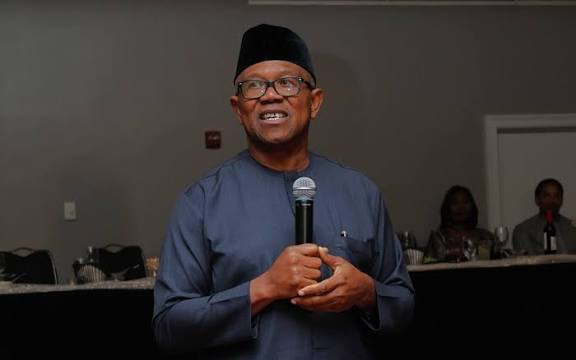
Peter Obi has alleged that Nigeria Football Federation officials prevented him from greeting the victorious Flamingos at Nnamdi Azikiwe International Airport in Abuja on Monday, claiming he was told officials feared losing their jobs if they allowed him to approach the team. The NFF had not publicly responded to the allegation at the time of the latest reports, while a presidential aide said security and administrative protocol could explain the restriction. The Flamingos returned home after defeating Japan 2–1 to win the 2026 FIFA U-17 Women’s World Cup, becoming the first African team to lift the trophy.
Nigeria Democratic Congress presidential candidate Peter Obi has accused officials of the Nigeria Football Federation of preventing him from greeting Nigeria’s newly crowned FIFA U-17 Women’s World Cup champions at the Abuja airport, alleging that football officials feared they could lose their jobs if they allowed him to approach the players. Obi said the encounter occurred at Nnamdi Azikiwe International Airport at about 7 a.m. on Monday as he prepared to board a flight to Enugu and noticed the Flamingos returning from Morocco after their historic 2–1 victory over Japan in Saturday’s final. The allegation has immediately taken on a political dimension because Obi, one of the country’s most prominent opposition figures and the NDC’s 2027 presidential candidate, described the incident as evidence of what he called a growing culture of “toxic politics,” while the NFF had not publicly confirmed his account as of the latest reporting.
Obi said he was genuinely excited to see the players and asked his protocol officer, Jackie Wayas, to find out whether he could greet and welcome them after their return. According to his account, he was subsequently told that NFF officials had rejected the request and specifically asked that he not approach the team because those involved feared losing their jobs. Obi did not publicly identify the NFF officials he said were responsible for the instruction, and no independent evidence has yet emerged confirming that any football official was threatened with dismissal or formally warned against allowing him access to the players.
The former Anambra State governor framed the episode as more than a personal slight. In a statement titled “A New Dimension of Toxic Politics in Nigeria,” he argued that political divisions were increasingly being allowed to interfere with ordinary national interactions and public events that should transcend partisan affiliation. He said the Flamingos represented Nigeria and that celebrating their success should not become entangled with rivalry between political actors, particularly after a tournament victory that brought unprecedented continental recognition to the country.
The timing of the incident made the allegation especially sensitive because the Flamingos had returned home only hours after achieving one of the biggest victories in Nigerian women’s football history. Nigeria defeated Japan 2–1 in the final of the FIFA U-17 Women’s World Cup in Rabat, Morocco, becoming the first African country to win the competition. The victory was the culmination of a tournament in which the Nigerian team progressed through a demanding knockout stage and ultimately lifted the trophy in front of a global audience, ending years of near-misses and establishing a new benchmark for African football at that age level.
The players returned to Abuja on Monday to national attention and celebrations, with their success drawing praise from political leaders, football administrators, supporters and former players. Against that backdrop, Obi said his intention was simply to congratulate the team in person. His allegation that he was prevented from doing so therefore shifted attention away from the sporting celebration and toward a political dispute over access, protocol and whether opposition figures are being deliberately excluded from national events.
Obi also said Monday’s incident was not the first time he had experienced similar treatment around a Nigerian national football team. He recalled traveling to Uyo, Akwa Ibom State, on March 25, 2025 for a World Cup qualifying match, where he said the state governor received him at the VIP stand. According to Obi, other government officials were later allowed to greet the players after the match, but he was prevented from doing the same. He said he was told on that occasion as well that officials could lose their jobs if they allowed him to proceed.
That earlier claim, like the latest one, remains Obi’s account and should not be presented as an independently established fact unless officials involved confirm it or documentary evidence emerges. The NFF had not issued a detailed public response to Monday’s allegation as of the latest reports, leaving a gap between what Obi says he was told and what football authorities say actually happened.
A presidential aide, Dada Olusegun, pushed back against Obi’s interpretation and argued that national sporting teams are often subject to security and administrative protocols designed to manage access to players, particularly when they are traveling or returning from official assignments. He said the Flamingos represented the entire country rather than any political party or individual and accused Obi of converting what could have been routine protocol into a political grievance.
Olusegun said security, administrative and operational considerations can determine who is allowed direct access to players at airports or during official team movements. He argued that such restrictions should not automatically be interpreted as evidence of political victimization, particularly when young athletes are returning from an international competition and may be subject to tightly managed schedules involving immigration, transport, media responsibilities, reception ceremonies and official protocol.
That response, however, did not address the specific part of Obi’s allegation that officials allegedly told his protocol officer they could lose their jobs if they permitted him to approach the team. That remains the most politically sensitive aspect of his claim because, if confirmed, it would suggest that the restriction was connected not merely to security or schedule management but to concerns over political consequences. No named NFF official has publicly confirmed that version of events.
The distinction is important because the factual dispute is not simply whether Obi was prevented from greeting the players. Politicians, dignitaries and supporters can legitimately be denied access to athletes for security, operational or scheduling reasons. The more serious allegation is that officials were allegedly motivated by fear of losing their jobs because the person seeking access was Peter Obi, an opposition presidential candidate.
Until the NFF provides a detailed explanation, that question remains unresolved. The federation could confirm that ordinary protocol was applied, deny that any official made the reported statement, acknowledge that access was restricted for political reasons or provide another explanation entirely. In the absence of such a response, responsible reporting requires presenting Obi’s allegation as his account rather than an established institutional policy.
The controversy also comes at a politically charged moment in Nigeria. Obi is preparing for the 2027 presidential election as the candidate of the Nigeria Democratic Congress and remains one of the most recognizable opposition figures in the country. His public appearances are therefore increasingly interpreted through an electoral lens, even when they involve events that are not formally political.
That dynamic creates challenges around national institutions and public ceremonies. Football teams, universities, religious organizations and state institutions often host or encounter politicians from multiple parties, particularly in election periods. Managing such interactions without giving the impression of partisan favoritism can become difficult when access decisions are made informally or without transparent protocols.
The Flamingos’ homecoming should ordinarily have been a unifying national moment. Their victory was historic not only because Nigeria won the title but because no African country had previously captured the FIFA U-17 Women’s World Cup. The achievement placed the team within the broader story of Nigerian women’s football, which has long been one of the country’s strongest areas of international sporting success through the Super Falcons and youth national teams.
The U-17 victory also carried significance for player development. Youth tournaments serve as a pathway into senior international football, and many players who excel at the U-17 level later move into professional clubs and senior national teams. The Flamingos’ success therefore represented both an immediate trophy and a potential foundation for Nigeria’s future at the senior level.
The final against Japan drew particular attention because Japan has one of the strongest women’s football development systems in the world and has produced highly technical national teams across age categories. Nigeria’s 2–1 victory therefore carried competitive weight beyond the symbolism of becoming the first African champion.
Images from the tournament showed Nigerian players celebrating together under confetti after the final, lifting the trophy and embracing on the pitch at the Mohammed VI Football Complex in Rabat. Their triumph generated widespread congratulations across Nigeria and the African football community, making Monday’s airport controversy an unwelcome political distraction from what should have remained a celebration of the players.
Obi’s statement nevertheless focused heavily on the principle of political tolerance. He said the Nigeria he wants to see should allow people of different political affiliations to interact normally and celebrate national achievements without fear, intimidation or discrimination. He argued that political differences should not become a reason to prevent ordinary human contact or shared national pride.
His language fits a broader message he has used in recent political speeches, where he has criticized what he describes as growing hostility within Nigeria’s political culture. Supporters of Obi see such incidents as evidence that opposition politicians are sometimes treated unfairly by institutions connected to the federal government, while critics argue that he frequently interprets routine administrative decisions through a political lens.
That disagreement is now playing out around the Flamingos controversy. Obi says the restriction was political and that officials explicitly cited fear of losing their jobs. The presidential response is that protocol and security considerations may have been involved and that national athletes should not be pulled into partisan battles.
The NFF’s response will therefore be important because it is the institution directly implicated in the allegation. If the federation confirms that officials prevented Obi from greeting the players, it will need to explain why. If it denies the claim, it will need to address how Obi’s protocol team came to believe that staff feared losing their jobs.
The issue also raises questions about how national teams are managed during official homecomings. Players returning from major tournaments may be surrounded by federation officials, security personnel, government representatives, media crews and family members, all competing for access. Clear written procedures can prevent disputes by establishing who is permitted to approach the team, when interactions can occur and whether politicians are treated differently from other dignitaries.
Without such clarity, decisions can appear arbitrary. A politician who is granted access may be seen as receiving favoritism, while another who is denied access may interpret the decision as politically motivated. Transparent rules would reduce the risk that sporting celebrations become entangled in partisan controversy.
Obi’s claim that a similar incident occurred in Uyo in 2025 adds another layer because he presents the Abuja episode as part of a pattern rather than an isolated misunderstanding. In both cases, he says he was told officials feared for their jobs if they permitted him to greet players. That allegation, if substantiated, would raise broader questions about political influence over public institutions and national sports administration.
At present, however, the evidence available publicly consists primarily of Obi’s own statement and the responses of political figures disputing his interpretation. No independently released NFF document, directive or internal communication has surfaced showing that staff were instructed to prevent Obi from approaching national-team players.
The safest factual conclusion is therefore limited. Obi says he was prevented from greeting the Flamingos at Abuja airport and was told NFF officials feared losing their jobs if they permitted him to approach. The NFF had not publicly responded at the time of the latest reporting, while a presidential aide said ordinary protocol and security considerations could explain the restriction and accused Obi of politicizing the team’s return.
The wider political controversy should not obscure the achievement that brought all the parties into the same space. The Flamingos returned as world champions after defeating Japan 2–1 and becoming the first African winners of the FIFA U-17 Women’s World Cup. Whatever explanation eventually emerges about Monday’s airport incident, their success remains independent of the political disagreement surrounding who was or was not allowed to greet them.
For the federation, the next step is likely to be clarification. A direct NFF account would help establish whether Obi’s access was denied, who made the decision and whether the reason was security, protocol, political sensitivity or something else. Without such clarification, competing political narratives are likely to fill the vacuum.
For Obi, the incident has become another example he uses to argue that Nigerian politics has become unnecessarily hostile. For government supporters, it is being presented as an attempt to convert a routine administrative restriction into a campaign grievance. Those competing interpretations will remain unresolved until the institution at the center of the allegation provides a fuller account.
The most important unresolved question is therefore not whether Obi was disappointed at the airport, but whether public officials genuinely believed they would be punished for allowing an opposition presidential candidate to congratulate a national team. That claim is serious enough to require evidence, and until such evidence or an official response emerges, it should remain clearly attributed to Obi rather than reported as established fact.
The Flamingos’ triumph deserves to remain at the center of the national story. Their World Cup victory was a landmark for Nigerian and African women’s football, achieved by young players whose success should not be reduced to the political dispute surrounding their arrival home. As the controversy continues, the clearest facts are that Nigeria returned from Morocco as world champions, Obi says he was prevented from greeting them, and the NFF has yet to provide the explanation needed to resolve the competing accounts.