PAKISTAN, SAUDI ARABIA AND TÜRKİYE HOLD CRUCIAL DEFENSE TALKS AS HOUTHI ATTACKS TEST COLLECTIVE SECURITY PACT
Pakistan, Saudi Arabia and Türkiye are holding a two-day security meeting in Islamabad from November 27 to 28, 2026, to strengthen implementation of the Makkah Joint Defence Agreement amid continuing Houthi attacks on Saudi Arabia. Signed on August 7, the agreement establishes that an armed attack against one member is considered an attack against all three. Pakistan has reaffirmed its commitment to defending Saudi Arabia but has ruled out offensive military operations against the Houthis inside Yemen, while Türkiye has similarly emphasized the alliance's defensive character. The discussions are expected to address institutional coordination, collective assistance and implementation procedures as the three countries seek to reconcile their different geopolitical interests and establish a credible regional security framework.
Pakistan, Saudi Arabia and Türkiye are convening a two-day security meeting in Islamabad beginning Friday, November 27, 2026, to establish mechanisms for implementing their collective defense agreement as continuing Houthi attacks on Saudi Arabia place the newly formed alliance under mounting pressure. The discussions bring together senior political, defense and military representatives of the three countries under the Makkah Joint Defence Agreement, signed on August 7 in Saudi Arabia. The agreement establishes that an armed attack against any member is considered an attack against all three, creating a framework for mutual assistance that includes military support. However, Pakistan's insistence that its involvement remain defensive, rather than extending to offensive operations against the Houthis inside Yemen, has raised important questions about how far the alliance is prepared to go in fulfilling its collective security commitments.
The Islamabad meeting represents an important stage in transforming the agreement from a declaration of political solidarity into a functioning international defense arrangement. According to Pakistani newspaper Dawn and reporting by the Associated Press, discussions are expected to focus on institutional coordination, implementation procedures and the security challenges confronting Saudi Arabia. Officials familiar with the preparations indicated that the participating countries intend to establish clearer arrangements governing their respective responsibilities when a member faces an external armed threat. The outcome could provide a clearer understanding of what collective defense means in practice, particularly where the member countries possess different strategic interests and approaches to military intervention.
Pakistan's Defense Minister Khawaja Muhammad Asif has reaffirmed Islamabad's commitment to protecting Saudi Arabia, maintaining that threats against the kingdom also concern Pakistan and Türkiye under the agreement. His remarks were intended to reinforce Pakistan's position as a dependable security partner while acknowledging the seriousness of continuing hostilities involving Yemen's Houthi movement. However, Islamabad has drawn a distinction between assisting Saudi Arabia in defending its territory and participating in military operations inside Yemen. That distinction has become one of the central issues surrounding the alliance because it affects how the agreement may be implemented during an ongoing regional conflict.
Saudi Arabia's security concerns have intensified as the confrontation with the Houthis has continued to affect its territory. Riyadh has sought stronger cooperation from its defense partners, emphasizing the importance of protecting its sovereignty, population and critical infrastructure. The kingdom's participation in the trilateral agreement reflects a broader effort to diversify its international security relationships while maintaining existing partnerships with Western governments. For Saudi officials, the credibility of the new arrangement will depend partly on the willingness of Pakistan and Türkiye to provide meaningful assistance when the kingdom faces sustained external threats.
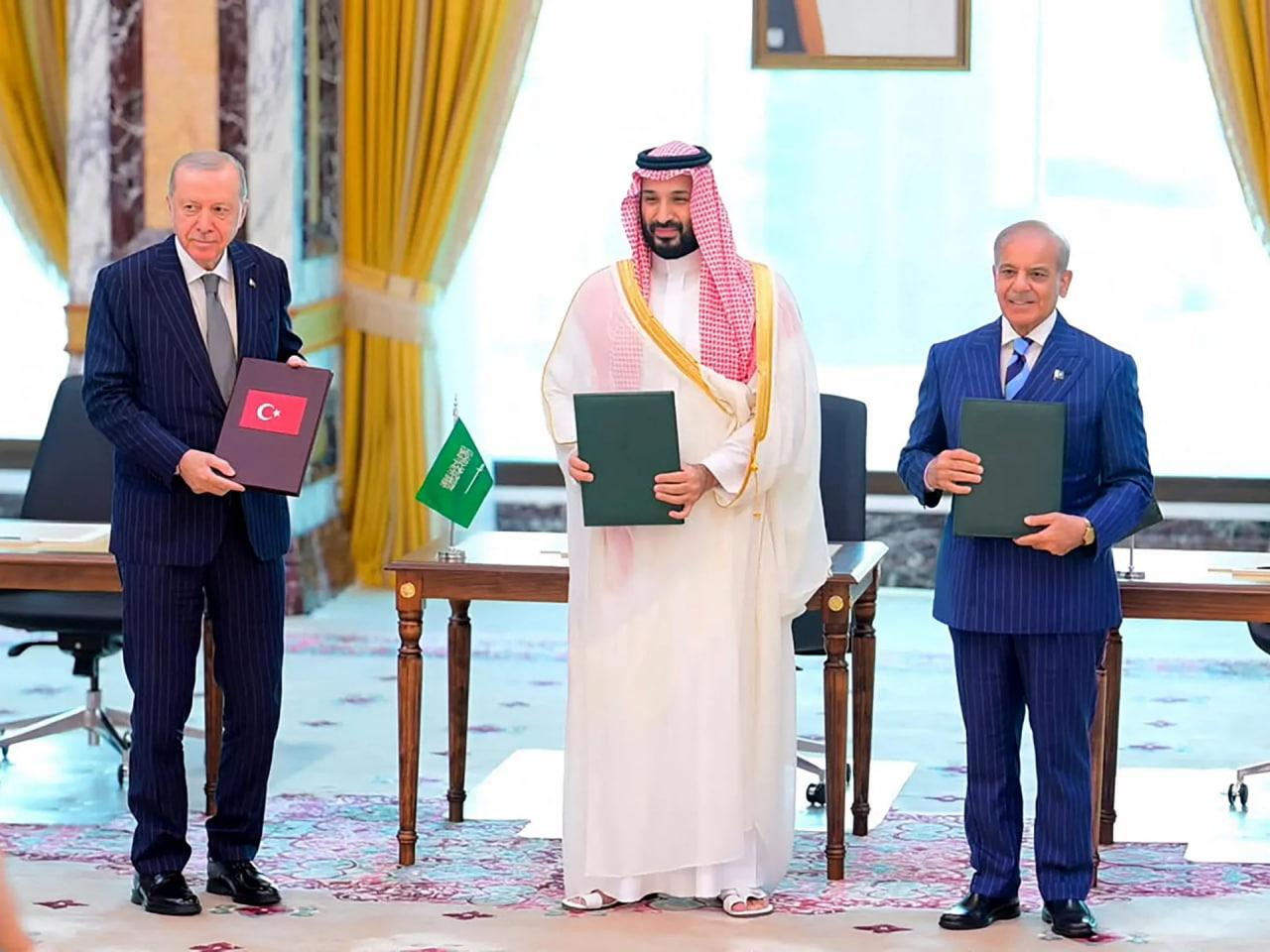
The Makkah Joint Defence Agreement was signed on August 7, 2026, during a period of considerable instability across the Middle East. Saudi Crown Prince Mohammed bin Salman, Pakistani Prime Minister Shehbaz Sharif and Turkish President Recep Tayyip Erdoğan participated in the establishment of a framework intended to strengthen cooperation among three influential Muslim-majority countries. The agreement brought together governments possessing different economic resources, military capabilities and geopolitical relationships. Its establishment also reflected a shared interest in expanding regional security cooperation without necessarily abandoning existing international defense partnerships.
The alliance's collective defense provision is among its most important features because it establishes a shared obligation to respond when a member is subjected to an armed attack. Public descriptions of the agreement indicate that the other members are required to provide assistance through available means, including military support. However, that language does not independently establish that every member must respond through identical military operations or participate in offensive action outside the territory of the country requesting assistance. The precise requirements depend on the agreement's complete provisions, implementing arrangements and the legal circumstances surrounding a particular conflict.
The first meeting of the alliance's Strategic Political and Defence Committee was held in Istanbul on August 31, bringing together foreign ministers, defense ministers and senior military officials from the three participating countries. The committee was established as the alliance's principal decision-making forum, providing an institutional setting through which members can consult on emerging threats and coordinate their responses. Its creation represented an acknowledgment that collective defense commitments require permanent administrative structures rather than relying exclusively on occasional meetings between national leaders.
A permanent secretariat has subsequently been established in Riyadh to coordinate the alliance's institutional activities. Pakistan's retired Lieutenant General Nauman Mahmood was appointed its first secretary-general for a three-year term, reflecting Islamabad's involvement in developing the organization's administrative framework. A working committee comprising representatives from the three countries has also been established to address matters associated with implementation. These arrangements are intended to provide greater continuity in the management of the alliance's affairs as its members develop a common approach to regional security challenges.
The agreement encountered an early practical test in October when Saudi Arabia, Pakistan and Türkiye agreed during an emergency meeting in Riyadh to advance implementation of their collective defense commitments. A joint statement released through Pakistan's Foreign Office announced that agreed military assistance arrangements would be implemented in accordance with the participating countries' national legislation. The decision was significant because it moved the partnership beyond its initial declarations and established a basis for direct security assistance to Saudi Arabia. Nevertheless, the subsequent discussions have revealed continuing differences concerning the circumstances under which such assistance could extend beyond defensive responsibilities.
Pakistan's position reflects the complex geopolitical environment within which Islamabad conducts its foreign and security policies. The country maintains longstanding military and economic relationships with Saudi Arabia while also sharing a border with Iran, which supports the Houthi movement politically and militarily. Escalating involvement in the conflict in Yemen could complicate Pakistan's relationships with Tehran at a time when Islamabad has sought to contribute to diplomatic efforts addressing wider regional tensions. Pakistan's government must therefore reconcile its commitments to Saudi Arabia with its broader national security interests and diplomatic responsibilities.
Pakistan has historical experience of confronting similar choices concerning Saudi Arabia's military involvement in Yemen. In 2015, when Riyadh sought international support for its intervention against the Houthis, Pakistan's Parliament adopted a position favoring neutrality in the Yemen conflict while affirming its commitment to protecting Saudi Arabia's territorial integrity. The decision reflected concern about the potential consequences of direct involvement in a regional confrontation involving competing Middle Eastern powers. Although the 2026 defense agreement has created a different institutional framework, the underlying distinction between protecting Saudi territory and participating in military operations inside Yemen remains relevant to Islamabad's present approach.
Pakistan's domestic security considerations add another dimension to the government's position. The country already faces substantial security responsibilities involving its borders, internal militant threats and longstanding regional tensions. Committing resources to an additional foreign military campaign could create competing demands on its security institutions and financial resources. Those considerations do not establish that Pakistan is unwilling to fulfill its obligations under the Makkah agreement, but they help explain why Islamabad has emphasized the defensive character of its proposed involvement.
Türkiye similarly faces complex strategic considerations as it participates in the new alliance. Ankara has extensive diplomatic and economic interests across the Middle East while retaining its longstanding membership of the North Atlantic Treaty Organization. Its involvement in the Makkah agreement creates an additional framework for regional security cooperation but does not automatically replace its existing international defense commitments. Türkiye has emphasized the defensive nature of the trilateral partnership, indicating caution concerning direct participation in military operations inside Yemen.
The Turkish government's completion of its ratification process has nevertheless reinforced the institutional foundations of the agreement. Turkish lawmakers had previously considered the pact as Saudi Arabia confronted renewed security pressures associated with the Houthi conflict. President Erdoğan's completion of the ratification process, reported on Friday, November 27, represents a further step toward formalizing Türkiye's participation. The development comes as the alliance's members seek to establish more detailed mechanisms for translating their respective commitments into coordinated action.
Türkiye's relationship with Saudi Arabia has developed considerably over recent years following periods of diplomatic disagreement. The two governments have expanded discussions involving defense cooperation, commercial relations and regional political engagement. Their participation in a collective defense arrangement reflects an additional stage in that evolving relationship. Nevertheless, cooperation between Ankara and Riyadh does not establish that their assessments of every regional conflict are identical, making continued consultation essential when the alliance confronts circumstances requiring a coordinated response.
The Houthi movement, formally known as Ansar Allah, emerged from northern Yemen and became one of the country's principal armed and political organizations. Its takeover of Yemen's capital, Sanaa, in 2014 contributed to the collapse of existing political arrangements and the subsequent intervention of a Saudi-led coalition in 2015. The conflict developed into a prolonged confrontation involving domestic Yemeni factions and regional powers, producing severe humanitarian consequences and substantial damage to the country's institutions and infrastructure. Despite periods of reduced hostilities and diplomatic engagement, the conflict has remained unresolved.
Saudi Arabia has repeatedly expressed concern about threats arising from the Houthi movement's military activities, while the Houthis have presented their confrontation with Riyadh within the context of the wider war in Yemen and regional political developments. The competing positions have complicated efforts to establish a durable settlement. International diplomatic initiatives have sought to reduce hostilities and encourage negotiations involving Yemeni parties, but renewed confrontations have continued to threaten progress. The current pressure on the Makkah alliance reflects the difficulty of separating Saudi Arabia's territorial defense from the broader conflict across its southern border.
The involvement of Iran further complicates the regional security environment. Tehran has established relationships with several armed political movements across the Middle East, including the Houthis. Saudi Arabia and other governments have accused Iran of supporting activities that threaten regional stability, while Iranian officials have emphasized their opposition to foreign military intervention and their own interpretation of regional security arrangements. The extent and nature of Iranian involvement in individual Houthi operations require separate evidential assessments rather than an assumption that every action is directly ordered by Tehran.
For Pakistan, maintaining communication with Iran has become particularly important as Islamabad seeks to support efforts aimed at reducing tensions between Tehran and Washington. Defense Minister Asif has described Pakistan's mediation activities as constructive while acknowledging that the diplomatic situation remains fragile. Participation in offensive operations against an organization associated with Iran could potentially complicate those efforts and create additional tensions along Pakistan's western border. Islamabad's defensive interpretation of the Makkah agreement therefore reflects an attempt to maintain its relationship with Saudi Arabia without abandoning its broader diplomatic approach.
The situation raises a fundamental question concerning the meaning of collective defense in international relations. Agreements establishing mutual security commitments frequently require members to assist one another when an armed attack occurs, but the nature of that assistance can differ according to treaty provisions and national decision-making procedures. Defensive military assistance, intelligence cooperation, logistical support and diplomatic action may constitute important forms of support without requiring every participating country to undertake offensive operations. Whether particular actions satisfy a treaty obligation depends on the agreement itself and the circumstances in which assistance is requested.
NATO provides a familiar example of the distinction between collective defense and automatic participation in an identical military response. Article 5 of the North Atlantic Treaty establishes that an armed attack against one member is considered an attack against all, while allowing individual members to take actions they consider necessary, including the use of armed force. The Makkah agreement operates under a separate legal and institutional framework, and its provisions should not be assumed to be identical to NATO's. Nevertheless, the comparison illustrates why the existence of a collective defense clause does not necessarily mean that every member is obligated to conduct the same military operation.
International law also distinguishes between a country's right to defend itself against an armed attack and the legal requirements governing military operations beyond its borders. Article 51 of the United Nations Charter recognizes individual and collective self-defense, subject to applicable international legal requirements. Military action undertaken in self-defense remains subject to considerations including necessity and proportionality, as well as relevant rules protecting civilians. The existence of a regional defense agreement does not independently override those obligations.
Pakistan's refusal to participate in offensive operations against the Houthis does not therefore establish, by itself, that Islamabad has violated the Makkah agreement. A finding of noncompliance would require examination of the treaty's precise obligations, the assistance requested by Saudi Arabia and the measures Pakistan has agreed or undertaken to provide. At the same time, persistent disagreements concerning the scope of assistance could weaken confidence in the alliance if members believe their partners are unwilling to provide support considered essential during a crisis. The Islamabad discussions offer an opportunity to clarify those expectations before further regional developments place additional pressure on the partnership.
For Saudi Arabia, the agreement's immediate value may lie in the availability of reliable defensive support and the political reassurance associated with formal commitments from Pakistan and Türkiye. Establishing predictable arrangements for consultation and assistance could contribute to the kingdom's broader security objectives while reducing uncertainty concerning the response of its partners during periods of heightened tension. However, the extent to which those arrangements will satisfy Saudi Arabia's expectations remains dependent on the decisions taken by the alliance's governing institutions.
The partnership also reflects Saudi Arabia's broader effort to diversify its international security relationships. The kingdom has maintained extensive defense cooperation with the United States for decades, including military training, equipment procurement and institutional partnerships. The Makkah agreement provides an additional framework through which Riyadh can develop regional relationships rather than relying exclusively on a single international partner. Available reporting indicates that the new alliance is intended to complement, rather than formally replace, Saudi Arabia's existing security cooperation with Washington.
Pakistan's longstanding relationship with Saudi Arabia also encompasses important economic considerations. Riyadh has provided financial assistance to Islamabad through arrangements intended to support Pakistan's economic stability, while Pakistani workers employed in Saudi Arabia contribute to the country's overseas remittance earnings. These economic connections reinforce the strategic importance of maintaining a constructive bilateral relationship. However, economic interdependence does not establish that Pakistan has surrendered its authority to make independent decisions concerning military participation in regional conflicts.
Türkiye similarly possesses commercial interests in expanding cooperation with Saudi Arabia and other Gulf countries. Defense industry partnerships, infrastructure investment and wider trade relationships have become important components of Ankara's regional engagement. Participation in the Makkah agreement could create opportunities for greater institutional cooperation across those areas, although specific commercial agreements should not be inferred from the current security meeting. The immediate focus remains the implementation of collective defense arrangements and the response to Saudi Arabia's security concerns.
The humanitarian situation in Yemen remains an important consideration as the alliance examines its response to the continuing conflict. Years of warfare have left substantial numbers of Yemenis dependent on humanitarian assistance while disrupting healthcare, education, water infrastructure and economic activity. Further military escalation could increase pressure on communities already experiencing severe hardship. Efforts to protect Saudi Arabia from armed attacks must therefore be considered alongside the international responsibility to protect civilians and support opportunities for a negotiated resolution to the Yemen conflict.
The United Nations and other international organizations have repeatedly emphasized the importance of political negotiations involving Yemen's competing parties. A durable settlement would require consideration of domestic governance, regional security, economic reconstruction and humanitarian access. External security arrangements may influence the wider environment within which those negotiations occur, but they cannot independently resolve Yemen's internal political disagreements. The distinction is important because stronger collective defense commitments do not automatically establish a diplomatic pathway toward ending the conflict that generated the security threat.
The Islamabad meeting is expected to address the procedures through which the three governments will coordinate their responses to future threats. Establishing reliable institutional arrangements could reduce uncertainty concerning who possesses the authority to initiate consultations, approve assistance and oversee implementation. Greater clarity may also help distinguish collective decisions from actions undertaken independently through pre-existing bilateral relationships. However, no final communiqué establishing the outcome of the November 27–28 discussions had been identified in reporting available ahead of the meeting.
Questions also remain concerning the precise obligations associated with the agreement and whether its members have established common interpretations of the circumstances that trigger collective assistance. Public statements have reaffirmed the commitment to mutual defense, but the complete treaty text and detailed implementation documents have not been made available in the material reviewed for this report. Consequently, it would be premature to conclude that the alliance either requires offensive operations in Yemen or categorically excludes them under every possible circumstance.
The credibility of the agreement will ultimately depend on the relationship between its publicly declared commitments and the assistance its members provide during actual security crises. Pakistan and Türkiye have indicated that they support Saudi Arabia's defense while maintaining caution concerning direct involvement in Yemen. Saudi Arabia, meanwhile, continues to seek reliable international support as it confronts armed threats. Reconciling those positions will require clearly defined obligations, effective institutional cooperation and continued political consultation among the three governments.
Less than four months after its establishment, the Makkah Joint Defence Agreement is facing a substantial test of its ability to accommodate different national security interests within a shared institutional framework. The continuing Houthi attacks have created urgency for Saudi Arabia, while Pakistan's diplomatic relationship with Iran and Türkiye's wider strategic commitments have reinforced the importance of defining the scope of collective assistance. The Islamabad talks could establish stronger mechanisms for managing those differences, but their practical significance will depend on the decisions reached and the subsequent implementation of the agreed commitments.
For the wider Middle East, the emergence of the trilateral alliance represents an important development in the organization of regional security relationships. Its members possess considerable diplomatic influence, economic resources and military capabilities, but translating those advantages into an effective collective defense arrangement requires more than declarations of solidarity. The central question is whether Pakistan, Saudi Arabia and Türkiye can establish mutually acceptable arrangements that protect threatened members without unnecessarily expanding existing conflicts. As the Islamabad discussions proceed, the strength of the Makkah pact will be measured through its ability to reconcile those competing responsibilities while preserving opportunities for diplomatic de-escalation and regional stability.