
POLICE DETAIN PROTESTERS AS INDIA YOUTH DEMONSTRATIONS BEGIN
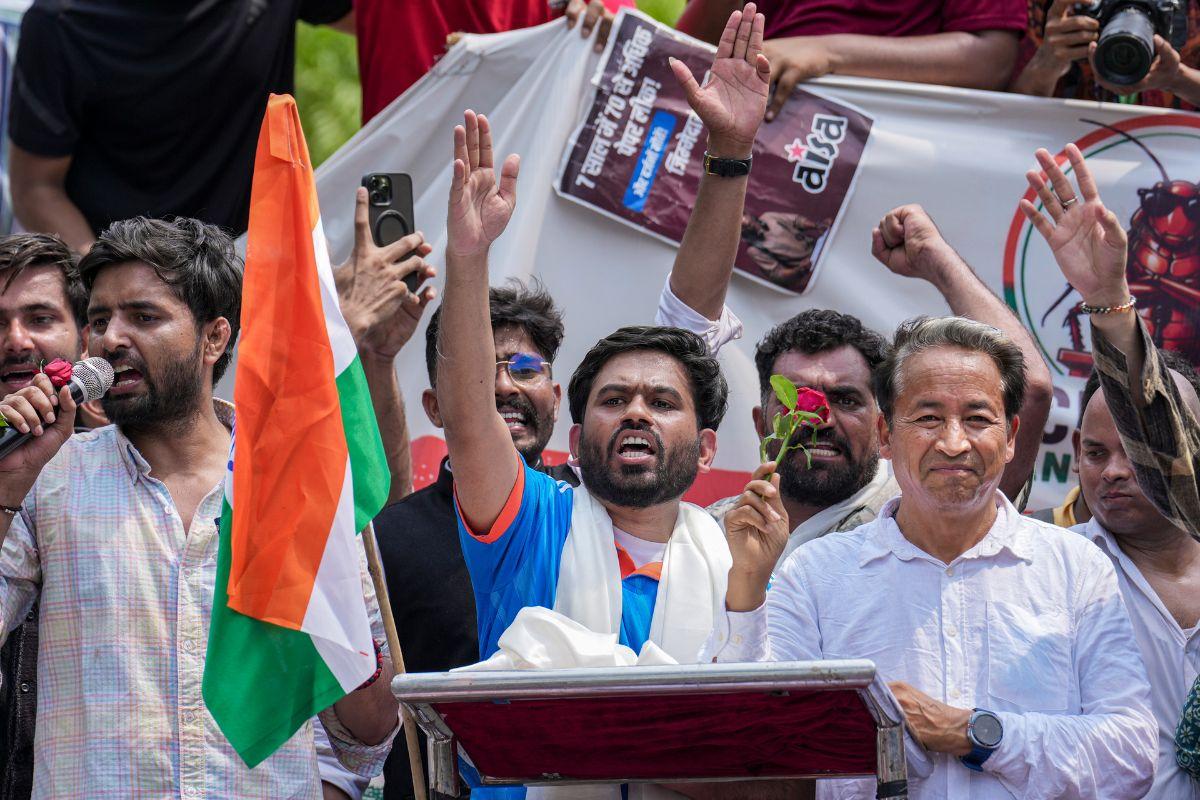
Fresh protests have begun in India as youth groups, students and civil society organizations demand the resignation of Chief Election Commissioner Gyanesh Kumar over a controversial nationwide voter roll verification exercise. Police detained some demonstrators in New Delhi on Friday, October 2, placing protesters into buses as security forces restricted gatherings around Jantar Mantar. Several nearby metro stations were closed and hundreds of police and paramilitary personnel were deployed around the protest area. The protesters allege that changes to voter rolls have improperly removed eligible voters and benefited Prime Minister Narendra Modi’s Bharatiya Janata Party. India’s Election Commission and government deny those allegations and say the verification exercise is intended to remove duplicate, deceased or otherwise ineligible voters.
Police detained protesters in New Delhi on Friday as youth led demonstrations began over India’s controversial voter roll revision, intensifying pressure on Chief Election Commissioner Gyanesh Kumar and placing one of the country’s most important democratic institutions under renewed scrutiny.
A coalition of student groups and civil society organizations gathered around Jantar Mantar in central New Delhi demanding Kumar’s resignation.
Reuters journalists at the scene reported that some protesters were bundled into buses and taken away by police.
Officers repeatedly warned demonstrators that gatherings of more than five people were prohibited in the area.
Hundreds of police and paramilitary personnel surrounded the protest site, while nearby roads and metro access points were restricted.
A separate demonstration organized by the youth led Cockroach Janta Party was scheduled to take place in Mumbai later on Friday.
The CJP says it intends to expand the demonstrations across India in the coming days.
PROTESTERS DETAINED IN NEW DELHI
The Delhi demonstration began under heavy security.
Only a relatively small number of protesters had gathered early Friday, but police moved quickly to prevent the crowd from expanding.
Some demonstrators were physically escorted onto buses.
Authorities had already warned that unauthorized gatherings would not be permitted around Jantar Mantar and surrounding areas.
The location is one of New Delhi’s best known protest sites and has frequently been used by political parties, labor groups and civil society organizations.
Security around the area was significantly increased ahead of Friday’s demonstration.
METRO STATIONS CLOSED
Entry and exit gates at multiple Delhi Metro stations were closed as authorities attempted to control access to central parts of the capital.
Local reporting indicated that 11 stations were affected.
Interchange services continued at some major stations, allowing passengers already inside the network to change lines.
Traffic diversions were also introduced around Jantar Mantar, Parliament Street, Connaught Place and nearby roads.
Police advised commuters to avoid affected areas.
The measures illustrate how seriously authorities were treating the possibility of larger demonstrations.
PROTESTERS SAY VOTING RIGHTS ARE AT RISK
The central dispute concerns India’s ongoing voter verification exercise.
Critics say revisions to electoral rolls have resulted in large numbers of eligible citizens being removed.
Some protesters say they discovered their names were no longer included in voter lists despite previously being registered.
They argue that losing registration could prevent legitimate voters from participating in elections.
For demonstrators, the issue goes beyond administrative errors.
They say access to the ballot is a fundamental democratic right and that improper removals could affect election outcomes.
ALLEGATIONS AGAINST THE ELECTION COMMISSION
Opposition parties and protest groups have accused the Election Commission of conducting voter roll revisions in ways that benefit Prime Minister Narendra Modi’s Bharatiya Janata Party.
The allegation is strongly disputed.
The Election Commission says its voter verification exercise is intended to improve the accuracy of electoral rolls by removing people who have died, duplicate registrations and persons who are otherwise not eligible to vote.
The government also denies that the process is politically manipulated.
There is currently no judicial finding establishing that the voter revision exercise was designed to benefit the BJP.
The dispute therefore remains politically contested.
WHY GYANESH KUMAR IS UNDER PRESSURE
Chief Election Commissioner Gyanesh Kumar has become the central focus of the protests.
Pressure on him intensified after reports emerged that other election commissioners had raised concerns internally about aspects of voter roll changes and related digital systems.
The Indian Express reported that Kumar’s two fellow commissioners had raised questions or concerns at least 14 times over approximately 10 months.
The issues reportedly included voter list revisions, registration procedures and Election Commission technology systems.
The Election Commission has responded that differences of opinion are normal within an institution and says its decisions comply with the law.
ELECTION COMMISSION ORDERS SOFTWARE REVIEW
The controversy has already led to internal action.
India’s Election Commission recently ordered a review of software used in the voter roll process.
The move came after reports of concerns about how voter records were being handled.
The commission has also instructed election officials to register newly eligible voters and people who may have been omitted.
Those actions indicate that procedures are still being adjusted as criticism increases.
The commission, however, continues to reject accusations that the process is politically motivated.
THE COCKROACH JANTA PARTY
One of the most unusual features of the protests is the rise of the Cockroach Janta Party.
The CJP began as a youth driven movement shaped heavily by online activism.
Its early campaigns focused on unemployment, examination paper leaks and alleged failures in India’s education system.
The movement gained national attention after organizing large demonstrations involving students and young professionals.
It has since broadened its agenda to include election administration and government accountability.
WHY THE NAME COCKROACH?
The movement adopted the cockroach as a symbol of survival and persistence.
Its organizers have promoted the idea that young Indians will continue organizing despite political pressure or attempts to suppress their online presence.
Supporters have appeared at demonstrations wearing cockroach themed masks and carrying banners.
The movement’s unconventional identity has helped it attract attention on social media.
Its growth also illustrates how digital platforms are increasingly allowing youth movements to organize outside traditional political party structures.
CJP PROTEST PLANNED IN MUMBAI
CJP founder Abhijeet Dipke announced that the latest campaign would begin in Mumbai on October 2.
The group planned to gather near Shivaji Park.
Mumbai Police initially denied permission for the demonstration at the proposed location.
Dipke nevertheless said the movement intended to continue with its campaign.
The CJP has announced plans to take the protests to other parts of India before eventually holding a larger demonstration in New Delhi.
Its primary demand is Kumar’s resignation.
STUDENT GROUPS ARE ORGANIZING SEPARATELY
The New Delhi demonstration is not identical to the CJP movement.
Several student organizations, civil society groups and activists have organized their own protests over the voter roll controversy.
This means the current demonstrations are emerging from multiple organizations rather than a single centralized movement.
Groups involved include student associations and activists concerned about election transparency.
Some opposition politicians have also expressed support.
However, the CJP has emphasized that it maintains its own identity.
CONGRESS PLANS SEPARATE PROTESTS
India’s main opposition Congress party is also preparing demonstrations.
Congress has accused the Election Commission of voter roll manipulation and has demanded Kumar’s resignation.
The party is expected to begin a separate round of protests on October 6.
This means pressure on the Election Commission could continue even after the current youth demonstrations.
Congress and other opposition parties have repeatedly accused the BJP government of benefiting from changes to voter lists.
The BJP and Election Commission reject those claims.
WHY VOTER ROLLS MATTER
Voter lists determine who is permitted to cast a ballot.
Before elections, authorities regularly update those lists.
People who have died need to be removed.
Duplicate registrations need to be corrected.
Citizens who move may need their registrations transferred.
Young people reaching voting age need to be added.
These routine administrative tasks can become politically explosive if large numbers of eligible voters believe they have been removed incorrectly.
Even a technically legitimate verification program can lose public confidence if the process is difficult to understand or correct.
MILLIONS OF NAMES HAVE BECOME PART OF THE CONTROVERSY
India’s voter verification exercise covers an electorate approaching one billion people.
That enormous scale makes errors difficult to avoid.
Critics say millions of people were excluded from preliminary voter lists during different stages of the exercise.
Those figures do not necessarily mean every excluded person permanently lost voting rights.
Draft voter rolls can later be corrected through claims, documentation and appeals.
But the scale of the revisions has intensified political concern.
The issue becomes particularly sensitive in closely contested states where relatively small changes in voter registration can affect election margins.
INDIA’S ELECTION COMMISSION HAS LONG HELD A SPECIAL STATUS
The controversy matters because India’s Election Commission has historically been regarded as one of the country’s most important independent institutions.
It supervises elections across the world’s largest democracy.
Its responsibilities include voter registration, election scheduling, polling rules and enforcement of campaign regulations.
Public confidence in the commission is therefore essential.
Both opposition allegations and government responses carry significant political consequences.
If voters believe the commission favors one side, trust in election outcomes can weaken.
At the same time, allegations against the commission require evidence and should not automatically be treated as established fact.
INTERNAL DISAGREEMENT ADDS TO SCRUTINY
Reports that other election commissioners questioned aspects of the process have increased attention.
Internal disagreement does not itself prove wrongdoing.
Large institutions frequently contain competing legal and technical opinions.
However, repeated concerns from senior officials can become politically significant when the same policies are already being challenged publicly.
The Election Commission has attempted to characterize those differences as part of normal internal deliberation.
Critics argue that the concerns deserve greater transparency.
PROTEST RIGHTS VERSUS PUBLIC ORDER
Friday’s events also raise a separate debate about the right to protest.
Police say public gatherings must comply with security restrictions and authorization requirements.
Authorities imposed restrictions around central New Delhi and warned against unauthorized assemblies.
Protesters argue that peaceful demonstration is a constitutional right.
This creates a familiar tension between public order enforcement and political expression.
Whether police actions were proportionate may become another issue in the wider debate.
WHY YOUNG PEOPLE ARE DRIVING THE MOVEMENT
The CJP’s emergence reflects broader frustration among parts of India’s younger population.
Employment, examinations and access to opportunity have become major youth political issues.
India has one of the world’s largest youth populations.
That creates enormous economic potential but also significant pressure to generate jobs and educational opportunities.
Exam paper leaks have triggered repeated anger because competitive examinations can determine access to universities and public sector employment.
The CJP initially built support around these concerns before moving into election accountability.
DIGITAL POLITICS IS CHANGING PROTEST ORGANIZING
The movement also demonstrates how political mobilization is changing.
Young protesters no longer require established political parties to coordinate demonstrations.
Messaging platforms, social media and online communities allow organizers to reach large audiences quickly.
Hashtags, short videos and livestreams can transform local grievances into national issues.
This creates opportunities for political participation.
It also creates challenges.
False information can spread rapidly.
Unverified claims can circulate before journalists or institutions have time to check them.
Political movements therefore operate in an environment where speed often competes with accuracy.
GOVERNMENT DENIES POLITICAL MANIPULATION
Prime Minister Modi’s government denies that voter rolls are being altered to benefit the BJP.
The Election Commission similarly rejects accusations of partisan manipulation.
Its stated position is that voter verification is necessary to keep electoral rolls accurate.
That includes identifying duplicate names, deceased voters and other ineligible registrations.
The central question is therefore not whether voter lists should be updated.
All major election systems require regular updates.
The dispute concerns how those revisions are conducted and whether eligible voters have sufficient opportunity to correct mistakes.
THE BURDEN OF PROOF REMAINS IMPORTANT
Claims that voter rolls have been deliberately manipulated to influence elections are serious.
They require strong evidence.
Individual cases of wrongful removal may demonstrate administrative failure without proving a coordinated political scheme.
Conversely, a sufficiently large pattern of improper removals could justify deeper scrutiny.
Independent review, transparent data and court oversight are therefore important.
Political accusations alone cannot resolve the dispute.
WHAT HAPPENS NEXT
The next major development will be the scale of the Mumbai demonstration and whether CJP protests spread to additional cities.
Authorities will also be watching whether demonstrations in New Delhi continue after Friday’s detentions.
The Election Commission’s response will be equally important.
If officials accelerate the restoration of eligible voters or publish more detailed data about removals, some concerns could be reduced.
If protesters remain dissatisfied, demonstrations could expand.
Congress is also preparing its own action beginning October 6.
That means the controversy is unlikely to disappear quickly.
A TEST FOR PUBLIC CONFIDENCE
The dispute ultimately extends beyond any single official or political party.
India’s election system depends on citizens believing they will be allowed to vote and that election rules are applied consistently.
The Election Commission says it is protecting that system by cleaning inaccurate voter lists.
Protesters argue that the same process is excluding legitimate voters.
Determining which concerns are supported by evidence will require transparency, review and legal scrutiny.
For now, the political pressure is moving from complaints and court challenges into the streets.
Police detentions in New Delhi and planned demonstrations in Mumbai mark the beginning of a new phase in a dispute that is increasingly testing public confidence in India’s election administration.