PRESIDENT MAHAMA DEPARTS GHANA FOR FIVE-DAY STATE VISIT TO BARBADOS TO STRENGTHEN BILATERAL RELATIONS
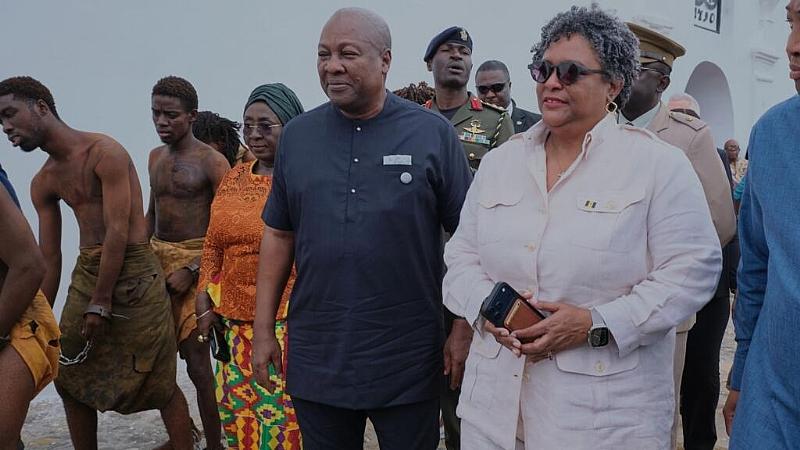
President John Dramani Mahama has departed Ghana for a five-day state visit to Barbados from November 26 to 30, 2026, aimed at strengthening diplomatic, economic and cultural relations between the two countries. During the visit, Mahama will meet Barbados President Jeffrey Davidson Bostic, hold bilateral discussions with Prime Minister Mia Amor Mottley and address a joint session of Parliament. His official program also includes a twinning ceremony between Cape Coast and Speightstown, the unveiling of a monument honoring King Cuffee and the opening of the Ancestral Memorial to the Enslaved. The visit will culminate in Barbados' 60th Independence Anniversary celebrations on November 30 and forms part of Ghana's broader efforts to deepen engagement with Caribbean nations and the African diaspora ahead of its assumption of the African Union chairmanship in 2027.
President John Dramani Mahama has departed Ghana for a five-day state visit to Barbados, scheduled to take place from November 26 to 30, 2026, as part of efforts to deepen diplomatic relations and expand bilateral cooperation between the two countries. The visit represents an opportunity to strengthen Ghana's engagement with the Caribbean, building upon longstanding historical, cultural and economic connections between Africa and nations whose populations share substantial African ancestry. Beyond traditional diplomatic relations, the engagement provides a platform for exploring opportunities in trade, investment, tourism, education and cultural exchange. It also comes amid continuing efforts to establish stronger economic and institutional partnerships between African countries and the Caribbean.
According to the Presidency, the visit will include bilateral talks with Prime Minister Mia Amor Mottley, an address to Barbados' Parliament, the unveiling of a monument honoring King Cuffee and participation in Barbados' 60th Independence Anniversary celebrations.
President John Dramani Mahama has departed Ghana for a five-day state visit to Barbados, scheduled to take place from November 26 to 30, 2026, as part of efforts to deepen diplomatic relations and expand bilateral cooperation between the two countries. The visit represents an opportunity to strengthen Ghana's engagement with the Caribbean, building upon longstanding historical, cultural and economic connections between Africa and nations whose populations share substantial African ancestry. Beyond traditional diplomatic relations, the engagement provides a platform for exploring opportunities in trade, investment, tourism, education and cultural exchange. The Ghanaian president is also expected to participate in Barbados' 60th Independence Anniversary celebrations, address the country's Parliament and attend ceremonies commemorating the shared historical experiences of Africans and their descendants across the Atlantic.
The visit was announced in a statement issued by Ghana's Presidency Communications and signed by presidential spokesperson Felix Kwakye Ofosu on Thursday, November 26. According to the Presidency, Mahama's acceptance of the invitation from Barbados reflects his administration's commitment to developing stronger relationships with Caribbean nations and the African diaspora. The visit follows his recent diplomatic engagement with Jamaica and forms part of a wider effort to translate historical and cultural connections into more substantial economic and institutional partnerships. Its significance is further amplified by Ghana's preparations to assume the chairmanship of the African Union in 2027, providing Mahama with an opportunity to advance closer cooperation between Africa and the Caribbean.
During his stay, Mahama is scheduled to meet Barbados President Jeffrey Davidson Bostic and hold bilateral discussions with Prime Minister Mia Amor Mottley. The engagements will provide an opportunity for the two governments to examine areas of mutual interest, particularly economic cooperation, diplomatic relations and cultural development. Ghana and Barbados share historical connections that have increasingly become the foundation for discussions concerning commercial partnerships, tourism and cooperation within international institutions. Although the precise outcomes of the bilateral discussions cannot be established before the meetings take place, the official program indicates that both governments intend to strengthen their relationship beyond ceremonial diplomatic exchanges.
One of the most significant engagements on Mahama's itinerary is his scheduled address to a joint session of the Parliament of Barbados on Friday, November 27. The address will provide the Ghanaian leader with a platform to discuss the historical relationship between Africa and the Caribbean, the importance of cooperation among developing economies and opportunities for expanding institutional partnerships. The Barbados Government Information Service has announced arrangements associated with the parliamentary engagement, reflecting preparations for the visiting head of state. Mahama's address is expected to attract attention from policymakers, diplomatic representatives and organizations interested in advancing stronger connections between African countries and Caribbean societies.
The state visit will also include a ceremony formally establishing a partnership between Cape Coast in Ghana and Speightstown in Barbados. Scheduled for Friday at the Speightstown Esplanade, the twinning arrangement is intended to encourage sustained engagement between the two communities through cultural exchange and institutional cooperation. The partnership carries particular historical significance because both communities are associated with the experiences of Africans who were forcibly transported across the Atlantic during the transatlantic slave trade. Establishing a formal relationship between them represents an effort to transform that historical connection into a foundation for contemporary collaboration.
Cape Coast occupies an important position in Ghana's historical and cultural identity because of its association with European colonial activity and the transatlantic slave trade. Cape Coast Castle, one of the country's most internationally recognized historical sites, served as a holding and departure point for enslaved Africans transported to the Americas and the Caribbean. Today, the castle attracts visitors from around the world, including descendants of enslaved Africans seeking to reconnect with their ancestral heritage. The partnership with Speightstown could provide additional opportunities for historical education, heritage tourism and exchanges involving communities whose histories were shaped by the same traumatic period.
The unveiling of a monument honoring King Cuffee is expected to form another important component of Friday's ceremony. Barbados' heritage authorities associate King Cuffee with the area now known as Cape Coast and identify him as an enslaved African connected to a planned uprising against the island's colonial plantation system in 1675. His story reflects the history of resistance among enslaved Africans who challenged the conditions imposed upon them under European colonial rule. Honoring his memory through a ceremony involving representatives of Ghana and Barbados provides an opportunity to recognize the historical agency of Africans whose resistance contributed to the broader struggle against slavery.
The cultural engagements will continue on Saturday, November 28, when Mahama is scheduled to speak at the official opening of the Ancestral Memorial to the Enslaved at Newton in Christ Church, Barbados. The memorial is dedicated to recognizing the experiences and suffering of Africans subjected to slavery and forced transportation across the Atlantic. Its establishment reflects continuing efforts within Caribbean societies to preserve historical memory and recognize the contributions of enslaved Africans to the development of their countries. Mahama's participation will reinforce Ghana's involvement in international initiatives concerning historical remembrance, reconciliation and reparatory justice.
The visit comes several months after Ghana hosted an international gathering focused on advancing reparatory justice for the historical consequences of slavery and colonialism. In June 2026, African and Caribbean representatives met in Accra to discuss coordinated approaches to addressing the continuing effects of those historical injustices. Mahama and Mottley participated in activities associated with the gathering, including engagements at the historic Christiansborg Castle in Accra. The discussions produced proposals concerning restitution, financial compensation, debt relief, cultural heritage and reforms to international institutions, reflecting a growing interest in developing coordinated positions between African and Caribbean governments.
Reuters reported at the time that the Accra gathering had produced a framework for advancing cooperation on reparations. The initiative brought together representatives of regions whose historical experiences remain connected through slavery, colonialism and their continuing economic and social consequences. Although governments involved in the discussions may differ regarding the specific mechanisms through which reparatory justice should be pursued, the engagement demonstrated their willingness to coordinate on issues of shared concern. Mahama's visit to Barbados provides another opportunity for those discussions to continue within a bilateral diplomatic setting.
Prime Minister Mia Mottley has become a prominent international advocate for reforms to the global financial system and greater recognition of the economic challenges confronting developing countries. Her public engagements have frequently addressed climate financing, debt sustainability and the difficulties faced by small island developing states in obtaining affordable development finance. Those concerns have considerable relevance for African countries, many of which also face constraints involving borrowing costs, infrastructure financing and economic vulnerability. Cooperation between Ghana and Barbados could consequently extend beyond historical remembrance into discussions about shared positions within international financial and development institutions.
For Ghana, closer economic engagement with the Caribbean offers opportunities to diversify its international commercial relationships. The country's exports, agricultural resources, manufacturing capabilities and growing services sector could provide potential areas for cooperation with Caribbean markets. Barbados, meanwhile, possesses experience in tourism, international business services and the administration of a relatively small but internationally connected economy. Exploring complementary commercial interests could help identify practical opportunities for businesses operating in both countries, although no specific new trade or investment agreement has been confirmed ahead of the scheduled bilateral talks.
Transportation remains an important consideration in efforts to strengthen commercial relationships between Africa and the Caribbean. Despite the historical and cultural connections linking the regions, geographical distance and limited direct transportation arrangements can make the movement of goods and people expensive and complicated. Businesses seeking to develop commercial relationships may encounter challenges involving shipping costs, travel arrangements and the availability of reliable logistical services. Addressing those difficulties would require cooperation extending beyond individual diplomatic visits, particularly if governments intend to establish sustainable economic relationships.
Tourism represents another area in which closer engagement could generate practical benefits. Ghana has invested considerable attention in heritage tourism and initiatives encouraging members of the African diaspora to visit the country, explore their ancestry and develop stronger connections with African communities. Barbados possesses a well-established tourism industry that contributes substantially to its international profile and economic activity. Cooperation between tourism authorities, heritage institutions and private businesses could create opportunities for joint promotional activities and exchanges involving historical tourism. However, no new direct flight arrangement or joint tourism agreement has been announced in connection with the visit.
The partnership between Cape Coast and Speightstown could also create opportunities for educational collaboration. Universities, schools, museums and cultural organizations in both communities possess resources relevant to understanding the historical relationships between Africa and the Caribbean. Exchanges involving students, researchers and educators could contribute to a more comprehensive understanding of slavery, resistance, colonialism and the development of modern African and Caribbean societies. Such cooperation could also help ensure that younger generations appreciate these historical connections through sustained educational engagement rather than ceremonial commemorations alone.
The cultural dimension of the relationship extends beyond shared historical experiences. African traditions influenced the development of Caribbean music, language, religious practices, cuisine and artistic expression, although those traditions evolved through interaction with different cultures and historical circumstances. Ghana and Barbados possess creative industries that could benefit from stronger professional relationships involving musicians, filmmakers, writers, visual artists and cultural institutions. Greater collaboration could provide opportunities for cultural productions that examine shared histories while introducing contemporary African and Caribbean perspectives to wider audiences.
The visit includes additional cultural and ceremonial engagements intended to reinforce the relationship between the two countries. Mahama is expected to participate in a tree-planting ceremony at Barbados' Botanical Gardens and attend a President's Ball celebrating the country's cultural heritage. Such events provide opportunities for interaction between government representatives, community leaders and cultural organizations outside the formal setting of bilateral negotiations. They also form part of the diplomatic traditions through which host governments recognize visiting heads of state and celebrate important national occasions.
The culmination of Mahama's visit will be his participation in Barbados' 60th Independence Anniversary celebrations on Monday, November 30. Barbados became independent from Britain on November 30, 1966, ending more than three centuries of British colonial rule. The country subsequently transitioned to a republic on November 30, 2021, replacing the British monarch as head of state while remaining a member of the Commonwealth. This year's celebrations therefore mark both six decades of independence and five years since the establishment of the republic, making the occasion particularly significant within the country's modern political history.
Mahama is expected to attend the anniversary parade and deliver a formal toast honoring the people of Barbados. His participation reflects the importance both governments have attached to recognizing their historical connections within the context of contemporary sovereign statehood. Ghana, which secured independence from British colonial rule in 1957, has historically occupied an influential position within discussions concerning African independence and Pan-Africanism. The presence of its president at Barbados' anniversary celebrations provides an opportunity to reflect on the experiences of two countries whose modern political development emerged from different circumstances within the wider history of British colonial rule.
The historical significance of Ghana's independence also provides important context for its contemporary engagement with the Caribbean. Under its first president, Kwame Nkrumah, Ghana became an influential advocate of African unity and stronger political connections between Africans and people of African descent around the world. Nkrumah's Pan-African vision emphasized the importance of cooperation across national boundaries and the continuing relationship between Africa and its diaspora. Although international political and economic circumstances have changed considerably since that period, those principles remain relevant to diplomatic initiatives seeking to strengthen African-Caribbean relations.
Mahama's preparations to assume the chairmanship of the African Union in 2027 provide additional significance to the visit. The position could offer him a platform to encourage greater engagement between African institutions and Caribbean governments on matters of common interest. International discussions involving climate change, development financing, historical justice and reform of global governance increasingly require cooperation among countries seeking greater influence within multilateral institutions. Closer coordination between African and Caribbean governments could help strengthen their ability to advance shared concerns through established international mechanisms.
Barbados' membership of the Caribbean Community provides another potential avenue for expanding Ghana's engagement with the wider region. CARICOM facilitates cooperation among Caribbean countries on matters involving economic integration, foreign policy and regional development. Although Ghana's current state visit is bilateral, stronger relationships with individual Caribbean governments could contribute to wider institutional engagement over time. Establishing broader cooperation would depend on subsequent discussions and agreements involving the relevant governments and regional organizations.
Economic cooperation between Africa and the Caribbean remains an area with considerable potential but also practical limitations. Historical and cultural connections do not automatically translate into commercial relationships unless businesses possess the information, financing and logistical arrangements necessary to operate across different markets. Governments seeking to encourage bilateral trade may need to address regulatory differences, investment protections and barriers affecting the movement of goods and services. The effectiveness of diplomatic initiatives will therefore depend partly on whether they produce practical mechanisms through which businesses and institutions can establish sustained partnerships.
The proposed cooperation also raises opportunities involving professional and technical exchanges. Ghana and Barbados could explore relationships between institutions working in education, healthcare, tourism administration, financial services and public sector management. Such exchanges may provide opportunities for professionals to share expertise and examine approaches developed in different economic and institutional environments. However, the official announcement has not established specific new employment, migration or professional recruitment agreements arising from the visit, making it important to distinguish potential areas of cooperation from commitments already negotiated.
For the African diaspora, Mahama's engagement with Barbados carries significance that extends beyond government-to-government relations. Many descendants of enslaved Africans have expressed interest in reconnecting with ancestral communities through travel, education, cultural exchange and historical research. Ghana's engagement with Caribbean countries provides an opportunity to develop those connections through partnerships that acknowledge both shared ancestry and the distinctive identities that have developed across different societies. Sustained cooperation could help deepen mutual understanding while creating opportunities for individuals and organizations on both sides of the Atlantic.
The remembrance ceremonies scheduled during the visit also highlight the importance of preserving historical sites and cultural records associated with slavery. Museums, memorials, archives and educational institutions provide mechanisms through which historical experiences can be documented and communicated to future generations. Cooperation between Ghanaian and Barbadian heritage authorities could contribute to the preservation of those records and encourage research examining the connections between particular African communities and Caribbean populations. Such collaboration could strengthen the historical foundations upon which wider cultural and diplomatic relationships are built.
As the visit progresses, attention will turn to the specific commitments emerging from Mahama's meetings with President Bostic and Prime Minister Mottley. While the announced program establishes a substantial schedule of diplomatic and cultural engagements, the complete outcomes of the bilateral negotiations have yet to be announced. No verified information has established the value of prospective investment agreements, new commercial commitments or specific implementation timelines. Those details will become important in determining the extent to which the visit produces measurable economic and institutional benefits.
President Mahama's five-day state visit represents a continuation of Ghana's efforts to strengthen its relationship with Caribbean nations through a combination of diplomacy, historical recognition and economic engagement. The parliamentary address, partnership between Cape Coast and Speightstown, remembrance ceremonies and independence celebrations provide opportunities to reinforce connections that have existed for centuries. However, the longer-term significance of the visit will depend on whether the governments establish sustainable arrangements capable of translating shared aspirations into practical cooperation. As Ghana prepares to assume greater responsibilities within the African Union, its engagement with Barbados could contribute to a broader effort to strengthen relationships between Africa and the Caribbean.
For both countries, the visit provides an opportunity to recognize a difficult shared history while developing a relationship oriented toward future opportunities. The experiences of slavery and colonialism remain important components of their historical connection, but contemporary cooperation also encompasses questions of economic development, cultural exchange and international representation. Mahama's participation in Barbados' independence celebrations will bring those themes together within a diplomatic engagement intended to strengthen relations between two sovereign nations. The enduring value of the visit will ultimately be measured through the partnerships that follow, the opportunities created for their citizens and the extent to which historical solidarity becomes a foundation for sustained cooperation across the Atlantic.