SENEGAL MIGRANT BOAT DEATH TOLL RISES TO 34 AS ONLY ONE SURVIVOR IS FOUND OFF KÉBÉMER
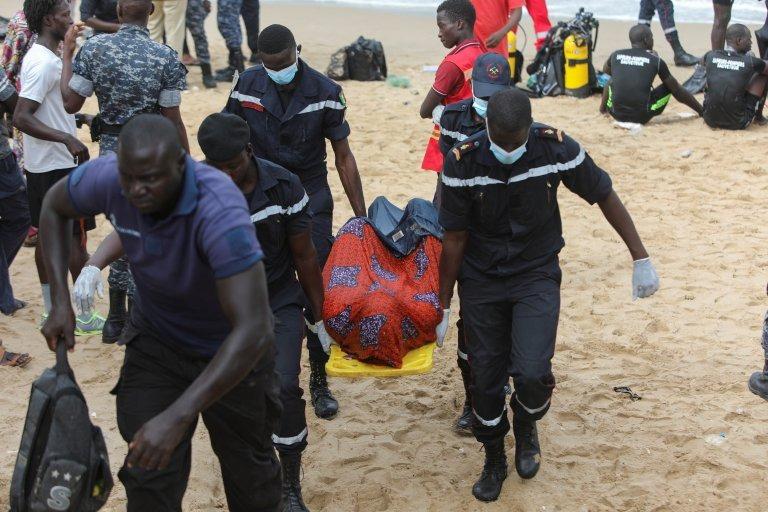
At least 34 people have died and only one survivor has been found after a migrant pirogue sank off Kébémer in northwestern Senegal. The government initially reported 21 deaths late Saturday, but the toll rose on Sunday as more bodies were recovered near the Loumpoul coastal area. Authorities do not yet know how many people were on board, and search operations are continuing.
The death toll from a migrant boat disaster off the northwestern coast of Senegal has risen to at least 34, with authorities confirming that only one survivor has so far been found as search teams continue combing the Atlantic coastline for more victims. The wooden pirogue was carrying people attempting to migrate irregularly toward Europe when it came into difficulty off Kébémer in the Louga region, near the Loumpoul coastal area between Dakar and Saint-Louis. What began late Saturday as a provisional report of 21 deaths has now developed into one of Senegal’s most serious recent migration tragedies, once again exposing the human cost of the Atlantic route used by thousands of West Africans hoping to reach Spain’s Canary Islands. Authorities have not yet established how many people were originally on board, meaning the final number of dead or missing could still rise as recovery operations continue along the coast.
Senegalese authorities initially announced that 21 bodies had been recovered and one person rescued, making clear at the time that the figure was provisional because search operations were still underway. By Sunday, the official toll had climbed to 34 dead and one survivor as additional bodies were discovered in the waters and along beaches around the affected coastal area. Gendarmes, firefighters, local officials and emergency teams have remained deployed around Kébémer and Loumpoul, searching for further victims while also beginning the difficult process of identifying those already recovered and assisting families who fear their relatives may have been on the vessel.
The wreck occurred near the Loumpoul dunes and the coastal communities around Tébène and Potou Saradao, a stretch of Senegal’s Atlantic shoreline that has repeatedly been associated with departures by migrants attempting to reach the Canary Islands. Bodies were reportedly found along the shoreline after the boat was believed to have capsized offshore, although authorities have not yet publicly established the exact cause of the disaster. Investigators will need to determine whether the vessel encountered rough seas, mechanical failure, overloading or another problem before it sank, and the only known survivor may become the most important source of information about what happened during the final moments of the journey.
The Senegalese Interior Ministry has expressed deep sorrow over the deaths and offered condolences to the families of the victims, while announcing that state services had been mobilised to continue search-and-rescue operations and support affected communities. The government has also renewed its pledge to intensify action against people-smuggling networks and strengthen cooperation with neighbouring countries used as departure points or transit routes. The latest tragedy has nevertheless demonstrated how difficult it remains to stop the movement of people willing to risk the Atlantic despite repeated warnings about the dangers involved.
The single survivor may now hold crucial information that investigators cannot easily obtain elsewhere because migrant boats frequently leave without formal passenger lists. Authorities are expected to seek details about where the boat departed from, how many passengers were on board, how long the vessel had been at sea and whether smugglers organised the journey. That testimony could also help establish whether additional people remain missing, an especially important question because officials have not announced that everyone who boarded the pirogue has been accounted for.
Local authorities have simultaneously begun the painful task of identifying the dead and notifying families. In many migration disasters, identification can take time because passengers may travel without official documents or use routes not disclosed to relatives before departure. Some families may only realise that a loved one was on board after reports of a shipwreck spread through their communities, leaving them waiting for confirmation while bodies are recovered and examined. That uncertainty is now hanging over families in northern Senegal, where early reporting suggests some of the victims may have come from communities around Léona and Thiéppe.
The disaster has once again drawn attention to the Atlantic migration route from West Africa to the Canary Islands, widely regarded as one of the most dangerous irregular migration corridors in the world. Migrants often make the journey in long wooden fishing vessels known locally as pirogues, boats that were originally designed for coastal fishing rather than long-distance travel across open ocean. These vessels can carry dozens or sometimes more than a hundred passengers together with fuel containers, food and water, placing enormous pressure on boats that may have limited navigation equipment, inadequate life jackets and little ability to withstand changing Atlantic conditions.
The journey from Senegal toward the Canary Islands can cover hundreds of kilometres and may last several days even when conditions are favourable. When boats drift off course or experience mechanical failure, passengers can remain stranded far from land with limited water, food or medical assistance. Exposure, dehydration, hunger and rough seas can become deadly even before a vessel capsizes, while survival chances fall sharply when an overloaded boat overturns far from rescue services.
The International Organization for Migration has repeatedly warned that tighter enforcement around known departure areas can push migrants and smugglers toward longer, more remote routes rather than eliminating the journeys altogether. When traditional departure points are monitored more closely, boats may leave from isolated parts of Senegal or neighbouring countries, increasing the time passengers spend at sea and making rescue operations significantly more difficult. In some cases, alternative Atlantic routes can extend for more than 2,000 kilometres, exposing passengers to risks far greater than those encountered on shorter coastal journeys.
The Kébémer disaster is therefore not an isolated accident but part of a wider pattern that has persisted across Senegal, Mauritania, The Gambia and other parts of West Africa. Young people continue boarding unsafe boats because many believe the possibility of reaching Europe offers a better future than the economic conditions they face at home. Unemployment and underemployment are major factors, but they are not the only ones. Family expectations, frustration with limited opportunities, the success stories of migrants already living abroad and the social prestige associated with migration can all influence a decision that may ultimately place a person’s life at risk.
For many families, migration is treated not only as a personal decision but as an economic strategy. Relatives may borrow money, sell property or combine savings to finance a journey, believing that a family member who reaches Europe will eventually send money home. When a boat disappears, those households lose both a loved one and the financial resources invested in the attempt. The emotional and economic consequences can therefore continue long after a disaster disappears from international headlines.
Senegal’s government has repeatedly tried to address the problem through law enforcement, public-awareness campaigns and promises of employment and training programmes aimed at young people. Officials routinely urge citizens not to trust smugglers or risk their lives at sea, but the continued departures show that warnings alone have not changed the calculations being made by thousands of potential migrants. As long as the perceived rewards of reaching Europe continue to outweigh the dangers in the minds of those considering the journey, smugglers will continue finding people willing to board unsafe vessels.
The economics surrounding irregular migration are also deeply connected to local communities. In coastal areas where fishing boats are common, access to vessels and people familiar with the sea can make departure easier, but local knowledge does not necessarily translate into safety on a long-distance Atlantic crossing. A pirogue that performs reliably near shore can become dangerously unstable when packed with passengers, fuel and supplies for a journey lasting several days. Strong winds, high waves or a sudden shift in passenger weight can quickly overwhelm a heavily loaded wooden vessel.
Authorities have not yet announced what specifically caused the Kébémer boat to sink, and there is currently no basis for stating that bad weather, brake failure, overloading or any other single factor was responsible. Those are common causes in similar tragedies, but investigators must still reconstruct the circumstances of this disaster. The survivor’s account, examination of any recovered parts of the boat and information from people involved in organising the journey could eventually provide a clearer picture.
The tragedy is also likely to renew pressure on the government to dismantle smuggling networks operating along the coast. Organisers can collect large sums from passengers while remaining safely on land, leaving migrants to make dangerous crossings under the control of inexperienced operators or even passengers selected to steer the boat. Investigators will therefore be interested not only in how the vessel sank but in who supplied it, who collected payments, who arranged fuel and supplies and who selected the departure point.
The lack of a passenger manifest can make those investigations extremely difficult. Smuggling networks operate outside legal transport systems, meaning authorities often have no reliable list of who travelled, how much they paid or who arranged the journey. In some cases, families receive little information before departure and may not know the precise route their relatives intended to take. That can leave governments struggling to establish even the basic number of people lost when a boat disappears.
Regional cooperation has become increasingly important because the migration networks do not respect national borders. People may travel from Guinea, Mali, The Gambia or other countries before joining boats leaving from Senegalese territory, while smugglers can relocate their operations when enforcement increases in one area. This means a vessel departing from Senegal can carry passengers of several nationalities and may have been organised through a network stretching across multiple countries.
European governments are also deeply involved in efforts to reduce departures. Spain and the European Union have invested in migration-control partnerships, maritime patrols and programmes intended to improve economic opportunities in West Africa. Critics argue, however, that tougher enforcement without sufficient legal migration pathways and meaningful economic alternatives can simply shift departures to more dangerous locations. The continuing appearance of longer routes suggests that smugglers are capable of adapting quickly when governments close familiar departure points.
The Canary Islands remain an attractive destination because reaching the islands means entering Spanish territory without crossing the Sahara and Mediterranean. Yet the Atlantic route can be even more unforgiving. Strong currents can carry boats far from their intended course, while a mechanical problem that might be survivable close to shore can become catastrophic hundreds of kilometres from land. Rescue teams may have little idea that a vessel is missing until relatives raise an alarm or bodies begin appearing along the coast.
That uncertainty contributes to a hidden death toll far greater than the number recorded in confirmed shipwrecks. Migrant-rights groups have documented hundreds of deaths along the Atlantic route in 2026 alone, but they also acknowledge that many disappearances are never fully counted. Boats can vanish without witnesses, wreckage or recovered bodies, leaving families without official confirmation of what happened.
This is why the 34 confirmed deaths off Kébémer represent only the visible portion of a much broader migration crisis. Every body recovered provides authorities with evidence of a specific tragedy, but other victims may never be found. For families, the absence of a body can prolong grief indefinitely because there is no funeral, no confirmed place of death and sometimes no certainty that a missing person is truly gone.
The one known survivor may also face a long recovery. Beyond any physical injuries suffered in the sinking, survivors of maritime disasters can experience severe psychological trauma after watching other passengers drown or disappear. If the individual lost friends or relatives on the same boat, the emotional consequences may be especially severe. Senegalese authorities will therefore need to treat the survivor not only as a witness but also as a victim requiring medical and psychological support.
The wider policy challenge remains enormous. Preventing future tragedies will require stronger policing of smugglers, but it will also require governments to confront why so many young people continue to see irregular migration as their best available option. Employment, education, entrepreneurship, confidence in institutions and realistic opportunities for social advancement all influence migration decisions. Without progress in those areas, security operations alone are unlikely to eliminate the demand for dangerous journeys.
The government’s repeated emphasis on youth employment and socio-economic inclusion acknowledges that reality. Senegal has experienced periods of strong economic growth and remains one of the more politically stable countries in West Africa, yet economic opportunities are unevenly distributed and many young people continue to struggle to find stable work. For someone who sees few prospects at home, stories of successful migrants sending money to their families can be more persuasive than warnings about people lost at sea.
Social pressure can reinforce that perception. In communities with large diaspora populations, migration may be associated with success, family responsibility and adulthood, while people who remain behind may feel they have failed to progress. That culture can encourage risk-taking even when the dangers are widely understood.
The latest disaster has now transformed those abstract risks into 34 confirmed deaths and a single known survivor. Families are waiting for identification, local communities are mourning and emergency crews are still searching the coastline. Authorities do not yet know how many people originally boarded the boat, which means the true scale of the loss remains uncertain.
For Senegal, the tragedy is another painful reminder that the Atlantic migration crisis is not measured only in departure statistics or interception figures. It is measured in parents waiting for children who never return, villages receiving bodies from the sea and survivors carrying memories of people they could not save.
What began on Saturday as a provisional report of 21 deaths has already risen to at least 34, and officials have warned that search operations are continuing. That means the final toll may still be higher.
The route from West Africa to Europe remains open in the minds of those desperate enough to attempt it, even as the Atlantic continues taking lives. Until the forces driving those journeys are addressed with the same urgency devoted to stopping the boats, tragedies like the one off Kébémer will remain a recurring part of the migration story.
For the families now gathered along Senegal’s northwestern coast, however, the political debate can wait. Their immediate concern is much more personal: identifying the dead, finding anyone still missing and hoping that the sea does not return more bodies.