
SERBIA’S PRESIDENT VUČIĆ RESIGNS SEVEN MONTHS EARLY, SETS SIGHTS ON PRIME MINISTER’S OFFICE
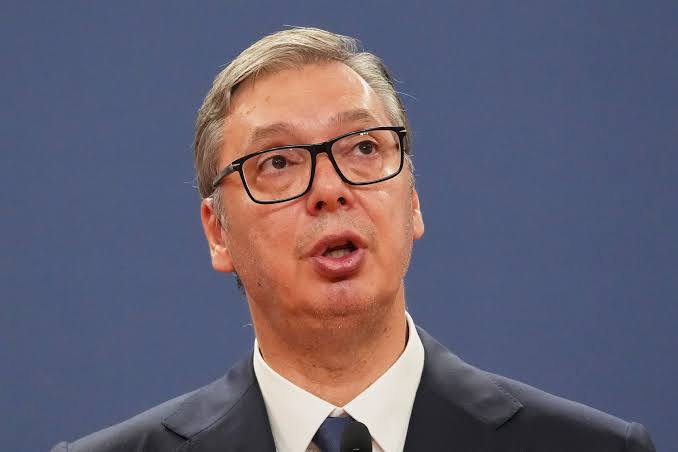
Serbian President Aleksandar Vučić has resigned seven months before the end of his second and final term as he prepares to contest the October 25 snap parliamentary election as the Serbian Progressive Party’s candidate for prime minister. Parliament Speaker Ana Brnabić is taking over as acting president, while Serbia must hold an early presidential election within three months.
Serbian President Aleksandar Vučić has resigned seven months before the end of his second and final term, triggering an early presidential election while he shifts his attention to becoming prime minister after Serbia’s October 25 snap parliamentary election.
Vučić formally announced his resignation on Sunday, September 27, bringing his presidency to an early end after nearly a decade in the office.
His departure represents a major political transition in Serbia, although it does not necessarily mark Vučić’s departure from political leadership.
Instead, the longtime Serbian leader is moving directly into the parliamentary campaign.
Vučić now heads the electoral list of his Serbian Progressive Party, known as SNS, and is the party’s candidate for prime minister.
Whether he ultimately becomes prime minister will depend on the results of the October 25 election and the formation of Serbia’s next government.
“I AM RESIGNING AS PRESIDENT”
Vučić announced his departure from the Presidential Palace in Belgrade as hundreds of supporters gathered outside.
“I am resigning as president,” he said.
He told supporters that Sunday would be his final evening in the presidential building and said he would transfer his duties to Parliament Speaker Ana Brnabić.
Vučić said he was proud of his record and thanked Serbian citizens who elected him to the presidency twice.
He had previously announced his intention to leave office early as Serbia prepared for the snap parliamentary election.
His second presidential term was not scheduled to expire for another seven months.
ANA BRNABIĆ TAKES OVER AS ACTING PRESIDENT
Under Serbian law, Parliament Speaker Ana Brnabić assumes presidential responsibilities following Vučić’s early departure.
She can serve as acting president for up to three months.
Serbia must now organize an early presidential election, with voting required within three months of the termination of Vučić’s mandate.
Vučić said he expects the first round of the presidential election to take place by the end of December.
The presidential campaign must last between 30 and 60 days.
Serbia therefore faces two major national elections within a relatively short period.
The parliamentary election is scheduled for October 25, followed by the early presidential election.
VUČIĆ TURNS ATTENTION TO PRIME MINISTER’S OFFICE
Vučić’s resignation allows him to concentrate on the parliamentary contest as SNS’s candidate for prime minister.
He said he wanted to participate in the election as an ordinary citizen rather than campaign while holding the presidency.
Serbian law did not require him to resign from the presidency to participate in the parliamentary campaign.
If SNS and its allies secure sufficient parliamentary support to form the next government, Vučić could return to the prime minister’s office.
He previously served as Serbia’s prime minister between 2014 and 2017 before becoming president.
The October election therefore presents the possibility of Vučić shifting from the presidency back to the position he held before becoming head of state.
NEARLY TWO YEARS OF PROTESTS
The election comes after nearly two years of sustained anti-government demonstrations.
The protest movement emerged following the November 2024 collapse of a concrete canopy at the railway station in Novi Sad, which killed 16 people.
The disaster triggered public anger and allegations of corruption and inadequate government oversight.
Student-led demonstrations subsequently expanded into a broader anti-government movement.
Protesters demanded greater accountability and eventually called for early parliamentary elections.
The demonstrations became some of Serbia’s largest political protests in decades, at times drawing hundreds of thousands of people.
Vučić and his government have rejected allegations that they were responsible for the disaster and have accused some opponents of seeking to destabilize the country.
OCTOBER 25 ELECTION TAKES CENTER STAGE
Vučić dissolved Serbia’s parliament on September 9 and scheduled the snap parliamentary election for October 25.
The election will feature SNS and its allies against several opposition groups.
Among them is Students Win, a student-led anti-corruption movement that emerged from the protest campaign.
European Serbia, an alliance of pro-Western opposition parties, is also contesting the election.
The groups have presented different political programs and approaches to Serbia’s domestic and international policies.
The result will determine the composition of parliament and which political forces are positioned to form the next government.
VUČIĆ HAS DOMINATED SERBIAN POLITICS FOR MORE THAN A DECADE
Vučić has occupied Serbia’s highest political offices for more than a decade.
He became prime minister in 2014 before winning the presidency in 2017.
He was reelected president in 2022.
His supporters credit his governments with infrastructure development, attracting foreign investment and maintaining Serbia’s diplomatic relationships with competing international powers.
His opponents have accused his governments of weakening democratic institutions, concentrating political power and exercising excessive influence over Serbia’s media environment.
Vučić and SNS have rejected allegations of authoritarianism and maintained that their governments have repeatedly received democratic mandates through elections.
BALANCING EUROPE, RUSSIA AND CHINA
Serbia remains a candidate for membership in the European Union, but Vučić has pursued relationships with countries outside the Western alliance system.
Belgrade has maintained historically close ties with Russia while developing significant economic relations with China.
At the same time, Serbia has continued negotiations over eventual EU membership and maintained economic and political relationships with European governments and the United States.
The status of Kosovo remains another major issue confronting Serbia’s next government.
Serbia does not recognize Kosovo’s declaration of independence, while the European Union and United States have pushed Belgrade and Pristina toward normalization of relations.
SERBIA ENTERS NEW ELECTION PERIOD
Vučić’s resignation formally ends his presidency earlier than scheduled but does not remove him from Serbia’s political contest.
Instead, it moves him directly into another.
The October 25 parliamentary election will determine the composition of Serbia’s next parliament and government.
A separate presidential election must then be completed within three months.
Until a new president is elected, Ana Brnabić will perform the duties of acting president.
For Vučić, the immediate objective is now the parliamentary election and a possible return to the prime minister’s office.
For Serbia, his resignation opens a new phase in a political confrontation shaped by nearly two years of protests, competing visions for the country’s future and two national elections before the end of the year.