Seven Missing Ghanaian Fishermen Found Alive in Benin Waters After 12 Days at Sea
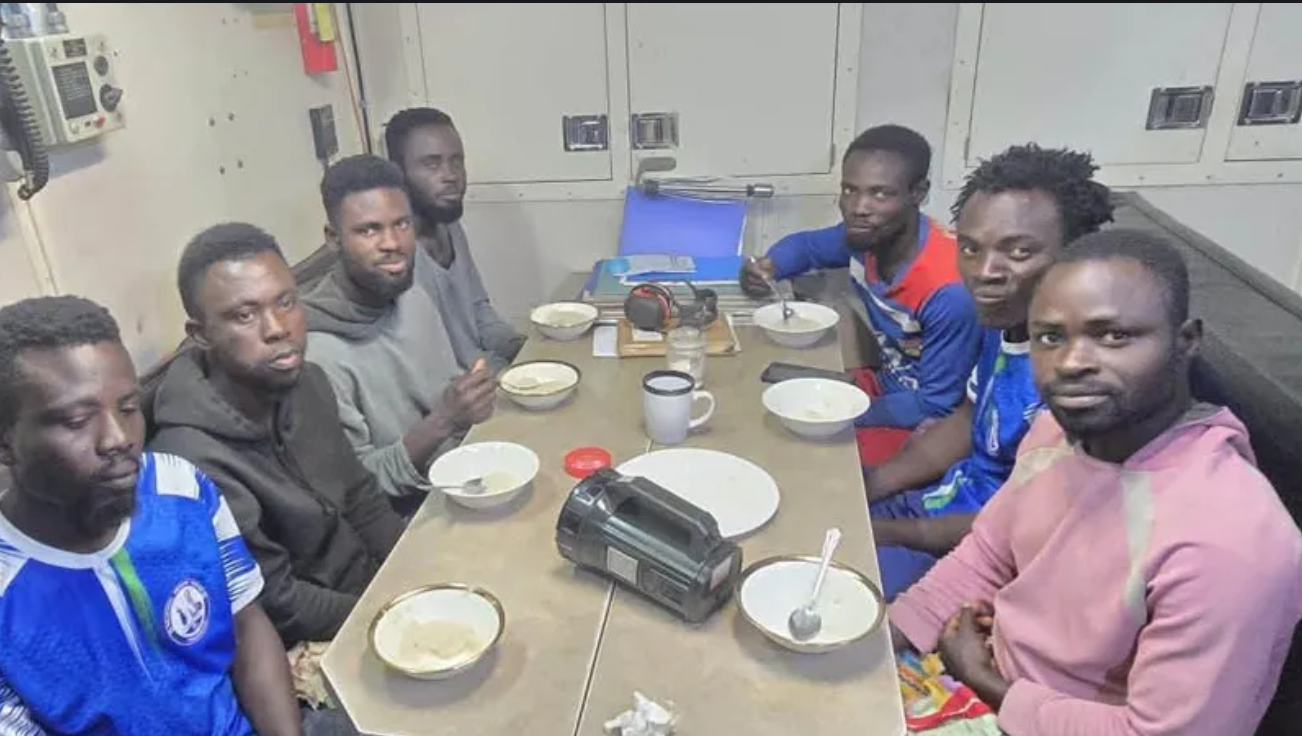
Seven Ghanaian fishermen aboard the canoe Second Chance have been found alive in Beninese territorial waters after spending about 12 days at sea following an engine failure. The vessel left Sekondi Fishing Harbour on October 9 for a fishing expedition off Axim and was carried eastward by ocean currents. Ghanaian authorities launched a multi-agency search after the canoe was reported missing on October 18. The crew was ultimately located near Grand-Popo in Benin, and Ghanaian, Togolese and Beninese authorities are coordinating their return home.
Seven Ghanaian fishermen who had been missing for nearly two weeks after their fishing canoe suffered an engine failure have been found alive in Beninese territorial waters, ending an increasingly desperate search that stretched across Ghana’s eastern coastline and eventually drew maritime authorities in Togo and Benin into the operation. The seven crew members of the canoe Second Chance were located on Wednesday night after spending about 12 days at sea, with Ghanaian authorities confirming Thursday, October 22, that efforts were underway to return them safely home. The discovery brought relief to their families and fishing communities in Sekondi, where fears had grown that the men could have been lost after repeated attempts to reach them failed.
The Western Regional Marine Police Command said the fishermen were rescued at about 10 p.m. on Wednesday, October 21, in Benin’s territorial waters. According to the command, local fishermen were involved in the rescue, while Ghanaian officials subsequently began coordinating with authorities in Benin and Togo to facilitate the crew’s repatriation. A separate account issued through the Ministry of Fisheries and Aquaculture said the Togolese Navy had deployed its patrol vessel OTI after a regional maritime distress alert and located the distressed fishing canoe approximately three nautical miles off Grand-Popo in Beninese waters. The two official accounts differ slightly over the immediate circumstances of the final rescue, but both confirm that all seven fishermen were found alive in Beninese waters and that regional maritime cooperation was central to reaching them.
The fishermen have been identified by the Western Regional Marine Police Command as Kofi Emmanuel, 32, Uncle Amoah, 45, Kwamena Nkum, 29, Kofi Aboagye, 36, Doboa, 35, Agya Badu, 42, and Kwamena Akyem, 40. Authorities said arrangements were continuing Thursday between the Marine Police Command, Ghana Navy and their counterparts in Benin and Togo to bring the crew back to Ghana. Early information from officials indicated that the men were in stable condition and had received food and water after their ordeal. Fisheries Commission officials said their immediate concern after establishing contact was the health and safety of the fishermen following days with severely limited supplies.
The ordeal began on October 9 when Second Chance departed Sekondi Fishing Harbour for a fishing expedition offshore Axim in Ghana’s Western Region. At some point during the trip, the canoe’s outboard motor reportedly failed, leaving the vessel without normal propulsion and exposing the crew to strong currents that gradually carried them away from their intended fishing grounds. What began as an offshore mechanical problem developed into a cross-border maritime emergency as the canoe drifted eastward along the Gulf of Guinea, eventually passing far beyond the area where Ghanaian rescue teams initially believed it might be located.
The owner of the canoe, Nana Kweku Atta, formally reported the vessel missing at the Fishing Harbour Police Station in Sekondi on October 18 after it failed to return and attempts to establish contact with the crew were unsuccessful. The report triggered a coordinated search involving the Western Regional Marine Police Command, Ghana Navy, Ghana Maritime Authority, Fisheries Commission, relevant coastal police stations, chief fishermen and fishing communities. The Western Naval Command and Eastern Naval Command in Tema were also alerted as authorities tried to determine whether the disabled canoe had been pushed eastward by ocean currents.
Initial information available to investigators suggested the canoe could have drifted toward Tema and the Volta coastline, but authorities repeatedly cautioned that its precise position had not been established. That uncertainty complicated the search because the crew was moving with the currents while rescue teams were working from incomplete location information. The situation also highlighted one of the persistent dangers faced by artisanal fishermen operating far offshore without the sophisticated navigation, tracking and emergency communications equipment available on larger commercial vessels.
A significant breakthrough came on October 21 when contact was established with members of the crew. One fisherman, identified in earlier media interviews as Kwame Akyim, described the engine failure and said strong tides had carried the vessel more than 120 nautical miles from its expected location. He said the fishermen had attempted to improvise by using canvas to help move the canoe after losing engine power. His account provided authorities with important information about the crew’s condition and the likely direction in which the vessel had drifted, although officials still struggled to establish an exact position.
The fishermen also described severe shortages of food and fresh water during their time at sea. According to the account given by the crew member, they survived partly by eating fish from their catch after their normal food supplies became depleted. He also said the men had resorted to boiling seawater in an effort to obtain something to drink. Medical experts generally warn that drinking seawater is dangerous because of its high salt concentration, and officials have not independently provided a detailed account of exactly how much seawater was consumed or how it was prepared. The claim therefore remains part of the crew’s description of their survival conditions rather than a medically verified assessment of their hydration during the ordeal.
The crew member said one fisherman had experienced stomach pain but that the men were otherwise holding up despite the prolonged exposure, hunger and uncertainty. He also claimed that vessels had passed without responding to their attempts to attract attention. Those assertions have not been independently verified, and no information has emerged identifying the vessels allegedly seen by the fishermen or establishing whether their crews were aware that Second Chance was in distress.
As contact improved, Ghanaian maritime agencies intensified efforts to reach the canoe. The Ghana Maritime Authority said on Wednesday that the Ghana Navy vessel GNS Aflao had been deployed with Marine Police officers and medical personnel aboard. At the same time, fishermen around Aflao were mobilized through local fishing leadership to assist with the search. Authorities also worked with national security personnel in an effort to use mobile phone signals to narrow down the crew’s location.
The search was complicated by conflicting location information. Ghana Maritime Authority officials said at one stage that the crew believed they were about 41 nautical miles south of Aflao, but descriptions of visible landmarks did not appear to correspond with that position. Fishermen reportedly described seeing a lagoon and ships at anchorage, leading officials to reconsider where the canoe might actually be. Language and communication difficulties also complicated attempts to establish reliable coordinates from the crew.
By Wednesday afternoon, Western Regional Minister Joseph Nelson said authorities had received information suggesting the crew had entered Togolese territorial waters. The Togo Navy was subsequently alerted, expanding what had begun as a Ghanaian search into a regional operation. Fisheries officials also indicated that communication with neighboring authorities was complicated at some stages by language differences as officials tried to determine whether the fishermen were dealing with Togolese or Beninese personnel.
According to the Ministry of Fisheries and Aquaculture, a distress alert was issued by the Ghana Navy and the Multinational Maritime Coordination Centre covering the area, after which the Togolese Navy dispatched the patrol vessel OTI. The ministry said the vessel located Second Chance about three nautical miles off Grand-Popo, a coastal community in Benin close to the Togolese border. The seven men were assisted and the fishing canoe was being towed toward the Ghana-Togo maritime boundary for eventual handover to Ghanaian authorities.
The Western Regional Marine Police Command’s account, released Thursday, said the fishermen had been rescued by local fishermen in Beninese territorial waters at approximately 10 p.m. Wednesday. Authorities have not yet publicly provided a detailed minute-by-minute reconstruction explaining how the intervention by local fishermen described by police corresponded with the Togolese naval operation described by the Fisheries Ministry. What is established across the official accounts is that Second Chance reached Beninese waters, all seven crew members survived and authorities from Ghana, Togo and Benin became involved in securing their safety and return.
The distance covered by the disabled canoe illustrates how rapidly a fishing emergency off Ghana’s western coastline can become a regional maritime incident. Second Chance left Sekondi for waters off Axim in the west of the country but was ultimately located hundreds of kilometers to the east near the Benin-Togo frontier. Ocean currents, wind and the absence of reliable propulsion can move smaller fishing vessels considerable distances, making search operations increasingly difficult when rescue authorities do not have continuous tracking information.
The episode has renewed attention on maritime safety among Ghana’s artisanal fishing fleet, particularly the availability of functioning communication systems, life jackets, emergency signaling equipment, navigation devices and reliable engines. The Ministry of Fisheries and Aquaculture, after confirming the rescue, urged fishermen to check weather conditions before departure, use life jackets, carry dependable communications equipment and observe maritime safety advisories. The ministry said safety at sea should remain a fundamental requirement for every fishing expedition.
For coastal communities across Ghana, fishing remains both a major source of income and an occupation involving significant physical and financial risk. Canoe fishermen can spend extended periods offshore and often operate in changing weather and sea conditions. Mechanical failure can become especially dangerous when vessels are far from shore, and rescue efforts depend heavily on how quickly distress information reaches authorities and whether an accurate position can be established. In the Second Chance case, days passed before a formal missing-person report was made, while authorities later struggled with uncertain coordinates even after communication with the crew had resumed.
The case may therefore prompt further questions about whether stronger tracking requirements or affordable emergency location technology should become more widely available to canoe operators. Officials had already acknowledged during the search that establishing the vessel’s exact location was one of the biggest challenges. Mobile phone communication eventually became useful, but cellular signals offshore can be unreliable and are not a substitute for dedicated maritime distress systems designed to transmit a vessel’s position during an emergency.
There is also likely to be scrutiny of the timeline between the canoe’s departure on October 9 and the formal report made to police on October 18. Fishing expeditions can vary considerably in duration, and authorities have not suggested wrongdoing by the canoe owner or crew, but understanding when Second Chance was expected back and when concern first arose could help determine whether earlier notification might have accelerated the search. No investigation findings have yet been released on that question.
Officials have also not provided a comprehensive medical update detailing whether any of the fishermen suffered dehydration, exposure, injuries or other health complications during their time adrift. Fisheries Commission officials said Wednesday night that the men had been given food and water and were considered safe, but a full health assessment is expected to provide a clearer picture of how the prolonged ordeal affected them. Authorities have not announced any deaths or life-threatening injuries among the seven.
For their families, however, the most important development is that a search that had carried the possibility of tragedy has ended with all seven men alive. The fishermen spent nearly two weeks away from home, much of that period without reliable contact and with the disabled vessel drifting far beyond Ghanaian waters. Their eventual location near Grand-Popo demonstrates the value of cooperation among neighboring Gulf of Guinea states when maritime emergencies cross national boundaries.
Ghanaian authorities were still coordinating the fishermen’s repatriation as of Thursday, October 22, with the Marine Police, Ghana Navy and authorities in Togo and Benin involved in the arrangements. Officials are expected to provide additional information once the crew is formally handed over and returns to Ghana, including their medical condition, the condition of Second Chance and a clearer reconstruction of the rescue operation.
The successful recovery of all seven fishermen brings the immediate emergency to a close, but important questions remain about the sequence of the rescue, the crew’s exact route after the engine failure and the safety systems available to artisanal fishermen operating far offshore. Those issues will become clearer as the men return home and maritime authorities complete their accounts. For now, the confirmed development is that the seven fishermen who left Sekondi on October 9 and disappeared into the Gulf of Guinea have been found alive, received assistance and are being brought back to Ghana after an ordeal that carried them from waters off Axim to the coast of Benin.