TINUBU’S FIVE-YEAR DEFENCE PLAN TARGETS TERRORISM, BANDITRY AND KIDNAPPING AS NIGERIA OVERHAULS SECURITY STRATEGY
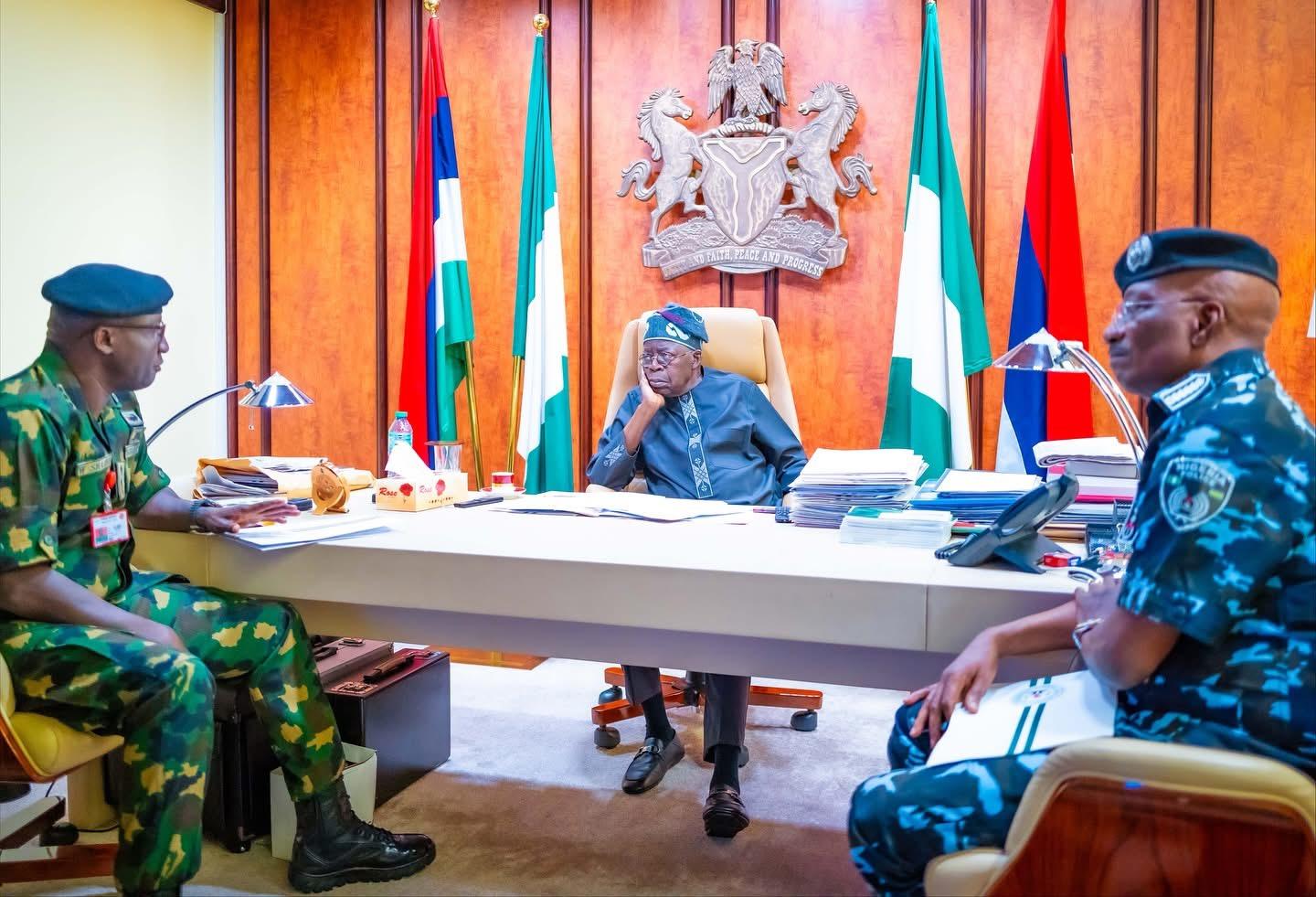
The APC Presidential Campaign Council says President Bola Tinubu’s Five-Year Strategic Defense Operations Plan is ready, describing it as a framework for confronting terrorism, banditry, kidnapping and other security threats through intelligence-led operations, technology, expanded manpower and coordinated security spending.
ABUJA, NIGERIA — President Bola Tinubu’s administration is moving ahead with a sweeping five-year strategic defense plan designed to overhaul the way Nigeria confronts terrorism, banditry, kidnapping and other security threats, placing intelligence coordination, military expansion, modern technology and long-term procurement at the center of a new national security architecture. The strategy, first ordered by Tinubu in August and now described by the All Progressives Congress Presidential Campaign Council as ready to guide the government’s security operations, represents an attempt to move Nigeria away from years of fragmented and largely reactive responses toward a system in which security agencies operate from a common assessment of the country’s most serious threats and deploy personnel, equipment and money according to clearly defined priorities. While the ruling party has presented the initiative as a major step toward eliminating insecurity, the full plan has not yet been released publicly, meaning its eventual success will be judged not by the ambition of its announcement but by whether Nigerians experience a sustained decline in kidnappings, terrorist attacks, bandit raids and other forms of violent crime.
The initiative originated from a directive Tinubu issued at the Federal Executive Council in August, when he approved the immediate preparation of a comprehensive National Threat Assessment alongside a rolling Five-Year Strategic Defense Operations Plan. The President said Nigeria’s defense, intelligence and security institutions had too often considered their operational requirements separately, without sufficient reference to an agreed national understanding of the threats confronting the country or a unified medium-term plan for responding to them. That fragmented approach, he argued, made coordination difficult and prevented government resources from being deployed as efficiently as they could be. Under the new framework, the threat assessment is expected to identify Nigeria’s principal security dangers, determine their relative urgency and define the objectives required to confront them, while the five-year defense plan translates those findings into operational priorities, manpower requirements, equipment needs, logistical support, capability gaps and a clear implementation timetable.
Tinubu placed the process under the coordination of his Special Adviser on Homeland Security, Major General Adeyinka Famadewa, with an 11-member committee drawing together some of the country’s most senior security officials. The committee includes National Security Adviser Nuhu Ribadu, Defence Minister Christopher Musa, Minister of State for Defense Bello Matawalle, Chief of Defense Staff Olufemi Oluyede, Army Chief Waidi Shaibu, Air Chief Sunday Kelvin Aneke, Naval Chief Idi Abbas, Director-General of the Department of State Services Tosin Ajayi and National Intelligence Agency Director-General Mohammed Mohammed. Bringing such officials together is intended to address one of the longstanding weaknesses in Nigeria’s security system: the existence of powerful agencies with overlapping responsibilities but sometimes inadequate intelligence-sharing, duplication of operations and competition over command authority. Tinubu said recent security successes had demonstrated that agencies could achieve considerably more when operating with a common objective and timely intelligence, and he instructed the committee to turn that principle into an enduring national framework rather than something dependent on temporary cooperation during individual crises.
The latest announcement came from the APC Presidential Campaign Council, which said the strategic plan would adopt a coordinated, intelligence-led and technology-driven approach to terrorism, banditry, kidnapping and other forms of criminality. The council said the framework would align military operations, training, equipment and expenditure with the actual threats confronting the country instead of allowing procurement or deployments to develop independently of an agreed operational strategy. That distinction is potentially significant because Nigeria has spent enormous sums on security over successive administrations while continuing to face multiple armed threats at the same time. A five-year framework, if implemented as described, could give the government a clearer basis for deciding whether a particular region needs more troops, aerial surveillance, armored vehicles, intelligence platforms, communications infrastructure or police rather than relying primarily on emergency purchases and short-term deployments after attacks have already occurred.
Nigeria’s security challenge is particularly difficult because it is not a single conflict that can be resolved through one military campaign. Boko Haram and the Islamic State West Africa Province remain active in the North-East, where insurgents have spent years adapting to military pressure and exploiting forests, border areas and difficult terrain. Across parts of the North-West and North-Central regions, armed bandit groups have built extensive networks around kidnapping, cattle rustling, village raids and extortion, while some groups have established relationships with jihadist organizations without necessarily sharing their ideological goals. Kidnapping for ransom has become a major national threat affecting highways, schools, farms, religious institutions and residential communities, while communal and farmer-herder violence continues to destabilize several parts of the Middle Belt. In the South-East, separatist-linked violence and attacks on government facilities remain concerns, while the Niger Delta still faces crude-oil theft, pipeline vandalism and illegal refining. Nigeria must also contend with maritime threats in the Gulf of Guinea and the risk that instability across the Sahel could push weapons, extremist networks and fighters toward the country’s northern borders.
That complexity explains why the administration is emphasizing a national threat assessment before operational planning. A military unit designed to fight jihadist insurgents in Borno may not be the most appropriate instrument for investigating kidnapping networks operating through criminal informants in Kaduna or dismantling oil theft operations in the Niger Delta. Effective security therefore requires the government to understand not simply where violence is occurring but who is responsible, how the groups are financed, where they recruit, how they communicate, which communities they exploit and what type of state response is most likely to weaken them. In theory, a unified threat assessment should make it possible to assign the right institutions to the right problems while ensuring that intelligence gathered by one agency is available to others capable of acting on it.
The government’s manpower expansion forms a major part of that strategy. The APC campaign council says Tinubu has approved the recruitment of 28,000 additional soldiers and 50,000 police officers, a significant increase in the number of security personnel available for deployment across the country. The Army expansion had already been formally announced in July, when the Presidency approved the transformation of the Nigerian Army from an eight-division structure to 12 divisions, alongside the recruitment of 28,000 additional personnel and acquisition of critical military platforms and equipment. The administration argues that the reorganization will give the Army broader geographical coverage and improve operational response times, particularly in areas where troops currently have to cover enormous territories with limited manpower.
The police expansion is equally important because the Armed Forces have increasingly been required to perform duties that would ordinarily belong to civilian law enforcement. Nigerian soldiers routinely operate checkpoints, patrol highways and respond to kidnapping and violent crime because the police lack enough personnel and specialized capability to cover the country effectively. Tinubu had initially approved the recruitment of 30,000 additional police officers, but after declaring a nationwide security emergency in November 2025, he authorized another 20,000 recruits, bringing the total planned intake to 50,000. He also ordered that officers assigned to protect Very Important Persons should be redirected toward mainstream policing, arguing that the state could not continue to devote large numbers of trained officers to private protection while police stations and communities in security-challenged areas remained understaffed.
Tinubu’s administration is also expanding the infrastructure required to absorb new personnel. The APC campaign council says new Army training depots have been established or approved in Osogbo, Osun State, and Amasiri-Edda in Ebonyi State, with each expected to accommodate thousands of recruits. The council says more than 5,000 recruits are already undergoing training at the Osogbo facility, while restructuring of Army formations is intended to increase the number of personnel available for operational deployment once training is completed. The challenge will be ensuring that the urgency to expand the force does not undermine training standards, discipline or professionalism, because rapid recruitment alone cannot produce improved security if newly deployed personnel are poorly prepared for complex counterterrorism, intelligence or civilian-protection responsibilities.
The administration has paired that force expansion with an effort to improve military welfare, approving salary increases of between 30 and 80 percent for roughly 250,000 members of the Armed Forces. Senior officers above colonel were approved for a 30-percent increase, personnel from colonel to warrant officer for 50 percent and lower-ranking troops from private to staff sergeant for as much as 80 percent, raising the annual military salary bill from approximately ₦660 billion to ₦924 billion. Tinubu has said better compensation is necessary because service members confronting terrorism, banditry and kidnapping are making significant sacrifices and must feel that government recognizes the risks they take. The APC campaign council has also pointed to new military accommodation, including a 700-unit barracks project in Ikere-Ekiti, as part of a wider attempt to improve the conditions under which personnel and their families live.
Military welfare can appear less dramatic than battlefield operations, but it has direct consequences for effectiveness. Soldiers who are poorly paid, badly housed or uncertain that their families will be supported if they are killed or injured are more difficult to retain and motivate, while better compensation can strengthen morale and reduce incentives for corruption. Welfare, however, cannot replace equipment, intelligence or leadership. Nigeria has previously spent substantial sums on fighter aircraft, armored vehicles, weapons and surveillance systems, yet security commanders have continued to request improved intelligence capabilities, communications equipment, drones and maintenance support. One of the most important promises contained in Tinubu’s five-year approach is therefore the creation of a multi-year defence expenditure and procurement plan linked directly to identified threats, allowing the government to plan equipment acquisition over several years rather than responding to every new crisis with isolated purchases.
That procurement framework could become one of the most consequential parts of the strategy if it is implemented with discipline and oversight. Modern military equipment is expensive not only to purchase but to maintain, train personnel on and integrate into existing systems. Fighter aircraft require pilots, engineers, spare parts, weapons and secure bases; drones require trained operators, communications links and intelligence teams capable of interpreting what they observe; surveillance technology produces little benefit if the information collected cannot reach commanders quickly enough to influence operations. A long-term plan should therefore allow Nigeria to consider the full life cycle of equipment rather than simply announcing new acquisitions, while ensuring that technology is bought because it addresses an identified operational gap rather than because a procurement opportunity becomes available.
The emphasis on intelligence may ultimately matter more than the number of new weapons acquired. Kidnapping networks, for example, are difficult to defeat through conventional military force alone because kidnappers frequently disperse into forests, use civilian informants and move hostages between temporary camps. Preventing abductions requires information about who organizes attacks, who supplies weapons, who negotiates ransom, how money is transferred and where groups operate before they strike. Similar intelligence is required against terrorist networks that rely on bomb makers, financiers, couriers and recruiters as well as armed fighters. Tinubu’s framework is therefore intended to strengthen cooperation between military intelligence, the Department of State Services, police intelligence units and community sources so that operations can become more preventive rather than remaining primarily reactive.
Local communities will remain essential to that model because technology cannot fully replace human intelligence. Drones can locate vehicles or camps, telecommunications analysis can reveal patterns and satellites can monitor movement, but residents often know which strangers have entered their communities, which routes armed groups use and which individuals are suddenly financing suspicious activity. Building that relationship requires trust. Communities that fear retaliation from terrorists or abuse by security forces may be unwilling to cooperate, while intelligence obtained from local disputes can sometimes be unreliable or deliberately manipulated. A successful national strategy must therefore strengthen accountability and civilian protection alongside military capability, because security forces that lose the confidence of the population also lose access to one of their most important intelligence sources.
The APC Presidential Campaign Council is already presenting recent military outcomes as evidence that the administration’s approach is working, claiming that more than 15,000 terrorists and bandits have been killed during Tinubu’s first three years in office and that more than 130,000 Boko Haram fighters and their dependants have surrendered through Operation Safe Corridor and related initiatives. Those figures come from the ruling party’s campaign structure and should not be treated as fully independent measurements of security progress. Nigeria’s military regularly publishes casualty, arrest and surrender statistics, but comprehensive verification is difficult in remote conflict areas, and surrender totals can include women, children and other dependants rather than armed combatants alone. The figures therefore provide part of the government’s assessment of its performance, but they do not by themselves establish that the underlying threats have been eliminated.
Operation Safe Corridor also illustrates the difficult balance between military pressure and non-kinetic approaches. The programme is designed to screen, deradicalize, rehabilitate and reintegrate former insurgents who surrender and are considered eligible for rehabilitation rather than immediate criminal prosecution. Supporters say the programme encourages defections, reduces the number of people available to insurgent organizations and can provide valuable intelligence about terrorist networks. Critics, particularly survivors and communities devastated by Boko Haram violence, have questioned whether former fighters are being reintegrated without sufficient accountability for crimes they may have committed. A serious five-year defence strategy will therefore need to demonstrate how rehabilitation, prosecution, victim support and community reconciliation fit together rather than treating surrender numbers alone as proof of success.
The same principle applies to military victories in the field. Nigeria has repeatedly recaptured territory from Boko Haram and destroyed insurgent camps, yet militant groups have shown an ability to disperse and return when military pressure weakens. A village cannot be considered permanently secure simply because troops briefly drive attackers away. Lasting security requires roads to reopen, farmers to return to their fields, children to attend school, markets to function and civilian government to operate without depending indefinitely on soldiers. The five-year horizon gives the administration an opportunity to measure progress through those outcomes rather than relying solely on the number of militants reported killed during operations.
In the North-West, that challenge is even more complicated because many armed groups are driven primarily by profit rather than ideology. Bandit leaders can fragment into smaller groups, relocate between forests and states and form temporary alliances depending on financial opportunity. Some communities have experienced repeated cycles in which armed groups are attacked, disperse into neighboring areas and later return. A coordinated strategy would need to prevent one state’s military operation from simply moving criminals into another jurisdiction while also disrupting ransom payments, arms supply networks and the local collaborators who make kidnapping operations possible.
The national strategy also has an important regional dimension. Nigeria’s borders with Niger, Chad, Cameroon and Benin are vast and difficult to police, while instability across the wider Sahel has created an environment in which extremist organizations, traffickers and weapons can move between weakly governed areas. Military coups and political tensions within West Africa have also complicated some forms of security cooperation. Nigeria cannot permanently suppress transnational militant networks through domestic operations alone, making intelligence-sharing with neighboring countries and continued cooperation through regional security structures essential to the success of the five-year plan.
Another important question is whether the strategy will reduce the extraordinary burden placed on the military for internal-security duties. Nigeria’s Armed Forces are now involved in operations across much of the federation, often performing tasks that range from counterterrorism to highway patrols and anti-kidnapping raids. That level of deployment can stretch personnel and equipment and blur the distinction between military and civilian policing. Expanding police manpower and capability could allow soldiers to withdraw gradually from ordinary law-enforcement duties and concentrate on high-intensity threats that genuinely require military force, while police take greater responsibility for investigation, arrest, evidence gathering and prosecution.
The debate over state police will remain connected to that objective. Tinubu has already urged the National Assembly to review existing laws to allow states that want their own police forces to establish them, responding to arguments that Nigeria’s centralized federal police structure cannot adequately cover every community in such a large and diverse country. Supporters of state police say governors need locally controlled forces capable of responding rapidly to threats, while critics fear that powerful state governments could use those forces against political opponents. The five-year defense plan does not itself resolve that constitutional debate, but any future state policing system would need to integrate with national intelligence and cross-border crime investigations if the broader security architecture is to remain coherent.
Funding will be another decisive test because long-term security strategies can become enormously expensive. Expanding troop numbers, raising salaries, constructing barracks, purchasing aircraft and surveillance equipment and maintaining operations across multiple regions require billions of naira every year. Tinubu’s decision to link the five-year operational plan with a multi-year defense expenditure framework could make spending more predictable, but it also raises questions about accountability. Nigeria’s defense sector necessarily keeps some information classified, yet excessive secrecy around procurement has historically created concerns about corruption, inflated contracts and equipment that fails to reach frontline units. The National Assembly will therefore need to exercise meaningful oversight without compromising operational security, ensuring that resources approved under the new strategy correspond to actual capability gaps and measurable security priorities.
Human rights will be equally important to the plan’s credibility. Nigeria’s security forces operate in extremely difficult conditions against armed groups that attack civilians and military personnel, but counterterrorism operations have also faced allegations of unlawful killings, arbitrary detention and civilian casualties. Air operations in particular have occasionally struck civilians after intelligence or targeting failures. A modern defense strategy built around technology and intelligence should reduce such risks by improving identification and surveillance, but sophisticated equipment does not automatically guarantee better decisions. Stronger rules of engagement, transparent investigations and accountability for operational mistakes will remain necessary if the government wants communities to trust the forces deployed to protect them.
There is also a political dimension to the latest announcement because it has been promoted by the APC Presidential Campaign Council as Nigeria moves toward the 2027 election. Tinubu inaugurated the campaign council in October and asked its members to defend the administration’s record while keeping governance priorities on track, meaning security achievements and promises are now becoming part of the ruling party’s case for another term. That campaign context makes careful distinction essential. The five-year plan itself originated in an official presidential directive and is a government policy process, but the latest claims about its readiness, operational achievements and the administration’s success against terrorists were released through the ruling party’s campaign structure. Nigerians will therefore have to distinguish between the formal content of the plan and the political interpretation being attached to it during an election campaign.
The government’s description of the strategy as a route toward eliminating insecurity is ambitious because Nigeria’s security crisis has survived repeated military offensives and major policy changes under several administrations. Boko Haram’s insurgency dates back more than 15 years, while kidnapping, banditry and communal violence have evolved in different forms across the country. Previous governments have announced new commands, operations, equipment purchases and security doctrines, often accompanied by declarations that criminal groups were being decisively weakened. Some of those initiatives produced meaningful results, but violence persisted because armed groups adapted, moved or exploited weaknesses elsewhere. Tinubu’s plan will therefore need to prove that it is structurally different from earlier initiatives rather than simply larger.
The best measure of success will not be the number of divisions created or recruits passing through training camps. It will be whether Nigerians feel safer in the places where insecurity has changed daily life. Farmers in Zamfara, Niger or Plateau will judge the strategy by whether they can reach their farms without paying levies to armed groups. Parents will judge it by whether children can attend boarding schools without fearing mass abduction. Motorists will judge it by whether roads previously associated with kidnapping become safe enough to travel freely. Businesses will judge it by whether trucks can move without costly escorts or disruptions, while displaced communities will judge it by whether they can return permanently to their homes.
Those practical measures are especially important because insecurity has economic consequences far beyond the immediate loss of life. Farmers abandon productive land, businesses avoid certain regions, transport costs increase and governments divert enormous resources toward emergency security spending that could otherwise support education, health or infrastructure. Successful security reform would therefore produce an economic dividend by expanding agricultural production, lowering logistics risks and making previously dangerous regions more attractive for investment.
The Tinubu administration appears to recognize that military force alone cannot generate that outcome. Its strategy combines recruitment, technology and operations with non-kinetic approaches, rehabilitation programmed and efforts to strengthen policing. Yet non-kinetic measures also require careful judgment. Negotiations with armed groups can save lives and create opportunities for surrender, but poorly designed amnesty arrangements may reward violence or allow criminal leaders to reorganize. Rehabilitation of former insurgents can weaken terrorist organizations, but victims need confidence that serious crimes are not being ignored. Development projects can reduce vulnerability to recruitment, but they cannot substitute for law enforcement against determined criminal networks.
The strength of a five-year framework is that it gives government enough time to address those different dimensions together. Modernizing a military, training tens of thousands of recruits, developing intelligence infrastructure and rebuilding confidence in local communities cannot realistically be completed in a few months. A rolling plan can allow priorities to change as threats evolve while preserving a broad strategic direction, provided the government establishes clear annual benchmarks and publicly reports enough information for citizens to determine whether progress is occurring.
Those benchmarks could include reductions in kidnapping incidents, terrorist attacks, civilian casualties and attacks on security installations, along with increased prosecution of suspects, reopening of roads and schools, restoration of farming activity and return of displaced communities. Publishing such indicators would give Nigerians a more meaningful measure of progress than casualty figures alone while still allowing sensitive operational information to remain classified.
Tinubu has repeatedly argued that Nigeria cannot achieve sustained economic development without security, and that principle now sits at the heart of the Five-Year Strategic Defense Operations Plan. The administration is attempting to create a security system in which Nigeria identifies its principal threats first, determines the capabilities required to defeat them and then directs manpower, technology and money toward those priorities over several years. On paper, that is a more coherent approach than allowing individual agencies to plan independently or waiting for major attacks before mobilizing resources.
The challenge is that Nigeria has no shortage of plans, committees or security operations. What citizens are demanding is implementation capable of changing conditions on the ground. The new Army divisions must translate into faster and more effective protection. Additional police officers must reach communities rather than disappear into VIP protection. New technology must generate actionable intelligence. Increased military salaries must improve morale and professionalism. Procurement budgets must deliver equipment that actually functions, and better intelligence coordination must prevent attacks rather than merely explain them afterward.
For that reason, the Five-Year Strategic Defense Operations Plan should be viewed as the beginning of a test rather than the declaration of victory implied by some political messaging around it. Its architecture is ambitious and responds to genuine weaknesses in Nigeria’s security system, particularly fragmented planning and insufficient coordination, but the value of the strategy will emerge only through results that can be seen and measured over time.
As Nigeria enters another election cycle with insecurity remaining one of the country’s most emotionally charged issues, Tinubu is effectively asking the public to believe that a larger, better coordinated and more technologically capable security establishment can finally reverse a crisis that has outlasted successive governments. The coming months will show whether the plan becomes a genuine operational blueprint or another document overwhelmed by the realities of Nigeria’s complex security environment.
If the administration can translate its threat assessment into precise deployments, expand security manpower without sacrificing training standards, disrupt kidnapping and terrorist financing, modernize intelligence systems and rebuild trust between security agencies and vulnerable communities, the five-year framework could mark an important shift in how Nigeria protects its citizens. If implementation falters, however, new divisions and recruitment figures will provide little reassurance to communities still facing attacks.
That is the standard against which Tinubu’s defense strategy will ultimately be judged. The stated objective is to eliminate or substantially reduce the security threats that have destabilized Nigeria for years, but the real measure will be whether ordinary Nigerians begin to live differently because of it — whether roads become safer, villages remain occupied rather than abandoned, schools stay open, farmers return to their fields and families no longer organize their lives around the possibility of kidnapping or armed attack. Only then will a five-year defense plan move beyond government strategy and become the security transformation the administration says it intends to deliver.