TRUMP JOKES THAT PARDONED THANKSGIVING TURKEYS WILL “LIVE FOREVER” AS FREEDOM AND FEATHERS ESCAPE THE DINNER TABLE
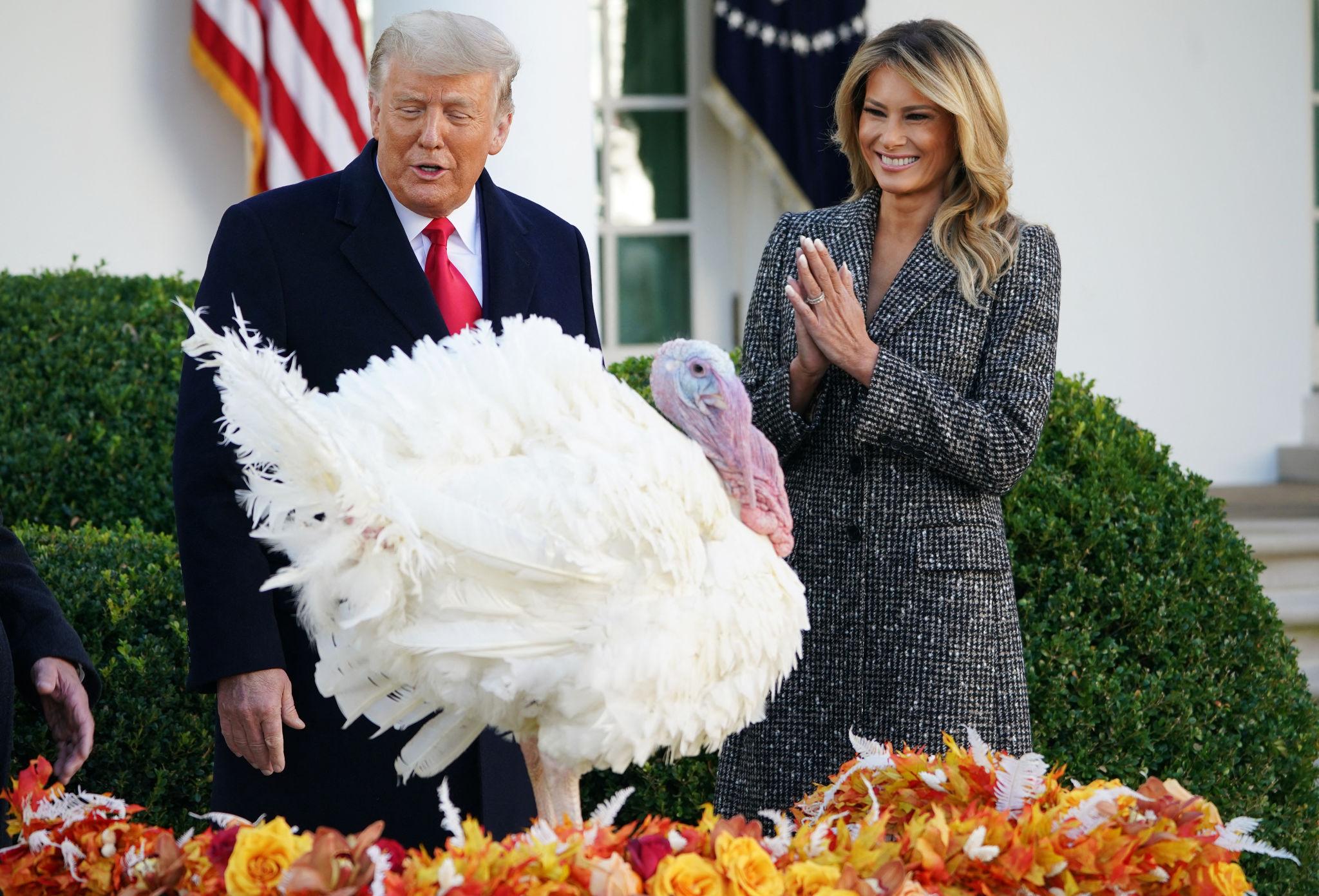
United States President Donald Trump has granted presidential Thanksgiving pardons to two turkeys named Freedom and Feathers during the 79th National Thanksgiving Turkey presentation and pardoning ceremony at the White House. Accompanied by First Lady Melania Trump, the President joked that the birds would live forever following his ceremonial intervention. Freedom was selected through an online public vote to appear before the President, while both turkeys, which were raised in West Virginia, will retire to Texas A&M University. The lighthearted ceremony continues a longstanding American presidential tradition formally established during George H.W. Bush's administration in 1989.
United States President Donald Trump brought a moment of humor to the White House on Tuesday, November 24, 2026, as he granted presidential Thanksgiving pardons to two turkeys named Freedom and Feathers, sparing them from becoming part of America's traditional holiday dinner. Accompanied by First Lady Melania Trump and several members of his administration, the President participated in the annual National Thanksgiving Turkey pardoning ceremony, a longstanding American tradition that provides a lighthearted departure from the serious responsibilities of presidential office. Trump jokingly suggested that the two birds would enjoy immortality as a result of his presidential intervention, drawing amusement from those gathered at the White House. However, the President also found an opportunity to poke fun at the names selected for the turkeys, demonstrating that although Freedom and Feathers had escaped the Thanksgiving dinner table, they were not entirely immune from his characteristic humor.
Invoking his presidential authority in a deliberately exaggerated manner, Trump described the pardons as full and unconditional before joking that the birds would consequently “live forever.” The remarks formed part of a ceremonial presentation that has become one of the most recognizable traditions associated with Thanksgiving at the White House. Although presidential pardons ordinarily carry considerable legal and political significance, the annual turkey pardon is an entirely symbolic exercise intended to entertain the public and celebrate the approaching holiday. For Freedom and Feathers, however, the ceremony has a practical consequence, as both birds will spend the remainder of their lives under the care of agricultural specialists rather than being processed for consumption.
The two turkeys were raised at Deans Gap Farm in Brandywine, West Virginia, by farmers Scott and Becky Rightsell under the direction of National Turkey Federation Chairwoman Christy Puffenbarger. Their journey to Washington represented the culmination of preparations involving agricultural professionals responsible for selecting and caring for the birds presented to the President. According to information published by the White House, both turkeys hatched on July 15, 2026, making them approximately four months old at the time of the ceremony. Freedom weighed approximately 42 pounds, while Feathers weighed 40 pounds, placing them among the substantial domesticated turkeys traditionally associated with America's Thanksgiving celebrations.
Unlike many previous ceremonies, the selection of this year's featured turkey involved direct participation from members of the American public. The White House invited people to vote online to determine which of the two birds would receive the ceremonial spotlight, following an earlier public poll that established their names. Freedom emerged as the preferred candidate and was consequently presented before the President during the ceremony on the White House grounds. Although Feathers did not receive the same individual attention during the formal presentation, both turkeys were included in the presidential pardon and will receive the same opportunity to spend their remaining lives away from the Thanksgiving dinner table.
Before arriving at the White House, Freedom and Feathers enjoyed accommodations at the historic Willard InterContinental Hotel in Washington, where the presentation of presidential turkeys has become an attraction in its own right. Photographs of the birds inside the hotel attracted attention as Americans followed preparations for the ceremony. Their temporary accommodation formed part of a broader tradition in which the selected turkeys are treated as unusually important guests before appearing alongside the President. The contrast between their luxurious surroundings and the conventional fate of Thanksgiving turkeys has become one of the humorous elements associated with the annual celebration.
Following their presidential reprieve, Freedom and Feathers are expected to travel to Texas A&M University, where they will be cared for within the institution's poultry science facilities. The university has an established reputation for agricultural education and research, making it an appropriate destination for birds whose unusual journey has attracted national attention. Their relocation will also provide opportunities for students and members of the agricultural community to learn more about poultry production, animal care and the significance of the turkey industry within American agriculture. Rather than returning to commercial production, the birds will remain at the university for the remainder of their natural lives.
Texas A&M has already announced plans for the turkeys to make a public appearance in its fan zone on Friday, November 27, providing supporters of the university's athletic teams with an opportunity to see the newly pardoned birds. Trump also incorporated the university's sporting identity into his remarks, suggesting that Freedom and Feathers would spend their retirement supporting the Texas A&M Aggies. The reference added a further element of humor to an occasion designed to celebrate American traditions while acknowledging the agricultural communities responsible for producing food consumed during the holiday. For the university, receiving the presidential turkeys provides an opportunity to bring national attention to its agricultural programs and introduce members of the public to its poultry science activities.
The ceremony marked the 79th National Thanksgiving Turkey presentation and pardoning event, according to the White House, although the history of presidential turkey pardons is more complicated than that number might suggest. The modern presentation tradition dates to 1947, during the administration of President Harry Truman, when representatives of the poultry industry began formally presenting Thanksgiving turkeys to the nation's chief executive. Those early presentations did not necessarily guarantee that the birds would be spared, and the practice of granting them an official ceremonial reprieve developed gradually over subsequent administrations. The event eventually evolved from a presentation recognizing American agriculture into an annual occasion associated with presidential humor and public celebration.
Historical accounts maintained by the White House Historical Association trace an earlier example of presidential mercy toward a turkey to the administration of Abraham Lincoln during the 1860s. According to the frequently repeated story, Lincoln's young son Tad became attached to a turkey intended for a Christmas meal and appealed to his father to spare its life. Lincoln reportedly agreed, establishing an early anecdote that would later become associated with the broader history of presidential turkey pardons. However, the incident occurred in connection with Christmas rather than Thanksgiving and did not immediately establish the formal annual ceremony familiar to contemporary Americans.
Other presidents subsequently participated in turkey presentations and occasionally spared the birds from consumption. In 1963, President John F. Kennedy allowed a turkey presented to him to live, only days before his assassination in Dallas, Texas. The incident became another important moment in the historical development of the tradition, although it was not until President George H.W. Bush's administration in 1989 that the formal annual presidential turkey pardon became firmly established. Bush publicly granted a reprieve to the bird presented to him, and his successors continued the practice, transforming it into a recognizable feature of the White House calendar.
Over the years, presidents from both major American political parties have incorporated their own personalities into the ceremony. The names assigned to the turkeys frequently provide material for humorous remarks, while references to current events, presidential responsibilities and popular culture have become common features of the presentations. In 2024, President Joe Biden pardoned two turkeys named Peach and Blossom, continuing the tradition during his final Thanksgiving season in office. Trump subsequently granted pardons to Gobble and Waddle in 2025 before returning this year to spare Freedom and Feathers, demonstrating how the ceremony has maintained its place within American presidential life despite significant changes in political leadership.
The continuing popularity of the turkey pardon reflects the broader cultural significance of Thanksgiving in the United States. Celebrated annually on the fourth Thursday of November, the holiday traditionally brings families and friends together for meals, religious observances, charitable activities and expressions of gratitude. Turkey has become closely associated with the Thanksgiving dinner table, alongside dishes such as stuffing, mashed potatoes, cranberry sauce and pumpkin pie. Although individual households observe the holiday in different ways, the presidential turkey ceremony draws upon the widespread cultural association between Thanksgiving and the preparation of a large shared meal.
Thanksgiving also represents an important commercial period for American farmers, food producers, retailers and hospitality businesses. Poultry farmers play a prominent role in supplying turkeys for holiday celebrations, while grocery stores and other businesses prepare for increased demand across several categories of food and household products. The National Turkey Federation's participation in the White House presentation provides an opportunity to recognize the work of agricultural producers whose contributions might otherwise receive limited attention outside farming communities. By introducing the public to the farms responsible for raising the selected birds, the ceremony connects a national holiday tradition with the agricultural industry supporting it.
Although the presidential presentation is generally regarded as a festive occasion, it has also become a platform through which American presidents occasionally discuss political developments. Trump's remarks on Tuesday extended beyond the fate of Freedom and Feathers, touching on his administration's economic record, ongoing construction projects at the White House and the results of the recent congressional midterm elections. The President expressed frustration over Republican electoral losses while presenting his administration's accomplishments in favorable terms. His assessment of those achievements represents his political position, rather than an independently established conclusion about the condition of the American economy or the performance of his government.
Trump also discussed plans for a new White House ballroom, suggesting that future Thanksgiving turkey ceremonies could be conducted inside the building once construction is completed. His remarks reflected the administration's intention to incorporate the facility into major White House events. However, the proposed location for next year's ceremony remains a future plan rather than a confirmed arrangement, and the actual venue will depend on the progress of construction and subsequent decisions by White House officials. Tuesday's event took place outdoors, preserving the familiar presentation format associated with many previous presidential turkey pardons.
Despite those political references, the ceremony's central attraction remained the unusual sight of a large turkey receiving ceremonial presidential protection. The occasion provided moments of amusement as Trump interacted with Freedom and addressed the audience gathered around the bird's presentation area. The President's exaggerated description of the pardon offered another example of the deliberately playful language frequently employed during these events. While no presidential declaration can extend a turkey's natural lifespan indefinitely, the symbolic promise captured the spirit of a tradition built around granting an unexpected reprieve to animals normally associated with the holiday meal.
For Freedom and Feathers, the immediate result is a journey from their birthplace in West Virginia, through an elaborate presentation in Washington, to a new home in Texas. Their retirement will allow the birds to remain part of public celebrations and educational activities long after the Thanksgiving dinner tables have been cleared. As Americans prepare to celebrate Thanksgiving on Thursday, November 26, the two turkeys have already secured an unusually fortunate place in the country's annual festivities. They may not achieve the immortality promised jokingly by the President, but they will certainly avoid the traditional fate awaiting millions of other Thanksgiving turkeys, ensuring that Freedom and Feathers leave the White House with something considerably more valuable than their moment of national fame.