TRUMP ORDERS FEDERAL EXECUTIONS SPED UP AS NEWSOM EMPTIES CALIFORNIA'S DEATH ROW. TWO MEN, 548 CONDEMNED PRISONERS AND A FIGHT OVER WHO GETS TO DECIDE WHO DIES
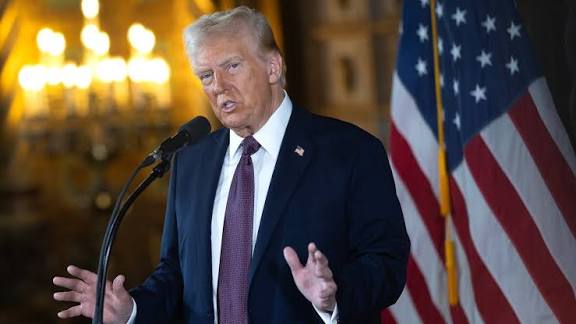
US President Donald Trump has ordered that federal executions be expedited. He used a public event to condemn California Governor Gavin Newsom's decision to commute the death sentences of 548 people, which reportedly covers everyone on the state's death row. Reports say Trump used his platform to attack Newsom directly. Coverage has highlighted that some of the commuted prisoners were convicted of notorious crimes, including the murder of children. The full text of any new written directive has not been widely published, as far as public reporting shows. It is also not yet clear what practical steps the Justice Department will take or how quickly. The federal government's ability to "expedite" executions is limited. Only a handful of people remain on federal death row after President Joe Biden commuted 37 of the 40 federal death sentences in December 2024. Each remaining case still faces court appeals. Newsom's move is the latest step in a campaign he began in 2019, when he declared a moratorium on executions and shut down California's execution chamber. California has not executed anyone since 2006. Commuting the sentences turns that pause into something far harder to reverse. Details of the legal process are still emerging, including how Newsom handled a state constitutional rule that requires California Supreme Court approval for clemency to people with more than one felony conviction. The clash pits the most powerful Republican in the country against a Democrat widely seen as a leading 2028 presidential contender. It also revives one of America's oldest and most bitter arguments. And it echoes debates in Nigeria, where thousands sit on death row without executions being carried out, and Ghana, which has moved to abolish the death penalty for ordinary crimes.
For most of America's history, the question of who should die for their crimes was settled quietly, case by case, in local courtrooms. This week it was settled loudly, from a presidential podium, as a personal fight between two of the most recognizable politicians in the country.
President Donald Trump has ordered that federal executions be expedited. He made the announcement at an event focused on condemning California Governor Gavin Newsom, who has commuted the death sentences of 548 people. That number reportedly covers the entire population of California's death row, once the largest in the Western world. Trump used the moment to attack Newsom directly. Coverage of the event, including reports that framed Newsom's decision as sparing "notorious child killers," made clear that the White House sees this as a fight over public safety, morality and political identity all at once.
The two decisions point in opposite directions. Washington says it wants more executions, faster. Sacramento says it wants none at all. Between them sit hundreds of prisoners, thousands of victims' relatives and a legal system that has never fully agreed on whether the state should kill.
Some care is needed about what is known and what remains unclear.
Reports confirm that Trump ordered federal executions to be expedited and that he condemned Newsom's commutations. What has not been made fully public, as far as available reporting shows, is the exact wording of any new written directive, which officials will carry it out, and what specific steps it requires. Presidents can tell the Justice Department what they want. They cannot order courts to skip appeals, and they cannot override constitutional protections for people facing execution.
On the California side, reports say Newsom commuted 548 death sentences. The precise legal form of the commutations, and how the state handled certain constitutional requirements, have not been fully detailed in public reporting. California's constitution says a governor cannot grant a pardon or commutation to a person convicted of a felony twice without a recommendation from the California Supreme Court, with a majority of the justices agreeing. Many people on death row have prior felony convictions. How Newsom addressed that rule could become the center of legal challenges from prosecutors, victims' families or political opponents.
Then there is the practical question. What can Trump actually speed up?
The answer, for now, is not much, at least in the short term. Federal death row is almost empty. In December 2024, weeks before leaving office, President Joe Biden commuted the sentences of 37 of the 40 people on federal death row to life in prison without the possibility of parole. He left three men facing execution. They are Dzhokhar Tsarnaev, convicted over the 2013 Boston Marathon bombing; Robert Bowers, who murdered 11 worshippers at the Tree of Life synagogue in Pittsburgh in 2018; and Dylann Roof, who killed nine Black churchgoers at the Emanuel AME Church in Charleston, South Carolina, in 2015.
All three cases involve mass killings driven by terrorism or hate. All three remain tied up in appeals and post-conviction challenges. Expediting their executions would mean pressing courts to move faster, defending against legal challenges more aggressively and preparing the federal execution facility in Terre Haute, Indiana. None of that happens overnight.
That is why many legal observers see the order as part of a longer project. Federal prosecutors have been told since early 2025 to seek the death penalty more often. New federal death sentences take years to produce, from indictment to trial to sentencing. And every new death sentence starts its own long march through the appeals courts. An order to "expedite" executions is a signal of intent. Its real effect will be measured over years, not weeks.
The order builds on what Trump did on his first day back in office.
On January 20, 2025, Trump signed an executive order titled "Restoring the Death Penalty and Protecting Public Safety." It directed the attorney general to seek the death penalty in appropriate federal cases, especially for the murder of police officers and for capital crimes committed by people in the country illegally. It instructed the Justice Department to help states obtain enough drugs for lethal injection. It also called on the department to work with state prosecutors to pursue state capital charges against the 37 men whose federal sentences Biden had commuted, where that was legally possible.
Weeks later, Attorney General Pam Bondi lifted the moratorium on federal executions that her predecessor, Merrick Garland, had imposed in 2021. She ordered the Justice Department to review its execution protocols and to move the men whose sentences Biden commuted into the federal supermax prison in Florence, Colorado. In April 2025, Bondi directed prosecutors to seek the death penalty against Luigi Mangione, the man charged with killing UnitedHealthcare executive Brian Thompson in New York. The administration later pushed for capital charges in murder cases in Washington, DC, as part of its broader crime campaign in the capital.
So the new order is not a sudden turn. It is an escalation, timed to a political fight.
To understand why this fight matters so much, it helps to look at how the death penalty in America has risen, fallen and risen again.
Capital punishment arrived with the first European colonists. Executions were public and common in the 18th and 19th centuries, carried out by hanging in town squares. Over time, states moved them behind prison walls and introduced methods that officials claimed were more humane: the electric chair in the 1890s, the gas chamber in the 1920s and lethal injection in the late 1970s.
The modern story begins in 1972. In a case called Furman v. Georgia, the US Supreme Court ruled that the death penalty, as it was then applied, was unconstitutional. The justices did not say executions were always wrong. Several of them said the system was arbitrary. Who lived and who died seemed to depend on chance, geography and race. Death sentences across the country were wiped out.
States rewrote their laws to answer the court's concerns. In 1976, in Gregg v. Georgia, the Supreme Court approved new systems that separated guilt from sentencing and required juries to weigh specific factors. Executions resumed in 1977, when Gary Gilmore faced a firing squad in Utah.
The numbers climbed through the 1980s and 1990s, peaking at 98 executions in 1999. Texas led the nation by a wide margin. Then the system began to shrink. DNA evidence exposed wrongful convictions. Since 1973, more than 190 people sentenced to death in the United States have later been exonerated, according to the Death Penalty Information Center. The Supreme Court barred the execution of people with intellectual disabilities in 2002 and of people who committed their crimes as juveniles in 2005. Drug companies, many based in Europe, refused to supply chemicals for lethal injection. Juries handed down fewer death sentences. Costs soared.
Today, 23 states have abolished the death penalty. Several others, including California until now, have kept it on the books while their governors imposed moratoriums. Yet the practice has not disappeared. In 2025, executions in the United States rose to their highest level in more than a decade, driven heavily by Florida under Governor Ron DeSantis. Alabama and Louisiana used nitrogen gas, a method never used before 2024. South Carolina carried out executions by firing squad. The death penalty in America has become rarer in most places and more aggressive in a few.
The federal death penalty has its own history. After Furman, federal executions stopped for decades. Congress restored capital punishment for some drug-related killings in 1988 and expanded it to dozens of crimes in the Federal Death Penalty Act of 1994. Timothy McVeigh, the Oklahoma City bomber, became the first person executed by the federal government in 38 years when he died in June 2001. Two more federal executions followed, in 2001 and 2003. Then nothing, for 17 years.
That changed in Trump's first term.
In July 2019, Attorney General William Barr announced that the federal government would resume executions, using a single drug, pentobarbital. After legal battles, the first execution took place on July 14, 2020, when Daniel Lewis Lee was put to death in Terre Haute. Over the next six months, the federal government executed 13 people. That was more than in the previous six decades combined. No president in more than a century had overseen so many federal executions.
The pace was striking, and so was the timing. Several executions took place after Trump lost the 2020 election, during the transition to Biden, which broke with a long tradition of restraint during a lame-duck period. Lisa Montgomery, executed on January 13, 2021, was the first woman put to death by the federal government in nearly 70 years. Her lawyers argued she suffered severe mental illness rooted in a lifetime of abuse. Dustin Higgs was executed on January 16, four days before Biden took office. Critics also raised concerns that executions during the COVID-19 pandemic put prison staff, lawyers and spiritual advisers at risk.
Supporters of the policy saw it differently. To them, the executions honored the law, delivered justice to victims' families and ended years of delay. Many of those executed had been convicted of horrifying crimes, including the murder of children.
Biden, who campaigned on ending the federal death penalty, did not ask Congress to abolish it. Instead, his attorney general paused executions and Biden used his clemency power at the end of his term. Trump attacked those commutations at the time. His new order, and his attack on Newsom, continue the same argument.
California's road to this moment has been long.
The state has carried out executions since the 19th century. In 1972, months before Furman, the California Supreme Court struck down the state's death penalty. Voters restored it that same year through Proposition 17. A new death penalty law followed in 1977, and in 1978 voters expanded it with a ballot measure known as the Briggs Initiative.
Over the following decades, California juries sent hundreds of people to death row. But the state executed very few. Since 1978, California has carried out only 13 executions. The last was Clarence Ray Allen in January 2006. Legal battles over the state's lethal injection procedures then halted executions entirely.
The gap between sentences and executions created a strange system. California's death row grew to more than 700 people, the largest in the Western Hemisphere. Most of those condemned were far more likely to die of old age, illness or suicide than by execution. Studies estimated that the system cost the state billions of dollars more than life imprisonment would have, largely because of the long and complex appeals that death cases require.
Californians have voted on the issue repeatedly. In 2012, Proposition 34, which would have replaced the death penalty with life without parole, failed narrowly. In 2016, voters rejected another repeal measure, Proposition 62, and narrowly approved Proposition 66, which aimed to speed up executions by limiting appeals. Even after that vote, executions did not resume.
Newsom took office in January 2019. Two months later, he signed an executive order placing a moratorium on executions. He withdrew the state's lethal injection protocol and closed the execution chamber at San Quentin State Prison. "I will not oversee the execution of any individual," he said at the time, calling the death penalty a "failure" that was discriminatory and irreversible.
In 2022, the state began moving people off death row and into general prison populations at other facilities. By 2024, San Quentin's death row had been emptied. Prosecutors in some counties, including Santa Clara and Los Angeles, asked courts to resentence people on death row to life without parole, citing concerns about racial bias and the fairness of old trials. As those cases moved forward, California's condemned population shrank, falling to the 548 people now covered by the commutations.
Commutation is a different kind of decision from a moratorium. A moratorium is a pause. The next governor can lift it. A commutation changes the sentence itself. Once a death sentence becomes life without parole, a future governor generally cannot turn it back into a death sentence. That is why Newsom's decision matters so much, and why his critics are so angry.
The timing adds to the controversy. Newsom is term-limited. His successor will take office in January 2027. Commuting the sentences now locks in his policy before he leaves. Supporters call it a final act of conscience. Critics call it a lame-duck move designed to override the will of voters who rejected abolition twice.
Many victims' families have reacted with fury. For them, a death sentence was a promise from the state that justice would be done. Some waited decades for an execution that never came. Others had made peace with the delay but believed the sentence itself carried meaning. Commutation, in their eyes, breaks that promise.
Among those who have sat on California's death row in recent years are some of the most infamous killers in modern American history. They include Richard Allen Davis, who kidnapped 12-year-old Polly Klaas from her bedroom in Petaluma in 1993 and murdered her, a crime that helped drive California's "three strikes" law. They include Cary Stayner, who murdered four women near Yosemite National Park in 1999, and Charles Ng, convicted of a series of murders in the 1980s. If the commutations cover the entire condemned population, as reported, people in cases like these would now serve life without parole rather than face a death sentence. Those case details help explain why critics have seized on the phrase "child killers" to frame Newsom's decision.
Supporters of the commutations respond with other facts. Life without parole in California means exactly that. No one covered by the decision will walk free. They point to the exonerations, the racial disparities in who gets sentenced to death and the billions spent on a system that rarely produced executions. They also argue that leaving people on death row for decades, with no realistic prospect of execution, serves no one, least of all victims' families stuck in endless legal hearings.
There is also a question that has not been answered in full public detail. Will the commutations hold up? California's constitutional limit on clemency for people with more than one felony conviction means the state Supreme Court may have a role. Prosecutors or victims' groups may go to court. If challenges succeed, some commutations could be delayed or blocked. As far as public reporting shows, the legal mechanics of the decision are still being examined.
Trump cannot overturn Newsom's commutations. That is the core of the federal-state divide.
In the American system, most crimes are prosecuted by states. Murder is usually a state crime. The people on California's death row were convicted under California law, in California courts. Only California's governor can grant clemency for state crimes. The president's pardon and commutation powers apply only to federal offenses.
The federal government has its own death penalty, covering crimes such as terrorism, killings of federal officers, certain drug-related murders and some killings that cross state lines. Federal prosecutors can sometimes bring federal charges for conduct that also violated state law, under a legal principle that allows both governments to prosecute the same act. But that requires a federal crime, a new prosecution and a new trial. It cannot simply restore a commuted state death sentence.
That limit is where the political theater and the legal reality separate. Trump can condemn Newsom. He can order federal prosecutors to seek death sentences more often. He can push the Justice Department to look for federal charges in some cases. He cannot reach into California's prisons and reverse the governor's decision.
The divide also exposes a tension in how both parties talk about power. Republicans have long defended states' rights, including the right of states like Texas and Florida to carry out executions without federal interference. Democrats have often argued for federal protection of civil rights against state action. On the death penalty, the positions are mixed. Trump is criticizing a state's use of its own authority. Newsom is defending it. Each side's argument on federalism tends to follow its position on the issue at hand.
And this fight is unmistakably political.
Trump and Newsom have clashed for years. In Trump's first term, they fought over wildfires, immigration, environmental rules and the pandemic. In 2025, the conflict became more intense. Trump sent National Guard troops into Los Angeles over Newsom's objections during protests over immigration raids. California sued. Newsom's office ran a social media campaign mocking the president in his own style. Later that year, Newsom led a successful push for California's Proposition 50, which redrew the state's congressional map in response to Republican redistricting in Texas.
Newsom is widely seen as a leading Democratic contender for the 2028 presidential election. He has built a national profile, toured early primary states and positioned himself as one of Trump's most aggressive opponents. Trump, for his part, is barred by the 22nd Amendment from seeking a third term, though he has at times hinted otherwise. The real 2028 contest may be between Newsom, or another Democrat, and a Republican successor such as Vice President JD Vance. But Trump remains the center of gravity in Republican politics. A fight with Trump is, in effect, a fight with the movement Newsom would have to defeat.
Crime is fertile ground for that battle. Republicans have long attacked Democrats as soft on crime. The death penalty is an emotional symbol of that argument. Attacking Newsom for sparing convicted child killers gives Trump a powerful message that is easy to understand and hard to answer in a short soundbite.
Newsom's political calculation is more complex. National polling shows support for the death penalty has declined from its peak in the 1990s. Gallup has found support for capital punishment for murder at around half of Americans in recent years, the lowest levels in decades. Among Democrats, support is far lower. For a candidate who needs to win Democratic primaries, a firm stand against executions is an asset. In a general election, it carries risk. Previous Democrats have learned that lesson painfully. In 1988, Michael Dukakis's answer to a debate question about whether he would support the death penalty if his own wife were raped and murdered was widely seen as damaging to his campaign.
Newsom has chosen to make the issue part of his legacy rather than avoid it. That choice tells voters where he stands. It also gives his opponents a ready-made attack line for the next three years.
Beyond US politics, the order and the commutations place the United States in an awkward position internationally.
Most of the world has moved away from capital punishment. According to Amnesty International, more than two-thirds of the world's countries have abolished the death penalty in law or in practice. The United States is the only country in the Americas to have carried out executions in recent years. Among democracies, it stands alongside a small group that still executes, including Japan.
Amnesty's recent reports have recorded a sharp rise in global executions, driven mostly by Iran and Saudi Arabia. China is believed to execute more people than any other country, though it keeps the figures secret. The United States regularly appears among the world's top executing nations in those reports. Human rights groups, the European Union and the United Nations have long urged Washington to end capital punishment. The UN General Assembly has repeatedly passed resolutions calling for a global moratorium on executions.
A presidential order to expedite executions runs against that trend. It is likely to draw criticism from European allies and human rights groups. It may also complicate extradition cases. Many countries refuse to send suspects to the United States unless prosecutors promise not to seek death. That practice is long-standing, and a push for more federal death sentences could make such cases harder to negotiate.
For readers in Nigeria and Ghana, the debate may feel distant. It is not. Both countries are wrestling with the same questions, in their own way.
Nigeria still has the death penalty. It applies to crimes such as murder, armed robbery, treason and, in several states, kidnapping. In the 12 northern states with Sharia penal codes, some offenses can carry death sentences under Islamic law. Yet Nigeria rarely executes anyone. The last known executions took place in December 2016, when three men were hanged in Benin City, Edo State. Human rights groups estimate that more than 3,000 people are on death row in Nigeria, one of the largest condemned populations in the world.
The reason for the gap is partly political. In most cases, Nigerian state governors must sign death warrants before executions can be carried out. Many have refused. Some cite religious beliefs. Others worry about wrongful convictions in a justice system that critics say relies too heavily on confessions, some allegedly obtained under torture. Others simply avoid the decision.
That leaves Nigeria in a situation similar to California's before this week. Thousands of people sit under sentences that are almost never carried out. Prisons are overcrowded. Many inmates on death row have waited years, even decades. Some say they were convicted unfairly. Their families live in limbo, as do the families of victims who were promised justice.
Nigeria has also seen intense public debate over clemency. In 2025, a presidential list of people granted mercy drew backlash after it emerged that it included individuals convicted of serious crimes, including a woman sentenced to death for killing her husband. The government said the list would be reviewed. The controversy showed how emotional clemency decisions can be, and how quickly they can become political, much as Newsom's decision has in the United States.
Lawmakers in Nigeria have, at times, pushed in the opposite direction. In 2024, the Senate approved a proposal to make drug trafficking punishable by death, a move that drew criticism from lawyers and rights groups and did not become settled law. Some states have expanded death penalty laws for kidnapping and other violent crimes in response to insecurity. Supporters argue that harsh punishments deter crime. Critics point out that executions are not carried out, so the threat rings hollow, and that the real problem is the failure to catch and convict offenders in the first place.
Ghana has taken a different path.
Ghana has not executed anyone since 1993. In July 2023, Parliament voted to remove the death penalty for ordinary crimes from the Criminal Offences Act and the Armed Forces Act, replacing it with life imprisonment. Rights groups hailed the vote as a major step. However, the 1992 Constitution still lists high treason as a capital offense. Because that provision is entrenched, removing it would require a national referendum. Ghana's death row population has been far smaller than Nigeria's, and the country has moved steadily toward full abolition.
Ghana's approach reflects a wider trend across Africa. In recent years, Sierra Leone, Chad, the Central African Republic, Zambia and Zimbabwe have abolished the death penalty. Kenya has not carried out an execution since 1987. Many African governments now argue that capital punishment does not fit with modern human rights commitments or with justice systems that can make mistakes. Others, including Nigeria, Egypt and Somalia, keep it, and some still carry out executions.
The American clash offers lessons for both countries.
The first lesson is about the cost of uncertainty. California held hundreds of people under death sentences for decades without carrying them out. Nigeria is doing the same with thousands. That gap between sentence and action creates a system that satisfies almost no one. It does not deliver the finality that supporters want. It does not deliver the mercy that opponents want. It costs money, clogs courts and leaves families in limbo.
The second lesson is about wrongful convictions. The United States, with its well-funded courts and DNA testing, has exonerated more than 190 people who had been sentenced to death. Nigeria's and Ghana's justice systems face far greater challenges in forensic science, legal aid and police investigation. If wealthy American courts can get it wrong that often, the risk of error elsewhere is real.
The third lesson is about politics. The Trump-Newsom fight shows how easily the death penalty becomes a symbol, used to signal toughness or compassion. In Nigeria, where insecurity from kidnapping, banditry and terrorism is a daily concern, politicians face strong pressure to appear tough. Calls to execute kidnappers or terrorists can be popular. But tough words do not stop crime if offenders are not caught, tried fairly and convicted.
The fourth lesson is about who decides. In the United States, governors and presidents each hold clemency power within their own systems. In Nigeria, governors and the president share a similar split, and both have used mercy powers in controversial ways. Clear, transparent rules for clemency can help prevent abuse. Secrecy breeds suspicion.
There is also a fifth lesson, one that cuts in more than one direction. Many Nigerians and Ghanaians support the death penalty for the worst crimes, especially those involving children, terrorism and mass killings. That view is shared by many Americans. Opposition to the death penalty is not the only principled position. Victims' families who want executions are not simply seeking revenge. They are asking the state to treat the worst crimes with the seriousness they deserve. Any honest debate, in Abuja, Accra or Washington, has to take that view seriously too.
What happens next will depend on several developments.
The first is the detail of Trump's order. If the Justice Department publishes specific instructions, such as new timelines for federal cases, changes to execution protocols or plans to pursue federal charges in cases once handled by states, the order's real reach will become clearer.
The second is the federal death row cases. Watch for movement in the appeals of Tsarnaev, Bowers and Roof, and for any scheduling of execution dates. Any date set would face immediate legal challenges.
The third is the legal response in California. Prosecutors, victims' families or political groups may challenge the commutations, especially around the requirement for California Supreme Court approval in cases involving people with prior felony convictions. Court rulings could test how far a governor's clemency power reaches.
The fourth is the next California governor. Newsom's successor will take office in January 2027. The commutations, if they stand, cannot easily be reversed. But a new governor could change how the state handles future death sentences, if prosecutors continue to seek them and juries continue to impose them.
The fifth is the 2028 campaign. Expect the death penalty, and this week's fight, to reappear in ads, debates and speeches. Newsom's critics will use the commutations against him. His supporters will frame the decision as courage. Republicans will try to make crime a central issue. Democrats will try to talk about wrongful convictions, cost and fairness.
For now, the facts that can be stated are these. President Donald Trump has ordered that federal executions be expedited, condemning California Governor Gavin Newsom for commuting the death sentences of 548 people. The full text and practical steps of Trump's order have not been widely published. Only three people remain on federal death row after Biden's December 2024 commutations, and their cases face ongoing appeals. Newsom's commutations follow his 2019 moratorium and the dismantling of San Quentin's death row. California has not executed anyone since 2006. Legal questions about the commutations, including the role of the state Supreme Court in some cases, have not been fully resolved in public reporting.
Two men, each convinced he is defending justice, have taken opposite sides on the oldest question a state can ask: whether it should take a life. One wants the federal machinery of death to move faster. The other has shut his state's machinery down. Their fight will shape American politics for years. Far from Washington and Sacramento, in crowded prisons in Nigeria and in a Ghana edging toward full abolition, the same question is waiting for an answer. Every country that keeps the death penalty must eventually decide whether it means to use it, and whether it can live with the mistakes it will make if it does.