UGANDA’S RULING PARTY RESISTS MUSEVENI’S PLAN TO POSITION SON MUHOOZI AS SUCCESSOR
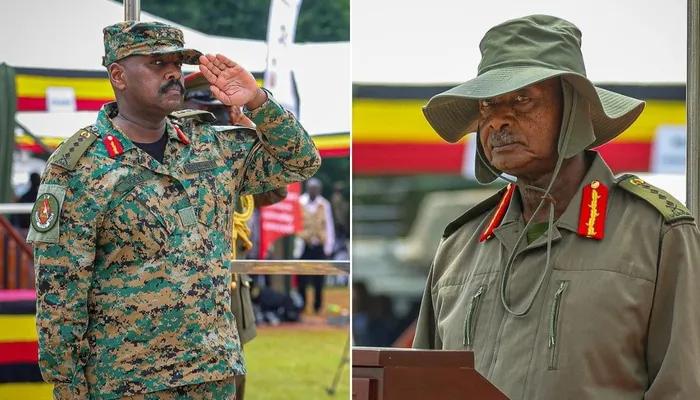
Senior figures in Uganda’s ruling National Resistance Movement have reportedly resisted President Yoweri Museveni’s effort to position his son, army chief General Muhoozi Kainerugaba, as his eventual successor. A vote at a November 10 Central Executive Committee meeting was reportedly abandoned after members raised objections, but the NRM has not issued a formal public decision rejecting Muhoozi, and other reports indicate he still has substantial support inside the party.
Uganda’s ruling National Resistance Movement is facing an unusually open succession dispute after senior party figures reportedly resisted President Yoweri Museveni’s effort to position his son, General Muhoozi Kainerugaba, as a possible successor in the 2031 presidential election. The disagreement emerged during a closed door meeting of the NRM Central Executive Committee, where members were asked to consider Muhoozi’s suitability to eventually replace his father after four decades of Museveni’s rule. According to several officials who attended the meeting and later spoke to international media, the debate became so contentious that a proposed vote on Muhoozi’s candidacy was abandoned before all members had cast their ballots.
The reported resistance is politically significant because Museveni has dominated both Uganda and the NRM since taking power in 1986, and major decisions inside the ruling party have rarely been associated with visible opposition to his preferences. The succession debate therefore represents more than a disagreement over one candidate. It has become a test of how much influence Museveni still exercises over senior party officials and whether the NRM is prepared to accept a transfer of power that critics could interpret as a family succession.
General Muhoozi Kainerugaba, 52, currently serves as Uganda’s Chief of Defence Forces and has become one of the most powerful figures in the country’s military and political establishment. He has publicly stated that he intends to contest the presidency in 2031 and has built a growing political network around the Patriotic League of Uganda, a movement that has organised nationwide mobilisation and endorsement campaigns promoting his leadership ambitions. Supporters present him as a younger figure capable of preserving political stability and continuing the core agenda of the NRM after Museveni eventually leaves office.
The latest controversy began after Museveni formally raised the question of succession with senior NRM leaders in late October. In a discussion paper circulated to members of the Central Executive Committee, the president reportedly acknowledged the growing campaign for Muhoozi to succeed him and invited party leaders to examine whether his son possessed the qualities required to lead Uganda. Museveni is reported to have highlighted Muhoozi’s military experience, patriotism, Pan African credentials and anti corruption positions while also telling committee members to consider the issue openly rather than simply accept a predetermined conclusion.
That paper was important because Museveni has historically avoided naming a successor despite years of speculation that Muhoozi was being prepared for the presidency. The president’s decision to place the matter before the party therefore marked a major shift, moving the succession debate from informal speculation into a structured discussion involving the NRM’s most senior officials. For Muhoozi’s supporters, it appeared to confirm that his long discussed presidential ambitions had finally received serious consideration at the highest level of the ruling party.
However, the process did not produce the smooth endorsement some of his allies had expected. According to five NRM officials quoted by AFP, several members objected during the November 10 meeting and received loud support from other participants. The sources said four members had voted in favour of Muhoozi and three against when the exercise was suspended, preventing the committee from reaching a final decision. That account has been widely reported across East African and international media, although the NRM itself has not issued a formal public statement confirming that Muhoozi was officially rejected.
That distinction is important because the internal party picture remains contested. Separate Ugandan reporting indicates that several senior officials spoke positively about Muhoozi during the same meeting and argued that he represented the strongest option for a stable transition after Museveni. Some supporters cited his leadership of the military, his anti corruption rhetoric and the grassroots activities of the Patriotic League of Uganda as evidence that he could inherit the ruling party’s political machinery and maintain continuity.
The disagreement therefore appears to be less a final rejection than an unresolved struggle over whether Muhoozi is ready to become the NRM’s next presidential candidate. Some senior party figures reportedly believe that his current position as army chief has given him influence but not enough direct experience in civilian politics. They have argued that before seeking the presidency, he should first leave military command, take up a civilian role and spend more time building relationships with ordinary voters and party structures.
NRM vice chairman Calvin Echodu was among those reported to have expressed reservations. According to accounts from people present, Echodu advised Museveni to remove Muhoozi from active military leadership and place him in a civilian position that would allow him to gain broader political experience before being considered for the presidency. He was also reported to have suggested that Museveni himself should contest again in 2031 because Muhoozi was not yet sufficiently prepared to take over.
Those comments have not been independently confirmed by Echodu in a formal public statement, but they illustrate the type of concern reportedly being raised inside the party. Some NRM officials appear worried that Muhoozi’s rapid transition from military commander to presidential candidate could create political and institutional difficulties, particularly because Uganda’s constitution requires the military to remain non partisan and active duty officers are restricted from conventional political activity.
Muhoozi’s supporters argue that his military career is one of his strongest qualifications because it has given him command experience and responsibility for national security. Critics within and outside the NRM, however, say his continued political mobilisation while serving as the country’s highest ranking military officer blurs the line between the armed forces and partisan politics. That issue is likely to become increasingly important if he formally prepares for a 2031 presidential campaign.
His social media conduct has become another major source of concern. Muhoozi has repeatedly used X to make provocative statements about political opponents, regional governments and senior Ugandan officials, sometimes issuing threats that have forced the government or military to clarify whether his remarks represented official policy. In recent days, he drew fresh controversy after threatening Vice President Jessica Alupo with arrest over allegations that she was connected to a supposed plan against the government.
He has also previously made inflammatory statements about opposition leader Bobi Wine and other critics, contributing to concerns among some NRM officials that his style could damage the party’s ability to build a broad national coalition. According to one source who attended the succession meeting, the general’s combative behaviour has created unease among senior party figures who believe a future president must demonstrate greater political restraint and an ability to win support beyond the military and his existing loyalists.
Supporters of Muhoozi reject the suggestion that his social media presence should disqualify him from leadership. They argue that his direct style appeals to younger Ugandans and distinguishes him from conventional politicians. The Patriotic League of Uganda has continued organising mobilisation campaigns despite the latest reports and has denied that the NRM has definitively rejected Muhoozi’s presidential ambitions.
The PLU’s response is significant because the organisation has become the central political vehicle for Muhoozi’s supporters. Senior members have repeatedly said he intends to contest the presidency in 2031 and have encouraged local endorsement campaigns across the country. Some PLU officials previously claimed that Museveni had already endorsed his son during the October meeting, although other NRM leaders disputed that interpretation and insisted no formal party nomination had taken place.
Muhoozi himself later instructed PLU leaders to stop publicly discussing confidential remarks allegedly made by Museveni during the Central Executive Committee meeting, while allowing grassroots political mobilisation to continue. That intervention suggested that the succession debate had become sensitive enough for the general to try to control public messaging around it.
The latest NRM meeting therefore appears to have exposed a divide between those who see Muhoozi as the natural continuation of Museveni’s political project and those who believe the party should avoid automatically transferring leadership within the president’s family. The dispute also raises broader questions about how the NRM will select its first new national leader in decades and whether the transition can occur without destabilising the political system Museveni has built.
Museveni, now 82, has ruled Uganda for approximately four decades and remains the dominant figure in the country’s political system. He came to power in 1986 after leading the National Resistance Army in a guerrilla war and subsequently transformed the movement into the NRM, which has remained in power ever since. Constitutional changes during his presidency removed both presidential term limits and the age ceiling, allowing him to continue contesting elections well beyond the limits that once would have prevented another candidacy.
The possibility that he could seek another term in 2031 therefore remains constitutionally possible. Some NRM officials reportedly favour that option because they believe the party is not yet ready to agree on a successor and that Museveni remains the only figure capable of keeping its competing factions together. Others believe another candidacy would simply postpone an unavoidable transition and deepen uncertainty about what happens when he eventually leaves office.
Museveni’s own discussion paper reportedly reflected awareness of that problem. Rather than simply declaring Muhoozi his successor, he asked party leaders to consider the qualities required in a future president and assess candidates against the NRM’s ideological principles. That approach could be interpreted as an effort to legitimise a succession process while still making the case that his son deserves consideration.
One passage attributed to the president said that as Muhoozi’s father and as the person who encouraged him to join the military, Museveni believed his son performed strongly against many of the criteria the party should consider. That wording stops short of a formal nomination but clearly signals that Museveni views Muhoozi as a credible candidate for the presidency.
The reported pushback therefore matters because it demonstrates that at least some party leaders are unwilling to treat the president’s preference as automatic. Even if Muhoozi ultimately receives the NRM ticket, the succession debate has exposed concerns that could shape how the party manages his transition from the military to civilian politics.
The dispute also reflects tension between the NRM’s long standing institutional identity and the increasingly personal nature of the succession question. Museveni built the party around a revolutionary movement that presents itself as broader than any individual leader, yet the absence of an established succession mechanism has allowed speculation to grow that power could eventually move directly from father to son.
Critics of Muhoozi have described that possibility as an attempt to create a political dynasty, while his supporters reject that characterization and say he has the same constitutional right as any other Ugandan citizen to seek the presidency. They argue that his family relationship with Museveni should not automatically disqualify him if he can secure party support and win a national election.
That debate is likely to become increasingly intense because Muhoozi’s political ambitions are no longer hypothetical. He has publicly said he intends to contest in 2031, and his supporters are already building structures designed to promote that campaign. The question is now whether those structures will eventually be absorbed into the NRM or continue operating as a separate political mobilisation network.
The Patriotic League of Uganda has so far described itself as a civic movement rather than a conventional political party, allowing Muhoozi to maintain a political support base while serving as army chief. However, a formal presidential campaign would likely require a clearer relationship with the NRM or another registered political organisation. That transition could create additional disputes over party positions, candidate selection and control of grassroots structures.
Opposition leaders are also watching the succession battle closely. Bobi Wine and the National Unity Platform have repeatedly accused Museveni of trying to create a family dynasty and have criticised Muhoozi’s role in national politics while commanding the military. The government rejects those claims and insists that Uganda’s political leadership will be determined through elections and constitutional processes.
The NRM’s internal disagreement could nevertheless affect opposition strategy because a contested succession may weaken the ruling party’s ability to present a unified presidential candidate. Conversely, a prolonged debate could eventually strengthen the party if it leads to an orderly process that resolves tensions well before the election.
The military dimension remains particularly sensitive. Muhoozi’s position as Chief of Defence Forces gives him enormous institutional authority, and Uganda’s armed forces have historically played a central role in the country’s political stability. Any presidential transition involving the sitting army commander will therefore attract close scrutiny over whether the military remains neutral or becomes identified with one political faction.
Museveni himself has spent much of his political career emphasising the importance of a disciplined military subordinate to national institutions. Critics argue that allowing his son to combine military leadership with an increasingly visible political campaign undermines that principle. Supporters respond that Muhoozi has not yet formally entered an election and remains focused primarily on his defence responsibilities.
The NRM will eventually have to address that contradiction if it moves closer to selecting him as its candidate. One option reportedly discussed by party officials is for Muhoozi to retire from military service well before the 2031 election and spend several years in civilian politics. That would allow him to build a conventional political profile, campaign openly and demonstrate whether he can attract support beyond the security establishment.
Such a transition would also provide a clearer test of his popularity. The PLU has organised large public events and endorsement activities, but those gatherings do not necessarily provide the same evidence as a competitive party primary or national election. Some NRM leaders reportedly want Muhoozi to prove that he can persuade voters rather than rely on his father’s influence or military authority.
The succession debate may also involve other potential NRM figures, although no alternative has yet emerged with comparable national visibility. Senior politicians, cabinet ministers and regional party leaders could eventually seek the nomination if Museveni opens the process more broadly. That possibility may partly explain why some officials are resisting an early decision in favour of Muhoozi.
By delaying a final endorsement, the party preserves leverage for competing factions and gives potential candidates more time to build support. For Museveni, however, prolonged uncertainty carries its own risks because rival groups may become more entrenched and the eventual transition could become harder to manage.
The latest meeting illustrates that dilemma. An early attempt to build consensus around Muhoozi appears to have encountered resistance, but abandoning the discussion entirely would leave the succession question unresolved. Museveni has reportedly indicated that the Central Executive Committee will meet again to continue deliberations, meaning the issue is likely to remain active rather than disappear.
Reports that only seven of 28 members had voted before the process was halted should also be interpreted cautiously. The partial vote does not establish whether Muhoozi would have won or lost if all members had participated, and different sources have provided different accounts of the overall balance inside the room. Some reporting describes widespread resistance, while other Ugandan outlets say a majority of members who spoke supported him.
That inconsistency is one reason the story should not be presented as a completed formal rejection. The strongest verified conclusion is that Museveni’s reported succession plan encountered significant resistance inside the NRM and that no final endorsement of Muhoozi has been publicly confirmed.
The Patriotic League of Uganda has moved quickly to challenge reports suggesting that the army chief has been politically defeated. Its officials maintain that Muhoozi still enjoys significant support within the NRM and say mobilisation for his 2031 candidacy will continue. The group argues that the party’s internal discussions remain unfinished and that media descriptions of a rejection are premature.
That response underscores how politically sensitive the language around the succession has become. Declaring Muhoozi “rejected” could influence supporters, rivals and party officials before the NRM itself has formally announced a position. For that reason, the current dispute is better understood as resistance to his proposed succession rather than a final institutional decision blocking his candidacy.
Museveni also retains substantial influence over whatever happens next. Even where party officials disagree with him, his authority within the NRM remains unmatched after four decades at the centre of the organisation. His eventual decision on whether to retire, run again or publicly support Muhoozi will heavily shape the options available to the party.
The president may choose to continue testing opinion before making a final commitment. By allowing senior officials to debate Muhoozi openly, he can identify sources of resistance and determine what political work would be required to build broader support. He can also evaluate whether his son’s current public image creates problems that need to be addressed before any formal succession.
For Muhoozi, the latest developments may increase pressure to change his political style. If concerns about provocative statements and coercive rhetoric are genuinely influencing senior NRM leaders, he may need to demonstrate a more restrained and civilian approach if he wants to broaden his support within the party. Continuing to rely heavily on military identity and confrontational social media messaging could strengthen critics who argue that he is not yet ready for national political leadership.
The succession issue is also likely to affect Uganda’s international relationships. Governments in East Africa, Europe and North America have worked with Museveni for decades and will pay close attention to any indication of who may eventually replace him. A smooth, constitutional transition would provide continuity, while a disputed succession involving the military could create uncertainty across the region.
Uganda plays a major security role in East Africa, including peacekeeping and counterterrorism operations in Somalia and cooperation with neighbouring countries. The country’s political stability therefore matters beyond its borders, particularly because the Ugandan military remains one of the region’s most influential armed forces.
Muhoozi has also cultivated relationships with regional leaders and has used social media to comment on political developments in neighbouring states. Some of those interventions have generated diplomatic controversy, including remarks about Kenya and other countries. Supporters describe his regional relationships as an asset, while critics see them as another example of an unpredictable political style.
The NRM’s eventual succession decision will therefore be judged not only on internal party calculations but also on whether the chosen candidate can preserve Uganda’s regional influence and domestic stability. Senior officials who have spent decades working under Museveni may be reluctant to endorse a successor they believe could create unnecessary conflict at home or abroad.
At the same time, the party cannot postpone generational change indefinitely. Many of the political and military figures who established the NRM during the guerrilla struggle are now elderly, and younger Ugandans increasingly dominate the electorate. The 2031 election may therefore become a major turning point regardless of whether Museveni contests again.
Muhoozi’s supporters argue that he represents that generational transition while preserving ideological continuity with the movement founded by his father. Critics counter that genuine generational change should involve an open competition rather than an inheritance of power within one family.
That debate will continue to shape Ugandan politics in the years ahead. The latest NRM meeting has shown that the question can no longer be managed entirely through speculation or private discussions because senior party figures are beginning to take public positions and competing factions are already mobilising.
The immediate outcome remains unresolved. There is no publicly announced NRM decision naming Muhoozi as its 2031 candidate, but there is also no formal party resolution permanently rejecting him. What has emerged is clear evidence that his proposed succession is contested inside the ruling party and that Museveni cannot simply assume unanimous support for a father to son political transition.
That in itself is a major development after four decades of highly centralised leadership. The NRM is now being forced to confront a question it has avoided for years: what happens when Yoweri Museveni is no longer its presidential candidate.
Whether the answer eventually becomes Muhoozi Kainerugaba, another NRM politician or Museveni himself seeking yet another term will depend on further negotiations inside the party. The November meeting suggests that those negotiations will be more difficult and politically consequential than the president and his son’s supporters may have expected.