UK IMPORTS £1.02BN IN REFINED FUEL FROM NIGERIA AS DANGOTE RESHAPES ENERGY TRADE
The UK government’s latest Nigeria Trade and Investment Factsheet confirms that Britain imported £1.0173 billion in refined oil from Nigeria in the 12 months ending June 2026, representing 53.5% of all UK merchandise imports from Nigeria. The value rose by more than 100% compared with the preceding 12-month period, making refined petroleum the largest British goods import from Nigeria.
LONDON/LAGOS — The United Kingdom imported more than £1 billion worth of refined petroleum products from Nigeria in the 12 months ending June 2026, a dramatic increase that has pushed processed fuel ahead of crude oil as Britain’s largest merchandise import from Africa’s most populous country and provided some of the clearest evidence yet that Nigeria’s long-standing petroleum trade model is beginning to change. Official UK government figures show refined-oil imports from Nigeria reached £1.017 billion during the period, accounting for 53.5 percent of all British goods imports from Nigeria and rising by more than 100 percent from the preceding 12 months, while the value of Nigerian crude oil imported into Britain fell by 56.2 percent to £550.3 million.
The reversal is particularly significant for a country that spent decades exporting crude oil while simultaneously importing enormous volumes of petrol, diesel, aviation fuel and other petroleum products because its domestic refineries were unable to meet national demand. Nigeria remains heavily dependent on hydrocarbons for export earnings, but the new British trade figures indicate that an increasing share of the value now comes from refined products rather than raw crude, coinciding with the rapid rise of the Dangote Petroleum Refinery outside Lagos and a wider expansion in Nigeria’s fuel-export capacity.
The UK government’s latest Trade and Investment Factsheet for Nigeria, updated on November 6 using Office for National Statistics data, shows that Britain imported approximately £1.9 billion in goods from Nigeria during the four quarters ending in the second quarter of 2026. Refined oil alone accounted for more than half of that figure. Crude oil represented another 28.9 percent, meaning those two petroleum categories together were worth approximately £1.57 billion and accounted for more than four-fifths of all British merchandise imports from Nigeria.
Gas remained Nigeria’s third-largest goods export to Britain at £179.5 million, representing 9.4 percent of merchandise imports and increasing by 7 percent from the previous period. Coffee, tea, cocoa and related products accounted for £40.3 million, more than doubling year on year, while beverages and tobacco contributed approximately £30 million, up 24.2 percent. The growth in those smaller categories demonstrates some expansion beyond hydrocarbons, but petroleum continues to dominate the commercial relationship by an overwhelming margin.
The most striking change is therefore not a broad diversification away from energy but a transformation within the petroleum sector itself. Britain bought substantially less Nigerian crude while purchasing dramatically more refined Nigerian fuel. Refined-oil imports were about £467 million higher than crude-oil imports during the period and were approximately 85 percent greater in value, reversing a trade structure in which crude had historically occupied the stronger position.
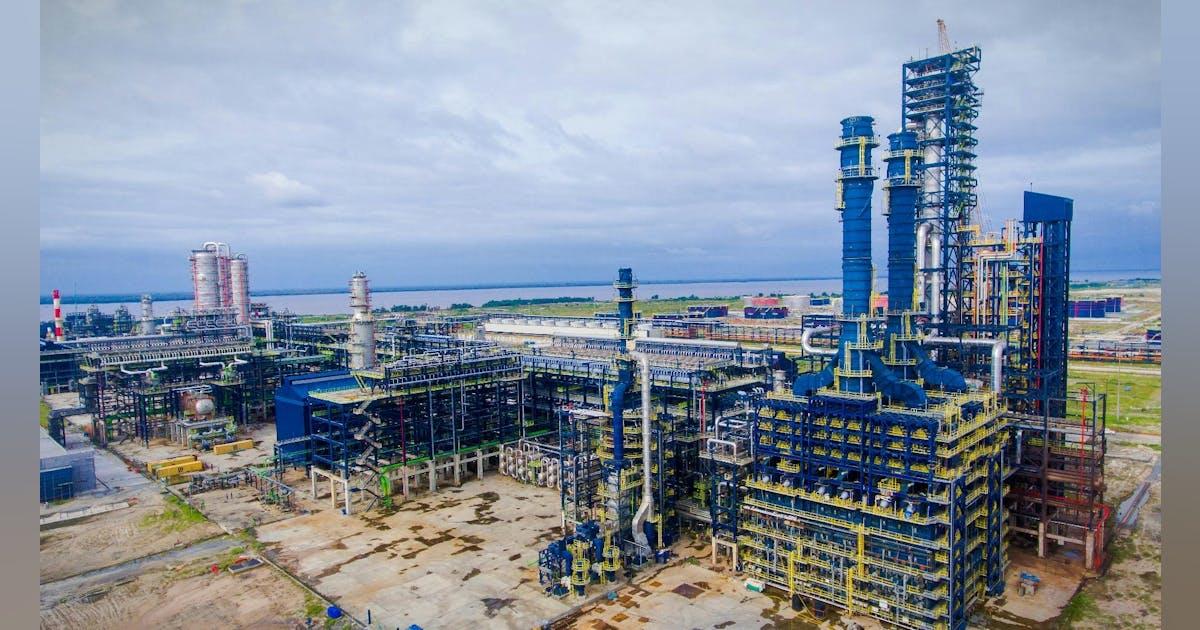
That transformation coincides directly with the emergence of the Dangote Petroleum Refinery as one of the most important refining complexes in the international market. The facility, located in the Lekki Free Zone near Lagos, began producing petroleum products in 2024 after years of construction and has progressively increased output of petrol, diesel, jet fuel and other products for both the domestic Nigerian market and international buyers.
The refinery was originally designed around a nameplate capacity of approximately 650,000 barrels of crude per day, already making it the largest single-train refinery in the world. In June 2026, however, Dangote said the facility processed more than 700,000 barrels per day during a performance test, temporarily exceeding that original design figure and demonstrating the scale at which the plant was capable of operating.
That increase has had consequences far beyond Nigeria’s domestic fuel market. Data cited by the U.S. Energy Information Administration show that Nigeria’s seaborne petroleum-product exports have increased roughly sevenfold since 2023. Before Dangote began operating, Nigeria’s seaborne refined-product exports averaged about 46,000 barrels per day in 2023. By the second quarter of 2026, that figure had risen to approximately 350,000 barrels per day.
Shipments to Europe expanded particularly rapidly. Nigeria exported an average of approximately 130,000 barrels per day of petroleum products to European destinations in the second quarter of 2026, compared with around 40,000 barrels per day during 2025 and only approximately 15,000 barrels per day in 2023. The scale of that increase makes Europe one of the clearest international beneficiaries of Nigeria’s growing refining capability.
The EIA explicitly links the change to Dangote. It says the opening and subsequent ramp-up of the refinery increased domestic product availability, reduced Nigeria’s dependence on imported fuels and generated enough surplus production to support a growing export business. Nigeria’s seaborne petroleum imports, which approached 400,000 barrels per day in 2023, had fallen below 130,000 barrels per day by the second quarter of 2026.
That shift represents something Nigerian policymakers had pursued unsuccessfully for decades. The country is one of Africa’s largest crude producers and has four state-owned refinery complexes, but those facilities spent long periods operating at extremely low utilization or remaining completely offline. Nigeria therefore developed the economically unusual situation of exporting crude to foreign refineries and then spending scarce foreign exchange buying processed fuel back from international suppliers.
The arrangement exposed the country to international refining margins, freight costs, currency weakness and disruptions in global fuel markets. It also contributed to pressure on Nigeria’s foreign-exchange reserves because importers required dollars to purchase refined petroleum products abroad.
The growth of Dangote has begun altering that equation. Domestic marketers increasingly source products inside Nigeria, while international traders now load Nigerian gasoline, diesel and aviation fuel for markets in Africa, Europe, North America and the Middle East. Nigeria has moved from being predominantly a net importer of refined products toward becoming an increasingly important supplier to the global market.
Britain’s latest figures provide a particularly striking illustration because the energy trade now runs strongly in both directions. While the UK imported £1.017 billion worth of Nigerian refined oil in the 12 months to June, it simultaneously exported £772.3 million worth of refined petroleum products to Nigeria.
The British exports were still enormous, accounting for 51.5 percent of all UK goods exports to Nigeria during the period. However, their value declined by 42.7 percent from the previous 12 months, when Britain exported an estimated £1.35 billion in refined oil to the Nigerian market.
That combination — Nigerian refined exports to Britain more than doubling while British refined exports to Nigeria fell sharply — provides stronger evidence of structural change than either figure viewed on its own. Nigeria recorded a refined-petroleum trade surplus of roughly £245 million with Britain during the latest period, a remarkable reversal for a country historically associated with importing finished fuels from European suppliers.
The two-way trade also demonstrates that Nigeria has not eliminated petroleum-product imports entirely. Different refineries produce different product grades and specifications, domestic demand fluctuates, trading companies take advantage of price differences and individual regions may still find imported cargoes commercially attractive. A country can therefore export large quantities of one fuel while continuing to import other refined products.
That complexity is important because claims that Dangote has already made Nigeria completely self-sufficient in fuel would go beyond the available evidence. The country has sharply reduced imports and increased exports, but international petroleum trading remains active and British refined products are still arriving in Nigeria in substantial volumes.
What has changed is the balance. Britain’s £772.3 million in refined-oil sales to Nigeria was down more than £575 million from the previous period, while its purchases of Nigerian refined oil accelerated in the opposite direction.
The overall goods relationship shifted accordingly. UK goods imports from Nigeria increased by 10.4 percent, or approximately £180 million, to £1.9 billion in the four quarters ending June 2026. British goods exports to Nigeria, by contrast, fell sharply, contributing to a £404 million UK trade deficit in goods with Nigeria compared with a £299 million British goods surplus during the corresponding previous period.
Services tell a very different story. Britain remains a major exporter of professional, financial, education, travel and other services to Nigeria, giving the UK a substantial overall services surplus. Total UK-Nigeria trade in goods and services stood at approximately £7.3 billion during the 12-month period, down 1.8 percent from the previous year.
Britain exported £4.8 billion in goods and services to Nigeria while importing approximately £2.5 billion, leaving the UK with an overall trade surplus of approximately £2.2 billion. That means Nigeria’s stronger merchandise performance has narrowed but not eliminated Britain’s broader trade advantage because the UK continues to earn substantially more from services.
For Nigeria, however, the petroleum reversal has economic significance beyond bilateral accounting. Refining crude domestically allows the country to capture more of the value chain before exporting. Instead of selling raw crude and allowing foreign refiners to earn the processing margin, Nigeria can theoretically retain more industrial value, support employment, develop logistics infrastructure and generate export revenues from finished products.
That has been one of the central arguments behind successive Nigerian governments’ efforts to restore domestic refining. Crude oil extraction employs relatively few people compared with the size of Nigeria’s population, while refining and associated petrochemical activity can support wider industrial networks involving transport, storage, engineering, maintenance, shipping and manufacturing.
Dangote’s scale gives that ambition an international dimension. The refinery has access to deep-water port facilities that allow large cargoes to be shipped directly into global trading networks, while its location on the Atlantic coast places European, West African and American markets within commercially viable shipping distances.
The refinery has also been able to benefit from disruptions elsewhere in the global market. Supply constraints connected with conflict around the Middle East and the Strait of Hormuz created additional demand for alternative sources of petroleum products during 2026, helping Nigerian exports move into markets traditionally supplied by Middle Eastern refiners.
The EIA said Nigerian petroleum-product shipments increased particularly strongly following Dangote’s maintenance and capacity expansion completed in February 2026, which coincided with disruptions to supplies moving through the Strait of Hormuz. The refinery was therefore positioned to capture demand at a moment when international buyers were actively diversifying supply.
Europe’s energy system has already gone through several major changes since Russia’s invasion of Ukraine in 2022, with buyers seeking alternatives to Russian petroleum and governments imposing increasingly complex sanctions on Russian-origin energy. New supply from large refining centers outside Russia has consequently become more commercially significant.
The United Kingdom introduced additional restrictions in May 2026 aimed at preventing petroleum products refined in third countries from Russian crude from entering its market. Nigeria received treatment that allowed its petroleum products to continue accessing Britain under the relevant compliance framework, reflecting the country’s growing status as an independent refining source rather than merely a transit route for Russian fuel.
The wider geopolitical environment therefore strengthens the strategic importance of Nigeria’s emerging refining industry. European buyers are not simply looking for inexpensive fuel; they are also attempting to diversify the geographic and political risks associated with traditional supply routes.
Nigeria is well positioned geographically, but whether it can convert the current opportunity into a durable long-term export industry will depend on several factors, including consistent refinery operations, reliable crude supply, competitive pricing, product quality and domestic energy policy.
Crude availability has already been contentious. Dangote has at times purchased crude from the United States and other international suppliers when Nigerian production arrangements did not provide sufficient volumes or commercially acceptable terms. That creates an unusual situation in which Nigeria’s largest refinery can import crude even though the country itself is a major oil producer.
The government has responded with measures intended to increase domestic crude supply to local refiners, including arrangements permitting transactions in naira. The objective is to guarantee sufficient feedstock while reducing pressure on foreign-exchange markets.
The refinery’s future expansion could make that challenge considerably larger. Dangote has announced plans to more than double processing capacity, with ambitions to move toward approximately 1.4 million barrels per day. If completed, such an expansion would place the complex among the largest refining centers anywhere in the world.
At that scale, domestic Nigerian crude production alone could face enormous pressure to supply both refinery demand and existing export commitments. Nigeria would then have to increase crude production substantially, import significant quantities of foreign crude or combine both strategies.
Dangote’s international competitiveness will also depend on reliability. Large global buyers require predictable cargo schedules and consistent fuel specifications. Unexpected shutdowns at a single massive refinery can have disproportionately large effects because so much production is concentrated within one complex.
That concentration creates both an advantage and a risk for Nigeria. The enormous scale allows Dangote to influence regional fuel prices and compete internationally, but operational problems at the plant can immediately affect both domestic availability and export volumes.
Nigeria’s government therefore continues to have an interest in restoring or sustaining other refineries and encouraging additional private investment rather than allowing one operator to become the country’s only meaningful source of large-scale refined petroleum products.
Competition is also important for domestic consumers. A successful export business may earn foreign exchange, but Nigerian households and businesses will judge the refining transformation partly through the prices they pay for petrol, diesel and other fuels at home.
Domestic refining does not automatically guarantee inexpensive fuel because pump prices still reflect crude costs, taxes, exchange rates, distribution expenses and international market conditions. If Nigerian refiners can sell products abroad at higher prices, policymakers must also decide how much freedom they should have to prioritize export markets when local demand remains strong.
Those tensions will become more important as Nigeria’s role in international product markets expands. A refinery designed primarily to solve the country’s import problem is increasingly becoming an export-oriented industrial asset capable of responding to price signals from London, Rotterdam, New York and other global trading centers.
The £1.02 billion British import figure illustrates exactly that evolution. Nigeria is no longer entering the UK energy relationship solely as a producer of crude oil and gas. It is increasingly appearing as a refiner selling finished fuels into one of the world’s mature energy markets.
That does not mean crude oil is becoming irrelevant. Britain still imported £550.3 million of Nigerian crude during the period, and crude remains central to Nigeria’s wider export earnings. What has changed is the relative weight of the two categories.
The decline in crude shipments to Britain may reflect several factors beyond the growth of domestic refining, including changing refinery demand inside the UK, international crude-price movements, cargo destination choices and Nigeria’s own allocation of barrels. The official data therefore should not be interpreted as proving that every barrel no longer shipped to Britain was diverted directly into Dangote.
Similarly, the more-than-100-percent rise in refined-oil imports cannot be attributed exclusively to Dangote on the basis of the UK dataset alone. The British statistics classify trade by country and commodity rather than identifying which Nigerian refinery processed every cargo.
Nevertheless, independent shipping data and the EIA’s analysis provide strong support for the broader conclusion that Dangote is the dominant force behind Nigeria’s export expansion. Before the refinery began operating, Nigeria’s seaborne product exports were relatively small. After production ramped up, shipments multiplied and European destinations became major buyers.
Reuters reported in June that Dangote’s exports reached approximately 353,000 barrels per day in April before easing to around 285,000 barrels per day in May. Roughly half of April shipments went to other African countries, demonstrating that Europe is only one part of the refinery’s rapidly expanding market.
Africa remains strategically important because many countries on the continent import substantial quantities of refined fuel despite producing crude oil themselves or being located near major producers. A large Nigerian refinery has the potential to shorten supply routes, lower shipping costs and reduce the continent’s reliance on European and Middle Eastern refining centers.
Exports to other African countries reached nearly 120,000 barrels per day in the second quarter of 2026, according to EIA figures, compared with approximately 89,000 barrels per day during 2025. That makes Dangote not only a Nigerian industrial project but an increasingly important component of African energy security.
The refinery has also sent cargoes to the United States and Saudi Arabia, illustrating how flexible global petroleum markets can become when a new plant reaches sufficient scale. Nigeria, which for decades watched tankers carry crude away before importing processed products from abroad, is now shipping its own finished fuels to some of the world’s largest energy markets.
That transformation has substantial symbolic importance for President Bola Tinubu’s government, which has repeatedly promoted domestic production and reduced import dependence as central economic objectives. Yet the administration cannot claim sole credit for Dangote’s development because the project was conceived, financed and built over many years across several Nigerian governments as a private-sector investment led by Aliko Dangote’s group.
The more important policy question is whether Nigeria can leverage the refinery’s success into a wider industrial transformation rather than treating one giant complex as the endpoint of its downstream strategy. Petrochemicals, plastics, fertilizers, industrial feedstocks and logistics could potentially generate additional value if domestic infrastructure and policy remain supportive.
There is also the question of public finances. Reduced fuel imports can ease foreign-exchange demand, while refined-product exports can bring new dollar inflows. However, the impact on government revenue depends on taxation, crude sales, export arrangements and the broader fiscal structure surrounding petroleum.
Nigeria’s central bank and economic managers have spent years attempting to stabilize the naira amid severe foreign-exchange shortages. A sustained reduction in fuel imports combined with large refined-product exports could improve the external position over time, although other factors including debt service, capital flows, crude production and imports of machinery and consumer goods will continue to influence currency pressures.
The bilateral data with Britain already shows one tangible shift. Nigeria earned more from selling refined petroleum products to the UK than Britain earned selling refined petroleum products to Nigeria during the period, creating an approximate £245 million advantage for Nigeria in that specific commodity category.
That figure would have been difficult to imagine during the years when Nigeria’s fuel market depended heavily on European imports. It does not mean the country has solved its energy problems, but it marks a substantial reversal in one of the most persistent contradictions of the Nigerian economy.
For Britain, Nigerian refined fuel provides another source of supply in an increasingly diversified energy market. British refiners, terminals and traders operate within a global system where cargoes move according to pricing, specifications and availability rather than fixed bilateral arrangements.
The United Kingdom can therefore simultaneously import Nigerian fuel and export British-refined products back to Nigeria. The trade figures reflect commercial decisions by multiple companies rather than a centralized government-to-government fuel exchange.
That makes the changing numbers particularly revealing. Markets are responding to the availability of significant volumes of Nigerian-refined product, and those cargoes are competitive enough to enter Britain even while British suppliers continue serving Nigerian buyers.
The next phase will determine whether the shift becomes permanent. One year of sharply higher trade can reflect unusual market conditions, and the 2026 period included significant international supply disruption. Analysts have therefore cautioned against assuming current export volumes will continue indefinitely at the same pace.
Yet the structural capacity that makes the exports possible is not temporary. Dangote now exists as a large operating refinery and is seeking further expansion. Even if trade flows vary from quarter to quarter, Nigeria has acquired refining capacity that did not exist when its import dependence was at its peak.
The UK government figures therefore capture more than an unusually strong year for petroleum trade. They provide statistical evidence of a deeper transition already visible in tanker movements, domestic fuel imports and refinery production.
Nigeria is still an oil-dependent economy. Petroleum still accounted for more than 82 percent of its merchandise exports to Britain when refined and crude oil are combined, and adding gas pushes the energy share even higher. The country has not diversified away from hydrocarbons in any meaningful sense.
What it is beginning to do, however, is capture more value from those hydrocarbons before they leave its shores.
That distinction could matter enormously over the long term. Crude-exporting economies surrender a significant portion of downstream value to foreign refiners, while countries with competitive refining industries can participate at multiple stages of the supply chain.
For Nigeria, the UK trade figures show that movement from aspiration into measurable commerce. Britain imported £1.017 billion in Nigerian refined petroleum products during the 12 months ending June 2026, more than double the previous period and almost twice the value of the Nigerian crude it purchased.
At the same time, British refined-oil exports to Nigeria fell 42.7 percent, while Nigeria’s broader seaborne product exports climbed to levels several times higher than they were before Dangote began production.
Taken together, those developments point toward a genuine restructuring of petroleum trade rather than an isolated increase in one export category.
The transition remains incomplete. Nigeria still imports fuel, still faces refinery-supply disputes, still depends overwhelmingly on petroleum for foreign earnings and still needs stronger industrial diversification. Dangote itself must prove that it can operate reliably at high utilization over many years while completing ambitious expansion plans.
But the direction of travel has become increasingly difficult to ignore.
For decades, one of the defining criticisms of Nigeria’s oil economy was that the country exported crude, surrendered the refining margin to foreign plants and then spent billions importing fuel made from petroleum it could have processed itself.
The latest British trade statistics tell a different story.
Nigeria is now shipping more than £1 billion worth of refined petroleum products into the United Kingdom, while Britain’s own refined-fuel sales to Nigeria are declining sharply. It is not yet the complete reversal of Nigeria’s petroleum dependence, but it is one of the clearest indications so far that Africa’s biggest oil producer is beginning to occupy a different place in the global energy value chain.