UNIABUJA STAFF, STUDENTS STAGE MASS PROTEST OVER DISPUTED LAND ALLOCATIONS, DEMAND TINUBU INTERVENTION
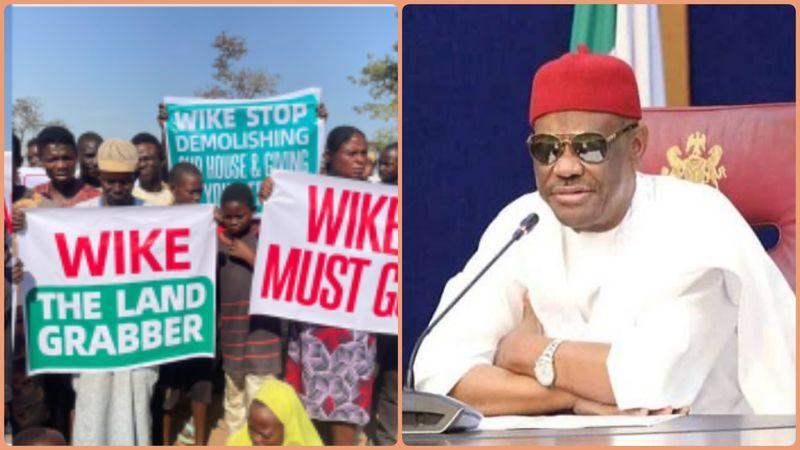
Lecturers, non-academic staff, students and alumni of the University of Abuja began a mass protest on November 16, blocking the main entrance and demanding President Bola Tinubu’s intervention over the FCT Administration’s reallocation of portions of land claimed by the institution.
ABUJA, NIGERIA — Lecturers, non-academic workers, students and alumni of the University of Abuja on Monday launched a mass protest against the Federal Capital Territory Administration over the disputed reallocation of portions of land historically associated with the institution, blocking the main entrance to the university and demanding direct intervention from President Bola Tinubu. The demonstrators accused FCT Minister Nyesom Wike of attempting to strip the university of land needed for its long-term academic, residential, agricultural and research expansion and warned that private developers or other allottees should stay away from the disputed areas until the legal controversy is resolved. The action represents the sharpest escalation yet in a land dispute that has been building for more than a year and now involves not only the university’s academic union but also senior staff, non-academic workers, students, alumni and the courts.
The protest began at the university’s main campus, where participants gathered under a joint mobilization involving the Academic Staff Union of Universities, the Senior Staff Association of Nigerian Universities, the Non-Academic Staff Union of Educational and Associated Institutions, the National Association of Academic Technologists, the Students’ Union Government and alumni representatives. Protesters blocked access to the main gate and said they intended to continue the action until the Federal Government intervened in the dispute. Organizers had earlier announced a three-day peaceful protest beginning on November 16 and urged students to join staff unions in what they described as an effort to protect university land for present and future generations.
The immediate grievance centers on allegations that portions of the land have been allocated to private companies and individuals despite a subsisting court order. The University of Abuja chapter of ASUU says Justice F.E. Messiri of the High Court of the Federal Capital Territory, sitting in Maitama, on August 18 ordered the parties to maintain the status quo ante bellum over Plot No. 1 in the Giri District pending the determination of a substantive suit. The court order followed litigation brought by the university against the FCT minister and related authorities over the ownership and control of the disputed property. ASUU says that notwithstanding that order, allocations were subsequently made on September 26 to private interests, an action the union describes as a direct affront to the court and a threat to the institution’s future.
The existence of the High Court order is independently verifiable. In Suit No. FCT/HC/CV/3500/2026, Justice Messiri granted leave directing all parties to maintain the status quo in respect of Plot No. 1, Giri District, while the substantive case remains pending. The legal effect of that order is now central to the dispute because the university and its unions argue that no party should alter possession or ownership arrangements while the case is before the court. Whether the September allocations legally breached that order is ultimately a question for the court to determine, and no final judgment has yet established that Wike or the FCTA acted unlawfully.
ASUU’s University of Abuja chairperson, Professor Sylvanus Ugoh, has accused the FCT Administration of disregarding the injunction and has warned that the union can no longer guarantee industrial harmony if the disputed allocations are not reversed. He argues that the land was originally allocated to the university at its establishment in 1988 and that the institution holds documentary evidence supporting its entitlement to approximately 11,824 hectares. According to the union, the land was deliberately reserved to allow for long-term expansion, hostels, research centres, innovation facilities, agricultural development and other projects expected of a major federal university located in the national capital.
The university’s supporters reject the argument that the land is excessive simply because portions remain undeveloped. Their position is that universities are established with planning horizons measured in decades, not only by immediate construction needs, and that surrendering undeveloped land now could cripple future growth once student numbers and academic programmes expand. They have pointed to other large Nigerian universities with substantial land holdings, including the University of Ilorin and Obafemi Awolowo University, to argue that a large permanent site is not unusual for a major federal institution.
Wike has taken the opposite position and has rejected the characterization of the dispute as land grabbing. The FCT minister first publicly intensified the controversy in June 2025, when he said the FCTA had recovered about 7,000 hectares from the university and would leave roughly 4,000 hectares for the institution. He accused the university of fencing and claiming more than 11,000 hectares without valid documentation and said the remaining land should be opened for development in the Giri District. The minister argued that it was unacceptable for a single institution to control such a vast amount of land while much of the area remained undeveloped and the FCT faced growing pressure for housing, infrastructure and planned urban expansion.
The disagreement has therefore become a fundamental clash over two competing interpretations of public land. The university says the acreage was deliberately allocated by government for educational purposes and remains a federal asset intended to serve the long-term needs of generations of students. Wike and the FCTA argue that land administration in Abuja rests with the Federal Capital Territory Administration and that unused or undocumented land can be recovered and reassigned in accordance with the Abuja Master Plan and broader development priorities.
Wike has also questioned ASUU’s legal standing to dictate land policy, asking publicly what business a trade union has with determining ownership or allocation within the FCT. During a recent media interaction, he insisted that the FCTA would not reverse its decisions because of threats of industrial action and said the administration was prepared to defend its position in court. He has maintained that the government is enforcing land-use rules rather than dispossessing the institution unlawfully and has accused the union of attempting to use strike threats as political or institutional pressure.
That response has hardened attitudes inside the university. Staff and student leaders now argue that the dispute is no longer only a question of how much land UniAbuja should retain but also a test of whether an interlocutory court order will be respected while the substantive litigation continues. Protesters say any private developer entering the disputed area risks becoming entangled in a legal and political confrontation whose outcome has not yet been determined.
The warning to allottees is therefore one of the most consequential elements of the protest. University stakeholders have said they will not permit individuals or organisations to begin development on land they regard as belonging to the institution, creating the possibility of confrontation if construction activity proceeds while demonstrations continue. That risk is one reason calls for presidential intervention have become more urgent, because a dispute that began as an administrative disagreement over acreage now involves court orders, private allocations, mass protest and the possibility of prolonged disruption to academic activities.
The university community’s demand for President Tinubu to intervene reflects the complicated institutional structure surrounding the dispute. UniAbuja is a federal university, while land administration in the Federal Capital Territory is exercised through the FCT Administration under the minister appointed by the President. That means both sides ultimately operate within institutions controlled by the Federal Government, giving the Presidency a potential political role even though the legal issues must remain for the courts to resolve.
The protest also threatens to disrupt academic activities if it expands beyond the current demonstrations. ASUU had already warned earlier in November that it could no longer guarantee industrial peace, while the student mobilization notice called for sustained participation over three days. If lecturers and non-academic workers formally withdraw services, the dispute could affect lectures, examinations, administration and other university operations, extending the consequences beyond land ownership into the academic calendar.
That possibility gives the conflict national significance. The University of Abuja is one of Nigeria’s major federal institutions and occupies a strategic location in the capital. It serves students from across the federation and has long been regarded as a university with significant potential for future expansion because of the size of the land originally associated with its permanent site. A prolonged confrontation over land could affect not only existing academic activities but also planned faculties, accommodation, research facilities and partnerships.
The dispute itself did not begin with Monday’s demonstration. In April 2025, Wike publicly criticized the scale of land associated with the university during an inspection of infrastructure around the Giri District. By June, he announced that the FCTA was reclaiming approximately 7,000 hectares and leaving around 4,000 hectares for the institution. The university’s alumni association subsequently challenged the move, describing it as arbitrary and warning that the reduction would undermine future growth. University representatives maintained that the original acreage had been granted as part of the national vision for a comprehensive federal university in Abuja.
The matter eventually moved into court, and the August 18 interim order froze the dispute pending substantive determination. That legal intervention should, in principle, have reduced tensions, but allegations that new allocations were made on September 26 instead intensified them. ASUU now argues that the alleged post-order allocations demonstrate why the protest is necessary, while Wike maintains that the FCTA’s authority over land remains intact and has dismissed accusations that he is acting outside the law.
The evidence available publicly does not yet establish every detail of the September allocations. The names of all companies and individuals said to have received portions of the disputed land have not been comprehensively published in the principal reports reviewed by VNTV, nor has a court yet ruled on whether those allocations amount to contempt or unlawful encroachment. Reporting should therefore distinguish between the verified existence of the court order and the union’s allegation that subsequent allocations violated it.
That legal distinction is important because the term “land grabbing” is inherently accusatory. Protesters and university unions are using it to describe what they believe is the unlawful transfer of public university land to private interests. Wike rejects the term entirely and argues that the real land-grabbing problem was the university’s own claim over acreage he says lacked adequate documentation. The clash is therefore partly factual, partly legal and partly political, and the courts remain the proper forum for resolving the ownership and authority questions.
The controversy also highlights the broader pressures surrounding land in Abuja. Rapid population growth, rising property values and the expansion of infrastructure have made land administration one of the most contentious areas of governance in the Federal Capital Territory. Wike has pursued an aggressive land reform and enforcement programme since becoming minister, revoking titles, demanding payment of outstanding ground rents, demolishing structures deemed illegal and reallocating some properties for development.
Supporters of those policies argue that Abuja has suffered from decades of speculation, abandoned allocations and violations of the Master Plan, making stronger enforcement necessary. Critics accuse the administration of excessive use of ministerial power, inadequate consultation and decisions that can disproportionately affect communities, institutions and individuals without enough transparency.
The UniAbuja dispute is especially sensitive because the contested land is not simply a private property claim but involves a major public educational institution. Even those who support stronger enforcement of Abuja’s planning rules may question whether land reserved for education should be treated the same way as speculative private holdings, while Wike’s supporters argue that public institutions must also justify their land use and cannot indefinitely retain large tracts without development.
The question of documentation is likely to become central when the substantive case is finally heard. Wike has repeatedly said the university lacks proper evidence for the full 11,000-plus hectares, while UniAbuja officials and unions insist that documentary records confirm the original allocation. The court will therefore need to examine the instruments creating the university’s interest in the property, subsequent planning records, survey documents and the legal authority under which the FCTA sought to reduce the acreage.
The outcome could have consequences beyond the University of Abuja. Other federal institutions in the FCT hold large parcels of land that may be only partially developed, and a ruling clarifying the extent of the minister’s power to reclaim or reallocate such property could affect future disputes involving government agencies, educational institutions and public bodies.
It could also clarify how interim court orders should constrain administrative action. If the university establishes that the FCTA altered the status of the land after being ordered to maintain the status quo, the court may have to consider whether those actions are valid. If the FCTA establishes that the disputed allocations concern land outside the precise scope of the order or that the university never had lawful title to those areas, the legal picture may look very different.
Until the court resolves those questions, both sides face risks in escalating the dispute. The university risks disruption to teaching, research and administration if protests become prolonged, while the FCTA risks appearing to disregard judicial processes if development proceeds on land directly covered by an injunction. Private allottees also face uncertainty because investments made before the ownership question is resolved could be challenged or rendered worthless depending on the eventual judgment.
That is why the protesters’ warning to private developers has attracted attention. They are effectively telling prospective allottees that possession of an allocation letter from the FCTA may not guarantee peaceful access to the land while university stakeholders dispute the legality of the allocation. The warning does not itself invalidate any title, but it underscores the practical uncertainty surrounding the property.
The protest has so far been described as peaceful, although blocking the main gate has already disrupted normal access to the campus. The presence of academic and non-academic unions alongside students gives the demonstration more organizational strength than a purely student-led protest and increases the likelihood that pressure could continue if negotiations fail.
Student participation also changes the political character of the dispute because young people are now framing the land as something that belongs to future generations rather than merely an asset controlled by the university administration. The Student Union has described the property as part of the institution’s inheritance and has urged students not to remain passive while portions are transferred elsewhere.
University workers make a similar argument from the standpoint of institutional planning. NASU and SSANU officials say laboratories, staff housing, student accommodation, research farms and future faculties require land that may appear unused today but could become essential as the university grows. They argue that public universities should be allowed to plan for future demand rather than surrender property simply because development has not yet reached every section.
Wike’s position is that such arguments cannot override the FCTA’s responsibility to manage Abuja’s scarce urban land. He has said the Giri District requires planned development and infrastructure and has pointed to new roads and nearby public institutions as evidence that keeping vast sections unused could frustrate broader city planning.
That policy debate would be easier to resolve through negotiation if not for the court case. Once litigation and an interlocutory order entered the dispute, the issue became as much about the rule of law as urban planning. For ASUU, the question is now whether executive authorities can continue taking decisions over disputed land after a judge has instructed the parties to maintain the previous position.
The minister has not publicly conceded that any subsequent allocation breached the order. His broader response has been that the FCTA will defend its decisions legally and that land-management authority remains with the administration. A court will ultimately have to determine which interpretation is correct.
President Tinubu’s response will therefore require care. He can direct political or administrative discussions between the university and FCTA, but he cannot properly substitute himself for the court on the legal ownership question. Any intervention would need to encourage compliance with judicial orders, reduce tension and perhaps facilitate negotiations over long-term development without prejudging the litigation.
The dispute could potentially be resolved through a negotiated boundary arrangement if both sides agree on the acreage genuinely necessary for the university and the areas the FCTA wants for wider district development. Such a compromise would require credible surveying, transparent documentation and guarantees that essential university expansion plans remain protected.
So far, however, the public positions remain far apart. The university side demands reversal of the allocations and recognition of the original acreage, while Wike insists that approximately 4,000 hectares is more than adequate and rejects the suggestion that the FCTA should surrender control because of union pressure.
That deadlock explains why the protest has become the preferred pressure tactic. After press conferences, alumni letters, court proceedings and public exchanges failed to settle the matter, university stakeholders are now attempting to make the political cost of proceeding with the reallocations more visible.
The demonstrations also place Wike under renewed scrutiny because land administration has become one of the defining and most controversial areas of his tenure as FCT minister. He has repeatedly defended a tough approach as necessary to restore the Abuja Master Plan, recover government property and ensure that allocations are actually developed rather than held indefinitely for speculation.
Critics say that approach must still operate within due process, transparent allocation procedures and the limits imposed by courts. The UniAbuja case could therefore become an important test of whether those principles are being observed when government development objectives collide with another federal institution’s claim to land.
For the university community, the immediate objective is clear: prevent any further development on the disputed property and force a political intervention before new structures or private projects make the conflict harder to reverse. For Wike and the FCTA, the challenge is to demonstrate that the reallocation process rests on lawful authority and does not violate the court order now at the center of the controversy.
The most important next development will be the response from the Presidency and the courts. If Tinubu intervenes politically, negotiations could reduce tensions before the three-day protest escalates into a longer industrial dispute. If no compromise emerges, the litigation may become the decisive arena and could eventually determine both the university’s land size and the validity of any allocations made during the dispute.
For now, the University of Abuja remains in open confrontation with the FCT Administration. The main campus entrance has been blocked, unions and students have mobilized together and protesters are warning developers not to enter the contested land. Wike, meanwhile, has shown no indication that he intends to reverse the FCTA’s position merely because of protest or strike threats.
The dispute is therefore no longer a technical disagreement hidden inside planning documents. It has become a public battle over institutional autonomy, executive power, land administration and judicial authority in the heart of Nigeria’s federal capital.
What happens next will determine not only the future physical size of the University of Abuja but also whether a major federal institution can preserve land allocated for long-term growth when the government authority responsible for the surrounding territory decides that significant portions should be used differently. Until the High Court resolves the underlying case or the Federal Government brokers a credible settlement, the protesters’ message is likely to remain unchanged: they regard the disputed land as part of the university’s future and say they will resist any attempt to develop it outside the institution.