
CHINA TAKES AIM AT US FOREIGN POLICY AT UN AS BEIJING DEFENDS GULF SOVEREIGNTY AND DEMANDS END TO PRESSURE ON CUBA
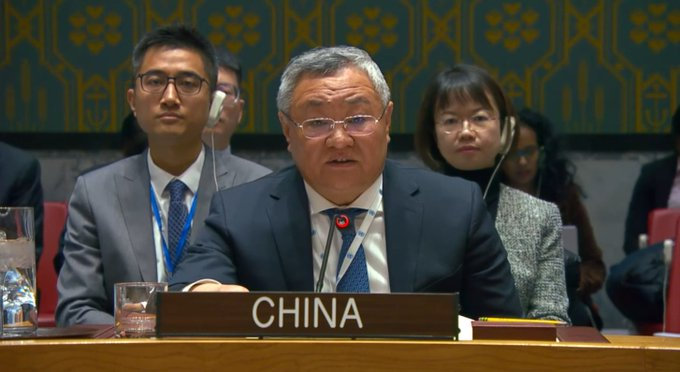
China has used the UN General Assembly period to reinforce its opposition to key elements of US foreign policy, calling for the sovereignty and security of Gulf states to be respected amid the Iran conflict while demanding an end to Washington's blockade, sanctions and pressure against Cuba. The diplomatic push comes immediately after President Xi Jinping's summit with US President Donald Trump, where the Middle East conflict and Strait of Hormuz crisis featured prominently.
China is using the world's biggest diplomatic stage to draw some increasingly clear red lines around American foreign policy.
As world leaders gather for the 81st United Nations General Assembly, Beijing has reinforced two positions that put it directly at odds with Washington.
In the Middle East, China says the sovereignty, security and territorial integrity of Gulf states must be respected while the conflict involving Iran must ultimately be resolved through diplomacy rather than escalating military confrontation.
On Cuba, Beijing wants something much more specific from Washington.
End the blockade.
End the sanctions.
And end what China describes as coercion and external pressure against Havana.
The positions are not entirely new.
What makes them particularly significant now is the timing.
They come during an extraordinary week in which Chinese President Xi Jinping met US President Donald Trump in Washington while the Iran conflict, disruption around the Strait of Hormuz and America's increasingly confrontational policy towards Cuba dominate international diplomacy.
The result is an increasingly visible contest between the world's two largest economies over not only trade and technology, but how international power should be exercised.
CHINA WALKS A CAREFUL LINE ON IRAN
Beijing's position on the Middle East is more complicated than simply supporting Iran against the United States.
China has repeatedly criticised US military pressure and called for dialogue.
But Beijing has also publicly stated that Iran must respect the sovereignty and security of neighbouring Gulf countries.
That distinction matters.
China's position is that the sovereignty, security and territorial integrity of Gulf states must be fully respected and civilians and non-military targets protected.
Beijing has also called for the safe passage of international waterways.
That includes the Strait of Hormuz.
China has urged Iran to cooperate in reopening the crucial waterway while simultaneously criticising US military deployments and blockade measures.
The balancing act reflects China's enormous economic interests in the region.
China imports large quantities of energy from the Middle East.
Any prolonged disruption to the Strait of Hormuz therefore represents more than a diplomatic problem for Beijing.
It threatens energy supplies, shipping routes, manufacturing costs and the wider Chinese economy.
That gives China a powerful incentive to prevent either Washington or Tehran from allowing the conflict to spiral further.
XI AND TRUMP JUST DISCUSSED IRAN
The UN diplomacy comes immediately after President Xi's summit with President Trump.
Iran and the wider Middle East conflict featured in those discussions.
Xi urged the United States and Iran to return to a previous framework for negotiations and work towards a broader settlement.
Trump, meanwhile, warned the Chinese leader against providing support to Iran.
The summit illustrated the difficult position Beijing occupies.
China has a comprehensive strategic partnership with Iran.
But it also maintains extensive economic and diplomatic relationships with Saudi Arabia, the United Arab Emirates, Qatar and other Gulf states.
Beijing therefore has little interest in choosing a regional war in which supporting one side could damage relationships with several others.
Its preferred message is negotiation.
China has called on Iran and the United States to remain restrained, rebuild negotiating mechanisms and conduct substantive discussions.
It has simultaneously encouraged Iran to engage directly with Gulf countries and respect their territorial sovereignty and national security.
HORMUZ IS NOW A GLOBAL ECONOMIC PROBLEM
The Strait of Hormuz has become one of the most dangerous pressure points in the conflict.
The narrow waterway connects Gulf energy producers with international markets and is one of the world's most important oil-shipping routes.
Disruption there has consequences far beyond Iran and the United States.
China has called for the strait to be reopened as quickly as possible and for international navigation to be protected.
Beijing's diplomats have previously argued that responsibility lies on more than one side.
China has called on Iran to remove restrictions affecting navigation while also calling on the United States to end its naval blockade.
That puts Beijing in an unusual position.
It is criticising Washington's military approach without giving Tehran unrestricted diplomatic cover.
China's message is effectively that neither side should be allowed to endanger international shipping or the sovereignty of other regional states.
THEN THERE IS CUBA
On Cuba, however, China's language towards Washington has been considerably more direct.
Beijing has repeatedly demanded an end to the US economic, commercial and financial embargo against the island.
China says American unilateral sanctions violate the Cuban people's right to development and interfere in the country's internal affairs.
It has called on Washington to end its blockade, sanctions and other forms of coercion and pressure.
That position directly contradicts the Trump administration's approach.
Trump used his own UN General Assembly speech this week to declare that Cuba was a “failed state” and predict that political change was coming to the Communist-run country.
The Cuban delegation walked out during Trump's remarks.
The US president said his administration was applying enormous pressure on Havana and declared that “freedom will be coming to Cuba.”
Washington has maintained its trade embargo against Cuba for more than six decades.
Trump's administration has intensified pressure on Havana as part of a broader US policy towards the Communist government.
China sees the situation very differently.
Beijing says Cuba should be allowed to determine its own political system without outside interference.
TWO SUPERPOWERS, TWO DIFFERENT ARGUMENTS
The disagreement exposes a much larger ideological divide between Washington and Beijing.
The United States frequently justifies sanctions and political pressure as tools for confronting governments it considers threatening, authoritarian or hostile to American interests.
China presents its foreign policy around principles of sovereignty, non-interference and opposition to unilateral sanctions.
Critics of Beijing argue that China's invocation of sovereignty can also serve its own strategic interests and shield governments with which it maintains close relationships.
China, meanwhile, accuses Washington of selectively applying international rules while using its economic and military power to pressure weaker countries.
That argument is increasingly appearing in China's diplomacy across Africa, Latin America and the Middle East.
Cuba and Iran now sit near the centre of it.
CUBA BECOMES ANOTHER US-CHINA FAULT LINE
Cuba is particularly sensitive because of its location.
The island lies only about 145 kilometres from Florida.
For Washington, Communist Cuba has represented a strategic and ideological challenge for more than six decades.
For Beijing, Havana is a longstanding political partner and increasingly important symbol of China's argument against unilateral US sanctions.
China's support does not mean Beijing controls Cuba's policies.
But China's economic and diplomatic relationship with Havana gives Cuba an important major-power partner at a time when Washington is increasing pressure.
That makes Cuba another arena where US-China competition is increasingly visible.
CHINA'S GULF POSITION IS MORE NUANCED
The Middle East presents a different calculation.
Beijing wants good relations with Iran.
It also wants good relations with Iran's Arab neighbours.
And above everything else, China wants oil and commercial shipping to continue moving.
Foreign Minister Wang Yi recently told Iranian Foreign Minister Abbas Araghchi that the continuation of the US-Iran conflict does not serve the interests of either the parties involved or the international community.
Wang encouraged Washington and Tehran to return to negotiations.
But he also supported dialogue between Iran and Gulf countries based on mutual respect for territorial sovereignty and national security.
China has additionally urged all sides to take steps towards reopening the Strait of Hormuz and protecting international navigation.
That is not unconditional support for Tehran.
It is an attempt to position Beijing as a diplomatic power capable of talking to virtually everybody involved.
THE UN BECOMES THE STAGE FOR A BIGGER POWER STRUGGLE
The confrontation between Washington and Beijing is no longer confined to tariffs, semiconductors and Taiwan.
It increasingly extends into competing ideas about how global crises should be managed.
Trump's America is prepared to use sanctions, military pressure and economic leverage aggressively in pursuit of US objectives.
China is presenting itself as an alternative voice centred on sovereignty, negotiation and opposition to unilateral coercive measures.
Whether other countries accept Beijing's description of its role is another question.
But at the United Nations, the contrast is increasingly difficult to miss.
On Cuba, Washington says pressure can force fundamental change.
China says Washington should stop interfering.
On Iran, the United States has used military force and continues to pressure Tehran.
China says negotiations must resume while also warning Iran to respect the security of neighbouring Gulf countries and international shipping.
And in the Strait of Hormuz, both superpowers have something enormous at stake.
Energy.
Trade.
Influence.
And the question of who gets to shape the rules governing the next international crisis.
The Trump-Xi summit may have demonstrated that Washington and Beijing are still willing to sit across a table from one another.
Their messages surrounding the UN General Assembly show something equally important.
Sitting at the same table does not mean they see the world the same way.