
DONALD DUKE SAYS HE WOULD CUT PETROL PRICE TO N300 PER LITRE IF ELECTED PRESIDENT IN 2027
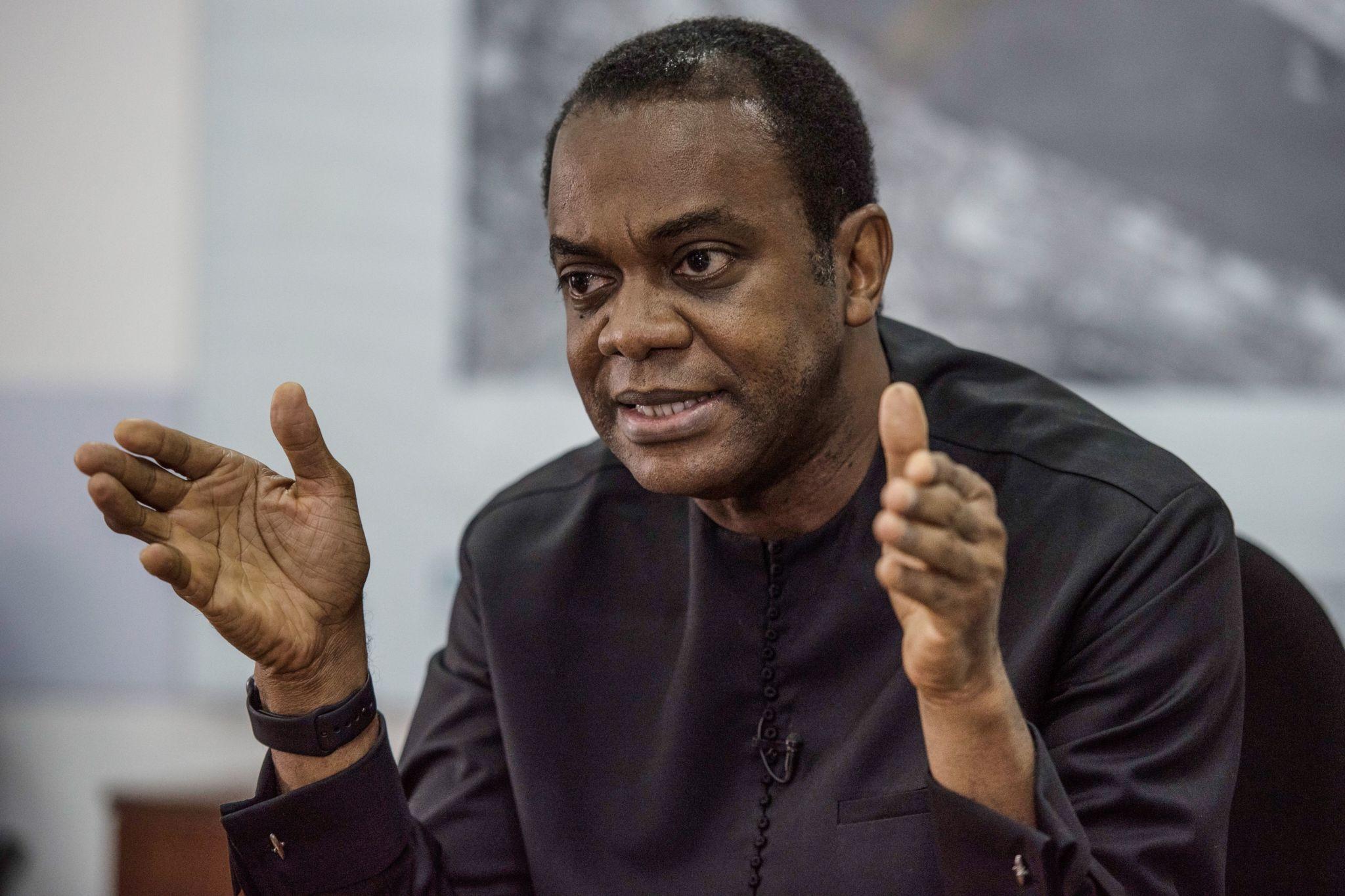
Peoples Redemption Party presidential candidate Donald Duke says he would seek to reduce petrol to about ₦300 per litre if elected Nigeria’s president in 2027. His proposal would price crude allocated for domestic consumption closer to its production cost instead of international market value. Duke says the approach would lower energy costs throughout the economy, but the plan would still face major questions over lost oil revenue, refinery costs, distribution, smuggling and whether discounted crude amounts to an indirect subsidy.
Peoples Redemption Party presidential candidate Donald Duke has promised to reduce the price of petrol to about ₦300 per litre if elected president in 2027, arguing that Nigeria should stop pricing fuel consumed domestically as though locally produced crude oil had first been purchased on the international market at full global prices.
The former Cross River State governor made the proposal during an appearance on Channels Television’s The Morning Brief on Wednesday, setting out what he described as an alternative to President Bola Tinubu’s petroleum-sector policies at a time when Nigerians are again confronting exceptionally high fuel costs. Duke said a government led by him would allocate part of Nigeria’s crude production directly to domestic consumption, price that crude around its production cost rather than the international benchmark and use the resulting lower input cost to reduce the retail price of Premium Motor Spirit.
“I will try and bring it to about ₦300,” Duke said while explaining the proposal, acknowledging that the target would initially sound unrealistic to many Nigerians given current pump prices. His argument rests on the claim that Nigeria could reserve roughly 600,000 barrels of crude oil per day for domestic use while selling the remainder internationally, allowing local refineries to receive crude at a lower accounting price and produce petroleum products for the Nigerian market at substantially reduced cost.
Duke said he would not continue Tinubu’s existing petroleum-pricing framework if elected. He criticized what he called the subsidy regime and argued that the more fundamental issue was the decision to price domestically consumed petroleum products against international crude values even though Nigeria itself produces crude oil. In his view, the government should distinguish between barrels sold into the international market and barrels assigned to domestic energy needs.
The proposal immediately places fuel pricing at the center of the developing 2027 presidential debate, less than four years after Tinubu announced the end of Nigeria’s long-running petrol subsidy system on the day of his inauguration in May 2023. The removal ended a system under which government spending had been used to keep retail petrol prices artificially below market levels, but it also contributed to a dramatic increase in transportation, logistics and household costs as domestic pump prices adjusted upward.
Petrol prices have climbed much further during 2026 as global energy disruptions and domestic market pressures have affected supply costs. In recent weeks, the Nigeria Labour Congress has said petrol was selling at around ₦1,430 per litre in major cities and as high as ₦1,500 in some locations, placing Duke’s proposed ₦300 target at only a fraction of prevailing prices in parts of the country.
That gap is why the proposal is likely to receive intense scrutiny. Reducing petrol from around ₦1,400 or more to approximately ₦300 would require either a very large reduction in the effective cost of crude supplied to local refiners, significant government intervention elsewhere in the value chain, sharply lower distribution and tax costs, or some combination of those measures. Duke’s argument is that Nigeria can achieve much of that reduction by treating crude reserved for domestic consumption differently from crude sold internationally.
He said local petroleum products should be priced according to what it costs Nigeria to produce and refine the crude rather than what the same barrel could earn in the international market. Duke cited production and processing costs that he said could justify a far lower domestic price, arguing that the current system forces Nigerians to pay a global-market value for a resource produced within the country.
That position represents a different interpretation of opportunity cost from the one generally used in market-based energy pricing. Under conventional commercial pricing, a barrel of crude has an international market value even if it is produced locally because the producer could sell it abroad instead. Supplying the same barrel to a domestic refinery at substantially below that value therefore carries an economic cost, even if government does not record the difference as a direct cash subsidy.
Duke’s proposal effectively argues that the state should accept that forgone export value as part of a broader domestic economic strategy. His case is that cheaper energy would reduce transportation and production costs across the economy, leaving households with more disposable income and allowing businesses to operate more competitively. The broader economic benefit, he argues, would outweigh the revenue Nigeria gives up by selling part of its crude below international value to domestic refiners.
That distinction is likely to become one of the main points of debate around his plan. A government can avoid writing a direct subsidy cheque while still providing an implicit subsidy if crude oil worth a higher amount internationally is deliberately sold domestically at a lower price. Whether such a policy is economically beneficial depends on how the lost revenue compares with the gains from cheaper fuel, stronger industrial activity and lower inflation.
Duke rejected the idea that Nigeria should simply continue current arrangements because they are already in place. “I won’t inherit his policies,” he said of Tinubu, adding that productivity would be central to his economic approach. His comments place him among opposition presidential candidates attempting to distinguish themselves from the Tinubu administration on one of the most politically sensitive economic decisions of the current government.
The petrol debate has become especially important because fuel prices affect nearly every part of the Nigerian economy. Road transport remains the dominant means of moving people and goods, while many businesses and households depend on petrol or diesel generators because electricity supply remains unreliable. An increase in pump prices therefore raises not only the direct cost of driving but also food distribution, market prices, small-business operating expenses and household energy costs.
That transmission was evident after the 2023 subsidy removal. Transport fares increased sharply, food prices accelerated and businesses passed higher logistics and power costs on to consumers. Although the government defended the reform as necessary to stop a costly and corruption-prone subsidy system, many households experienced a severe decline in purchasing power.
Duke tied the current fuel-price burden to Nigeria’s broader economic difficulties. He argued that a worker earning the ₦70,000 national minimum wage can now spend an extremely large share of monthly income simply purchasing petrol, leaving little for food, rent, school fees and other necessities. The comparison is politically powerful because it highlights how energy costs can overwhelm household budgets even when the government’s wider economic indicators show improvement.
He also connected economic weakness to insecurity, arguing that banditry, kidnapping and other crimes are partly symptoms of a system that has failed to create sufficient productive opportunities for a rapidly growing population. Duke contrasted Nigeria’s present economic capacity with earlier decades, saying population growth had not been matched by equivalent expansion in productive government resources and employment.
That broader argument is likely to form part of his 2027 campaign message. Duke is presenting lower fuel prices not simply as a consumer benefit but as one element of a wider productivity strategy intended to reduce operating costs throughout the economy.
The question is whether the arithmetic behind ₦300 per litre can withstand detailed examination.
Nigeria’s petroleum value chain involves more than the cost of producing crude oil. Refiners must process the crude, operate and maintain complex facilities, finance working capital, transport products, pay marketers and distributors and account for taxes and other regulated charges. Even if crude were supplied domestically at a heavily discounted price, those costs would still have to be recovered.
The exchange rate also matters because many refinery components, maintenance services and financial obligations are denominated in foreign currency. A weaker naira can raise operating costs even for a refinery processing Nigerian crude.
The Dangote Petroleum Refinery has significantly expanded Nigeria’s domestic refining capacity, but its presence has not permanently insulated the country from international oil-market conditions. Earlier in 2026, record fuel prices persisted despite strong output from the giant refinery as disruptions in international energy markets pushed crude and product prices higher. That experience illustrated the difficulty of separating a domestic fuel market entirely from global energy economics.
Nigeria has also experimented with supplying crude to local refiners in naira rather than dollars, part of an effort to reduce pressure on foreign exchange and support domestic refining. The arrangement has periodically faced disputes over crude availability, pricing and payment conditions, demonstrating that the mechanics of domestic crude allocation can become complicated even when there is political agreement on the objective.
Duke’s proposed system would go considerably further by explicitly treating crude for local consumption as a domestic economic input rather than a commodity priced principally by its international value.
Supporters of such an approach could argue that resource-producing countries are entitled to use part of their natural wealth to reduce domestic energy costs and support industrial development. Cheap energy has historically played a role in the development strategies of several oil-producing economies.
Critics would counter that selling crude below market value can recreate many of the same fiscal pressures associated with subsidies. If the Nigerian National Petroleum Company or government-owned crude is diverted from higher-priced exports to lower-priced domestic sales, the federation receives less revenue. That can reduce money available for federal, state and local governments unless the lost income is recovered through higher tax revenue generated elsewhere in the economy.
The old subsidy system became politically and fiscally controversial for precisely that reason. For years, successive governments argued that large amounts of public revenue were being used to hold petrol prices below market levels, reducing funds available for infrastructure, education, healthcare and other government priorities.
The system also attracted allegations of fraud, inflated consumption figures and payments for products that were either never supplied or moved across Nigeria’s borders to neighboring countries where fuel prices were higher. Cheap Nigerian petrol created strong incentives for smuggling, meaning part of the subsidy intended for Nigerian consumers effectively benefited users outside the country.
Any government attempting to sell petrol at ₦300 while surrounding countries or the global market price remained significantly higher would have to address that arbitrage problem. Unless border enforcement and distribution controls were extremely effective, traders could potentially buy subsidized or discounted fuel in Nigeria and resell it elsewhere for large profits.
Duke has described the previous subsidy structure as a “scam,” making clear that he is not proposing a straightforward return to the old payment model. His alternative is essentially to redesign the pricing base itself by lowering the crude value used in calculating domestic fuel costs.
That difference may be politically important but would still need to be evaluated in fiscal terms. Whether a discount is called a subsidy, domestic-resource pricing or an industrial policy mechanism, the government would need to account transparently for the revenue that could otherwise have been earned from selling the crude internationally.
There would also be questions about who receives the discounted crude and how the benefits reach motorists. If refiners obtain cheaper feedstock but retail prices remain determined by private commercial decisions, government would need a mechanism to ensure that the lower crude cost actually translates into lower pump prices rather than larger refining or marketing margins.
Price regulation could achieve that objective, but it would represent another significant shift away from the market-oriented downstream reforms pursued under Tinubu.
The current administration has argued that deregulation encourages investment and prevents government from accumulating unsustainable subsidy liabilities. Tinubu has repeatedly defended subsidy removal as a painful but necessary reform, saying the old system consumed resources that could be directed toward more productive uses.
Opposition politicians increasingly disagree over what should replace it. Some advocate restoring a form of subsidy, others favor direct support for vulnerable households, while Duke is proposing a production-cost model based on locally allocated crude.
That creates the possibility that fuel pricing will become one of the clearest policy dividing lines in the 2027 election.
For voters, the attraction of Duke’s promise is obvious. Petrol at ₦300 per litre would dramatically reduce transport and generator costs relative to current prices and could feed through into lower production and distribution expenses across the economy.
For economists and policymakers, the more difficult questions concern sustainability. A presidential commitment to a specific pump price must account for crude prices, exchange rates, refinery efficiency, taxes, distribution costs and changes in international markets. All of those factors can move significantly during a four-year term.
If global crude prices rose sharply, maintaining a fixed domestic price would require the state to absorb a larger gap. If international prices fell, the same policy could become easier to sustain. A rigid numerical target can therefore become difficult to maintain unless government is prepared to adjust fiscal policy as market conditions change.
Duke described ₦300 as a target he would “try” to achieve rather than presenting it as a legally guaranteed fixed price under all conditions. That wording matters because it leaves some room for implementation details and changing economic conditions.
His broader argument is clearer: Nigeria should use its status as an oil producer to create a domestic energy advantage rather than forcing citizens to pay the full international opportunity cost of locally produced crude.
The proposal also reflects a longstanding debate in resource-rich countries about whether natural resources should primarily maximize government export revenue or be used directly to support domestic development. Nigeria has struggled with that question for decades because it exports crude while frequently importing refined products, despite being one of Africa’s largest oil producers.
The emergence of large-scale domestic refining has changed part of that equation. The Dangote refinery and the rehabilitation of state-owned facilities offer Nigeria greater potential to process crude locally, but domestic refining alone does not automatically guarantee cheap fuel. Refiners still operate within an economy influenced by world crude prices, exchange rates and financing costs.
Duke is effectively proposing that government intervene at the crude-pricing stage to break that link.
His claim is likely to receive much greater examination as the 2027 campaign progresses, particularly if fuel prices remain above ₦1,000 per litre. Rival candidates and economic advisers will be expected to present their own calculations showing whether ₦300 is feasible and what effect such a policy would have on government revenue.
Duke has also called for presidential candidates to participate in robust debates, saying voters should hear detailed policy arguments rather than rely solely on campaign slogans. That could force the fuel proposal into a more technical discussion where assumptions about crude allocation, production costs, refining margins and fiscal losses are tested publicly.
For now, the promise represents a clear political challenge to Tinubu’s downstream petroleum policy. Duke is arguing that subsidy removal should not mean Nigerian consumers must automatically pay a price tied to the full international value of domestic crude, while the existing system largely treats petroleum products as market-priced commodities.
The policy difference is substantial and will require more than competing claims about whether subsidy is good or bad. The core question is who should capture the economic value of Nigeria’s crude oil: the government through international-priced sales, refiners through commercial margins, or domestic consumers through deliberately cheaper feedstock and fuel.
Duke’s ₦300 proposal gives voters a simple headline figure, but implementing it would require a detailed framework covering crude allocation, refinery pricing, distribution, smuggling, revenue losses and the relationship between government and private operators. Those details have not yet been fully set out publicly, and they will determine whether the plan can move beyond a campaign commitment into a sustainable petroleum policy.
As the 2027 election approaches, fuel pricing is likely to remain one of the most immediate economic issues facing Nigerian voters because its effects are felt daily in transport fares, food prices, business costs and household budgets. Duke has now placed a specific number on his alternative, promising to pursue petrol at about ₦300 per litre if elected. The next stage of the debate will be whether he can demonstrate, with sufficiently detailed fiscal and petroleum-sector calculations, that the reduction can be achieved without recreating the financial and market distortions that led successive governments to dismantle the previous subsidy system.