FLÁVIO BOLSONARO LANDS IN MIAMI AFTER ELECTION DEFEAT AND PASSPORT STANDOFF
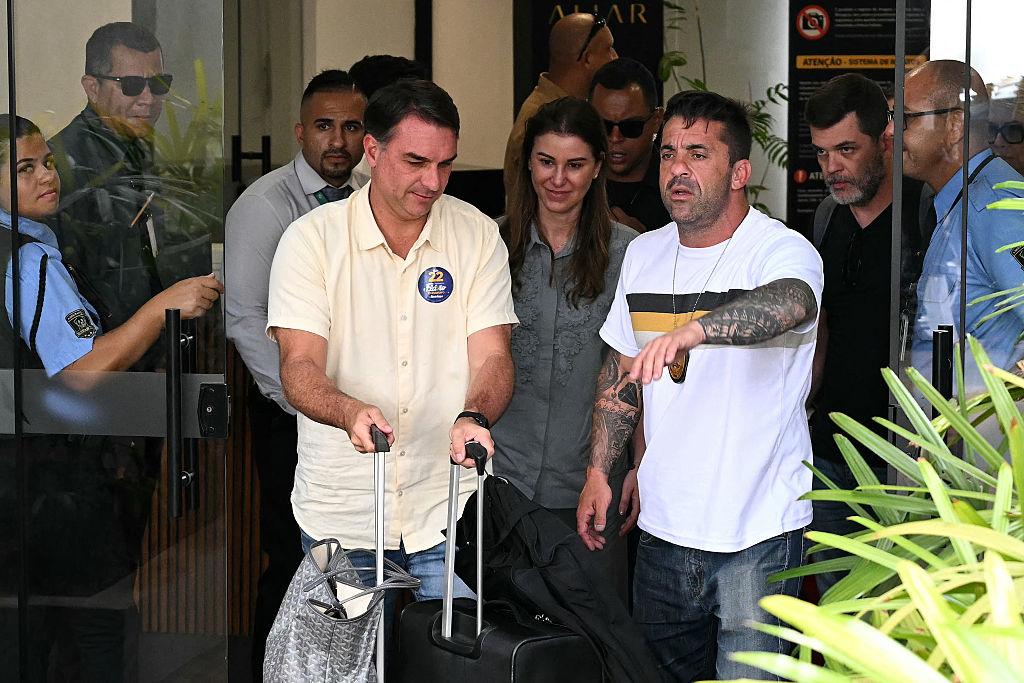
Reuters has confirmed that Brazilian Senator Flávio Bolsonaro arrived in Miami on Wednesday with his wife and two daughters after leaving Brazil following his presidential election defeat. Reuters TV images showed the family stepping from a Gulfstream G400 at Miami-Opa Locka Executive Airport. Bolsonaro left after failing to comply with a Brazilian Supreme Court order to surrender his passports in connection with a money-laundering investigation in which he denies wrongdoing. The United States has said it will grant entry visas to Bolsonaro and his family.
Brazilian Senator Flávio Bolsonaro has arrived in Miami with his wife and two daughters after leaving Brazil in the immediate aftermath of his presidential election defeat and failing to comply with a Supreme Court order requiring him to surrender his passports, a development that could deepen an already sensitive diplomatic confrontation between Brasília and Washington.
Reuters TV images on Wednesday showed Bolsonaro and his family stepping from a Gulfstream G400 at Miami-Opa Locka Executive Airport before entering the airport facility. The arrival provides the first direct visual confirmation that the defeated presidential candidate has reached the United States after days of uncertainty over his whereabouts and the route he took after leaving Brazil.
The aircraft carrying Bolsonaro arrived in Miami at approximately 10:31 a.m. Brasília time after a journey that took the family through Argentina and Ecuador, according to flight-tracking data and immigration information cited by Reuters. Bolsonaro, his wife and two daughters had entered Argentina late Tuesday before boarding a private Baires Fly aircraft in Puerto Iguazú, flying first to Guayaquil and then continuing to South Florida.
The confirmed arrival comes only three days after Bolsonaro lost Brazil’s presidential runoff to incumbent President Luiz Inácio Lula da Silva. Bolsonaro has not formally conceded the election and has challenged aspects of the vote, while Lula has moved ahead following his victory.
The journey has attracted intense attention because Bolsonaro left Brazil while under a Supreme Court order to surrender his passports in connection with an ongoing money-laundering investigation. He denies wrongdoing in that case. Reuters reported that he failed to comply with the Tuesday deadline and that federal police sources said his travel documents had subsequently been canceled.
The court order had raised immediate questions about whether Bolsonaro would attempt to remain in Brazil while challenging the investigation or leave the country before authorities could physically secure his passports. His departure transformed those questions into an international issue once it became clear that he was heading toward the United States.
A senior U.S. State Department official said Washington would issue visas to Bolsonaro and his family and allow them to enter the country. President Donald Trump subsequently said he approved of Bolsonaro coming to the United States, adding another political dimension to the case as relations between the Trump administration and Lula’s government remain strained.
Trump has publicly expressed sympathy toward the Bolsonaro family and has repeatedly criticized the treatment of former President Jair Bolsonaro by Brazil’s judiciary. His support for Flávio Bolsonaro’s arrival is likely to attract scrutiny in Brazil because the senator left while subject to an active judicial order and remains connected to an ongoing criminal investigation.
The United States has not publicly said that it is granting Flávio Bolsonaro asylum. The confirmed position from Washington is that he and his family will receive visas permitting entry. That distinction is important because permission to enter the United States does not itself determine his long-term immigration or legal status.
Brazilian authorities have not announced that Bolsonaro has been convicted of any offense connected to the investigation that triggered the passport order. He remains under investigation and denies wrongdoing. Any suggestion that his departure proves guilt would therefore go beyond the established facts.
The investigation concerns alleged ties between Bolsonaro and figures linked to financial misconduct and money laundering. Brazilian judicial authorities had sought to secure his passports because of concerns that he might leave the country while the investigation continued.
Bolsonaro’s departure has also created immediate political consequences inside Brazil. As a senator and the defeated presidential candidate of the Brazilian right, he had been expected by allies to play a major role in organizing opposition to Lula after the election.
Reuters reported that even members of Bolsonaro’s political operation were surprised by his departure. His campaign manager had expected him to remain in Brazil and take a leading role in the opposition following the runoff defeat.
Instead, Bolsonaro left the country less than three days after the election, creating uncertainty over whether he intends to continue directing his political movement from abroad, return to Brazil voluntarily or remain in the United States while legal proceedings continue.
His route out of Brazil has become an important part of the developing story. According to Argentina’s migration authorities, Bolsonaro and his family entered the Argentine province of Misiones late on Tuesday using valid travel documents and crossed the Tancredo Neves International Bridge into Puerto Iguazú.
They later boarded a Gulfstream G400 operated by Baires Fly. Flight-tracking records showed the aircraft leaving Puerto Iguazú shortly after midnight and arriving in Guayaquil, Ecuador, early Wednesday morning before departing again for Miami.
Reuters TV images later captured Bolsonaro disembarking with his wife and two daughters at Opa-locka Executive Airport, confirming that the family had completed the journey. The Reuters photographs from Miami show Bolsonaro stepping from the aircraft after arrival in Florida.
The episode bears unavoidable similarities to events involving Bolsonaro’s father, former President Jair Bolsonaro, who also traveled to the United States following Lula’s 2022 election victory. The elder Bolsonaro later returned to Brazil and eventually faced criminal proceedings connected to an alleged attempt to overturn the 2022 election result.
Flávio Bolsonaro’s circumstances are different and should not be treated as legally identical. His departure comes amid a separate investigation and after his own defeat in the 2026 presidential election. However, the fact that another member of the Bolsonaro family has traveled to the United States immediately after losing a presidential contest has intensified political debate inside Brazil.
Lula has criticized Flávio Bolsonaro’s departure, saying the senator should have remained in Brazil and answered the allegations against him. Bolsonaro’s allies, meanwhile, have accused Brazil’s judiciary of political overreach in cases involving members of the political right.
Those competing interpretations are likely to dominate Brazilian political debate in the coming days. The legal facts remain narrower: Bolsonaro was ordered to surrender his passports, did not meet the deadline, left Brazil and has now been documented arriving in the United States.
The diplomatic implications could become more serious if Brazilian authorities seek his return or if the courts issue additional measures against him. At present, Reuters has not reported a formal Brazilian extradition request.
Any future extradition process would depend on the nature of the charges, the status of the investigation and the legal procedures governing cooperation between Brazil and the United States. Such a process would be separate from the political statements being made by leaders in both countries.
Washington’s willingness to admit Bolsonaro and his family may nevertheless strain relations. Lula’s government has previously accused the Trump administration of interfering politically in Brazilian affairs and of treating members of the Bolsonaro family more favorably than other Brazilian political actors.
Trump, for his part, has denied taking sides in Brazil’s election while simultaneously criticizing aspects of the vote and expressing support for Bolsonaro. On Wednesday, he described the Brazilian election as “very strange” and said he approved of Bolsonaro coming to the United States.
Those comments are likely to be closely examined in Brasília because they come immediately after Bolsonaro challenged the election outcome and left the country while facing a judicial order.
Brazil’s election itself has formally produced a victory for Lula. Bolsonaro’s refusal to concede does not change the certified electoral result, although his campaign has indicated it intends to pursue legal challenges.
The speed of his departure has shifted much of the political conversation away from the election result and toward his legal position, his relationship with the U.S. government and what he intends to do from Miami.
There is also uncertainty surrounding his status as a sitting senator. His arrival in the United States does not automatically remove him from office, but prolonged absence could raise political and procedural questions if he remains abroad while Congress resumes its work.
His supporters will also be watching for signs that he intends to establish a political base in Florida, a state with a substantial Brazilian community and strong connections to conservative political networks.
Miami has historically served as a hub for Latin American political exiles, opposition figures and wealthy families facing political or legal crises in their home countries. Bolsonaro’s arrival therefore carries symbolism beyond the practical question of where he will stay.
The United States has so far treated the matter primarily as an immigration and diplomatic issue rather than publicly framing Bolsonaro as a political exile. The State Department’s confirmation that his family would be allowed entry stops short of declaring that Washington has taken a position on the Brazilian criminal investigation.
The distinction could become increasingly difficult to maintain if Brazilian authorities intensify legal action and Bolsonaro remains in the United States with Trump’s public support.
Another unresolved question is whether Bolsonaro traveled using documents that were still legally valid at the moment he crossed into Argentina and boarded the private aircraft. Argentina’s migration authorities said the family entered using valid travel documents, while Reuters later reported that Brazilian federal police considered the passports canceled after he missed the surrender deadline.
That chronology could become relevant if Brazilian authorities examine whether any laws were violated during the departure itself.
For now, the most important new fact is no longer speculative. Flávio Bolsonaro is in Miami. Reuters journalists documented his arrival, ending uncertainty over whether he had merely departed South America or had actually entered the United States.
The next phase of the story will center on what Brazilian courts do in response, whether Bolsonaro speaks publicly from Florida, and whether Washington takes any further action concerning his immigration status.
The case could also become an immediate test of U.S.-Brazil relations following Lula’s election victory. A dispute involving a defeated presidential candidate, an active Supreme Court order and explicit support from the American president carries the potential to move rapidly from a domestic Brazilian legal issue into a broader diplomatic confrontation.
Until additional judicial steps are taken, however, several distinctions remain essential. Bolsonaro lost Sunday’s election, is under investigation rather than convicted in the money-laundering matter, failed to comply with an order to surrender his passports, and has now arrived in the United States with his family after traveling through Argentina and Ecuador.
What happens next will depend less on the flight that brought him to Miami than on the legal and political decisions that follow it in Brasília and Washington.