GHANA POLICE INTERCEPT COUNTERFEIT FABRICS SMUGGLED FROM NIGERIA WORTH ABOUT ₦2.31 BILLION
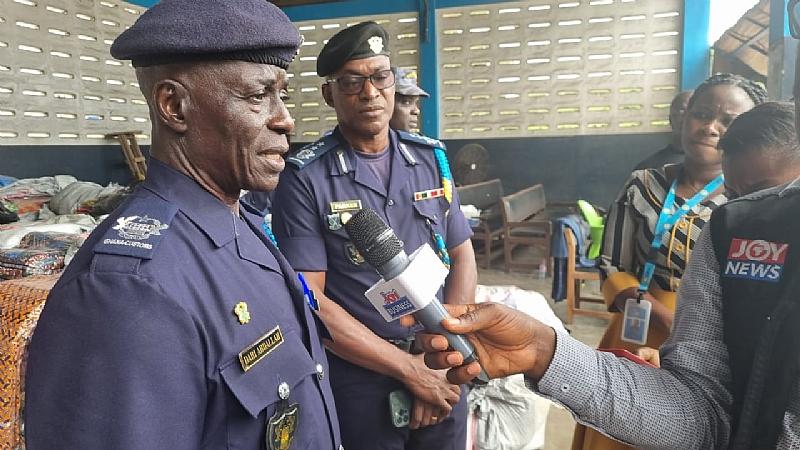
The Ghana Police Service has intercepted counterfeit wax prints smuggled from Nigeria and carrying imitated GTP designs, with Tex Styles Ghana valuing the seized fabrics at about GH¢20 million, roughly ₦2.3 billion depending on the exchange rate used. The fabrics were allegedly brought into Ghana without the required taxes being paid, while the Police Intelligence Unit has taken over investigations to identify those behind the shipment.
The Ghana Police Service has intercepted a large consignment of counterfeit wax prints smuggled into the country from Nigeria, with the seized fabrics estimated to be worth about GH¢20 million, equivalent to roughly ₦2.31 billion depending on the exchange rate applied. The operation was carried out by the Special Operations Team of the Inspector General of Police after officers reportedly received intelligence about the movement of the fabrics into Ghana. The seized products were found to carry designs and markings imitating fabrics produced by Tex Styles Ghana Limited, the company behind the popular GTP brand, raising renewed concerns about smuggling, intellectual property theft, tax losses and the growing pressure counterfeit textiles are placing on Ghana’s local manufacturing industry.
The fabrics were reportedly transported into Ghana without payment of the required taxes and duties, according to information released after the operation. Police and representatives of the textile industry said the consignment was headed toward the local market before it was intercepted, meaning the products could have reached traders and consumers across the country within days if the operation had not taken place. The Police Intelligence Unit has since taken over the investigation and is expected to identify the individuals and networks responsible for transporting, importing and distributing the counterfeit textiles.
Schandorf Nii Obodai, Environmental Sustainability Manager at Tex Styles Ghana, said the seized fabrics were valued at approximately GH¢20 million when the materials in storage and those still loaded inside the intercepted truck were assessed together. He said the scale of the consignment demonstrated the size of the illegal textile trade and the financial damage counterfeit fabrics can cause to legitimate manufacturers, workers and government revenue. According to him, a shipment of that size could remain in circulation in Ghanaian markets for months and compete directly with locally manufactured fabrics that have gone through proper production and tax processes.
Obodai said the impact extends far beyond the value of the goods themselves because smuggled fabrics enter the market without the costs borne by legitimate manufacturers and importers. Local textile companies pay taxes, employ workers, maintain factories, purchase raw materials and comply with regulatory requirements, while counterfeit products can be transported into the country and sold at significantly lower prices because those costs have been avoided. The result, manufacturers argue, is an unfair market in which genuine Ghanaian products must compete against imitations produced and distributed through illegal channels.
The interception forms part of a wider anti counterfeit campaign involving Ghanaian textile manufacturers and the Ghana Police Service. The campaign has intensified as local companies complain that copied designs and fake branding have become increasingly common in markets across the country. Some of the counterfeit fabrics are made to look almost identical to genuine GTP products, including the use of copied logos, stamps, packaging and design patterns that can make it difficult for ordinary buyers to distinguish between authentic and imitation cloth.
Tex Styles Ghana has warned repeatedly that GTP does not operate manufacturing factories in Nigeria, Côte d’Ivoire or any other African country outside Ghana. Obodai said traders sometimes tell customers that imported fabrics carrying GTP designs were produced by an overseas branch of the company, but he described that explanation as false. According to him, genuine GTP fabrics sold under the company’s Ghanaian brands are produced in Ghana, and fabrics manufactured elsewhere using copied GTP designs or stamps should not be presented to consumers as authentic products.
The company says the copying of its designs is one of the most serious threats facing the local textile industry because patterns created and developed by Ghanaian designers can be reproduced elsewhere at lower cost and then brought back into the country for sale. These imitation fabrics are often offered at prices below genuine products, attracting customers who may not realize they are purchasing counterfeit goods. In other cases, consumers may knowingly buy cheaper imitations because of the price difference, adding another layer of difficulty for local manufacturers attempting to protect their brands.
The scale of the latest seizure has drawn attention because GH¢20 million worth of fabric represents a significant quantity of merchandise. While authorities have not yet released a complete breakdown of the number of individual pieces contained in the shipment, officials said the volume was large enough to have supplied the local market well beyond the immediate festive season. That means the interception may have prevented a substantial amount of counterfeit cloth from competing with locally produced fabrics during one of the busiest commercial periods of the year.
The timing is particularly important because demand for traditional and printed fabrics normally rises toward the end of the year. Weddings, funerals, festivals, Christmas celebrations, church events and family gatherings all contribute to increased clothing purchases during the festive period, making November and December especially important months for textile producers and traders. Counterfeiters and smugglers can exploit that increased demand by flooding markets with cheaper imitations during the same period that local manufacturers depend on stronger sales.
Tex Styles Ghana said the financial consequences of such activity extend directly to jobs. When local factories lose sales to counterfeit imports, production can decline and companies may reduce working hours, postpone investment or cut jobs. Ghana’s textile industry once employed considerably more workers than it does today, and manufacturers have repeatedly blamed smuggling, counterfeit imports, high operating costs and weak enforcement for the contraction of parts of the sector.
Obodai said the continued entry of imitation fabrics into Ghana has contributed to the collapse or decline of several local textile companies over the years. He argued that the impact should not be viewed only as a dispute between a private company and counterfeit traders because every reduction in local production can affect factory workers, distributors, designers, transporters and other businesses connected to the textile supply chain.
Government revenue is another major concern. Because the seized fabrics were allegedly brought into Ghana without the required taxes being paid, the shipment represents potential revenue that would have been lost if the goods had reached the market. Smuggling allows traders to bypass customs duties and other charges that legitimate businesses are required to pay, giving illegal operators a price advantage while reducing money available to the state for public expenditure.
The Ghana Revenue Authority and security agencies have struggled with textile smuggling for years, particularly along land borders and informal routes connecting Ghana with neighboring countries. Counterfeit products can enter through official crossings using false declarations or can be moved through unapproved routes that avoid customs inspection completely. Once inside the country, the fabrics can be distributed through established trading networks, making them difficult to trace back to the original importer.
Research into counterfeit trade in Ghana has previously identified textiles as one of the sectors vulnerable to cross border smuggling. An OECD study found that counterfeit goods are sometimes imported into one West African country before being transported across land borders into another, allowing traders to take advantage of weak controls and differences in enforcement. The report specifically noted that illicit goods can move through regional routes involving Nigeria, Togo and Ghana, demonstrating why cooperation between customs and police agencies remains important.
The latest seizure therefore fits into a broader problem that extends beyond one shipment. Counterfeit trade is increasingly associated with organized networks capable of moving large volumes of products across borders, disguising their origin and distributing them rapidly once they reach urban markets. Ghana’s Criminal Investigations Department has warned that intellectual property offenses are not simply minor commercial violations but can form part of wider transnational criminal operations involving fraud, smuggling and other illegal activities.
CID Director General COP Lydia Donkor recently said counterfeit products present serious economic and public safety concerns and emphasized the need for stronger cooperation between law enforcement agencies, regulators and private companies. Although her remarks addressed a wider range of counterfeit goods, including medicines, electrical products and cosmetics, the same enforcement challenge applies to textiles because large scale smuggling requires networks capable of financing transport, storage and distribution.
In the textile sector, the harm is primarily economic rather than medical or safety related, but the scale can still be substantial. Counterfeit goods can undermine registered trademarks, reduce company revenue and damage consumer confidence. A customer who unknowingly buys a poor quality imitation believing it is genuine may blame the legitimate manufacturer when the fabric fades, tears or performs badly, even though the company had no involvement in producing it.
That reputational risk is one reason Tex Styles Ghana has been working closely with authorities to identify fake products. Companies may examine print quality, labeling, stamps, fabric texture and other characteristics to distinguish genuine products from copies. Counterfeiters, however, continually improve their methods and can reproduce branding with enough accuracy that inexperienced buyers may struggle to identify the difference.
Public education therefore forms another part of the enforcement effort. GTP has urged traders and consumers to verify where their fabrics come from and to be cautious when told that a GTP branded product was manufactured outside Ghana. The company’s position is straightforward. It says it does not operate factories elsewhere in Africa producing GTP or Vlisco cloth and that claims of Nigerian or Ivorian GTP factories should be treated with suspicion.
The latest seizure also places attention on the commercial relationship between Ghana and Nigeria. The two countries maintain extensive legitimate trade and business links, and millions of lawful goods move between them every year. The fact that the counterfeit fabrics were reportedly smuggled from Nigeria should therefore not be confused with legal Nigerian textile exports or legitimate trade between businesses in the two countries.
Investigators will instead focus on identifying the specific individuals and companies behind the consignment. That process may involve examining transport records, warehouse locations, shipping documents, telephone communications and financial transactions connected to the truck and the seized merchandise. Police may also attempt to determine where the fabrics were manufactured, who financed their production and which traders were expected to receive them once they reached Ghanaian markets.
The Intelligence Unit’s involvement suggests authorities are treating the operation as more than a simple roadside seizure. Investigators are expected to pursue the network behind the shipment and determine whether the consignment forms part of a larger pattern of repeated imports. If the same distributors have previously brought similar goods into Ghana, the investigation could lead to additional seizures or arrests.
At the time of the latest reports, police had not publicly announced arrests connected to the consignment. Authorities had also not released the names of suspected owners, drivers, importers or intended recipients. That means responsibility for the shipment has not yet been established and any individuals later identified will remain suspects unless and until charges are filed and proven in court.
The case could also involve customs offenses in addition to intellectual property violations. If investigators confirm that the goods entered Ghana without payment of required duties, authorities may examine whether customs declarations were falsified, whether established border procedures were deliberately avoided or whether officials assisted the shipment. Those questions will become clearer as the investigation progresses.
Ghana has previously introduced measures intended to protect the textile industry, including restrictions on textile imports, tax stamps and monitoring programs designed to distinguish legitimate products from illegal ones. Enforcement has produced periodic large seizures, but manufacturers continue to complain that counterfeit fabrics remain widely available in major markets.
An earlier interception by Ghana Revenue Authority officials at Dabala uncovered more than 11,000 pieces of imitation wax prints after a container had allegedly been declared as carrying a far smaller quantity. Officials said the case demonstrated how importers can use false declarations to conceal the true volume of goods being brought into the country. The seizure also included thousands of mobile phones hidden within the shipment, illustrating how smugglers can combine different categories of merchandise in a single operation.
The continuing recurrence of such cases suggests that seizures alone may not be enough to eliminate the trade. Manufacturers have called for stronger border enforcement, faster prosecution and greater cooperation with market associations so that counterfeit goods can be identified before they spread through retail networks. They have also argued that penalties must be strong enough to discourage traders from treating seizures as an ordinary cost of doing business.
There is also an economic argument for strengthening the local textile industry itself. Ghanaian fabrics carry cultural and commercial significance across West Africa, and companies such as GTP have built brands around designs used for weddings, funerals, festivals and everyday clothing. Protecting those brands helps preserve local design work and manufacturing capacity while supporting jobs connected to weaving, printing, distribution and retail.
At the same time, consumers are highly sensitive to price. Genuine locally manufactured fabrics may cost more than imitations, particularly when counterfeiters avoid taxes and use cheaper production methods. Enforcement therefore has to be accompanied by policies that help local manufacturers remain competitive on price, energy costs and production efficiency.
The latest GH¢20 million interception is significant precisely because it shows how much money can be involved in a single shipment. If goods of that scale can enter the country regularly, the cumulative impact on taxes and local sales could be substantial. That is why manufacturers describe counterfeit textile smuggling as an industrial problem rather than isolated petty trading.
Police will now face pressure to move beyond confiscating the fabrics and identify those responsible for the operation. The success of the investigation will be measured not only by the value of the goods seized but by whether authorities can disrupt the wider network that arranged the shipment.
For Tex Styles Ghana, the seizure has prevented a major quantity of imitation GTP products from reaching consumers, but company officials say the larger challenge remains. Counterfeit fabrics are still present in markets, and traders continue to use claims of foreign GTP production to convince customers that imitations are genuine.
The company is therefore using the latest operation to repeat its warning that authentic GTP fabrics are produced in Ghana and that consumers should be cautious about products presented as Nigerian or Ivorian manufactured versions of the same brand. The message is intended both to protect customers and to reduce the market available to counterfeiters.
The interception also sends a broader message to smugglers that Ghanaian authorities are increasing cooperation with private manufacturers in identifying illegal products. Intelligence from industry sources can help police recognize suspicious shipments more quickly because companies understand their own designs, production volumes and distribution channels.
For government, the issue remains closely connected to revenue protection and industrial policy. Every counterfeit shipment that bypasses taxes potentially deprives the state of income while simultaneously weakening companies expected to create jobs and contribute to the tax base. Preventing the trade therefore serves both enforcement and economic objectives.
The investigation is still developing, and police have not yet disclosed how the shipment crossed into Ghana, where exactly it was intercepted or who was expected to receive it. Those details will be important in determining whether the case involved established border smuggling routes or a more sophisticated operation using formal cargo channels.
What is already clear is that the intercepted consignment was large enough to have a significant presence in the local textile market. With an estimated value of GH¢20 million, the shipment represents one of the more substantial recent reported seizures involving counterfeit GTP designs and demonstrates the financial scale of the trade authorities are attempting to disrupt.
The Police Intelligence Unit will now be expected to identify the people behind the consignment and determine whether further shipments are connected to the same network. Until arrests or charges are announced, the investigation remains open, but the seizure has already prevented millions of cedis worth of counterfeit fabrics from entering Ghana’s retail market while once again exposing the pressure illegal imports place on the country’s textile industry.