GHANA’S 10-YEAR RAW RUBBER EXPORT BAN FACES ENFORCEMENT CRISIS AS POLICE AND CUSTOMS INTERCEPT SUSPECTED ILLEGAL SHIPMENTS
Ghana's ten-year ban on raw natural rubber exports is facing mounting enforcement challenges after the Ghana Police Service and the Customs Division of the Ghana Revenue Authority intercepted several consignments suspected of being prepared for illegal export. Reports published on November 26, 2026, revealed that Customs seized four containers in October, while separate police operations uncovered substantial discrepancies in shipment documentation and resulted in two arrests. The controversy intensified after the Tree Crops Development Authority requested the suspension of a proposed auction involving six containers of confiscated rubber, citing regulatory and traceability concerns. Industry stakeholders have called for stronger institutional coordination to protect domestic processing companies, agricultural investments and the government's industrialization agenda.
Ghana's ambitious policy to prohibit the export of raw natural rubber for ten years is facing mounting enforcement challenges following a series of interceptions by the Ghana Police Service and the Customs Division of the Ghana Revenue Authority. Nearly seven months after the government introduced the prohibition to strengthen domestic manufacturing and protect industrial investment, suspected attempts to export the commodity illegally have continued to raise concerns about regulatory oversight and the effectiveness of the country's trade enforcement mechanisms. Investigations reported by the Daily Graphic and Angel Online on Thursday, November 26, 2026, have also brought renewed scrutiny to the Tree Crops Development Authority following its intervention in a proposed auction of seized rubber consignments intended for local processing companies.
The controversy centers on several enforcement operations conducted during October and November, alongside disagreements concerning how confiscated commodities should be handled. In October, Customs officers intercepted four containers containing raw rubber at a facility within Tema Port, where the consignments were allegedly being prepared for shipment abroad. Separate police operations subsequently uncovered discrepancies involving the declared quantities and intended destinations of other rubber shipments. Although the circumstances surrounding those consignments remain subject to investigation, the incidents have intensified concerns among industry stakeholders that unauthorized exports could undermine the government's efforts to establish a more productive domestic rubber processing industry.
In one of the reported operations, police discovered approximately 47 metric tons of raw rubber in a truck whose accompanying documentation declared a substantially smaller quantity of 1,500 kilograms. The discrepancy raised suspicions concerning the accuracy of the documentation and whether applicable trade and regulatory requirements had been properly observed. Another operation in November resulted in the arrest of two individuals in connection with a rubber consignment reportedly valued at approximately GH¢400,000. The suspects were subsequently granted bail while investigations continued, and no conviction has been established in connection with those allegations.
The enforcement operations have drawn attention to the challenges associated with verifying the origins, ownership and intended destinations of agricultural commodities transported across Ghana. Rubber can pass through several commercial intermediaries before reaching processing facilities, creating administrative responsibilities for authorities seeking to establish whether consignments are moving through lawful supply chains. Effective enforcement requires reliable documentation and coordination between institutions responsible for regulating agricultural production, domestic commerce and international trade. Where those arrangements are inadequate, discrepancies can remain undetected until enforcement officers intervene.
The latest controversy intensified after the Tree Crops Development Authority requested that Customs suspend arrangements for disposing of six containers of seized rubber. In a letter dated November 20, 2026, the authority sought a temporary suspension of the proposed auction and associated administrative processes while further regulatory consultations and investigations were undertaken. The request came after Customs had reportedly informed domestic rubber processors about arrangements to make the confiscated commodity available to them. The intervention has generated questions within the industry about how the respective statutory responsibilities of Customs and the sector regulator should be coordinated.
The Tree Crops Development Authority defended its involvement by referring to its responsibilities under the Tree Crops Development Authority Act, 2019, commonly identified as Act 1010. The legislation establishes the authority as the regulatory institution responsible for developing and supervising several strategic agricultural commodities, including natural rubber. Its position is that transactions involving seized rubber require appropriate examination of regulatory compliance, commodity traceability and other sector-specific obligations. The authority described the requested suspension as a temporary measure rather than a decision to permanently prevent domestic processing companies from acquiring the material.
Customs, meanwhile, possesses statutory responsibilities concerning the seizure, forfeiture and lawful disposal of goods under Ghana's customs legislation. Those responsibilities are particularly important where commodities have allegedly been involved in unauthorized international trade. The existence of separate regulatory responsibilities does not necessarily establish that either institution has acted unlawfully, but it highlights the need for clearly defined procedures when enforcement operations involve agricultural commodities subject to specialized oversight. The outcome of the consultations could establish how similar confiscations will be administered in the future.
The Daily Graphic, in an editorial accompanying its November 26 reporting, called for stronger cooperation among the institutions responsible for implementing the rubber export prohibition. The newspaper argued that enforcement operations should be supported by regulatory arrangements capable of addressing suspected violations without creating unnecessary delays for domestic manufacturers. It also called for greater scrutiny of the circumstances surrounding suspicious shipments and improved verification of the documents associated with commodity movements. Those recommendations reflect growing concern within the industry about the relationship between policy announcements and their practical implementation.
The government's prohibition was introduced through an administrative directive signed on April 27, 2026, by the Minister of Trade, Agribusiness and Industry, Elizabeth Ofosu-Adjare. The decision followed Cabinet deliberations in November 2025 and subsequent discussions concerning the Accelerated Export Development Programme. Under the directive, the export of raw natural rubber from Ghana was prohibited for a period of ten years, subject to any subsequent amendment or revocation authorized through the government's established decision-making procedures. The policy was designed to increase the availability of essential raw materials for domestic manufacturers while encouraging investment in industrial processing.
The prohibition forms part of the government's broader Feed-the-Industry agenda, which seeks to establish stronger relationships between Ghana's agricultural production and its manufacturing sector. Rather than relying predominantly on the export of unprocessed agricultural commodities, the administration intends to encourage domestic enterprises to transform locally produced materials into products capable of generating greater economic value. The approach is also connected to the government's 24-Hour Economy initiative and its objective of expanding productive economic activity and employment opportunities.
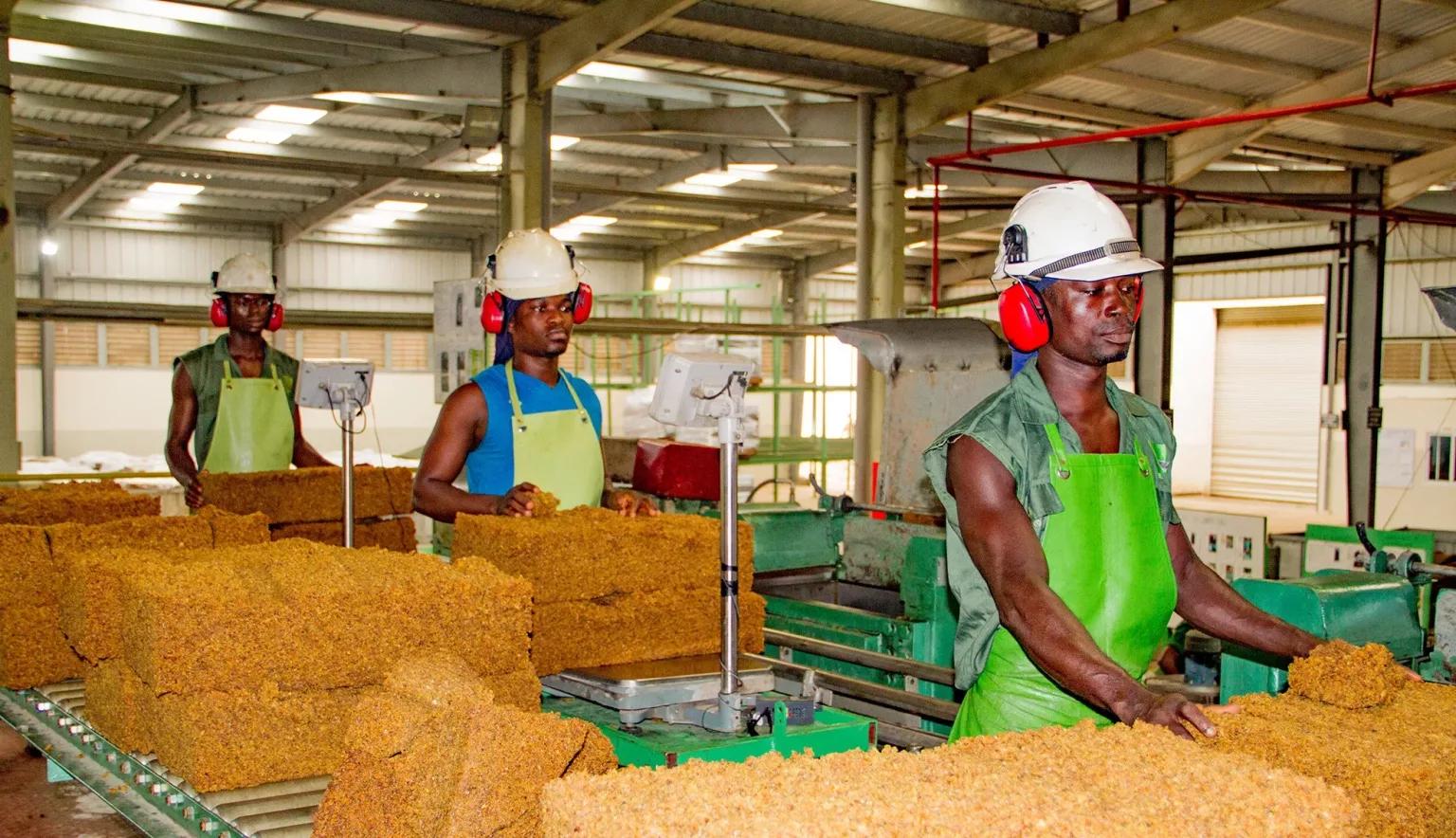
For Ghana's rubber processing companies, access to a reliable supply of natural rubber is fundamental to their ability to maintain industrial operations. Processing facilities require substantial investment in machinery, energy infrastructure, personnel and quality control systems, much of which must be maintained regardless of fluctuations in the quantity of raw materials available. When factories receive insufficient supplies, their operating costs can increase relative to the amount of material they process. Prolonged shortages can consequently weaken the commercial viability of investments intended to expand domestic industrial capacity.
The government's intervention reflects the economic principle that countries can retain additional value by undertaking more stages of commodity production within their own borders. Natural rubber harvested from plantations can be processed into standardized industrial materials used in the manufacturing of tires, automotive components, footwear, medical products and other commercial goods. However, the extent to which Ghana can participate in those downstream industries depends on the technological capabilities of local enterprises, the availability of investment and their ability to meet international manufacturing standards.
Prohibiting raw material exports does not automatically establish a complete domestic manufacturing industry. The immediate effect of such a restriction is to influence where the underlying commodity may be sold, potentially increasing its availability to local processors. Establishing additional manufacturing capabilities requires separate investment in technology, industrial infrastructure, workforce development and market access. The long-term effectiveness of Ghana's rubber policy will therefore depend on whether increased domestic supplies translate into competitive processing operations and further industrial development.
The interests of rubber farmers remain equally important within the policy debate. Producers depend on reliable markets and commercially sustainable prices to maintain their plantations, employ workers and meet household expenses. Rubber cultivation requires a considerable period of investment before newly planted trees reach productive maturity, meaning that farmers must make decisions with long-term financial consequences. Policies that alter the structure of the market can influence their expectations concerning the profitability of future agricultural investment.
Restricting international exports can reduce the number of potential buyers available to farmers, particularly where domestic processing companies possess substantial influence over commodity purchasing. If local demand is insufficient or purchasing prices become unattractive, producers may experience financial difficulties despite the government's intention to strengthen the industry. Conversely, a competitive and adequately financed domestic processing sector could provide more consistent markets and reduce uncertainty associated with dependence on foreign commodity traders. The balance between those outcomes will depend on market conditions and the effectiveness of regulatory protections.
The importance of those concerns was acknowledged during a stakeholder meeting convened by Ofosu-Adjare in May 2026. The engagement brought together farmers, processing companies, industry associations and representatives of the institutions responsible for implementing the prohibition. Discussions included concerns about the pricing of raw rubber and the need to resolve difficulties affecting different participants within the industry. The government's engagement with stakeholders established an opportunity to identify practical challenges arising from the policy, although continued consultations will remain necessary as implementation progresses.
The Tree Crops Development Authority subsequently announced stronger compliance measures across the agricultural commodities falling within its jurisdiction. In September, the authority disclosed that more than 100 newly recruited compliance and enforcement officers had been deployed following training undertaken in collaboration with the Ghana Police Service. The regulatory measures addressed issues including unauthorized trading, purchases below established minimum prices and compliance with licensing requirements. Those developments demonstrate that enforcement responsibilities extend beyond preventing unauthorized exports to maintaining orderly commercial relationships within domestic agricultural markets.
Rubber is one of six strategic tree crops regulated by the authority, alongside cashew, shea, coconut, mango and oil palm. Ghana considers these commodities important to its efforts to diversify agricultural production and develop additional sources of industrial raw materials and export earnings. The challenges confronting the rubber sector could therefore provide lessons relevant to the administration of other agricultural industries where the government seeks to encourage domestic processing. Effective regulation requires attention to the particular production cycles, commercial relationships and investment needs associated with each commodity.
The authority had previously established a permit system for the export of certain unprocessed tree crops, with requirements taking effect on May 2, 2025. That arrangement required exporters of unprocessed rubber, cashew and shea to secure written authorization from the regulator before undertaking export activities. The subsequent ten-year prohibition introduced a more restrictive framework specifically concerning raw natural rubber. Distinguishing between earlier permit arrangements and the later export prohibition is essential for understanding the regulatory environment within which rubber traders and processing companies currently operate.
The financial history of Ghana's rubber industry also helps explain the government's interest in preserving its domestic processing capabilities. Rubber plantations and outgrower schemes have benefited from agricultural development initiatives intended to expand production and create commercial opportunities for farmers. These programs have involved financial commitments from participating institutions and long-term arrangements connecting agricultural producers with industrial buyers. Maintaining viable relationships across that production system is important for protecting earlier investments and supporting the continued development of the industry.
Concerns surrounding agricultural financing were raised in earlier reporting on the government's decision to impose the export ban. Industry stakeholders had expressed apprehension about difficulties recovering loans associated with rubber plantation development and the consequences of disrupted commercial relationships between growers and processors. Where financing arrangements depend on predictable sales or repayment structures, changes in the movement of agricultural commodities can influence the ability of lenders and other institutions to recover their investments. These concerns reinforce the importance of considering financial sustainability alongside the government's industrial objectives.
The Western Region remains an important center of Ghana's natural rubber industry, with plantations and processing operations providing employment and supporting commercial activity within surrounding communities. The sector creates opportunities not only for plantation workers but also for transport operators, agricultural suppliers, maintenance technicians and businesses providing services to processing facilities. Changes in the industry's performance can therefore have consequences extending beyond the companies directly involved in producing and purchasing natural rubber.
Ghana Rubber Estates Limited is among the established companies operating within the industry, with activities encompassing plantation management and industrial processing. Its operations demonstrate the connection between agricultural production and manufacturing that the government's current policy seeks to strengthen. Expanding such industrial relationships could help retain economic activity within producing communities and create opportunities for workers to develop specialized technical skills. However, the benefits depend on processing facilities remaining commercially viable and farmers receiving appropriate compensation for their produce.
International competition presents another important consideration. Natural rubber is traded within a global market influenced by industrial demand, commodity prices, production conditions and developments in major rubber-producing countries. Domestic Ghanaian processors must ultimately compete with suppliers operating elsewhere, making productivity, quality and production costs important determinants of their ability to secure buyers. Guaranteed access to local raw materials may support their operations, but it does not remove the requirement to remain internationally competitive.
The government's objective of increasing foreign exchange earnings through value addition will similarly depend on the performance of domestic processors. Exporting processed rubber can potentially generate greater revenue than selling the underlying commodity in an unprocessed state. However, the net economic benefit must also account for processing costs, imported equipment, energy consumption and other commercial expenses. Evaluating the policy requires attention to the actual value generated within Ghana rather than relying solely on the volume of raw material retained in the country.
For exporters previously involved in the international trade of unprocessed rubber, the prohibition requires adjustments to established business arrangements. Some businesses may have opportunities to enter partnerships with local processing companies, diversify into other commodities or participate in the export of processed materials. Others may face difficulties adapting their commercial operations to the new regulatory framework. Providing clear guidance concerning permitted activities could assist legitimate businesses in understanding their obligations while reducing uncertainty surrounding the implementation of the directive.
The enforcement controversy also raises questions about how authorities should manage seized agricultural commodities while investigations remain ongoing. Confiscated materials may retain substantial commercial value, but their ownership and legal status must be established before disposal can proceed through appropriate channels. Premature release can complicate legal proceedings, while unnecessary delays can increase storage expenses and affect the condition of agricultural materials. Establishing clear procedures could help reconcile evidential requirements with the economic objective of returning lawfully forfeited commodities to productive use.
The disagreement involving Customs and the Tree Crops Development Authority consequently presents a test of institutional coordination. Both organizations have responsibilities connected to the movement and regulation of rubber, but their mandates operate within different statutory frameworks. Cooperation between the agencies could help ensure that commodities intercepted during enforcement operations are handled in a manner consistent with both customs law and agricultural regulation. Greater clarity concerning those arrangements would also provide domestic processors with a better understanding of when seized materials may lawfully become available for purchase.
Transparency will be particularly important in administering any future auctions. Publishing appropriate information concerning the legal status of confiscated commodities, the conditions governing their disposal and the criteria through which eligible purchasers are selected could strengthen confidence in the process. Such arrangements would help distinguish legitimate regulatory interventions from allegations of unnecessary administrative obstruction. They would also support accountability by providing a clearer record of how valuable agricultural commodities are handled after seizure.
The latest enforcement operations do not establish the total quantity of rubber that may have been exported unlawfully since the prohibition took effect. Intercepted shipments provide evidence of specific enforcement concerns, but they cannot independently establish the overall scale of noncompliance across Ghana's rubber industry. Comprehensive data concerning domestic production, industrial consumption, authorized commodity movements and confirmed violations would be necessary to evaluate the broader effectiveness of the policy.
Industry stakeholders have called for stronger cooperation among government institutions to address those challenges. Effective information sharing could assist authorities in identifying inconsistencies across commercial documentation and determining whether agricultural consignments comply with applicable requirements. Such coordination would also reduce the risk of unnecessary duplication between institutions responsible for overseeing different stages of the commodity supply chain. The government's industrial policy would benefit from enforcement arrangements capable of supporting lawful businesses while identifying suspected violations.
The implications extend beyond the immediate question of rubber exports. Ghana's wider economic strategy includes efforts to strengthen domestic manufacturing, diversify exports and generate employment through agricultural value addition. Those objectives require regulatory arrangements that investors, farmers and businesses can understand and rely upon over extended periods. Persistent uncertainty concerning enforcement or the administration of confiscated commodities could make commercial planning more difficult, particularly for enterprises considering significant investments in processing infrastructure.
For the government, the continuing challenge is to ensure that restrictions intended to support manufacturers do not create unintended difficulties for agricultural producers. Farmers require commercially sustainable prices and dependable purchasing arrangements, while processors need consistent access to raw materials at costs that allow them to remain competitive. Establishing a workable relationship between those interests will require consultation, market monitoring and effective implementation of existing regulatory protections. The success of the export prohibition will depend partly on whether the domestic market can serve both groups without creating unsustainable imbalances.
Several questions remain outstanding following the November 26 reports. The final outcome of investigations involving the intercepted consignments has not been publicly established, and authorities have not confirmed whether the proposed auction of the six containers will proceed following the regulatory consultations. Further information concerning domestic factory utilization, commodity pricing and the broader impact of the prohibition would also assist in evaluating whether the policy is achieving its intended industrial objectives. Those developments will be important in determining whether the latest controversies represent isolated enforcement difficulties or more persistent implementation challenges.
Nearly seven months into Ghana's ten-year raw rubber export prohibition, the government's industrial strategy is confronting a practical test involving agricultural markets, institutional responsibilities and trade enforcement. The interceptions demonstrate that authorities are actively investigating suspected violations, while the disagreement concerning confiscated consignments reveals the need for greater clarity in the administration of the policy. For domestic processors, the immediate concern remains access to sufficient raw materials, while farmers continue to depend on commercially sustainable markets for their produce.
The longer-term significance of the prohibition will ultimately be determined by its economic outcomes rather than the number of consignments intercepted or the duration of the restriction itself. Increased industrial production, sustainable agricultural incomes, competitive processed exports and employment generation would provide more substantive measures of its effectiveness. Achieving those objectives will require coordinated enforcement, transparent regulation and sustained investment across Ghana's rubber value chain. As the outstanding investigations and regulatory consultations continue, the government's response will provide an important indication of how effectively its agricultural and industrial policies can be translated into practical economic development.